Russula griseopurpurata

Russula griseopurpurata

Russula griseopurpurata Latest News

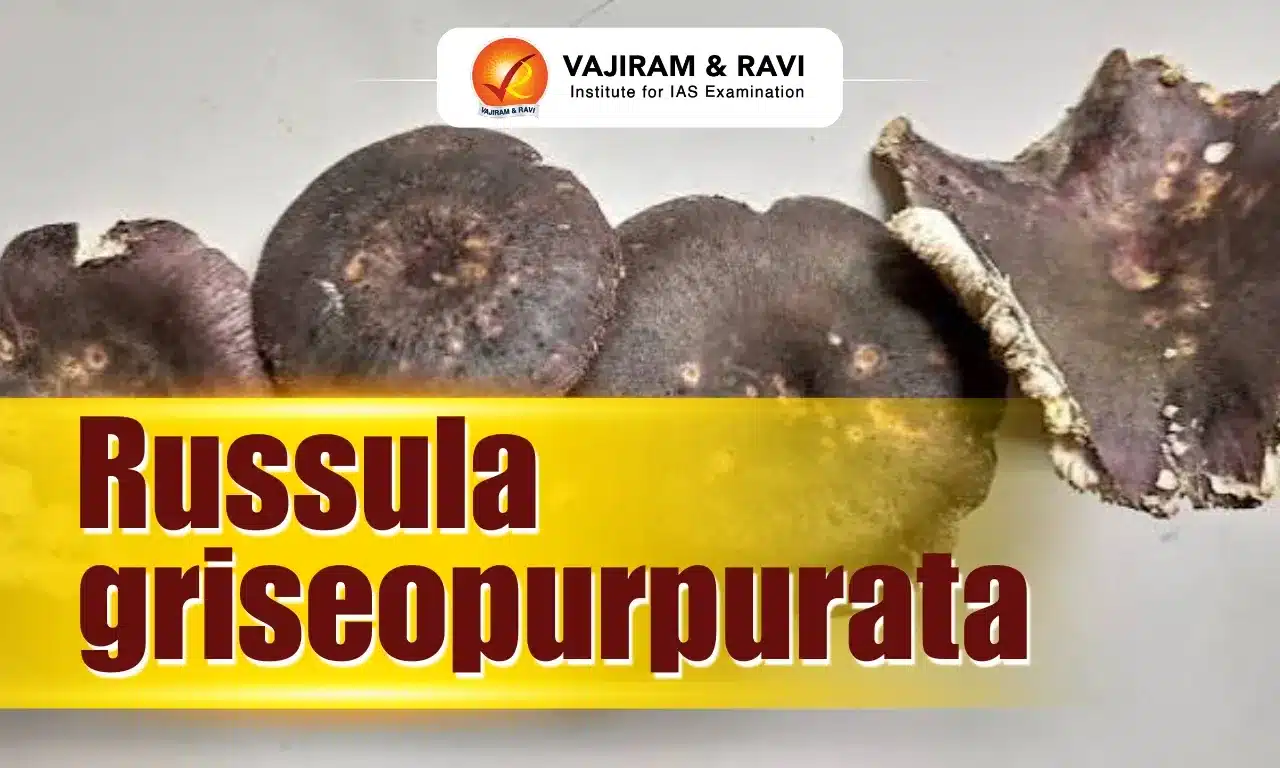
A mushroom collected beneath a sal tree in Meghalaya’s Ri-Bhoi district in 2022 has been identified as a new species to science, named Russula griseopurpurata.

About Russula griseopurpurata

  • It is a new species of mushroom.
  • The species has so far been recorded from Meghalaya and West Bengal. 
  • They were found singly or in scattered groups beneath sal trees. 
  • It has a greyish-purple cap that develops cracks as it matures. 
  • Its gills show characteristic forkings near the stalk.  
  • It belongs to the large and diverse Russula genus.
  • Russula genus comprises about 2,000 species worldwide, with more than 180 species documented in different parts of India
  • Although some Russula species are edible, the researchers have not established R. griseopurpurata as edible
  • Its reported mild taste and odour do not constitute a food-safety assessment.

News: HUB

Russula griseopurpurata FAQs

Q1: What is Russula griseopurpurata?

Ans: Russula griseopurpurata is a newly identified species of mushroom.

Q2: From which Indian states has Russula griseopurpurata been recorded?

Ans: Meghalaya and West Bengal.

Q3: Where was Russula griseopurpurata found growing?

Ans: It was found singly or in scattered groups beneath sal trees.

Q4: What is the characteristic colour of the cap of Russula griseopurpurata?

Ans: Its cap is greyish-purple.

Cessna C172

Cessna C172

Cessna C172 Latest News

A Cessna C172 trainer aircraft with two people onboard suffered damage after veering off the runway at the Baramati airfield, Maharashtra, recently.

About Cessna C172

  • The Cessna C172, commonly known as the Cessna 172 Skyhawk, is a four-seat, single-engine aircraft.
  • It is manufactured by Cessna, an American manufacturer of general aviation aircraft (now part of Textron Aviation).
  • Since its introduction in 1956, Cessna has produced more than 44,000 of these aircraft, making it the most-built airplane of all time. 
  • It is used primarily for training and/or private aviation and is still in production today. 
  • More than 50% of the world's pilots started their training in the Cessna 172, and it remains a popular aircraft for flight training and personal use. 

Cessna C172 Features

  • This fixed-wing aircraft features a high-wing design, offering great visibility to beginner pilots.  
  • It also has a reputation for stability, forgiving handling, and simple controls. 
  • The design prioritizes stability over speed (with a maximum cruise speed of 124 knots), allowing students to focus more on maneuvers, takeoffs, landings, safety, and control before speed. 
  • Maximum Range: 640 nm

News: NDTV

Cessna C172 FAQs

Q1: What is the Cessna C172?

Ans: The Cessna C172, commonly known as the Cessna 172 Skyhawk, is a four-seat, single-engine aircraft.

Q2: Why is the Cessna 172 significant in aviation history?

Ans: It is widely regarded as the most-produced aircraft of all time, with more than 44,000 aircraft produced.

Q3: What is the primary use of the Cessna 172?

Ans: It is used primarily for flight training and private aviation.

Q4: Why is the Cessna 172 widely used for flight training?

Ans: It is known for its stability, forgiving handling and simple controls, making it suitable for trainee pilots.

Q5: Is the Cessna 172 still in production?

Ans: Yes, the Cessna 172 is still in production.

Lake Mead

Lake Mead

Lake Mead Latest News

Lake Mead, the largest reservoir in the United States, has plummeted to its lowest water level since it was filled some 90 years ago, another sign of the crisis plaguing the Colorado River system.

About Lake Mead

  • It is one of the largest man-made lakes in the world, located on the border between Southern Nevada and northwestern Arizona in the United States.
  • It was formed in the mid-1930s by the damming of the Colorado River through the construction of the Hoover Dam. 
  • It is the largest reservoir in the U.S. when it's full of water. 
  • When Lake Mead is completely full, it stretches 180 km long. It can be 162 m deep at its deepest point. 
  • The water surface is 375 m above sea level, covering an area of 640 sq.km.
  • Most of the water is drawn from Rocky Mountain snowmelt and runoff
  • It supplies drinking water for about 25 million people. 
  • It is home to many species of mammals, including desert bighorn sheep, mountain lions, beavers, coyotes, and bats. 
  • Since 1999, periods of extended drought paired with increased water demands driven by population growth have caused a drastic drop in lake levels. 

Key Facts about Colorado River

  • It is a major river of North America.
  • Course
    • It rises in the Rocky Mountains of Colorado, United States.
    • It flows generally west and south for 2,330 km into the Gulf of California in northwestern Mexico.
  • It flows through seven U.S. states and two Mexican states.
  • The river drains a vast arid and semiarid sector of the North American continent.
  • It is often referred to as the “Lifeline of the Southwest.”
  • Lakes: It forms several major reservoirs, including Lake Mead and Lake Powell.
  • International boundary: Colorado forms an international boundary between Arizona (US) and Mexico.
  • Tributaries: The Colorado River has several tributaries, including Green, Gunnison, San Juan, Dolores, Little Colorado, Gila, and Virgin Rivers.
  • One of the Colorado River’s most famous features is the Grand Canyon, which it carved over millions of years.
    • Grand Canyon landscape is a UNESCO World Heritage Site and a major tourist attraction.
  • The river also flows through Canyonlands National Park and Horseshoe Bend in Arizona.

News: APN

Lake Mead FAQs

Q1: Where is Lake Mead located?

Ans: Lake Mead is located on the border between Southern Nevada and northwestern Arizona in the United States.

Q2: How was Lake Mead formed?

Ans: Lake Mead was formed by damming the Colorado River through the construction of the Hoover Dam in the mid-1930s.

Q3: What is the status of Lake Mead among reservoirs in the United States?

Ans: Lake Mead is the largest reservoir in the United States when it is full.

Q4: What is the primary source of water for Lake Mead?

Ans: Most of its water comes from snowmelt and runoff from the Rocky Mountains.

Q5: What has caused a drastic decline in Lake Mead’s water levels since 1999?

Ans: Extended periods of drought combined with increasing water demand due to population growth.

Phulkari

Phulkari

Phulkari Latest News

Several years after Punjab’s traditional embroidery, Phulkari, secured the coveted Geographical Indication (GI) tag, the craftspersons who keep the centuries-old practice alive continue to struggle for recognition and a sustainable livelihood.

About Phulkari

  • Phulkari, meaning “flower work,” is a traditional embroidery art of Punjab.
  • There are various theories about the origin of phulkari. 
  • Some believe this embroidery dates back to the 7th century CE, while others suggest it originated from Iran, where it was known as Gulkari.
  • However, distinct styles of phulkari have been identified, making it uniquely Punjabi.
  • References to phulkari can be found in ancient texts, folk legends, and literature, with the earliest mention in the 18th-century Punjabi literature. 
  • It symbolizes life and is intricately linked to the birth of a girl child in Punjabi families, where mothers and grandmothers start embroidering Phulkari dupattas upon her birth.  
  • Girls learned to embroider early, with the number of phulkaris reflecting the family’s status and marking cultural milestones.
  • It received a Geographical Indication (GI) tag in 2010.

Phulkari Features

  • It's an amalgam of cotton and silk. 
  • The cloth used is usually hand-woven thick cotton, called ‘ khadder’. While the threads are thin, lustrous, and breakable silk, called ‘pat’
  • The cloth is usually dyed red, but can be white, grey, or black also. 
  • And the treads are a myriad of colors, ranging from the rich dark pink to soothing off-whites.
  • The stitch is intricate, small, and completely fills the cloth. The stitch can be vertical, horizontal, or diagonal to create the shadow effect. 
  • Phulkari embroidery makes use of the least complicated patterns to create extremely intriguing designs. 
  • The designs and patterns can vary from geometrical figures to flowers to local fauna. Peacocks, elephants, birds, and camels appear frequently.
  • Phulkari’s product range includes embroidered chaddars, dupattas, and stoles, traditionally worn by brides or for ceremonies.

News: TI

Phulkari FAQs

Q1: What is Phulkari?

Ans: Phulkari is a traditional embroidery art of Punjab.

Q2: What does the word “Phulkari” mean?

Ans: “Phulkari” means “flower work.”

Q3: When did Phulkari receive a Geographical Indication (GI) tag?

Ans: Phulkari received a GI tag in 2010.

Q4: What materials are traditionally used in Phulkari?

Ans: Phulkari traditionally involves a cotton base fabric embroidered with silk thread.

Suckermouth catfish

Suckermouth catfish

Suckermouth catfish Latest News

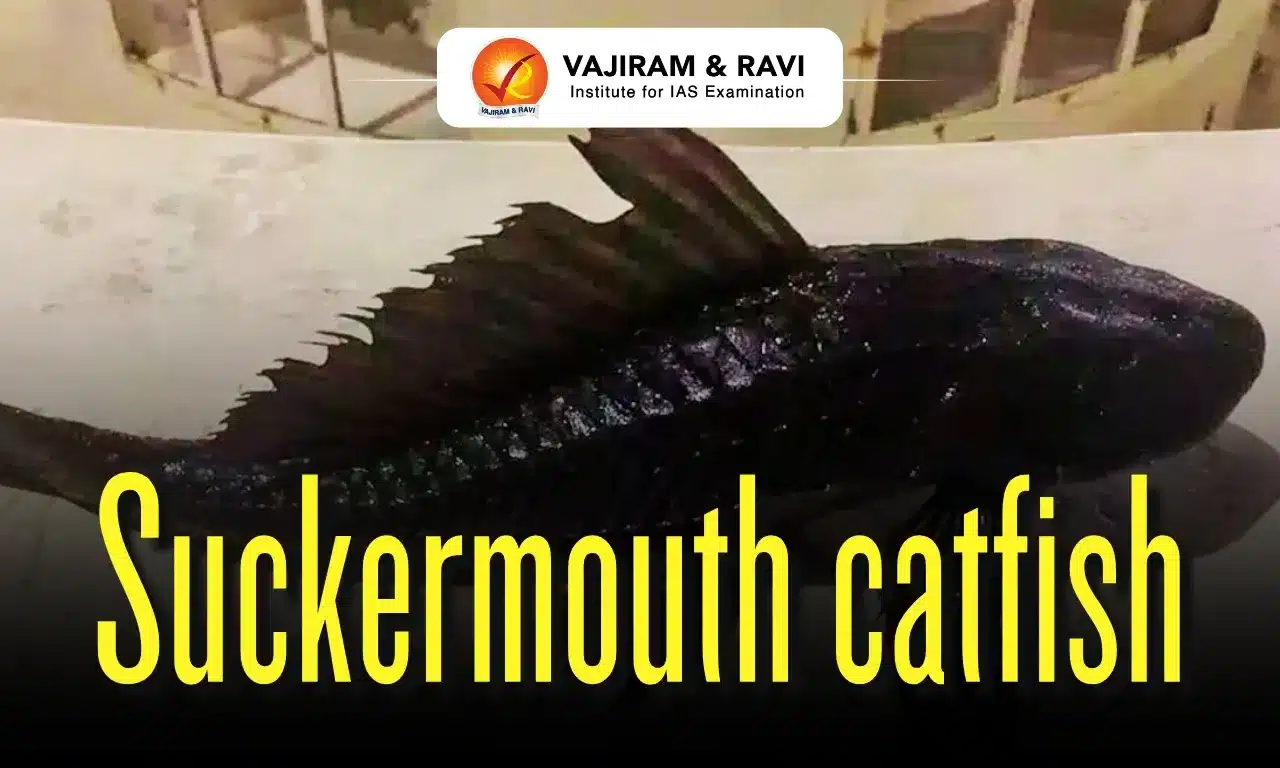
The Bombay Natural History Society (BNHS) has launched an active removal of invasive fish species like the suckermouth catfish and others from Ujani reservoir.  

About Suckermouth catfish

  • It is a tropical fish belonging to the armored catfish family (Loricariidae). 
  • Appearance: It has a strongly arched body and a very large dorsal fin with one spine and seven branched rays.
  • Its ability to endure out of water is facilitated by its accessory breathing organ, akin to a gill cavity, which permits the fish to extract oxygen from the air.
  • It is locally known as' Helicopter fish’ for its unusual appearance.
  • It is native to the Amazon River in South America and entered India through the global aquarium trade. 
  • Distribution: It naturally occurs in northeastern Brazil, the Guianas, and Trinidad and Tobago. 
  • Diet: They are opportunistic omnivores and feed on algae, plants, invertebrates and small fish. 
    • It feeds on fish eggs, burrows into river banks and earthen check dams.
  • It is known for its resilience and adaptability, particularly its ability to survive in conditions that would be inhospitable to other fish.

Source: IE

Suckermouth catfish FAQs

Q1: Suckermouth Catfish is native to which continent?

Ans: South America

Q2: What is the Scientific name of Suckermouth Catfish?

Ans: Hypostomus plecostomus

Thoti Tribe

Thoti Tribe

Thoti Tribe Latest News

Recently, it was observed that the Thoti tribe in Telangana is facing a rapid decline driven by a shrinking population. 

About Thoti Tribe

  • It is a small tribal community concentrated in northern Telangana.
  • They are classified as a Particularly Vulnerable Tribal Group (PVTG).
  • They have historically served as village messengers, ballad singers, and folk artists, maintaining a rich heritage of storytelling and indigenous cultural practices. 
  • Historically, they were oral storytellers, narrating episodes from the Mahabharata using traditional instruments such as the burra, maddela, and harmonium.
  • Language: They speak Gonti as their mother tongue and have a more traditional appearance.
  • Society
    • The social structure of this community is hierarchically organized, wherein the village head and elders of the community exercise authority over most social, political, and legal matters related to the community and its members.
    • Belief System: They are known to be strong believers in the idea of rebirth, this is also evidenced in their traditional songs.
    • They worship and believe in their community God called “Persapen” and other village deities, and celebrate a festival known as “Nagappa Jathara” (Chariot festival). 
    • During ceremonial occasions, Thotis play the kingri, a three-stringed fiddle, and blow trumpets.
  • Many Thoti women are skilled tattoo artists, and they are responsible for the complex tattoos covering the arms, shoulders, and chests of many Gond women.
  • The Thotis have been known to practice endogamy.

Source: TT

Thoti Tribe FAQs

Q1: Thoti tribe is mainly found in which state?

Ans: Telangana

Q2: Language spoken by Thoti people belongs to?

Ans: Dravidian family

E-Samudra Platform

E-Samudra Platform

E-Samudra Platform Latest News

Recently, the Union Minister for Ports, Shipping and Waterways inaugurated the E-Samudra platform. 

About E-Samudra Platform

  • It is a comprehensive digital platform making maritime governance simpler, more transparent and more stakeholder-centric.
  • It is an initiative by the Directorate General of Shipping, and is driving a digital revolution in maritime governance.
    • This comprehensive e-governance solution streamlines shipping and seafarer operations, automates administrative processes, and enhances compliance monitoring.
  • It is aimed at transforming maritime governance by bringing services for seafarers, shipping companies, ports and other stakeholders under a single digital window.
  • It transforms maritime administration from a physical office-based model into an integrated digital ecosystem. It represents a transition towards Digital First and Faceless Governance
  • It is part of a broader effort to make maritime administration more transparent, technology-driven and accessible while strengthening the safety, security and welfare of India’s growing seafarer workforce.
  • It will bring maritime services into a single digital window with end-to-end workflows, online payments, real-time tracking and digitally issued certificates.

Source: PIB

E-Samudra Platform FAQs

Q1: E-SAMUDRA is a platform launched by which ministry?

Ans: Ministry of Ports, Shipping & Waterways

Q2: E-SAMUDRA is part of which larger vision?

Ans: Maritime India Vision 2030

Tadoba-Andhari Tiger Reserve

Tadoba-Andhari Tiger Reserve

Tadoba-Andhari Tiger Reserve Latest News

Odisha’s wildlife department has initiated the second phase of tiger translocation to Similipal Tiger Reserve (STR) after the state successfully brought two tigresses from the Tadoba-Andhari Tiger Reserve. 

About Tadoba-Andhari Tiger Reserve

  • Location: It is located in the Chandrapur district in Maharashtra.
  • It is the largest and oldest tiger reserve in Maharashtra. 
  • It was established in 1955, the reserve consists of Tadoba National Park and Andhari Wildlife Sanctuary.
    • The word ‘Tadoba’ is derived from the name of the God “Tadoba” or “Taru,” which is praised by local tribal people of this region, and “Andhari” is derived from the name of the Andhari River that flows in this area.
  • It has corridor linkages with Nagzira-Navegaon and Pench Tiger Reserves within the State.
  • It has a hilly topography with an average elevation of 200–350 metres.
  • Water Sources: There are two lakes and one waterway in the reserve: Tadoba Lake, Kolsa Lake, and the Tadoba River.
  • Vegetation: It falls in the central plateau province of the Deccan peninsula, with tropical dry deciduous forests and a typical central Indian faunal assemblage.
  • Flora: It mainly consists of Teak, Ain, Bamboo, Bija, Dhaoda, Haldu, Salai, Semal and Tendu. 
  • Fauna: It is home to Indian leopards, sloth bears, Indian gaur (bison), wild dogs (dholes), striped hyenas, marsh crocodiles, sambar deer, chital (spotted deer), barking deer, and four-horned antelopes (chousingha).

Source: IE

Tadoba-Andhari Tiger Reserve FAQs

Q1: Tadoba-Andhari Tiger Reserve is located in which state?

Ans: Maharashtra

Q2: What type of forest is found in in Tadoba-Andhari Tiger Reserve?

Ans: Tropical dry deciduous forests

Mithun

Mithun

Mithun Latest News

Over 200 mithuns have died in a foot-and-mouth disease (FMD) outbreak in Dibang Valley district of Arunachal Pradesh in the last one month.

About Mithun

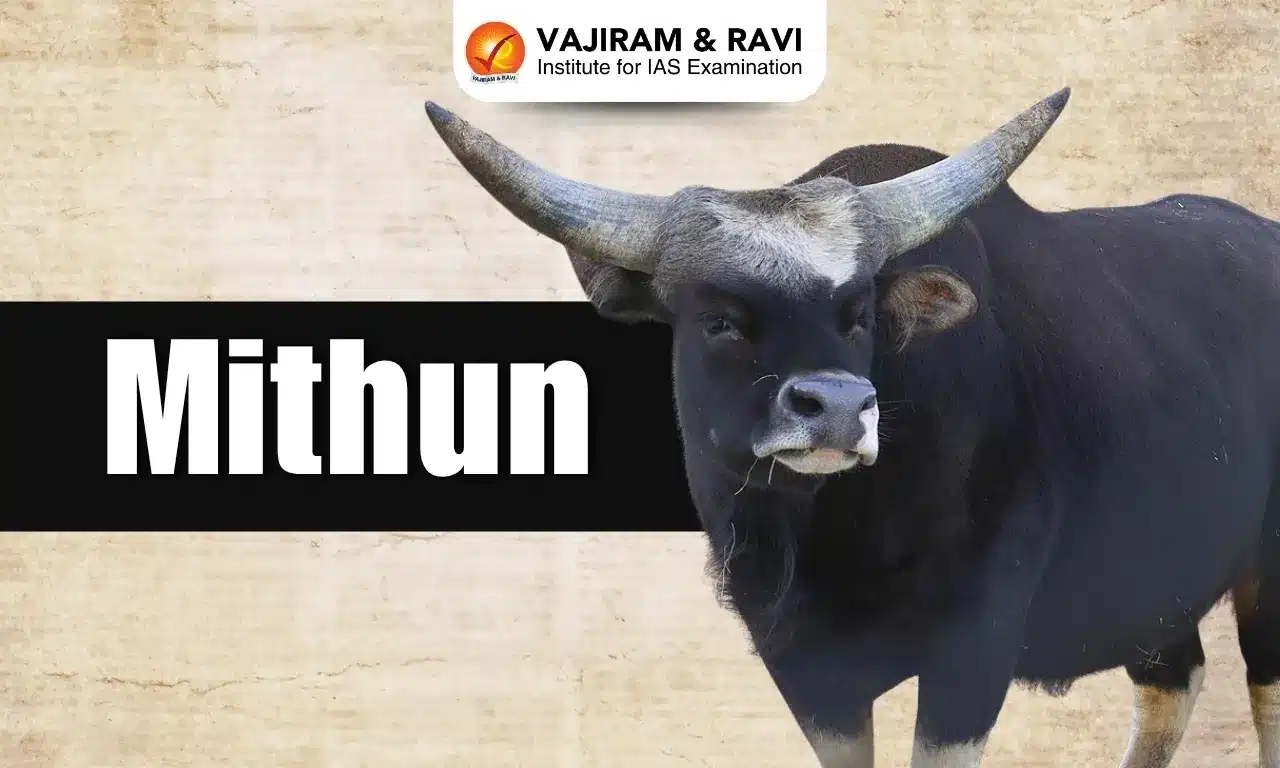
  • The Mithun, or gayal, is a heavily built, semi-domesticated bovine species.
  • Scientific Name: Bos frontalis
  • Mithun is believed to have originated more than 8000 years ago and is considered to be a descendent of wild Indian gaur, or bison.
  • It is also known as the ‘cattle of the mountain’.

Mithun Distribution

  • The highest concentration of mithuns in the world is spread over the North Eastern (NE) region of India, with Arunachal Pradesh having the highest population.
  • It is also found in China and parts of Southeast Asia, viz., Bangladesh, Myanmar, and Bhutan.
  • The geographic zone is covered with tropical evergreen rain forests. 
  • It is the state animal of Arunachal Pradesh and Nagaland.
  • The ‘Soulung’ festival is observed annually by the Adi tribes of Arunachal Pradesh to commemorate the birth and arrival of Mithun on this earth.

Mithun Features

  • It appears somewhat similar to that of Gaur but are distinctly smaller in size. 
  • The characteristic feature lies in the head, which has a well-developed, broad frontal bone with a flat-shaped face. 
  • From the front view, it appears like an inverted triangle from where two horns emerge from the lateral sides.
  • Horn colour varies from whitish yellow to salty black in most animals.
  • The skin color of the head and body is blackish-brown in both sexes, and the forehead is creamy white or yellowish in color.
  • The other distinguishing features are a small and double dewlap and white stockings.
  • They move in small groups with one or two males and several females and calves.

Mithun Conservation Status

It is classified as 'Vulnerable  ' under the IUCN Red List. 

What is Foot and Mouth Disease (FMD)?

  • It is a severe, highly contagious viral disease that affects all cloven-hoofed animals, including cattle, sheep, goats, camelids, deer, and pigs. 
    • Cloven-hoofed animals are those with divided hooves. It does not affect horses or zebras. 
  • Cause: It is caused by an Aphthovirus of the family Picornaviridae.
  • It is a transboundary animal disease (TAD) that deeply affects the production of livestock and disrupts regional and international trade in animals and animal products. 
  • Intensively reared animals are more susceptible to the disease than traditional breeds.
  • FMD is a disease of animals, not humans, and is a different disease than hand, foot, and mouth disease which is common in young children. 
  • FMD is not transmitted to humans by eating affected meat. 
  • Transmission: 
    • The virus is transmitted through direct contact between healthy and infected animals. 
    • Indirect contact with contaminated objects (fomites) such as vehicles, clothing, footwear, and bedding can also spread FMDV. 
    • Additionally, consuming contaminated feed or milk can transmit the virus as well as through respiratory aerosols.  
  • Symptoms:
    • FMD is characterised by fever and blister-like sores on the tongue and lips, in the mouth, on the teats and between the hooves.
    • The disease is rarely fatal in adult animals, but there is often high mortality in young animals due to myocarditis.
  • Treatment: Vaccination is the only effective preventive measure against FMD.

News: DC

Mithun FAQ's

Q1: What is Mithun?

Ans: Mithun, also known as gayal, is a heavily built, semi-domesticated bovine species.

Q2: Which region of India has the highest concentration of Mithun?

Ans: The North-Eastern region of India has the highest concentration of Mithun.

Q3: What type of habitat is associated with the geographic distribution of Mithun?

Ans: Its geographic range is associated with tropical evergreen rainforests.

Q4: Which states of India have declared Mithun as their state animal?

Ans: Arunachal Pradesh and Nagaland.

Q5: What is the IUCN Red List status of Mithun?

Ans: Mithun is listed as Vulnerable on the IUCN Red List.

Myoglobin

Myoglobin

Myoglobin Latest News

Recently, scientists have engineered lettuce and tobacco plants to produce myoglobin.  

About Myoglobin

  • It is a small protein that accounts for about 2% of total muscle protein. 
  • It is found predominantly in striated muscle tissue, namely skeletal muscle and cardiac muscle.
  • Specifically, it is in the cytoplasm of cardiac myocytes and the sarcoplasm of oxidative skeletal muscle fibers.
  • It encodes a single polypeptide chain with one oxygen binding site.
  • It is one of the members of the globin superfamily, which also includes hemoglobin. It often gets compared structurally and functionally to hemoglobin.
  • Composition: It’s made of amino acids, iron and other molecules that work together to hold onto oxygen.

Functions of Myoglobin

  • Transports Oxygen: It transports oxygen from the bloodstream to your muscles when they need it to convert stored energy into movements.
  • It serves as a sensitive indicator of cellular damage when detected in urine or plasma.
  • It serves as a buffer of intracellular oxygen concentrations and as an oxygen reservoir in muscle. 
  • Enzymatic functions: It is necessary for the decomposition of bioactive nitric oxide to nitrate. The removal of nitric oxide enhances mitochondrial respiration.
  • Remove reactive oxygen species: It can do this by interacting with fatty acids.

Source: HT

Myoglobin FAQs

Q1: Where does Myoglobin found?

Ans: Muscle cells

Q2: What is the role of Myoglobin?

Ans: Act as Oxygen reservoir during hypoxia

Enquire Now