Green India Mission

Green India Mission

Green India Mission Latest News

Recently, the Comptroller and Auditor General (CAG) have flagged major shortcomings in the implementation of the Green India Mission (GIM).  

About Green India Mission

  • It was launched in the year 2014 as a Centrally Sponsored Scheme.
  • It is one of the eight Missions under the National Action Plan on Climate Change (NAPCC).
  • It aims at protecting, restoring and enhancing India’s forest cover and responding to climate change through adaptation and mitigation measures.
  • Objectives: Its objectives include improving ecosystem services such as biodiversity, water and carbon sequestration, as well as increasing means of forest-based livelihood.
  • Targets
    • The mission envisages increasing forest and tree cover over 5 million hectares and improving the quality of forest/tree cover over another 5 million hectares.
    • Enhanced annual CO2 sequestration by 50 to 60 million tonnes.
    • Revised Targets: India has committed to creating an additional carbon sink of 2.5-3 billion tonnes of CO2 equivalent by 2030 through additional forest and tree cover. 
  • Nodal Ministry: Ministry of Environment, Forest and Climate Change

Source: TH

Green India Mission FAQs

Q1: Green India Mission was launched under which initiative?

Ans: National Action Plan on Climate Change

Q2: Which ministry launched Green India Mission?

Ans: Ministry of Environment, Forest and Climate Change
Vishnugad Pipalkoti Hydro Electric Project (VPHEP)

Vishnugad Pipalkoti Hydro Electric Project

Vishnugad Pipalkoti Hydro Electric Project Latest News

Seven workers were killed after a landslide triggered a massive surge of water and debris into an under-construction tunnel of the 444-MW Vishnugad-Pipalkoti Hydroelectric Project in Uttarakhand’s Chamoli district recently.

About Vishnugad Pipalkoti Hydro Electric Project

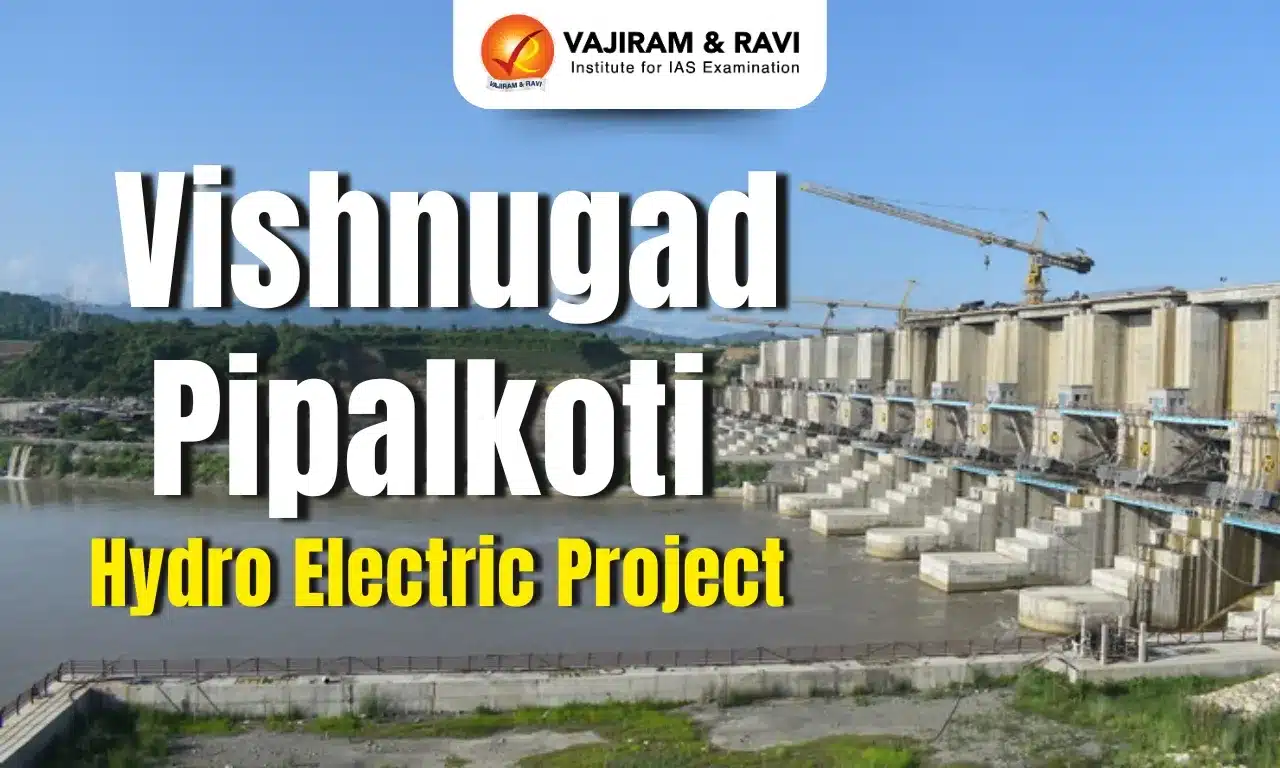
  • It is a run-of-river hydropower scheme being developed on the Alaknanda River (a major tributary of the Ganga River) in the Chamoli district of Uttarakhand.
  • The project envisages the construction of a 65 m high concrete diversion dam, along with a 13.4 km long Head Race Tunnel (HRT) and a 3.04 km long Tail Race Tunnel (TRT).  
  • With an installed capacity of 444 MW (4 × 111 MW), VPHEP is designed to provide peaking power to India’s Northern Grid.
  • The project, when completed, will generate an estimated 1,665 gigawatt-hours (or million kilowatt-hours) of electricity in a typical year. 
  • All water diverted from the river will be returned to the river approximately 18 km after the point of diversion. 
  • It is being developed by THDC India Ltd, (formerly Tehri Hydro Development Corporation Limited) and financed by a US $648 million loan from the World Bank.
    • THDC is a joint venture between the government of India and the government of Uttar Pradesh.

News: NIE

Vishnugad Pipalkoti Hydro Electric Project FAQs

Q1: What is the Vishnugad Pipalkoti Hydro Electric Project (VPHEP)?

Ans: It is a run-of-river hydropower project being developed on the Alaknanda River in Uttarakhand.

Q2: What is the installed capacity of the Vishnugad Pipalkoti Hydro Electric Project?

Ans: Its installed capacity is 444 MW.

Q3: Which company is developing the Vishnugad Pipalkoti Hydro Electric Project?

Ans: It is being developed by THDC India Ltd, (formerly Tehri Hydro Development Corporation Limited).

Q4: Which international institution is financing Vishnugad Pipalkoti Hydro Electric Project?

Ans: The World Bank is financing the project.

Foreign Assets of Small Taxpayers – Disclosure Scheme

Foreign Assets of Small Taxpayers – Disclosure Scheme

Foreign Assets of Small Taxpayers – Disclosure Scheme Latest News

Recently, the government has notified a one-time voluntary disclosure scheme, Foreign Assets of Small Taxpayers – Disclosure Scheme (FAST-DS).

About Foreign Assets of Small Taxpayers – Disclosure Scheme

  • It is a one-time voluntary disclosure scheme contained in Chapter IV of the Finance Act, 2026.
  • It enables eligible taxpayers to declare certain undisclosed foreign assets, undisclosed foreign income, or undeclared foreign assets on payment of a specified tax or fee.
  • Asset includes immovable property, jewellery, artistic work, shares, securities or any other asset or income,
  • The scheme applies to two broad categories of asset or income
  • Category 1: An undisclosed foreign asset or foreign income that was not previously offered to tax, the aggregate value must not exceed ₹1 crore.
    • Under this, taxpayers need to pay 30% of fair market value of assets or 30% of undisclosed income as tax and 30% as additional income tax in lieu of penalty in order to get immunity from prosecution.
  • Category 2:  It covers foreign assets that were already offered to tax or acquired when the taxpayer was a non-resident but were not reported in the relevant tax-return schedule. The threshold for such declarations is ₹5 crore.
    • For this category, immunity from both penalty and prosecution is available with the fee payment of Rs 1 lakh.
  • Immunity: Taxpayers making valid declarations will receive immunity from any further tax or penalty and from prosecution under the Black Money (Undisclosed Foreign Income and Assets) and Imposition of Tax Act, 2015.

Source: IE

Foreign Assets of Small Taxpayers – Disclosure Scheme FAQs

Q1: What is nodal agency for the Disclosure Scheme ?

Ans: CBDT

Q2: What is Foreign Assets of Small Taxpayers – Disclosure Scheme?

Ans: It is a one-time voluntary disclosure scheme contained in Chapter IV of the Finance Act, 2026.

Mount Ararat

Mount Ararat

Mount Ararat Latest News

A German-Turkish research team conducted the first survey of Mount Ararat’s glacier in eastern Turkey recently.

About Mount Ararat

  • It is a volcanic massif located in extreme eastern Turkey.
  • It overlooks the point at which the frontiers of Turkey, Iran, and Armenia converge. 
  • Mount Ararat (16,940 feet, 5165 m) is the highest mountain among hundreds found in the area, and the highest in the Armenian Highlands. 
  • It is the highest mountain in Turkey.  
  • The dormant volcano is also known as Mount Agri and Mount Masis.  
  • It is actually part of two snow-capped peaks, named Greater Ararat and Lesser Ararat.
    • Both Great and Little Ararat are the product of eruptive volcanic activity. 
    • Neither retains any evidence of a crater, but well-formed cones and fissures exist on their flanks. 
    • The only true glacier is found on the northern side of the Great Ararat, near its summit. 

News: STD

Mount Ararat FAQs

Q1: Where is Mount Ararat located?

Ans: It is located in extreme eastern Turkey.

Q2: What type of mountain is Mount Ararat?

Ans: Mount Ararat is a volcanic massif.

Q3: What are the other names of Mount Ararat?

Ans: It is also known as Mount Agri and Mount Masis.

Q4: Is Mount Ararat an active or dormant volcano?

Ans: It is a dormant volcano.

Subansiri River

Subansiri River

Subansiri River Latest News

The Subansiri River in Arunachal Pradesh's Upper Subansiri district has risen to an unusually high and forceful level despite no rainfall being reported in the area, raising concerns among local residents.

About Subansiri River

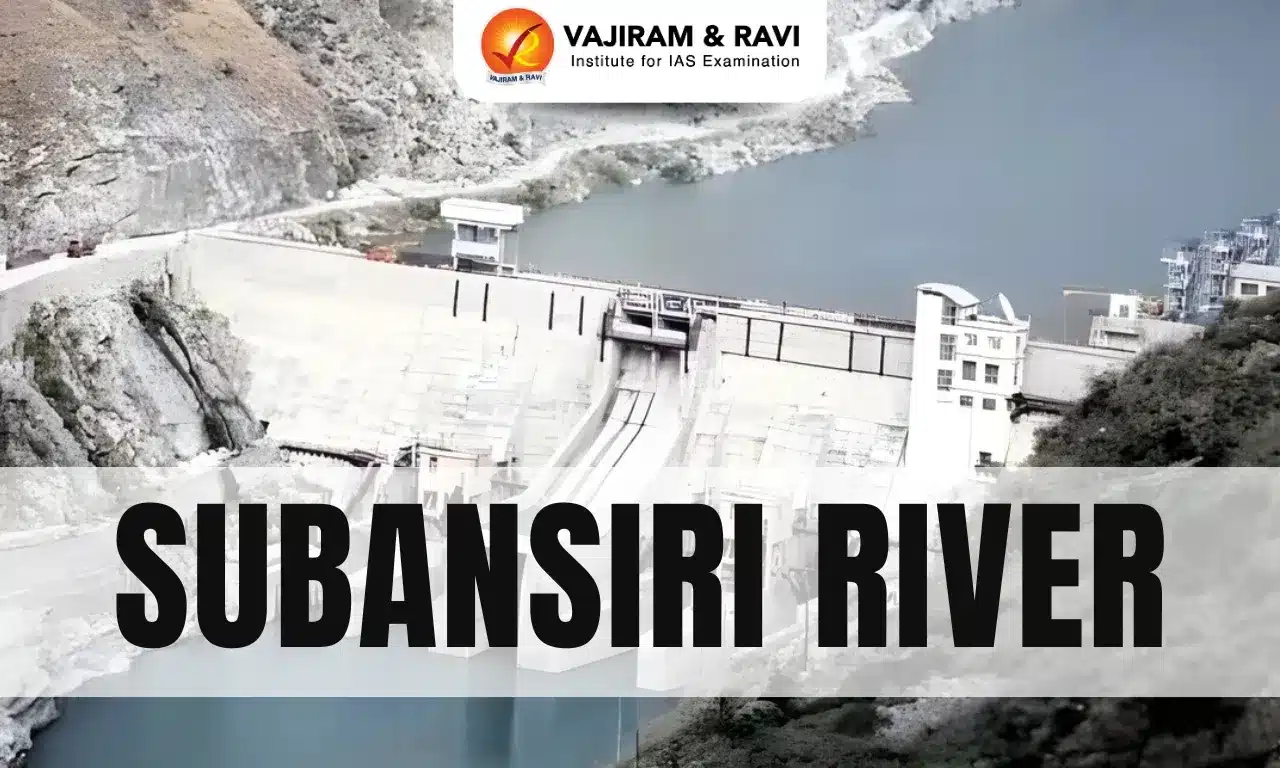
  • It is a right-bank tributary of the Brahmaputra River, originating in Tibet and flowing through Arunachal Pradesh and Assam. 
  • It is a trans-Himalayan and antecedent river, meaning it existed before the Himalayas rose and continued its course through the mountains.  
  • It is also called the “Gold River” because of the gold dust found in its waters. 
  • Course
    • It originates in the Tibetan Plateau, where it is formed by the confluence of three small streams: Lokong Chu, Chayal Chu, and Tsari Chu. 
    • It flows eastward in Tibet for about 170 km before turning south and entering India near Taksing in Arunachal Pradesh. 
    • In Arunachal Pradesh, the Subansiri River flows east and southeast through the Miri Hills, carving deep gorges and creating a rugged landscape. 
    • After covering about 250 km in the Eastern Himalayas, it descends into the Assam Valley at Dulangmukh in Dhemaji district. 
    • Here, it slows down and meanders through the plains for about 86 km, passing near Majuli—the world’s largest river island—before merging with the Brahmaputra River at Jamurighat in Lakhimpur district, Assam
    • It is the largest tributary of the Brahmaputra River. 
  • Its total length is approximately 442 kilometres, with the river draining a basin of roughly 32,000 sq.km.
  • The river is fed by a combination of snowmelt from its Tibetan headwaters and the intense southwest monsoon precipitation that falls over the Himalayan foothills between June and September.  
  • Tributaries: Major tributaries of the river are Laro, Nye, Yume, Tsari, Kamla, Jiyadhol, Ranganadi and Dikrong.
  • Lower Subansiri Hydroelectric Project:
    • It is a 2000 MW run-of-the-river hydro project being constructed on the Subansiri River.
    • It is located at Gerukamukh on the Arunachal Pradesh–Assam border.
    • It will be the single largest hydroelectric plant in India when completed.

News: IT

Subansiri River FAQs

Q1: The Subansiri River is a tributary of which major river?

Ans: It is a right-bank tributary of the Brahmaputra River.

Q2: Where does the Subansiri River originate?

Ans: It originates in Tibet, on the Tibetan Plateau.

Q3: Through which Indian states does the Subansiri River flow?

Ans: It flows through Arunachal Pradesh and Assam.

Q4: Why is the Subansiri River called an antecedent river?

Ans: It is considered antecedent because its course predates the rise of the Himalayas and it maintained its course as the mountains rose.

Q5: What is the approximate total length of the Subansiri River?

Ans: Approximately 442 kilometres.

Cauvery Wildlife Sanctuary

Cauvery Wildlife Sanctuary

Cauvery Wildlife Sanctuary Latest News

Three alleged poachers were killed in an exchange of fire with forest personnel at Cauvery Wildlife Sanctuary in Karnataka’s Chamarajanagar district recently.

About Cauvery Wildlife Sanctuary

  • It is located in the Ramanagara, Chamarajanagar, and Mandya districts of Karnataka
  • Established in 1987, it covers an area of approximately 1,027 sq.km.  
  • It is situated on the banks of the River Cauvery, which flows through the major part of this protected area. 
  • To the east and northeast, the sanctuary is bordered by Tamil Nadu state. 
  • Vegetation: It has riverine and dry deciduous forests and some patches of scrub forest. 
  • Flora: Among the unique tree species, you will find teak (Tectona grandis), Sandalwood (Santalum album), Bamboo (Dendrocalamus strictus), Indian gooseberry (Phyllanthus Emblica), and Terminalia (Terminalia arjuna).
  • Fauna
    • Notable mammals include the Bengal tiger, Indian leopard, elephants, gaur (Indian bison), sloth bear, wild boar, and the Sambar deer. 
    • There are more than 250 bird species, including the Crested Hawk Eagle, Indian Roller, White-bellied Drongo, Malabar Pied Hornbill, and the endangered Great Hornbill. 

News: TELE

Cauvery Wildlife Sanctuary FAQs

Q1: Where is the Cauvery Wildlife Sanctuary located?

Ans: It is located in the Ramanagara, Chamarajanagar, and Mandya districts of Karnataka.

Q2: Which major river flows through the Cauvery Wildlife Sanctuary?

Ans: The River Cauvery flows through the sanctuary.

Q3: What are the major types of vegetation found in the Cauvery Wildlife Sanctuary?

Ans: It has riverine forests, dry deciduous forests, and patches of scrub forest.

Chips to Start-up Programme

Chips to Start-up Programme

Chips to Start-up Programme Latest News

According to the Ministry of Electronics and Information Technology more than 68,000 students have been trained in semiconductor chip design under the government’s Chips to Start-ups (C2S) Programme. 

About Chips to Start-up Programme

  • It is an umbrella capacity-building initiative launched by the Ministry of Electronics and Information Technology (MeitY) in 2022.
  • Funding and Tenure: Total outlay of ₹250 crore over five years.
  • Target: It targets the development of 85,000 industry-ready professionals across undergraduate, postgraduate, and doctoral levels.
  • It aims to catalyse the incubation of 25 start-ups and enable 10 technology transfers.

Features of Chips to Start-up Programme

  • It seeks to provide access to SMART lab facilities, train one lakh students, generate 50 patents, and support at least 2,000 focused research publications. 
  • It supports innovation, enhances employability, and enables academic institutions to play a more active role in India’s semiconductor value chain.
  • Programme Approach and Implementation
  • The C2S Programme adopts a comprehensive approach, providing students with hands-on experience in chip design, fabrication, and testing.
    • Training: It is achieved through regular training sessions in collaboration with industry partners, combined with mentorship and practical support.
    • Access: Students gain access to advanced chip design tools, fabrication facilities, and testing resources, including state-of-the-art EDA software and semiconductor foundries.
    • Prototype: These opportunities also include implementing R&D projects under the C2S Programme to develop working prototypes of Application-Specific Integrated Circuit (ASICs), Systems-on-Chip (SoCs), and Intellectual Property (IP) Core designs.

Source: TH

Chips to Start-up Programme FAQs

Q1: Chips to Start-up- C2S Programme was launched by which ministry?

Ans: Ministry of Electronics & Information Technology

Q2: Chips to Start-up (C2S) Programme was launched in which year?

Ans: 2022

Leucas droupadiae

What is Leucas droupadiae

Leucas droupadiae Latest News

Botanists recently discovered a previously unknown plant species named growing along the sandy shores of the Coromandel Coast.

About Leucas droupadiae

  • It is a new species of plant belonging to the mint family (Lamiaceae).
  • It was discovered along the sandy shores of the Coromandel Coast during a survey of the coastal dunes in the Cuddalore district of Tamil Nadu. 
  • It thrives in nutrient-poor, sandy habitats.  
  • What sets Leucas droupadiae apart from its closest relatives is its unique loner growth habit and its striking seeds. 
  • While most similar plants in this family grow as creeping vines or branched bushes with deep taproots, this new species stands upright as a single, unbranched stem, reaching only about 15 centimeters in height. 
  • It anchors itself into the sands using a shallow web of fibrous roots rather than a single thick root. 
  • Most distinctively, the plant produces oblong fruit, known as nutlets, that are a brilliant golden yellow and covered in irregular dark brown spots, a feature not seen in its cousins. 
  • The scientists have named the plant in honour of Smt. Droupadi Murmu, the 15th President of India
  • Because of its limited range, the species has been provisionally labelled as “Data Deficient," .

News: RM

Leucas droupadiae FAQs

Q1: What is Leucas droupadiae?

Ans: It is a newly discovered species of plant belonging to the mint family Lamiaceae.

Q2: Where was Leucas droupadiae discovered?

Ans: It was discovered along the sandy shores of the Coromandel Coast in Cuddalore district, Tamil Nadu.

Q3: Which plant family does Leucas droupadiae belong to?

Ans: It belongs to the Lamiaceae family, commonly known as the mint family.

Q4: What is the distinctive growth habit of Leucas droupadiae?

Ans: It has a single, upright and unbranched stem.

RSVC-AMRIT Platform

RSVC-AMRIT Platform

RSVC-AMRIT Platform Latest News

Recently, the Principal Scientific Adviser to the Government of India launched the RSVC AMRIT platform.

About RSVC-AMRIT Platform

  • It is developed by NABARD in collaboration with the Office of the Principal Scientific Adviser (OPSA) to the Government of India.
  • AMRIT Platform serves as the digital backbone of the RuTAGe Smart Village Centre (RSVC) ecosystem.
  • Focus: It supports rural innovation and technology transfer and enables wider adoption of appropriate technologies in rural areas.
  • It is designed as a comprehensive digital ecosystem supporting the complete RSVC lifecycle, from technology discovery and validation to deployment tracking, collaboration, monitoring and knowledge management.
  • The platform will progressively bring together innovators, technology providers, startups, validators, accelerators, implementation partners, funding agencies, academic institutions and rural communities on a shared platform. 

What is The Rural Technology Action Group (RuTAG)?

  • It is an initiative of the Office of the Principal Scientific Adviser (OPSA) which was launched in 2004.
  • It was conceptualized as a mechanism to provide a higher level of Science &Technology intervention and support for rural areas.
  • Objectives of RuTAG Initiative
    • Connecting Stakeholders: Collaborating with stakeholders Non-Government Organizations, Self Help Groups, Community Organizations, and Start-ups to identify sector-specific technology needs.
    • Demand-driven technologies: Developing technologies based on socio-economic data coherent with national/regional priorities.
    • Prototype Validation: ValidatIng developed prototypes and explored commercialization with scalability aspects.
    • Commercialization: Commercializing the potentially validated technologies for national/global markets.

Source: PIB

RSVC-AMRIT Platform FAQs

Q1: What is the primarily aim of RSVC-AMRIT?

Ans: It supports rural innovation and technology transfer and enables wider adoption of appropriate technologies in rural areas.

Q2: RSVC-AMRIT Platform was developed by whom?

Ans: It is developed by NABARD in collaboration with the Office of the Principal Scientific Adviser (OPSA) to the Government of India.

SraVaani

SraVaani

SraVaani Latest News

Recently, researchers at IISc’s SPIRE Lab, in collaboration with ARTPARK and Google, have released SraVaani.

About SraVaani

  • It is the first multilingual Indian speech recognition model.
  • It extends automatic speech recognition to several regional and non-scheduled Indian languages that remain underserved by existing speech technology.
  • It covers 20 scheduled languages and 45 regional languages and dialects.
  • It can convert spoken words into text across 10 scripts and automatically identify the language being spoken, without users having to select one first.
  • The model supports languages such as Garo, Angika, Chakma, Kokborok, Tulu, Bundeli and Bajjika.
  • The SraVaani model is based on Project Vaani, one of IISc’s major programs, to understand the linguistic diversity of India.
    • The project has gathered around 31,000 hours of speech data obtained from over 156,000 speakers from 165 regions, thus providing the needed information about natural conversational-speech to the researchers.
    • SraVaani uses a FastConformer-based automatic speech recognition architecture.
  • Applications: It could support applications in areas such as education, digital services, banking, healthcare, e-governance and customer support, particularly where users prefer interacting in regional languages.

Source: TH

SraVaani FAQs

Q1: SraVaani was developed by which organisation?

Ans: IISc’s SPIRE Lab, in collaboration with ARTPARK and Google

Q2: What is SraVaani model?

Ans: Multilingual Indian speech recognition model

Enquire Now