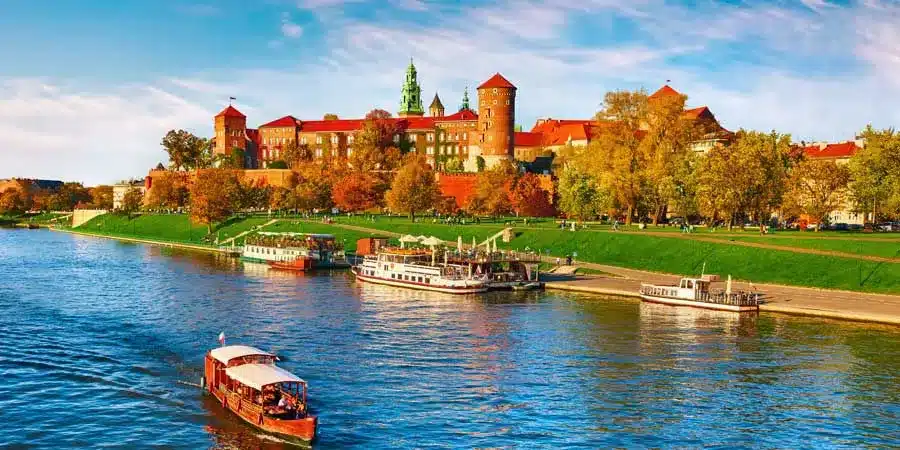
Poland

Key Facts about Poland

Poland Latest News

India and Poland are working on a series of agreements in key areas, including cyber security, space, and clean coal. 

About Poland

  • Location: It is a Central European country.
  • Bordering Countries: It is bordered by 7 nations: by Germany in the west; the Czech Republic in the southwest; Slovakia in the south; Ukraine  in the southeast; Belarus in the east; Lithuania and Russia in the northeast.
  • Water Bodies: It is bordered in the north by the Baltic Sea. 
  • It is a member of both NATO (North Atlantic Treaty Organization) and the European Union (EU).
  • Capital City: Warsaw

Geographical Features of Poland

  • Climate: It has a continental climate, moderated by westerly winds. 
  • Mountain Ranges: Major ranges include the Sudetes, and the Tatra Mountains which are the most elevated part of the Carpathian Mountains.
  • Highest Point: Its highest-point is Mt. Rysy which stands at 2,499 m (8,199 ft) in elevation.
  • Major Rivers: It is drained by the Rivers Vistula Warta and Oder.
  • Natural Resources: The country has deposits of coal, natural gas, and economically important minerals such as copper, rhenium, sulfur, and salt. 

Source: News On Air

Poland FAQs

Q1: What is the capital of Poland?

Ans: Warsaw

Q2: Which is the highest peak of Poland?

Ans: Mt. Rysy

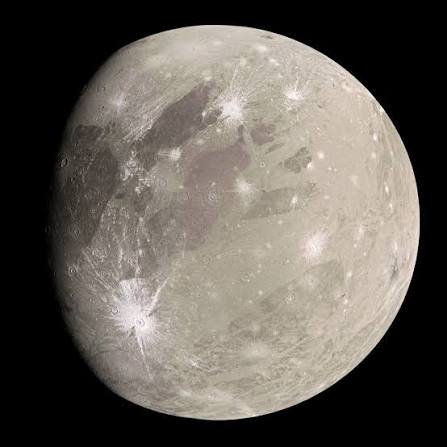
Ganymede

Ganymede

Ganymede Latest News

Magnetic and auroral evidence points to a vast ocean beneath Ganymede, but surface salts do not yet prove a direct connection through its roughly 150-kilometre ice shell.

About Ganymede

  • It is the largest of Jupiter’s satellites and of all the satellites in the solar system.   
  • It is the only moon known to possess its own magnetic field. 
  • Discovered by Galileo Galilei in 1610, Ganymede's name is derived from a figure in Roman mythology associated with the god Jupiter.  
  • It has a diameter of about 5,270 km, which makes it larger than the planet Mercury. 
  • It is situated about one million kilometers from Jupiter, exhibiting synchronous rotation, which means it always shows the same face to the planet. 
  • Ganymede’s relatively low density of 1.93 grams per cubic cm indicates that its composition is roughly half rock and half water ice by mass.  
  • Ganymede has a core of metallic iron, which is followed by a layer of rock that is topped off by a crust of mostly ice that is very thick. 
  • There are also a number of bumps on Ganymede's surface, which may be rock formations. 
  • It is believed that Ganymede has a saltwater ocean below its surface. 
  • A thin atmosphere surrounds Ganymede, containing hydrogen and possibly other compounds like carbon dioxide. 
  • Ongoing exploration, including missions like the recently launched Jupiter Icy Moons Explorer (JUICE), aims to deepen our understanding of Ganymede's geology, potential oceanic layers, and its role in the broader context of the solar system's formation and evolution.

News: SD

Ganymede FAQs

Q1: What is Ganymede?

Ans: Ganymede is the largest moon of Jupiter and the largest natural satellite in the Solar System.

Q2: What is unique about Ganymede among the moons of the Solar System?

Ans: Ganymede is the only moon known to possess its own magnetic field.

Q3: Who discovered Ganymede?

Ans: Galileo Galilei discovered Ganymede in 1610.

Q4: What is the internal structure of Ganymede?

Ans: Ganymede has a metallic iron core, followed by a rocky layer, and a very thick crust composed mostly of ice.

Exercise Veer Guardian 2026

Exercise Veer Guardian

Exercise Veer Guardian Latest News

The Japanese Self-Defense Force (JASDF) contingent recently touched down in Jodhpur ahead of Exercise Veer Guardian 2026.

About Exercise Veer Guardian

  • It is a bilateral air exercise between the Indian Air Force and the Japanese Air Self-Defense Force (JASDF).
  • The first edition of the exercise was held in 2023 at Hyakuri Air Base, Japan. 
  • It seeks to enhance interoperability, operational synergy, and mutual understanding, reinforcing the enduring bonds of friendship between India and Japan.
  • Ex Veer Guardian 2026:
    • Location: Jodhpur, Rajasthan
    • It will focus on improving the tactical proficiency of participating units and deepening mutual understanding between the two air forces. 
    • The training will include air-combat manoeuvring, giving personnel from both countries an opportunity to train together in complex operational scenarios. 
    • Japan is participating with three F-2A fighter aircraft from the 8th Air Wing at Tsuiki Air Base, along with approximately 110 personnel.
    • This is the first time that the Mitsubishi F-2 fighter aircraft will participate in an exercise in India.

News: TOI

Exercise Veer Guardian FAQs

Q1: What is Exercise Veer Guardian?

Ans: Exercise Veer Guardian is a bilateral air exercise between the Indian Air Force (IAF) and the Japanese Air Self-Defense Force (JASDF).

Q2: When was the first edition of Exercise Veer Guardian held?

Ans: The first edition was held in 2023.

Q3: What are the main objectives of Exercise Veer Guardian?

Ans: It aims to enhance interoperability, operational synergy and mutual understanding between the Indian and Japanese air forces.

Q4: Which Japanese fighter aircraft are participating in Exercise Veer Guardian 2026?

Ans: Three Mitsubishi F-2A fighter aircraft are participating.

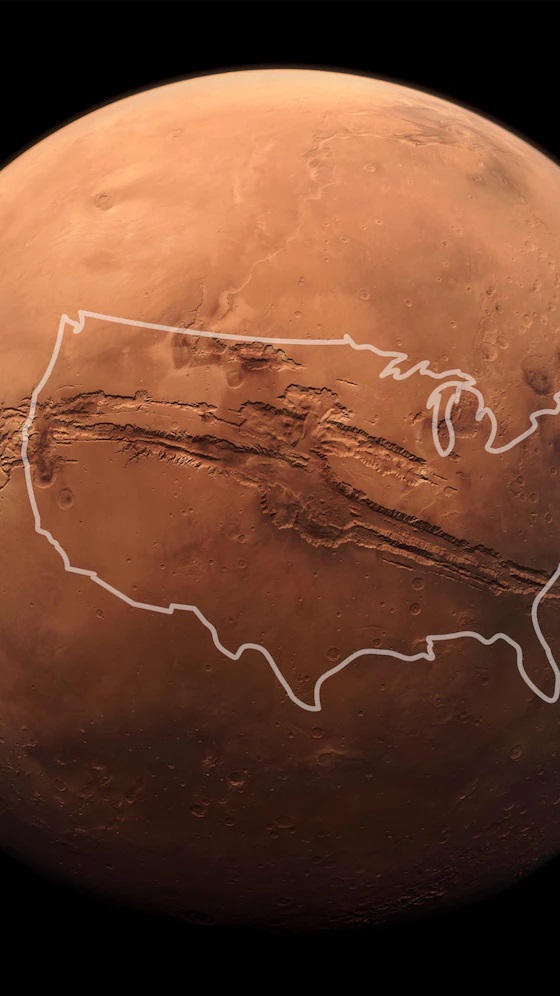
Valles Marineris

valles-marineris

Valles Marineris Latest News

A vastly larger outburst flood occurred on Mars during the Late Hesperian to Early Amazonian, when the breaching of paleolakes in Valles Marineris, the largest canyon system in the Solar System, unleashed a massive deluge.

About Valles Marineris

  • Valles Marineris, or Mariner Valley, is a vast system of interconnected canyons on the planet Mars.
  • The system was discovered during, and named for, the Mariner 9 mission in 1971.
  • The canyons extend in an east-west direction for roughly 4,000 km just south of the equator. 
  • By comparison, Earth’s natural wonder, the Grand Canyon, is only 446 km long.
  • It is one of the larger canyons in the solar system.
  • It spans about 20 percent of the entire circumference of Mars. 
  • Individual canyons are typically 200 km across and have walls 2–5 km high.
  • At the centre of the system, several canyons merge to form a depression 600 km across and 9 km deep.
  • The canyon system contains a number of different features that give clues to its formation. 
    • Some of the canyon walls appear to be fault scarps that formed as a result of crustal movement along faults radiating from the Tharsis rise, an enormous volcanic bulge to the northwest. 
    • Erosion, however, has also played a significant role in canyon formation, as indicated by deep gullies cut in the walls.
    • In places, the canyons contain thick sedimentary sequences that may have been deposited in lakes that formerly occupied the canyons. 
    • These lakes later may have drained catastrophically to the east, where there is evidence of large floods.

News: TH

Valles Marineris FAQs

Q1: What is Valles Marineris?

Ans: Valles Marineris is a vast system of interconnected canyons on Mars.

Q2: When was Valles Marineris discovered?

Ans: Valles Marineris was discovered during the Mariner 9 mission in 1971.

Q3: How long does the Valles Marineris canyon system extend?

Ans: It extends for roughly 4,000 km.

Q4: Where is Valles Marineris located on Mars?

Ans: It is located just south of the Martian equator.

Enquire Now