Organisation for Economic Co-operation and Development

Organisation for Economic Co-operation and Development

Organisation for Economic Co-operation and Development Latest News

OECD has become the latest global body to raise its growth forecast for India recently, predicting that India’s economy will grow by 7.1% in 2026-27, up from the 6.3% forecast earlier.

About Organisation for Economic Co-operation and Development

  • It is an international organization established with the aim of fostering economic growth and development among member countries. 
  • It succeeded the Organisation for European Economic Co-operation (OEEC), which focused on distributing Marshall Plan aid post-World War II. 
  • The convention establishing the OECD was signed on Dec. 14, 1960, by 18 European countries, the United States, and Canada and went into effect on Sept. 30, 1961. 
  • OECD members are typically democratic countries that support free-market economies.
  • Current Members: 38 countries. 
  • Headquarters: Paris, France.
  • The stated goal of the OECD is to shape policies that foster prosperity, equality, opportunity and well-being for all.
  • The organization's activities encompass a wide range of areas, including trade, industry, agriculture, and environmental protection, with a focus on sustainable development. 
  • The governance structure consists of the OECD Council, the OECD Secretariat, and numerous committees that address specific topics such as public governance and climate change. 
  • Lacking the power to enforce its decisions, the OECD is essentially a consultative assembly that pursues its program through moral suasion, conferences, seminars, and numerous publications.  
  • The OECD publishes economic reports, statistical databases, analyses, and forecasts on the outlook for economic growth worldwide.
  • Major Reports Published by the OECD:
    • OECD Economic Outlook 
    • PISA (Programme for International Student Assessment) 
    • Health at a Glance 
    • Country Peer Review Reports 
  • The organization also seeks to eliminate bribery and other financial crime worldwide.
  • The OECD maintains a so-called “black list” of nations that are considered uncooperative tax havens.
  • India and OECD:
    • India is one of the many non-member economies with which the OECD has working relationships in addition to its member countries.
    • India has been an OECD Key Partner since 2007.

News: TH

Organisation for Economic Co-operation and Development FAQs

Q1: What is the Organisation for Economic Co-operation and Development (OECD)?

Ans: It is an international organisation that works to promote economic growth, development, prosperity and well-being among countries.

Q2: How many countries are currently members of the Organisation for Economic Co-operation and Development (OECD)?

Ans: 38 countries.

Q3: Where is the headquarters of the Organisation for Economic Co-operation and Development (OECD) located?

Ans: Paris, France.

Q4: Which type of economies are typically associated with Organisation for Economic Co-operation and Development (OECD) membership?

Ans: OECD members are generally democratic countries with market-oriented economies.

Q5: Is India a member of the Organisation for Economic Co-operation and Development (OECD)?

Ans: No, India is not an OECD member.

Satellite Smart Anti Airfield Weapon

Satellite Smart Anti Airfield Weapon

Satellite Smart Anti Airfield Weapon Latest News

Recently, the Ministry of Defence has inked a contract with Bharat Dynamics Limited (BDL) for the procurement of 160 Satellite Smart Anti Airfield Weapons (SAT-SAAW) along with associated equipment for Indian Air Force (IAF). 

About Satellite Smart Anti Airfield Weapon

  • It is an air-to-ground precision guided glide bomb which can be launched from platforms like Jaguar, Hawk & Su-30 MKI.
  • It has the capability to neutralise enemy airfields from a long stand-off range.
  • Developed by: It is indigenously designed and developed by Defence Research and Development Organisation (DRDO).
  • Features
    • The system will have an indigenous content of 60% along with indigenisation of sub-systems like Initial Measurement Unit, Long Impact Delay Fuse and Twin Store Carrier to further boost Aatmanirbharta in defence.
    • It has the capability to destroy infrastructure, including runways, taxiways, aircraft hangars, reinforced bunkers, and radar installations.
    • The SAT variant uses satellite navigation (GPS/NavIC) integrated with an onboard Inertial Navigation System (INS) to hit stationary targets with high accuracy (typically within 7 meters) in all weather conditions, day or night.
    • The SAT-SAAW will be delivered between 2027-2028 and 2028-2029.

Source: PIB

Satellite Smart Anti Airfield Weapon FAQs

Q1: What is Satellite Smart Anti Airfield Weapon?

Ans: It is an air-to-ground precision guided glide bomb which can be launched from platforms like Jaguar, Hawk & Su-30 MKI.

Q2: Which organisation developed the Satellite Smart Anti Airfield Weapon?

Ans: Defence Research and Development Organisation (DRDO)

Community of Latin American and Caribbean States

Community of Latin American and Caribbean States

Community of Latin American and Caribbean States Latest News

Recently, India-Community of Latin American and Caribbean States (CELAC) Foreign Ministers’ Meeting was held on the margins of the high-level UN General Assembly session.

About Community of Latin American and Caribbean States

  • It was created on December 3, 2011, in Caracas, Venezuela, with the signature of The Declaration of Caracas. 
  • It is a regional bloc that aims to unite, strengthen, and promote the interests of Latin American and Caribbean states.
  • It was created with a commitment to advance the gradual process of regional integration, unity and carefully balancing political, economic, social and cultural diversity of Latin America and the Caribbean.
  • Background: It is a successor of the Rio Group and the 2nd Latin American and Caribbean Summit on Integration and Development (CALC).
  • Member Countries: CELAC comprises 33 countries.
  • It is not a treaty-based organization.
  • It has no permanent secretariat, no headquarters, and no binding decision-making powers.
  • Governance
    • It operates through a rotating pro tempore presidency held by a member state for one year.
    • Its decisions are adopted by consensus and take the form of political declarations rather than legally binding instruments.
    • Its decisions are governed by rules adopted by the Heads of State and Government Summit in Caracas 2011.

Source: DD News

Community of Latin American and Caribbean States FAQs

Q1: What is Community of Latin American and Caribbean States?

Ans: It is a regional bloc that aims to unite, strengthen, and promote the interests of Latin American and Caribbean states.

Q2: When was Community of Latin American and Caribbean States regional bloc was formed?

Ans: It was created on December 3, 2011, in Caracas, Venezuela, with the signature of The Declaration of Caracas. 

Transfer Pricing

Transfer Pricing

Transfer Pricing Latest News

The Finance Minister recently urged BRICS nations to share their experiences on treaty interpretation and multilateral negotiations in international taxation, saying global transfer pricing disputes “disproportionately” burden developing countries.

About Transfer Pricing

  • Transfer pricing refers to the prices of goods and services that are exchanged between companies under common control.
  • For instance, when a subsidiary company provides goods or services to its parent company or another subsidiary within the same group, the price set for these transactions is known as the transfer price. 
  • They represent a complex and important aspect of business, in particular for companies operating in different tax jurisdictions. 
  • The transfer pricing method is generally used by multinational companies (MNCs) and their subsidiaries or sister companies to allocate income and expenses. 
  • Effective but legal transfer pricing takes advantage of different tax regimes in different countries by raising transfer prices for goods and services produced in countries with lower tax rates. 
  • In some cases, companies even lower their expenditure on interrelated transactions by avoiding tariffs on goods and services exchanged internationally.  
  • The benefits of transfer pricing are tax savings, profit allocation among subsidiaries, and enhanced financial efficiency. 
  • However, transfer pricing must comply with international regulations to avoid issues such as tax evasion.
  • Companies must comply with the transfer pricing rules established by the countries in which they operate, adhering to the arm's length principle (ALP) to ensure transactions are priced as if they were between unrelated parties. 
    • ALP: Related parties price transactions as if they were transactions on an open market. 
    • The Indian transfer pricing regulations (ITPR) require that income arising from ‘international transactions’ between ‘associated enterprises’ be computed with reference to the ALP.
  • International transfer pricing disputes arise mainly as countries seek to ensure MNCs are subject to tax on profits attributable to their respective jurisdictions. 
  • Accordingly, differences in allocation of taxable income among countries can give rise to disputes among taxpayers and tax authorities as well as those in different jurisdictions.

News: TP

Transfer Pricing FAQs

Q1: What is transfer pricing?

Ans: Transfer pricing refers to the prices of goods and services exchanged between companies under common control.

Q2: Which type of companies commonly use transfer pricing

Ans: Multinational companies (MNCs) and their subsidiaries or sister companies commonly use transfer pricing.

Q3: What is the purpose of transfer pricing within multinational companies?

Ans: It is used to allocate income and expenses among related companies within the group.

Q4: What is the Arm's Length Principle (ALP) in transfer pricing?

Ans: The ALP requires related-party transactions to be priced as if they were conducted between unrelated parties in an open market.

Q5: Why is the Arm's Length Principle important in transfer pricing?

Ans: It helps ensure that related companies do not artificially manipulate prices to shift taxable income between jurisdictions.

OLED (Organic Light-Emitting Diode)

OLED (Organic Light-Emitting Diode)

OLED (Organic Light-Emitting Diode) Latest News

India is currently investigating LG Electronics and Samsung for allegedly paying lower tariffs on imported display parts  that go into making panels for OLEDs.

About OLED (Organic Light-Emitting Diode)

  • It refers to a class of light-emitting devices where the emissive layer is composed of carbon-based organic molecules that glow when excited by an electric current.
  • The OLED structure consists of a multilayer array of thin organic films sandwiched between two electrodes, at least one of which is transparent, allowing light emission.  When electrical current is applied, a bright light is emitted.  
  • OLEDs differ from both traditional LEDs (inorganic diodes that emit light at specific points) and LCDs (which rely on liquid crystals and a backlight). 
  • Instead, OLEDs are self-emissive surfaces, which means every pixel generates its own light. 
  • OLED displays provide the best image quality, and they can also be made transparent, flexible, foldable, and even rollable and stretchable.
  • An OLED display have the following advantages over an LCD display:
    • Improved image quality: Better contrast, higher brightness, fuller viewing angle, a wider color range, and much faster refresh rates.
    • Lower power consumption.
    • Simpler design that enables ultra-thin, flexible, foldable, and transparent displays
    • Better durability: OLEDs are very durable and can operate in a broader temperature range.
  • Advanced OLED configurations include PHOLED (Phosphorescent OLED) variants, which use phosphorescent phosphors to increase light efficiency, and WOLED (White OLED), used in lighting technology to generate white light with a wide colour spectrum.

News: TH

OLED (Organic Light-Emitting Diode) FAQs

Q1: What is OLED?

Ans: It a class of light-emitting devices that uses carbon-based organic molecules to produce light when excited by an electric current.

Q2: What is the emissive layer of an OLED made of?

Ans: It is made of carbon-based organic molecules.

Q3: What is the basic structure of an OLED?

Ans: An OLED consists of multiple thin organic films sandwiched between two electrodes, with at least one electrode being transparent.

Q4: How does an OLED produce light?

Ans: It produces light when an electric current excites the organic molecules in its emissive layer.

Q5: What does self-emissive mean in an OLED display?

Ans: It means that each pixel generates its own light and does not require a separate backlight.

Tulu Language

Tulu Language

Tulu Language Latest News

Recently, the Karnataka government decided to accord Tulu the second additional administrative language status.

About Tulu Language

  • Tulu is classified among the five Dravidian languages, the others being Tamil, Telugu, Kannada, and Malayalam.
  • It is spoken mainly in the coastal districts of Dakshina Kannada and Udupi in Karnataka, and northern parts of Kasaragod district in Keralam.
  • It has borrowed many words from the Kannada language, but they are not closely related. 
  • Tulu Nadu has its own script called Tigalari script, which is not widely used.
  • The oldest available inscriptions in Tulu are from the period between 14th to 15th centuries AD.
  • Tulu is taught as the third optional language in schools, from Class 6 to Class 10, in Dakshina Kannada and Udupi districts since the 2010-11 academic year. 
  • Recognition: The Registrar General and Census Commissioner has recognised Tulu as an independent language of India and is also treated as an important non-scheduled language of India.
  • Cultural significance: The language has a strong oral tradition, rich folklore, and cultural practices like Yakshagana, Bhoota Kola, and others.

Source: IE

Tulu Language FAQs

Q1: Which region's people speak Tulu Language?

Ans: It is spoken mainly in the coastal districts of Dakshina Kannada and Udupi in Karnataka, and northern parts of Kasaragod district in Keralam.

Q2: Tulu language belongs to which type of language?

Ans: Dravidian languages

Organization of Islamic Cooperation

Organisation of Islamic Cooperation

Organisation of Islamic Cooperation Latest News

India recently categorically rejected the references to Kashmir in the Joint Communique of the Contact Group on Jammu and Kashmir of the Organisation for Islamic Cooperation (OIC).

About Organisation of Islamic Cooperation 

  • It is the second largest intergovernmental organisation after the United Nations.
  • It has a membership of 57 states spread over four continents.
  • OIC aims to preserve Islamic values, safeguard and defend the national sovereignty and independence of member states, and contribute to international peace and security. 
  • The OIC considers itself as the “collective voice of the Muslim world” and endeavors to safeguard and protect the interests of its member states in economic, social, and political areas. 
  • History:
    • The Organization of Islamic Conference was established upon a decision of the historical summit, which took place in Rabat, Kingdom of Morocco, on 25 September 1969,  following the criminal arson of Al-Aqsa Mosque in occupied Jerusalem.
    • The organisation operates under the Charter of the OIC, originally adopted in 1972 and substantially revised in 2008 at the Dakar Summit. 
    • The name ” Organization of Islamic Conference” was changed to “Organization of Islamic Cooperation (OIC)” in June 2011 at the 38th Council of Foreign Ministers (CFM) in Astana. 
  • Headquarters: Jeddah, Saudi Arabia.
  • Its official languages are Arabic, English, and French.
  • The OIC is composed of the following main bodies:
    • Islamic Summit Conference (ISC): It is the supreme authority of the OIC, which meets every three years to lay down the Organization’s policy.
    • Council of Foreign Ministers (CFM): It meets once a year to examine the implementation of its decisions taken within the framework of the policy defined by the ISC.
    • General Secretariat: It is the executive organ of the OIC entrusted with the implementation of the decisions of the two preceding bodies.
    • Independent Permanent Human Rights Commission (IPHRC), established in 2011.
  • Specialised and affiliated institutions include the Islamic Development Bank (IsDB), the Islamic Educational, Scientific and Cultural Organization (ICESCO), and the Statistical, Economic and Social Research and Training Centre for Islamic Countries (SESRIC). 
  • The OIC partners with international mechanisms (including every specialized UN agency), governments, and civil society organizations (CSOs) to address issues of concern to its member states and Muslims worldwide.
  • Core agenda items have historically centred on the Palestinian question and the status of Jerusalem, solidarity among Muslim states, countering Islamophobia, and economic and scientific cooperation. 
  • India and OIC:
    • The 1969 Snub: India was invited to the inaugural OIC summit in Rabat, Morocco, in 1969, but was disinvited at the last minute due to pressure from Pakistan.
    • Guest of Honour (2019): In 2019, India participated for the first time in an OIC CFM meeting.
    • India has strategically bypassed the OIC as a collective bloc, instead building massive economic and security ties directly with the Gulf and Arab nations.
    • Kashmir Issue: India consistently rejects the OIC's locus standi on its internal affairs, stating that the organisation has no mandate to comment on matters regarding sovereign Indian territories.

News: TH

Organisation of Islamic Cooperation FAQs

Q1: What is the Organisation of Islamic Cooperation (OIC)?

Ans: It is an intergovernmental organisation representing the collective interests of its member states and the Muslim world.

Q2: How many member states does the Organisation of Islamic Cooperation (OIC) have?

Ans: It has a membership of 57 states spread over four continents.

Q3: Where is the headquarters of the Organisation of Islamic Cooperation (OIC) located?

Ans: Jeddah, Saudi Arabia.

Q4: When was the Organisation of Islamic Cooperation (OIC) established?

Ans: 25 September 1969.

Q5: What are the official languages of the Organisation of Islamic Cooperation (OIC)?

Ans: Arabic, English and French.

PBSHABD Platform

PBSHABD Platform

About PBSHABD Platform

  • Prasar Bharati-Shared Audio-Visuals for Broadcast and Dissemination (PB-SHABD) was launched in March, 2024.
  • It is a news feed service from Prasar Bharati, open to media users round the clock.

Features of PBSHABD Platform

  • It gives registered media organisations free, ready-to-use news in text, video, audio, photo and infographic formats. 
  • It supplies timely, authentic and ready-to-use news content from India and the world.
  • Its users are registered media organisations, digital publishers and content creators. Newspapers, news television channels and digital news publishers form the bulk of this base.
  • Format and Languages: Under this content is offered in five formats, namely text, video, audio, photographs and infographics and news is provided in 15 Indian languages and under nearly 50 news categories.
  • Coverage: It extends across national, regional and local developments.
  • The service is free of cost. Registered users pay no subscription fee for the content they download. Its free access has been assured up to March 2027.

Key Facts about Prasar Bharti

  • It is the Public Service Broadcaster of the country.
  • It is a statutory autonomous body established in 1997 under the Prasar Bharati Act 1990.
  • Objective: To conduct public broadcasting services intended to inform and entertain the public.
  • The corporation works through two constituents, Akashvani and Doordarshan. 
  • Headquarter: New Delhi

Source: PIB

PBSHABD Platform FAQs

Q1: What is PBSHABD Platform?

Ans: It is a news feed service from Prasar Bharati, open to media users round the clock.

Q2: What is the objective of BSHABD Platform?

Ans: It supplies timely, authentic and ready-to-use news content from India and the world.

Black Carbon

Black Carbon

Black Carbon Latest News

A new report has identified black carbon as a significant contributor to Himalayan glacier melt. 

About Black Carbon

  • Black carbon is a dark sooty material emitted during both natural and anthropogenic activities.
  • It results from incomplete combustion of fossil fuels, biofuels and biomass.
  • It is a component of PM 2.5.
  • It is a short-lived climate pollutant (SLCP) due to its atmospheric lifetime of only a few days to weeks, yet it has a substantial impact on global warming.
  • After CO₂ black carbon is the second most significant contributor to global warming. Unlike CO₂, it is a particle, not a greenhouse gas.
  • b: Primary sources include coal-fired power plants, cookstoves, diesel engines, and the burning of biomass fuels such as wood, other fossil fuels, forest fires, crop-residue burning, and brick kilns.
  • It does not remain confined to its source region.

Impact of Black Carbon

  • Human Health: It has a significant adverse effect on human health and leads to premature mortality.
  • Regional atmospheric heating: It remains in the atmosphere for only days to weeks, but during that period it strongly absorbs sunlight and can produce substantial atmospheric heating.
  • Responsible for glacial melt: Black carbon particles deposited on snow and ice darken the surface, reduce its albedo, and cause it to absorb more solar radiation. This can accelerate snow and ice melt.
  • Environment: It affects climate, agriculture, and ecosystems.
    • It can alter rainfall patterns, regional atmospheric circulation, and cloud formation, accelerate glacier melting, influence freshwater supplies for millions, and contribute to rising sea levels.

Source: IE

Black Carbon FAQs

Q1: What is Black carbon?

Ans: Black carbon is a dark sooty material emitted during both natural and anthropogenic activities.

Q2: How does Black carbon form?

Ans: It results from incomplete combustion of fossil fuels, biofuels and biomass.

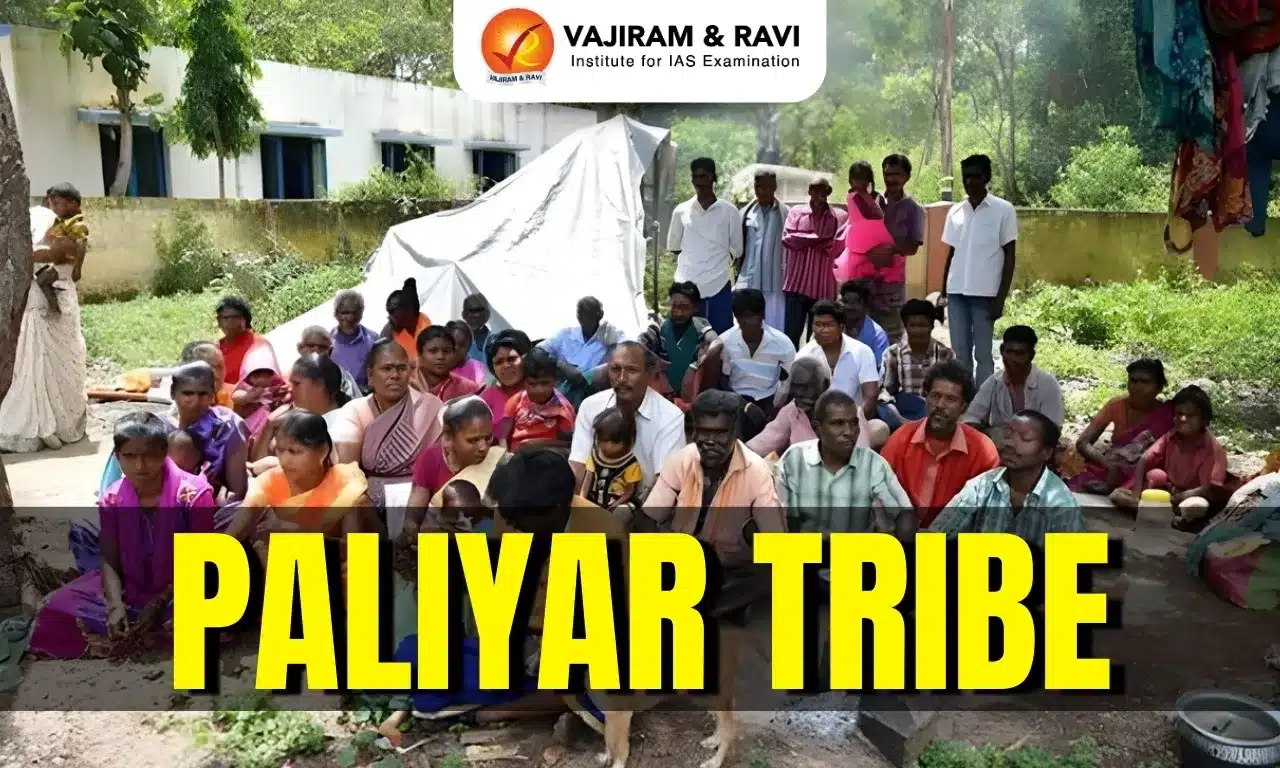
Paliyar Tribe

Paliyar Tribe

Paliyar Tribe Latest News

18 families having patta in Nochiodai, a remote settlement of the Paliyar tribe located 32 km inside the Srivilliputhur-Megamalai Tiger Reserve (SMTR), recently received solar power supply.

About Paliyar Tribe

  • They are one of the many ethnic Dravidian (ethnolinguistic and cultural) tribes in Southern India. 
  • They are a Scheduled Tribe primarily located in the South Western Ghats montane rain forests of Tamil Nadu and eastern Kerala. 
  • They are and have been known by multiple names, such as the Paliyans, Palaiyars, Pazhaiyares, and Panaiyars. 
  • Language: They primarily speak a dialect related to Tamil, reflecting their Dravidian linguistic heritage.
  • Occupation: 
    • Traditionally, the Paliyars were hunters and gatherers.
    • Many have transitioned into traders of forest products, food cultivators, and beekeepers.
    • Some work as wage laborers on plantations or in nearby towns. 
  • Their major source of food is yams.  
  • They are recognized for their extensive knowledge and traditional practices pertaining to the use of medicinal plants.  
  • Palliyars have small communities called kudis, sometimes living in caves or mud shelters. 
  • They bury their dead near their homes.  
  • Their festivals involve nature-based rituals, dancing, and music.
  • They have a special ceremony to invoke rain and protect the forest spirits.

Key Facts about Srivilliputhur-Megamalai Tiger Reserve 

  • It is located in the state of Tamil Nadu.
  • It lies in the ecologically sensitive Western Ghats region.
  • It was formed in February 2021 by combining Grizzled Squirrel Wildlife Sanctuary and Megamalai Wildlife Sanctuary.
  • It functions as a connecting link between Kerala’s Periyar Tiger Reserve and Tamil Nadu’s Southern Kalakkad-Mundanthurai Tiger Reserve.
  • Rivers: The area primarily relies on three perennial rivers: Vaigai, Suruliyaru, and Shanmuganathi.
  • The climate of the reserve is influenced by both the southwest and northeast monsoons.
  • Vegetation: It’s a blend of tropical evergreen and semi-evergreen forests, dry deciduous and moist mixed deciduous woods, and grasslands.
  • Flora: Some notable plant species in the reserve include Teak, Indian Rosewood, Bamboo species, Wild fig trees, Evergreen shrubs, and medicinal plants.
  • Fauna:
    • Mammals: Elephants, Tiger, Leopard, Nilgiri Tahr, Gaur, Spotted Deer, Barking Deer, Sambar Deer, Wild Boar, Porcupine, Nilgiri Langur, Lion-Tailed Macaque, etc.
    • It is particularly celebrated as the last known stronghold of the Grizzled Giant Squirrel (Ratufa macroura), a spectacular arboreal mammal found only in a handful of locations in peninsular India and Sri Lanka. 
    • Birds: Red-Whiskered Bulbul, Common Iora, White-Browed Wagtail, Grey Wagtail, Pied Bush Chat etc.
    • Reptiles: Wood Snake, Monitor Lizard, Chameleon, etc.

News: NIE

Paliyar Tribe FAQs

Q1: Where are the Paliyar Tribe primarily located?

Ans: They are primarily located in the South Western Ghats montane rain forests of Tamil Nadu and eastern Kerala.

Q2: What are some alternative names of the Paliyar tribe?

Ans: Paliyans, Palaiyars, Pazhaiyares and Panaiyars.

Q3: Which language do the Paliyar tribe primarily speak?

Ans: They primarily speak a dialect related to Tamil.

Q4: What is the major source of food for the Paliyars?

Ans: Yams are their major source of food.

Enquire Now