Southern Indian Ocean Fisheries Agreement

Southern Indian Ocean Fisheries Agreement

Southern Indian Ocean Fisheries Agreement Latest News

Recently, the central government has approved India’s accession to the Southern Indian Ocean Fisheries Agreement (SIOFA). 

About Southern Indian Ocean Fisheries Agreement

  • It is an international fishing agreement signed in Rome on 7th July 2006 and entered into force in June 2012.
  • It is aimed at enhancing its role in managing ocean resources and creating opportunities for Indian fishing vessels to operate in the southern Indian Ocean while adhering to international regulations.
  • Objectives
    • To ensure the long-term conservation and sustainable use of the fishery resources in the area through cooperation among the Contracting Parties.
    • To promote the sustainable development of fisheries in the Area
    • The SIOFA Agreement covers fishery resources including fish, molluscs, crustaceans and other sedentary species within the area, but excluding highly migratory species (Annex I of UNCLOS).
  • Structure
    • Meeting of the Parties: It is the governing body of SIOFA and is composed of all the Contracting Parties. It meets at least annually.
    • Scientific Committee: It is a subsidiary body that acts as an advisory body to the Meeting of the Parties. It conducts scientific assessment, encourages and promotes cooperation and provides scientific advice.
    • Secretariat: Implements and coordinates the administrative provisions of the Agreement and maintains records of the proceedings of the Meeting of the Parties and its subsidiary bodies.

India and SIOFA

  • As of now, India is classified as a Cooperating Non-Contracting Party (CNCP) to the SIOFA, which limits its participation in decision-making processes from 2022.
  • Significance to India
    • Accession as a Contracting Party would enable India to participate fully in these bodies and provide access to scientific data, research programmes, and stock assessments.
    • It will open up new fishing opportunities for the Indian fishers and entrepreneurs.
    • India will also play a key role in preserving marine resources, ensuring their long-term viability and supporting the livelihoods of Indian fishing communities.

Source: PIB

Southern Indian Ocean Fisheries Agreement FAQs

Q1: When was Southern Indian Ocean Fisheries Agreement entered into force?

Ans: It entered into force in June 2012.

Q2: What is the aim of Southern Indian Ocean Fisheries Agreement?

Ans: It is aimed at enhancing its role in managing ocean resources and creating opportunities for Indian fishing vessels.

Jeypore Ground Gecko

Jeypore Ground Gecko

Jeypore Ground Gecko  Latest News

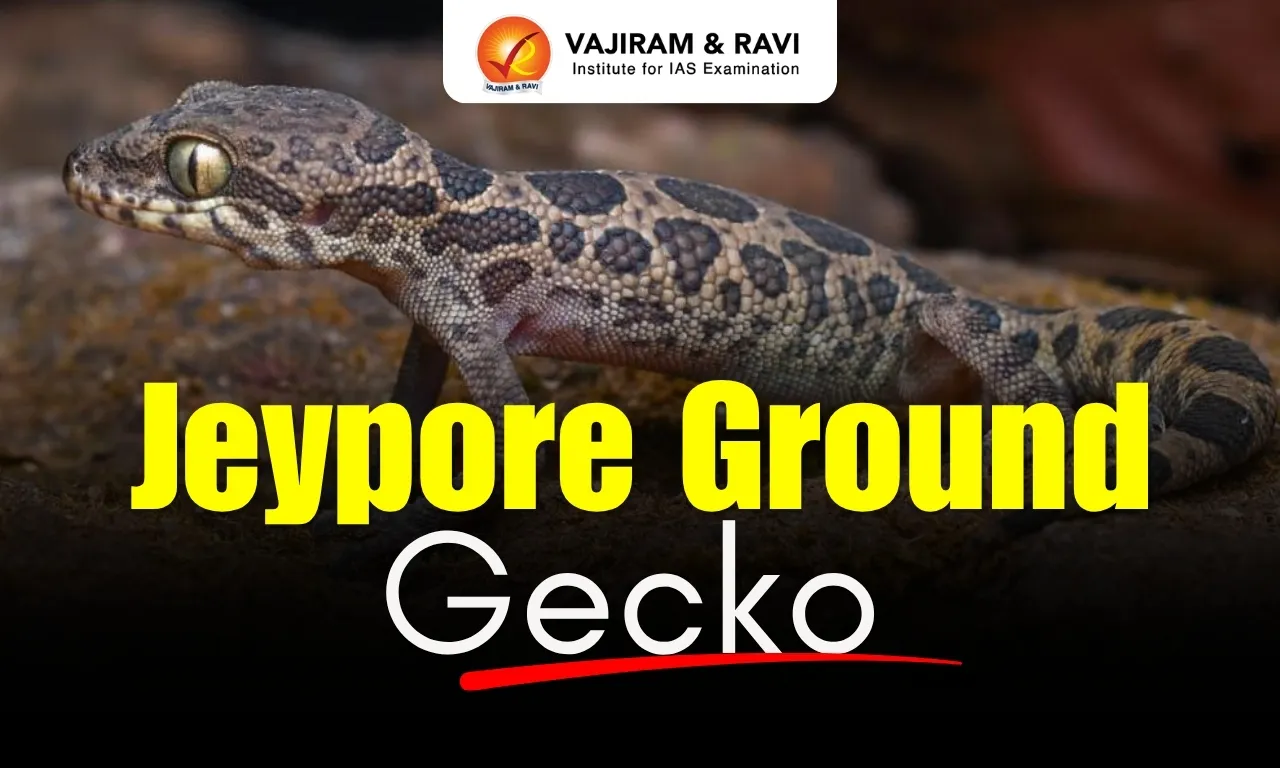
Recently, herpetologists raised concern that a bauxite mining project in Odisha threatens the future of rare Jeypore ground gecko (Cyrtodactylus jeyporensis).

About Jeypore Ground Gecko   

  • It is a reptile found in India.
  • It is also known as the Jeypore Indian gecko or the Patinghe Indian gecko.
  • It was originally described as far back as 1878 by the British naturalist Richard Henry Beddome. 
  • Appearance: The nocturnal gecko, some 3.6 inches long, with a comparatively large head, and a yellow-orange body.
  • Habitat: It inhabits semi-evergreen forests.
  • Distribution: It is a relatively range-restricted species that is only found in high-elevation (900–1,400 metres) forests in the northern Eastern Ghats of southern Odisha and northern Andhra Pradesh. 
  • Threats: Habitat loss and degradation, forest fires, tourism, quarrying and mining activity among the reasons for the species’ decline.
  • Conservation Status
    • IUCN Red List: Endangered
    • CITES: Appendix II

Source: TH

Jeypore Ground Gecko FAQs

Q1: What is Jeypore Ground Gecko ?

Ans: It is a reptile found in India.

Q2: Which is the preferred habitat of Jeypore Ground Gecko ?

Ans: It inhabits semi-evergreen forests.

Magnesium Hydridomethylzincate

Magnesium Hydridomethylzincate

Magnesium Hydridomethylzincate Latest News

Scientists at the Indian Institute of Science Education and Research, Thiruvananthapuram, have developed a chemical compound named magnesium hydridomethylzincate.

About Magnesium Hydridomethylzincate

  • It is a crystalline, hydride-rich organometallic compound that does not rely on bulky supporting ligands.
  • It is a compound of magnesium, zinc, hydrogen, and carbon.
  • Properties
    • Under solvent-free, anaerobic conditions, it releases hydrogen and methane at temperatures as low as 80°C via reductive elimination, leaving behind elemental magnesium and zinc. 
    • When the compound is heated in solution to 100° C, it releases hydrogen.
    • It is solid at room temperature.
    • It is revealed that each unit of the compound’s paired molecular structure could produce two molecules each of hydrogen and methane.
    • It is established that methane emerged before hydrogen, indicating the compound was releasing the gases through successive chemical reactions.
  • Potential Applications
    • This organometallic compound could potentially provide molecular platforms for the storage and controlled release of fuel gases.
    • It could offer an alternative to transporting methane and hydrogen as compressed gases.

Source: TH

Magnesium Hydridomethylzincate FAQs

Q1: What is Magnesium Hydridomethylzincate?

Ans: It is a crystalline, hydride-rich organometallic compound that does not rely on bulky supporting ligands.

Q2: What is the application of Magnesium Hydridomethylzincate?

Ans: It could potentially provide molecular platforms for the storage and controlled release of fuel gases.

Combined Task Force 154

Combined Task Force 154

Combined Task Force 154 Latest News

The Indian Navy is scheduled to hand over command of Combined Task Force 154 (CTF 154) at a ceremony in Manama, Bahrain. 

About Combined Task Force 154

  • It is the Combined Maritime Forces’ (CMF) dedicated multinational maritime training task force.
  • It was established in May 2023.
  • It is dedicated to enhancing maritime security through multinational training programs across the Middle East and the wider region.
  • It operates alongside CMF’s other task forces: CTF 150 (Maritime Security), CTF 151 (Counter-Piracy), CTF 152 (Maritime Security in Arabian Gulf) and CTF 153 (Maritime Security in Red Sea).
  • Training: The training focuses on five core pillars: Maritime Domain Awareness (MDA), Law of the Sea, Maritime Interdiction Operations, Maritime Rescue and Assistance, and Leadership Development.
  • It focuses on professional training and capacity building to strengthen interoperability and operational readiness among the 47 nations associated with the maritime partnership.
  • CTF 154 trains partner navies and improves operational capabilities to enhance maritime security in the Middle East.
  • India joined the Combined Maritime Forces as an associate partner in 2022 and became a full member in 2023.

Source: DD News

Combined Task Force 154 FAQs

Q1: What is Combined Task Force 154 ?

Ans: It is the Combined Maritime Forces’ (CMF) dedicated multinational maritime training task force.

Q2: What is the role of Combined Task Force 154 ?

Ans: It is dedicated to enhancing maritime security through multinational training programs across the Middle East and the wider region.

Soybean Cultivation

Soybean Cultivation

Soybean Cultivation Latest News

Recently, the ICAR–National Soybean Research Institute (ICAR-NSRI) in Indore assessed the yield potential of improved soybean varieties NRC 268 and NRC 270. 

About Soybean 

  • Soybean, (Glycine max), sometimes called soja bean, is an annual legume of the pea family (Fabaceae). 
  • In agriculture, soybean enhances soil fertility through nitrogen fixation.
  • It is a major crop cultivated during the kharif season (July-October) in the rainfed (dryland) areas of central and peninsular India.
  • Required Climatic Conditions for Soybean
    • Climate: Soybean grows well in warm and moist climate.
    • Temperature: A temperature of 26.5 to 30°C appears to be the optimum for most of the varieties.
    • Rainfall: Soybean is highly sensitive to water stress, particularly during critical growth phases such as flowering, pod development, and seed filling.
    • Soil: Well drained and fertile loam soils with a pH between 6.0 and 7.5
  • Major Soyabean Growing States: Madhya Pradesh, Maharashtra, Rajasthan, Karnataka, Chhattisgarh, Telangana, Karnataka and Chhattisgarh.

Source: PIB

Soybean Cultivation FAQs

Q1: What is Soybean ?

Ans: Soybean, (Glycine max), sometimes called soja bean, is an annual legume of the pea family (Fabaceae). 

Q2: What is the environmental role of Soybean ?

Ans: In agriculture, soybean enhances soil fertility through nitrogen fixation.

Measles

Key Facts about Measles

Measles  Latest News

Recently, one death due to measles, 161 confirmed cases have been reported in Kozhikode district so far this year. 

About Measles    

  • It is a highly contagious, serious airborne disease caused by a virus.
  • Cause: It is caused by a virus in the paramyxovirus family.
  • Transmission of Measles
    • It spreads by contact with infected nasal or throat secretions (coughing or sneezing) or breathing the air that was breathed by someone with measles. 
    • The virus remains active and contagious in the air or on infected surfaces for up to two hours. 
    • The virus infects the respiratory tract, then spreads throughout the body, causing severe disease, complications, and even death.

Symptoms of Measles

  • The first sign of measles is usually high fever, beginning about 10 to 14 days after exposure to the virus and lasting four to seven days.
  • A runny nose, cough, red and watery eyes, and small white spots inside the cheeks can develop in the initial stage.
  • A rash erupts after several days, usually on the face and upper neck.

Treatment for Measles

  • No specific antiviral treatment exists for measles.
  • It can be prevented with a safe and effective measles-rubella (MR) vaccine that gives long-term immunity.

Source: TH

Measles FAQs

Q1: What is Measles ?

Ans: It is a highly contagious, serious airborne disease.

Q2: What is the cause for Measles ?

Ans: It is caused by a virus in the paramyxovirus family.

Trishna Wildlife Sanctuary

Trishna Wildlife Sanctuary

Trishna Wildlife Sanctuary Latest News

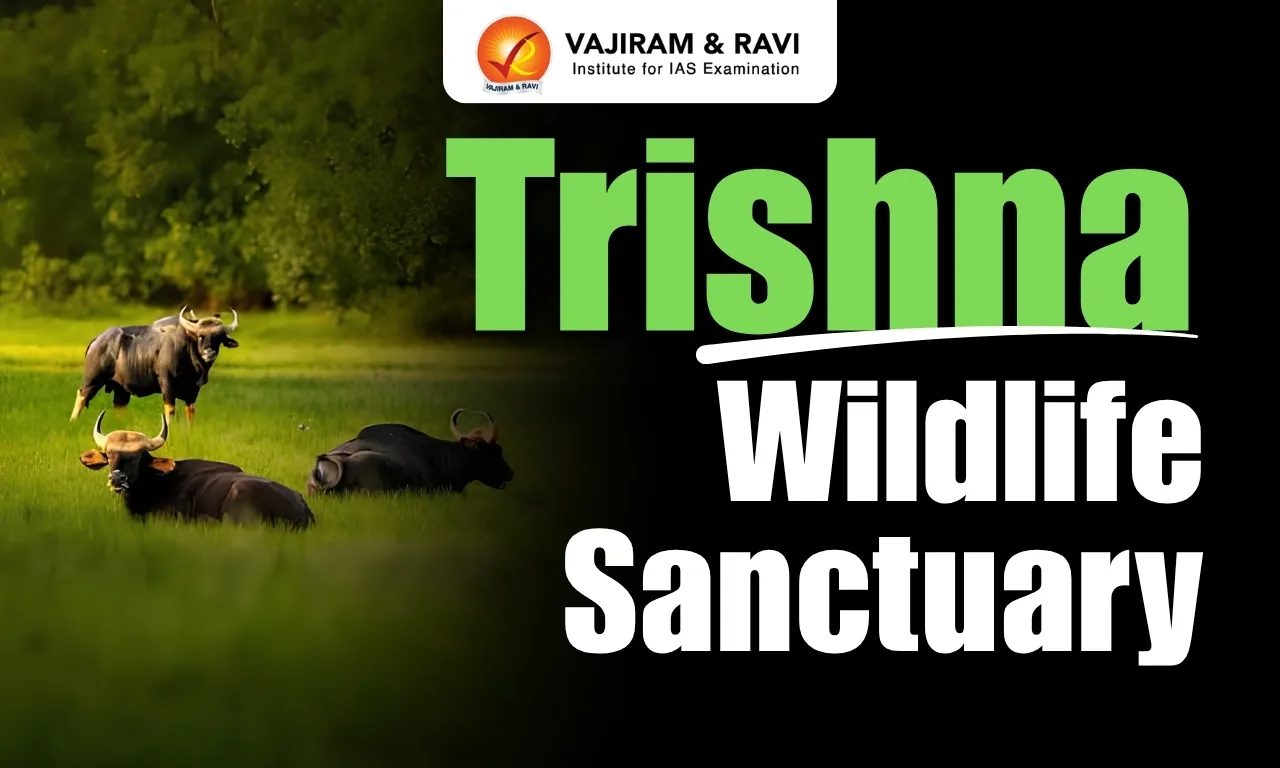
Recently, a rare sighting of Phayre’s Leaf Monkeys, popularly known as Spectacle Monkeys, has been captured on camera at Trishna Wildlife Sanctuary in South Tripura. 

About Trishna Wildlife Sanctuary

  • Location: It is situated in the state of Tripura.
  • It was established in 1988. 
  • Vegetation: Three types of forests are found in the Sanctuary: Tropical Semi evergreen Forest, Moist Mixed Deciduous Forest, and Savanah woodland. 
  • Flora: It is home to 230 tree species, 400 herbs, 110 shrubs, and 150 climbers. 
    • Some of the prominent medicinal plant species are Kurcha, Tulsi, Vasak, Sarpaganda, Rudraksha, Bel, etc.
    • One species of Bamboo Oxytenanthera nigrociliata, locally known as Kaillai, is common here
  • Fauna: It is home to Gaur or Indian Bison and to highly endangered only ape species of the Indian subcontinent i.e, the Hoolock Gibbon, and primates like Capped Langur and Golden Langur.

Key Facts about Phayre’s Leaf Monkey

  • It is a distinctive primate recognised by the pale markings around its eyes, which resemble a pair of spectacles.
  • Its characteristic appearance has earned it the popular name Spectacle Monkey.
  • Behavior: The species is primarily arboreal, spending much of its time in trees, where it feeds mainly on leaves and other plant matter.
  • Conservation Status: IUCN Red List: Endangered
  • Threats: Habitat destruction, forest degradation, fragmentation and other human-induced pressures are among the major challenges facing its survival.

Source: TI

Trishna Wildlife Sanctuary FAQs

Q1: Whaere is Trishna Wildlife Sanctuary located?

Ans: Tripura

Q2: What type of vegetation is found in Trishna Wildlife Sanctuary?

Ans: Tropical Semi evergreen Forest, Moist Mixed Deciduous Forest, and Savanah woodland. 

Alpine Musk Deer

Alpine Musk Deer

Alpine Musk Deer Latest News

A recent report said that the alpine musk deer faces mounting conservation concerns, with India’s recognised zoos reporting just two living captive Himalayan musk deer—both male—and no females. 

About Alpine Musk Deer

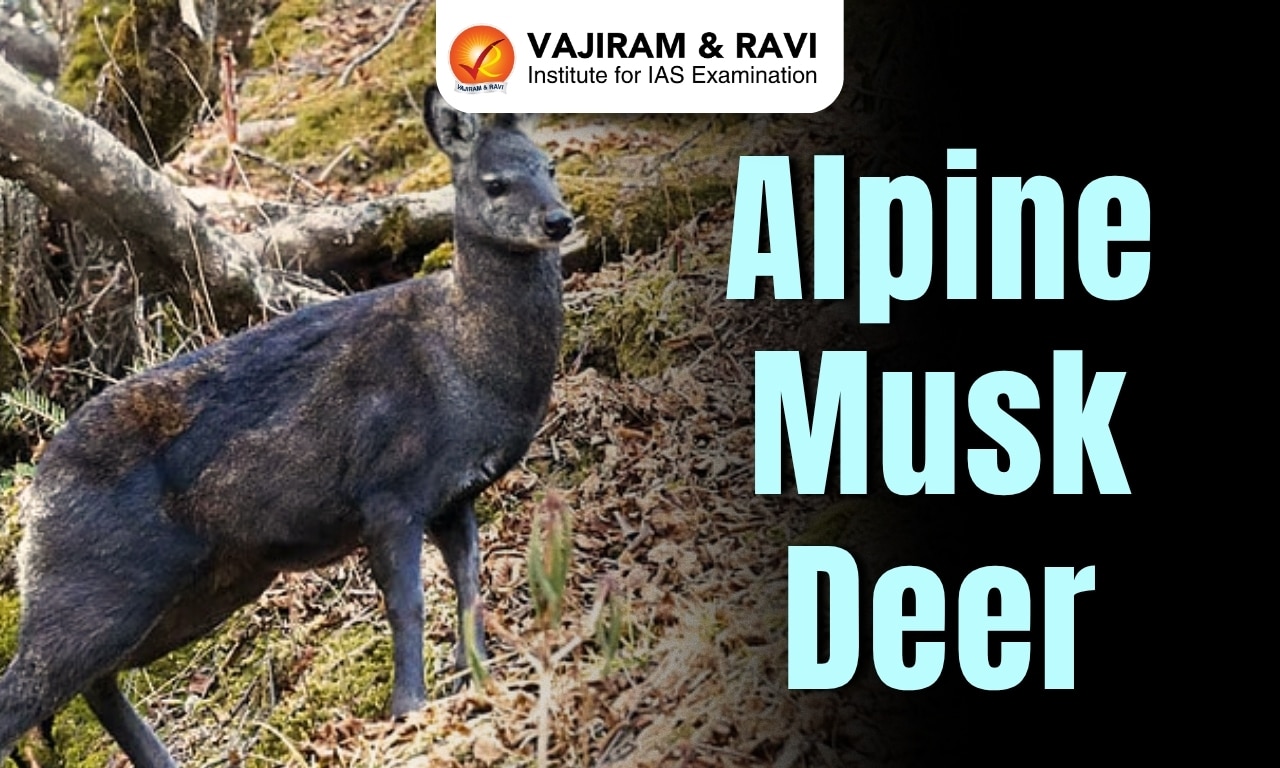
  • The Alpine musk deer (Moschus chrysogaster) is a musk deer species found only in Asia.
  • It is not a true deer, but rather its family is closely related to Bovidae, the group that contains antelopes, bovines, sheep, and goats.
  • Alpine musk deer are named for having an externally visible musk sac between the male testes. Its fangs grow during mating season and are used for sparring with other males.
  • Habitat: It inhabits coniferous and deciduous forests in the mountain regions at elevations of 3,000–5,000 m.
  • Distribution: It is mainly found in India, Nepal, Bhutan and China.
  • Characteristics
    • Behavior: It is generally solitary and a crepuscular animal.
    • Diet: It is a ruminant herbivore, foremost a browser and feeds mainly on forbs, grasses, moss, lichens, and shoots, leaves and twigs of shrubs.
  • Threats: The main threat to the Alpine musk deer is poaching for its musk, which is used in cosmetic products.

Conservation Status of Alpine Musk Deer

Source: NIE

Alpine Musk Deer FAQs

Q1: What is Alpine Musk Deer?

Ans: The Alpine musk deer (Moschus chrysogaster) is a musk deer species found only in Asia.

Q2: Where do we find Alpine Musk Deer?

Ans: It is mainly found in India, Nepal, Bhutan and China.

Brunei

Brunei

Brunei Latest News

Recently, the third meeting of the India–Brunei Darussalam Joint Trade Committee (JTC) was convened to review bilateral trade and economic cooperation and identify avenues for strengthening commercial ties between the two countries.  

About Brunei

  • Location: It is located along the northern coast of Borneo Island in Southeast Asia.
  • Bordered by: Brunei is bordered by the South China Sea in the north and on all other sides by Malaysia.
  • Brunei is divided into two non-contiguous parts by a portion of the Malaysian State of Sarawak.
  • Capital: Bander Seri Begawan
  • It is a member country of the Commonwealth and ASEAN.

Geographical Features of Brunei

  • Terrain: It consists of flat coastal plain rises to mountains in the east; hilly lowland in the west.
  • Climate: The climate of Brunei (or Brunei Darussalam) is equatorial, i.e. hot, humid and rainy throughout the year. 
  • Mountain: Bukit Pagon is the highest point in the country at 6,069 ft along the border with Malaysia in the eastern mountainous region.
  • Rivers: Numerous rivers drain the land, including the Belait, Pandaruan, and Tutong.
  • Natural Resources: It mainly consists of crude oil, natural gas, and tropical timber.

Source: PIB

Brunei FAQs

Q1: What is the capital city of Brunei ?

Ans: Bander Seri Begawan

Q2: Which rivers flows in Brunei ?

Ans: Belait, Pandaruan, and Tutong.

Enquire Now