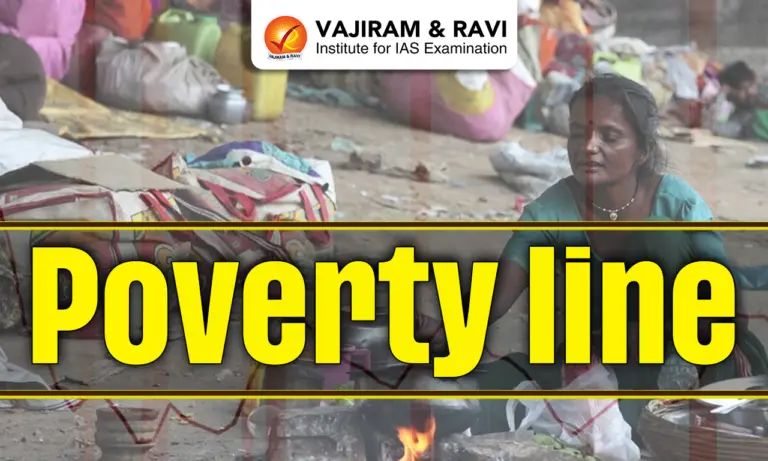
The Poverty Line is a basic economic concept used to identify the minimum level of income needed for an individual or family to meet essential needs such as food, clothing, shelter, education, and healthcare. It serves as a benchmark to distinguish between the poor and non-poor in a society. The poverty line helps governments and policymakers measure poverty, design welfare programmes, and assess the effectiveness of poverty reduction efforts over time.
About Poverty Line
- The poverty line is a way to measure the minimum income a person or family needs to meet their basic needs like food, clothing, shelter, education, and healthcare. It helps to understand whether a person is able to afford a basic standard of living or not.
- If a family earns less than this minimum amount, they are considered to be living below the poverty line. Such families are usually seen as financially weak and may require support from the government.
- When people fall below the poverty line, they may become eligible for government welfare schemes such as food support, housing assistance, healthcare benefits, and employment programmes.
- The poverty line is not the same in every country. Each country decides it based on its own cost of living, including expenses like rent, food prices, transport, and other daily needs.
- If a person’s income is above the poverty line, it is assumed that they can manage essential needs like food, clothing, shelter, medicine, and basic services without external help.
Methods of Measuring Poverty Line in India
- In India, the poverty line is fixed by the Planning Commission (earlier) using data from the National Sample Survey Organisation (NSSO). This data is collected through regular surveys that study how much money people spend on daily needs.
- These surveys are usually conducted every five years and are based on household consumption rather than income. This means they look at how much people spend on goods and services instead of how much they earn.
- To calculate the poverty line, India uses something called a “poverty line basket” (PLB). This basket includes basic items needed for survival such as food, clothing, fuel, rent, transport, education, and health-related expenses.
- Earlier, the PLB was designed mainly on calorie intake needs, such as around 2400 calories in rural areas and 2100 calories in urban areas. Over time, this approach has changed as basic needs have expanded beyond just food.
- The cost of the items in the PLB is calculated based on average prices in the country, which helps decide the minimum monthly or daily spending required to live at a basic standard.
- In India, poverty lines are different for rural and urban areas because living costs are not the same. For example, earlier estimates were around ₹781 per month (rural) and ₹965 per month (urban), showing how low the official minimum standard was.
- There are two main survey methods: Uniform Reference Period (URP) and Mixed Reference Period (MRP). URP asks about spending in the last 30 days, while MRP includes both 30-day and 1-year consumption data, making it more accurate.
- Over time, expert committees have suggested changes in measurement. The Tendulkar Committee (2009) recommended shifting from calorie-based measurement to nutritional outcomes and including health and education costs more clearly.
- The Tendulkar method showed higher poverty levels compared to older methods, which led to debate because it suggested that more people were poor than earlier official estimates.


Poverty Line Estimation Committees in India
- Alagh Committee (1979)
- The Alagh Committee (1979) was one of the earliest committees in India to formally define the poverty line in a systematic way.
- It suggested that poverty should be measured based on minimum nutritional requirements, focusing mainly on food intake needed for survival.
- It fixed the basic calorie needs at around 2400 calories per person per day in rural areas and 2100 calories in urban areas, recognising that rural people need more energy due to physical labour.
- Based on these calorie norms, it worked out a minimum level of spending required to meet basic food needs, which became the foundation for India’s early poverty line estimates.
- Lakdawala Committee (1993)
- The Lakdawala Committee (1993) improved the earlier method by focusing more on actual consumption patterns and price changes instead of only calorie intake.
- It recommended that poverty should be measured using consumption expenditure data collected by the NSSO (National Sample Survey Organisation), making the process more data-driven.
- To adjust poverty lines for inflation, it suggested using CPI-AL (Consumer Price Index for Agricultural Labourers) for rural areas and CPI-IW (Consumer Price Index for Industrial Workers) for urban areas.
- It also introduced the idea of creating state-specific poverty lines, since prices of goods and services vary across different states in India.
- Tendulkar Committee (2009)
- The Tendulkar Committee (2009) brought a major shift in how poverty was measured in India.
- It moved away from the earlier pure calorie-based approach and introduced a more comprehensive “Poverty Line Basket (PLB)”, which included not just food but also basic non-food needs.
- It included important expenses like healthcare, education, clothing, and other essential services, recognising that poverty is not only about hunger but also access to basic human development needs.
- It recommended using a uniform poverty basket for both rural and urban areas, but allowed different monetary values because of cost differences.
- According to its estimates for 2011-12, the poverty line was around ₹816 per month in rural areas (about ₹27/day) and ₹1,000 per month in urban areas (about ₹33/day).
- Based on this method, about 21.9% of India’s population (nearly 26.9 crore people) was estimated to be below the poverty line, with higher poverty in rural areas.
- Rangarajan Committee (2014)
- The Rangarajan Committee (2014) was set up to review and improve the Tendulkar Committee’s approach because many experts felt it underestimated real poverty levels.
- It suggested a broader consumption basket and slightly higher minimum expenditure levels to better reflect real living costs.
- According to its estimates, the poverty line was about ₹972 per month in rural areas (around ₹32/day) and ₹1,407 per month in urban areas (around ₹47/day).
- Using this method, it estimated that around 29.5% of India’s population in 2011-12 was below the poverty line, which was significantly higher than the Tendulkar estimate.
- However, the government did not officially accept this report, so the Tendulkar Committee’s estimates remained the last official poverty figures used for policy for a long time.
International Poverty Line by World Bank
- The World Bank international poverty line is a global standard used to measure extreme poverty across countries. As of June 2025, it has been updated to $3.00 per person per day, based on 2021 Purchasing Power Parity (PPP) data. This replaces the earlier $2.15 (2017 PPP) line.
- This means that anyone living on less than $3 a day is considered to be in extreme poverty according to the latest global standard. The update reflects changes in prices and cost of living, especially in low-income countries.
- The main reason for this revision is updated global price data from the International Comparison Program (ICP), which collects information on how much goods and services cost in different countries. This helps convert currencies into a common comparison unit using PPP (Purchasing Power Parity).
- With rising prices and inflation in many low-income countries, the cost of meeting basic needs like food, clothing, and shelter has increased, which led to the revision of the poverty line.
- Based on this new standard, it is estimated that around 831 million people worldwide are living in extreme poverty, showing that poverty remains a major global challenge.
- Apart from the extreme poverty line, the World Bank also uses other income levels for better comparison:
- $4.20 per day for lower-middle-income countries
- $8.30 per day for upper-middle-income countries
- These additional poverty lines help in understanding poverty in countries where living standards are higher than the poorest nations, but where many people are still struggling to meet basic needs.
- The World Bank also uses a societal poverty line, which adjusts with a country’s income level, meaning that as a country becomes richer, the definition of poverty also becomes stricter.
- Another important concept is the Multidimensional Poverty Measure, which looks beyond income and includes factors like education, health, and living conditions, giving a broader understanding of poverty.
- These global poverty measures are widely used to track progress towards international goals like the Sustainable Development Goals, which aim to reduce extreme poverty worldwide.
- They are also useful for comparing countries and monitoring global poverty trends, helping organisations like the World Bank and United Nations design global development policies.
- For understanding poverty within a specific country, the national poverty line is more appropriate, as it is designed according to local prices, consumption patterns, and living standards.
- The World Bank regularly updates its poverty estimates whenever new global price data becomes available. The latest update is based on 2021 price data, released in 2024, which is now being used for global poverty calculations.
- Earlier methods of measuring poverty have not changed, but the data and price adjustments are updated regularly to make estimates more accurate and realistic.
- With the 2025 update, changes in price levels, revised poverty lines, and new household survey data (including data from countries like India) have all affected global poverty estimates.
- As a result, global extreme poverty estimates have increased by about 125 million people, meaning more people are now classified as poor under the updated standard.
- Region-wise impacts also vary:
- In South Asia, about 45 million fewer people are now estimated to be in extreme poverty.
- In Sub-Saharan Africa, around 111 million more people are now considered extremely poor due to revised calculations.
Multidimensional Poverty Index (MPI)
- Meaning of Multidimensional Poverty
- Multidimensional poverty means looking at poverty in a broader way, not just through income, but by considering many different aspects of life.
- It includes the idea that a person is poor if they face multiple deprivations in daily living, not only if they earn less money.
- These deprivations can include poor health, lack of education, low-quality living conditions, unemployment or poor jobs, and even lack of safety or exposure to violence.
- Measurement of Multidimensional Poverty
- Multidimensional poverty is measured using the Multidimensional Poverty Index (MPI), which checks poverty at the individual level rather than just households or income levels.
- The most commonly used method to calculate MPI is the Alkire-Foster Method, which combines different indicators of deprivation into one index.
- Global Multidimensional Poverty Index (GMPI)
- The Global MPI (GMPI) is an internationally recognised measure developed by the Oxford Poverty and Human Development Initiative (OPHI) and the United Nations Development Programme (UNDP) since 2010.
- It covers around 100 developing countries and focuses on three major areas: health, education, and living standards.
- A person is considered MPI poor if they are deprived in at least one-third of 10 weighted indicators.
- These indicators capture multiple hardships at the same time, such as malnutrition, lack of schooling, poor housing, and lack of basic facilities.
- National Multidimensional Poverty Index (NMPI – India)
- India has developed its own version called the National MPI (NMPI), which follows the global model but is adjusted to suit Indian conditions.
- It keeps the original 10 indicators and adds two more important indicators: Maternal Health and Bank Account access, reflecting India’s policy priorities.
- The NMPI is calculated using two main parts:
- Headcount Ratio (H): the percentage of people who are multidimensionally poor.
- Intensity of Poverty (A): how many deprivations, on average, a poor person suffers.
- The final MPI value is a combination of both how many people are poor and how poor they are, giving a fuller picture of deprivation.
- In India, NITI Aayog is responsible for measuring MPI under the Global Indices for Reforms and Growth (GIRG) framework.
- The data used comes from the National Family Health Survey (NFHS), and the latest report is based on NFHS-4 and NFHS-5.
- Key Findings from Recent MPI Report
- India has seen a strong decline in multidimensional poverty, with the poverty headcount falling from 29.17% in 2013-14 to 11.28% in 2022-23.
- Around 24.82 crore people have moved out of multidimensional poverty in the last 9 years, showing major improvement in living conditions.
- Not only has the number of poor reduced, but the intensity of poverty has also decreased, meaning people who are still poor are experiencing fewer deprivations than before.
- All 12 indicators of MPI have shown improvement, especially in areas like electricity access, sanitation, and housing conditions.
- The highest levels of deprivation are still seen in cooking fuel and housing, while the lowest are in bank accounts, electricity, and child mortality.
- States like Uttar Pradesh, Bihar, Madhya Pradesh, Odisha, and Rajasthan have shown the fastest decline in poverty levels.
- India is considered on track to achieve SDG Target 1.2, which aims to reduce multidimensional poverty by at least half before 2030.
- Government schemes like PM Ujjwala Yojana, Saubhagya, Swachh Bharat Mission, and Jal Jeevan Mission have played a major role in improving living conditions.
- Importance of NMPI
- NMPI provides a more detailed and realistic understanding of poverty, as it looks beyond income and includes multiple aspects of life.
- It helps identify poverty even at the district and regional level, making it more useful for targeted planning.
- It allows governments to design focused welfare programmes for the most deprived groups.
- It captures overlapping disadvantages, such as when a person lacks both education and healthcare, affecting overall well-being.
- Limitations of NMPI
- The MPI may sometimes be less sensitive, because a person must be deprived in at least one-third of indicators to be classified as poor.
- This rule can miss people who are slightly below the threshold but still struggling in real life.
- Some experts argue that it does not fully capture the impact of events like the COVID-19 pandemic, especially job losses and health system stress.
- It may also not reflect issues like stagnant wages and changing consumption patterns, which can affect living standards even if MPI shows improvement.
Challenges in Defining Poverty Line
- Narrow focus on income/consumption: The poverty line mainly uses consumption expenditure, so it does not fully reflect other aspects of poverty like health, education, sanitation, and living conditions.
- Does not show real living conditions: It often fails to capture the actual hardships of daily life, such as poor housing quality, lack of clean water, or job insecurity.
- Issues with Poverty Line Basket (PLB): The selection of goods and services in the PLB is difficult because prices of essentials vary widely across states, regions, and time periods.
- Ignores regional differences: A single national poverty line does not properly reflect differences in cost of living between rural areas, small towns, and big cities.
- Excludes near-poor population: People who are just above the poverty line but still struggling are not counted, even though they may face serious economic difficulties.
- Limited focus on vulnerable groups: It does not specifically highlight the conditions of women, children, elderly, and disabled people, who often face deeper disadvantages.
- No impact of sudden shocks: It does not account for unexpected events like job loss, illness, disasters, or pandemics that can push families into poverty.
- Static and delayed updates: Poverty lines are not updated frequently, so they may not reflect current inflation and changing living standards.
- Minimal standard of living approach: It measures only basic survival needs, not a dignified or adequate standard of living.
Significance of Poverty Line in Policy Making
- Measuring the extent of poverty: The poverty line provides a clear way to estimate how many people are poor in the country. It helps convert poverty from a general idea into a measurable figure (headcount ratio), which shows the scale of the problem.
- Understanding progress over time: By comparing poverty data across different years, the government can check whether poverty is increasing or decreasing. A fall in the number of people below the poverty line indicates that welfare policies and economic growth are making a positive impact.
- Helping in targeted welfare delivery: One of the most important uses of the poverty line is in identifying Below Poverty Line (BPL) households. This ensures that government benefits reach the right people through schemes like:
- PDS (Public Distribution System): Subsidised food grains under the National Food Security Act (NFSA)
- PM Awas Yojana (PMAY): Affordable housing for poor families
- VB-G RAM G: Employment support for rural households, especially the most vulnerable
- NSAP pensions: Financial support for elderly, widows, and disabled persons
- Ayushman Bharat: Health insurance for poor and vulnerable families
- Supporting inclusive economic growth: The poverty line helps evaluate whether economic growth is benefiting all sections of society or only a few. If GDP grows but poverty does not reduce, it shows that growth is not inclusive or not reaching the poor.
- Guiding government planning and budgeting: Poverty estimates help the government design budgets and allocate resources more effectively. It ensures that more funds are directed towards poverty alleviation and social welfare programmes.
- Helping in policy evaluation: It acts as a tool to judge the success of various government schemes. If poverty levels decline after implementing a programme, it suggests that the policy is effective and impactful.
- Supporting constitutional goals: Although the Constitution does not directly mention the poverty line, it aligns with the Directive Principles of State Policy, which aim to create a society based on social, economic, and political justice.

 Last updated on Oct, 2026
→ UPSC 2027 Notification will be released on 13 January 2027 at upsconline.nic.in.
→ Check Nobel Prize 2026 Winners List here.
→ Download PIB PRiSM Monthly Magazine 2026 here.
→ Check UPSC Monthly Current Affairs Magazine The Recitals here.
→ Check out the latest UPSC Syllabus here.
→ Download UPSC Model Answers for Mains 2026
→ UPSC Mains Question Paper 2026 is out now for Essay & GS Paper 1, 2, 3 & 4.
→ UPSC Calendar 2027 has been released.
→ Enroll in Vajiram & Ravi’s UPSC Mains Test Series 2027 for structured answer writing practice, expert evaluation, and exam-oriented feedback.
→ Join Vajiram & Ravi’s UPSC Mentorship Program 2027 for personalized guidance, strategy planning, and one-to-one support from experienced mentors.
→ Go through the UPSC Mains Previous Year Papers to enhance your preparation.
→ UPSC has released UPSC Toppers List 2025 with the Civil Services final result on its official website.
→ Also check Best UPSC Coaching in India
Poverty Line FAQs
Q1. What is the Poverty Line?+
Q2. How is poverty measured in India?+
Q3. What are the major poverty estimation committees in India?+
Q4. What is the difference between the national and international Poverty Line?+
Q5. What is the Multidimensional Poverty Index (MPI)?+
Tags: indian society indian society notes poverty line