Murud-Janjira Fort

Murud-Janjira Fort

Murud-Janjira Fort Latest News

Months after being closed during the monsoon for safety and cleaning work, the historic Murud Janjira Fort in Maharashtra's Raigad district has finally reopened to visitors recently.

About Murud-Janjira Fort

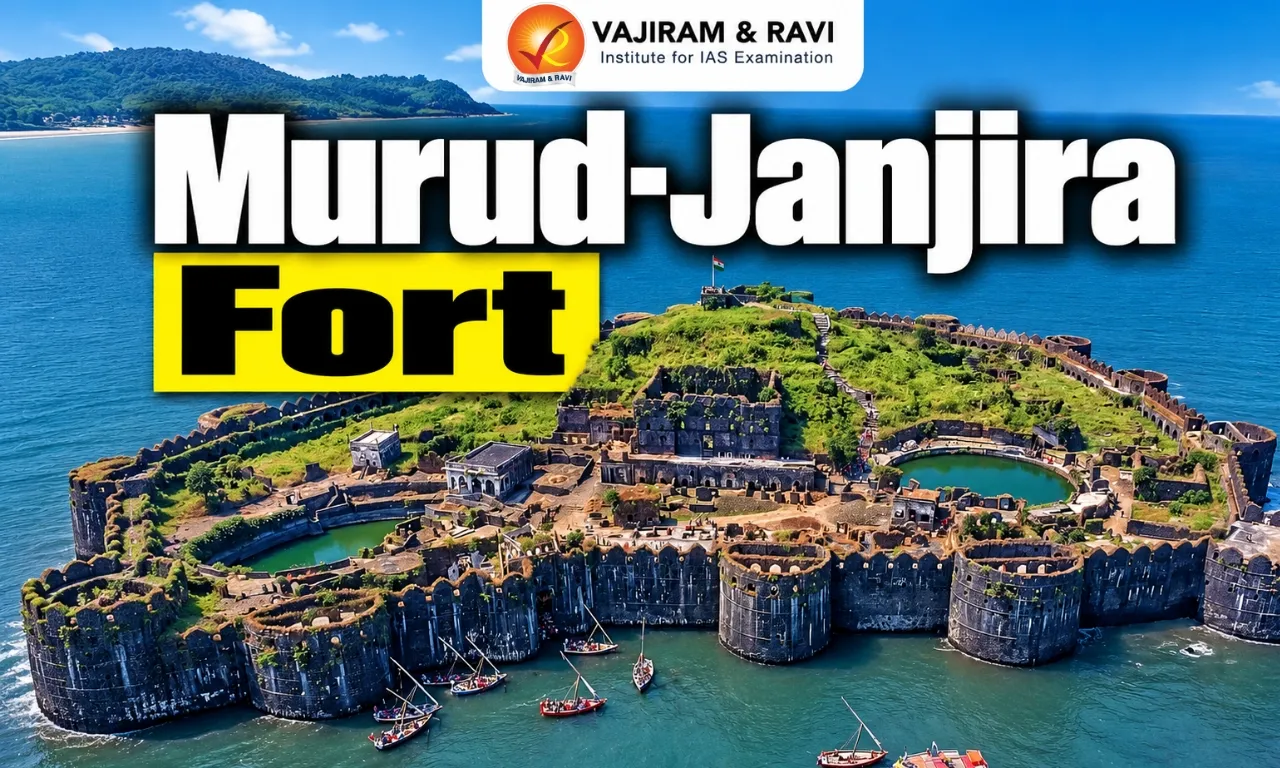
  • It is an island fort located on an island off the coastal village of Murud, in the Raigad district of Maharashtra. 
  • It is surrounded by the Arabian Sea on all sides and is one of the strongest marine forts of India.  

Murud-Janjira Fort History

  • The history of Murud Janjira Fort dates back to the 15th century, when the Siddi rulers established a powerful naval base along Maharashtra's western coast.
  • The Siddis were the rulers of Murud-Janjira. They were people of African origin who had come to India many centuries ago. 
  • The name "Janjira" is believed to have originated from the Arabic word "Jazeera," meaning island.
  • Initially constructed as a small wooden fort by local fishermen, it was later rebuilt into a massive stone fortress under the Siddis. 
  • The fort’s strategic location on the bustling maritime trade route connecting Broach, Daman, Diu, and Mangalore made it a vital hub for commerce and military operations. 
  • Over the centuries, Siddi alignment with Mughals provoked conflict with local kings, including Shivaji and his son Sambhaji, who attempted to scale the walls and tunnel to it, respectively. 
  • However, no outsider (including British, French, and Portuguese colonists) ever made it past the fort’s 12 m-high granite walls, which, when seen during high tide, seem to rise straight from the sea. 
  • Despite numerous attempts, its defenses remained unbreached, earning it the moniker “Unconquerable Janjira.” 

Murud-Janjira Fort Architecture

  • The structure is built on a rock outcrop and has 26 massive bastions and high protective walls.
  • The fort was made by a mixture of lead, sand, and gul. 
  • The main gate of the fort facing Rajapuri on the shore is a huge structure. There is a small gate towards the open sea to escape from the enemies. 
  • Once it stood firm and robust in defence with 572 roaring cannons, only a few of the large cannons remain in place today, and the largest of them is known as the Kalaal Bangdi. 
  • Earlier the fort was a full-fledged living place with all the necessary facilities like palaces, quarters for officers, a mosque, two small 18 m natural freshwater lakes, etc. 
  • There is also a deep well with cold and sweet water, a wonder of nature in the midst of the sea.  

News: MD

Murud-Janjira Fort FAQs

Q1: Where is Murud-Janjira Fort located?

Ans: Murud-Janjira Fort is located on an island off the coastal village of Murud in Maharashtra’s Raigad district.

Q2: Who were the traditional rulers of Murud-Janjira Fort?

Ans: The Siddi rulers were the traditional rulers of Murud-Janjira Fort.

Q3: Why was Murud-Janjira Fort strategically important?

Ans: Its location along a busy maritime trade route made it important for commerce and military operations.

Q4: Which Maratha rulers attempted to capture Murud-Janjira Fort?

Ans: Chhatrapati Shivaji Maharaj and his son Sambhaji attempted to capture the fort.
Kailadevi Wildlife Sanctuary

Kailadevi Wildlife Sanctuary

Kailadevi Wildlife Sanctuary Latest News

A new study by WWF-India, in collaboration with the Rajasthan Forest Department, highlights Kailadevi Wildlife Sanctuary as a key stronghold for wildlife conservation and tiger recovery in Rajasthan. 

About Kailadevi Wildlife Sanctuary

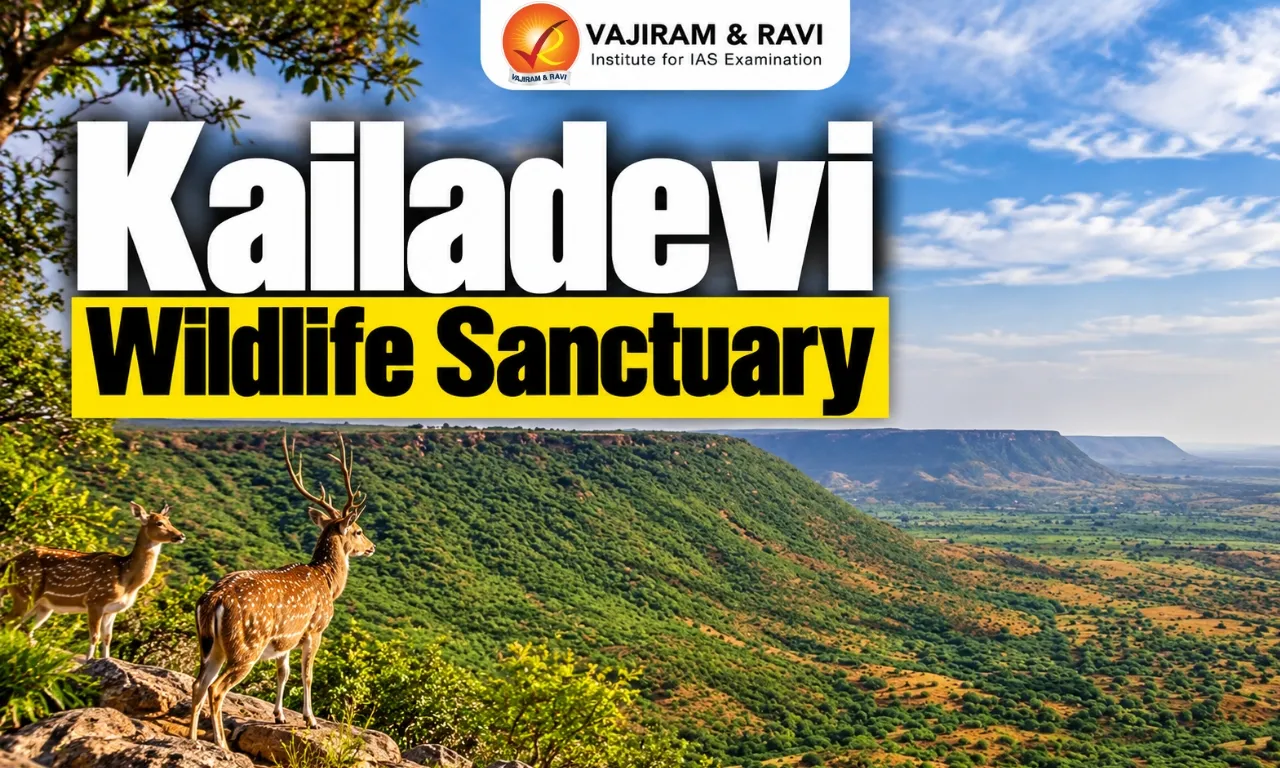
  • It is located in the Karauli district of Rajasthan. 
  • It spans about 674 sq.km. and was established in 1983.  
  • It serves as a northern extension and buffer zone of the Ranthambore Tiger Reserve, acting as a wildlife corridor connecting Ranthambore to the Chambal region. 
  • It is geographically characterized by rugged hills, deep gorges (locally referred to as khos), and dry deciduous forests, with the Banas River on its western edge and the Chambal River to the southeast. 
  • The sanctuary is also culturally significant due to the Kaila Devi Temple within its boundary, attracting many pilgrims.  
  • It has become a popular reference among environmentalists and conservationists for the community-initiated forest protection committees (referred to as kulhadi bandh panchayats) that are operational in the area. 
    • These forest protection committees prevent the carrying of axes into the forests, a symbol of protecting the forests.  
  • Flora: The forest vegetation mainly comprises species like dhok, khair, and tendu trees.  
  • Fauna: Its rich wildlife includes Bengal tigers, leopards, sloth bears, Indian grey wolves, striped hyenas, jackals, nilgai, chinkara, sambar, chital, and over 200 species of birds such as kingfishers and peafowl. 

News: WWF

Kailadevi Wildlife Sanctuary FAQs

Q1: In which state is Kailadevi Wildlife Sanctuary located?

Ans: Kailadevi Wildlife Sanctuary is located in Rajasthan.

Q2: Kailadevi Wildlife Sanctuary serves as a northern extension and buffer zone of which tiger reserve?

Ans: It serves as a northern extension and buffer zone of Ranthambore Tiger Reserve.

Q3: Which geographical features characterize Kailadevi Wildlife Sanctuary?

Ans: It is characterized by rugged hills, deep gorges and dry deciduous forests.

Q4: Which river flows along the western edge of Kailadevi Wildlife Sanctuary?

Ans: The Banas River flows along its western edge.

Q5: Which river lies to the southeast of Kailadevi Wildlife Sanctuary?

Ans: The Chambal River lies to its southeast.

Glacial Lake Outburst Flood Warning System

Glacial Lake Outburst Flood Warning System

Glacial Lake Outburst Flood Warning System Latest News

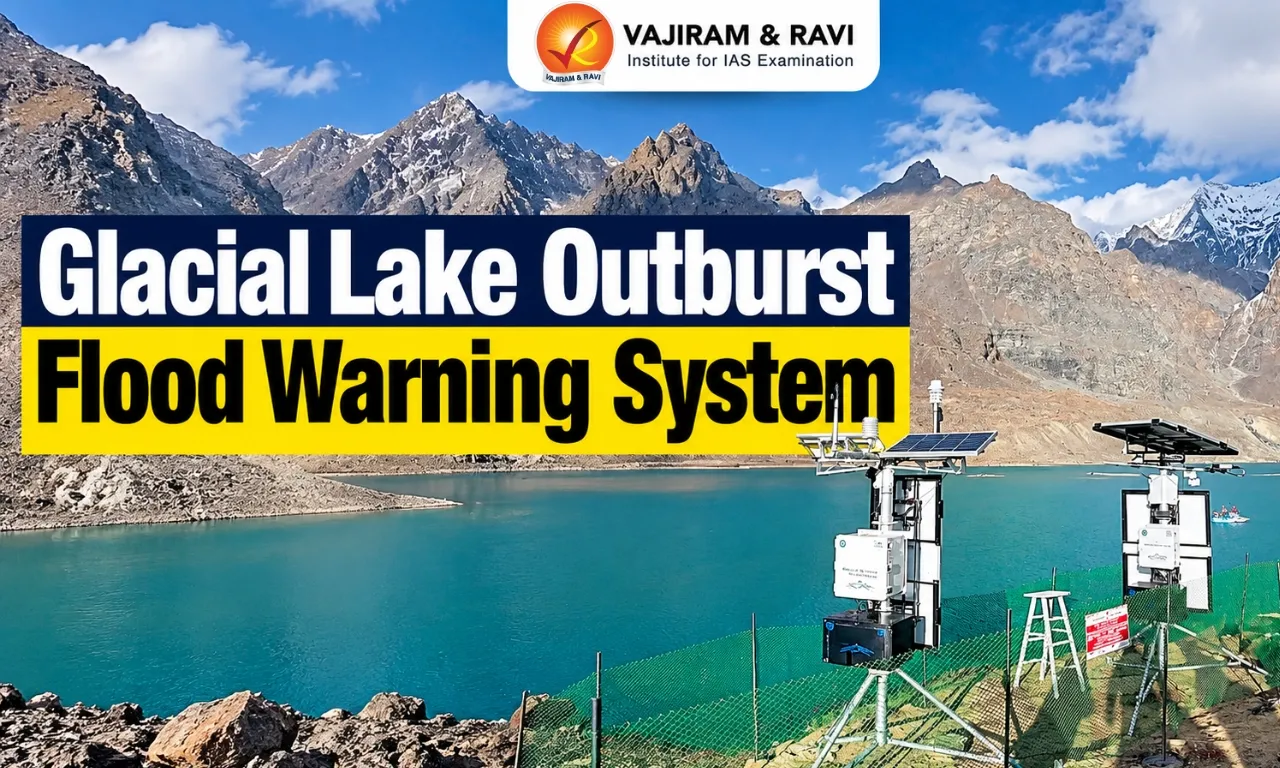
Recently, the country's first Glacial Lake Outburst Flood (GLOF) early warning system has been installed at Ghepan Ghat glacial lake in Himachal Pradesh's Lahaul and Spiti district.

About Glacial Lake Outburst Flood Warning System

  • It is installed at Ghepan Ghat glacial lake in Himachal Pradesh.
  • It is developed by the Centre for Development of Advanced Computing (C-DAC) under a pilot project funded by the National Disaster Management Authority (NDMA).
  • Components: It comprises a floating buoy deployed in the water, an automatic weather station on the shore and a glacier vision unit equipped with two cameras.

Working of Glacial Lake Outburst Flood Warning System

  • The floating buoy continuously monitors changes in the water and transmits data at intervals of 10 minutes under normal conditions.
  • In an emergency, the system is designed to begin transmitting information within 30 seconds, enabling authorities to detect sudden changes in the lake.
  • The automatic weather station records 14 environmental parameters, while the two-camera glacier vision unit continuously monitors changes in the lake and its surroundings.
  • All three systems are interconnected through a supercomputer-based analytical platform.
  • It will provide disaster management authorities with crucial data for timely risk assessment and preparedness against potential hazards.

Significance of Glacial Lake Outburst Flood Warning System

  • The installation marks a significant milestone in monitoring glacial lakes and assessing potential flood threats in the ecologically sensitive Himalayan region.
  • The initiative will also help raise public awareness about flood-prone areas and support disaster management planning.

Source: NIE

Spot-bellied Eagle-Owl

Spot-Bellied Eagle-Owl

Spot-bellied Eagle-Owl Latest News

In a major ornithological milestone, spot-bellied eagle-owl, a rare and elusive species, has been documented for the first time in Kozhikode, Kerala.

About Spot-bellied Eagle-Owl

  • The spot-bellied eagle-owl, also known as the forest eagle-owl, is a large bird of prey with a formidable appearance.
  • Scientific Name: Ketupa nipalensis.
  • It is closely related to the barred eagle-owl, which looks similar. However, these two owls live in different areas. 

Spot-bellied Eagle-Owl Habitat and Distribution

  • It is a forest-inhabiting species found in the Indian Subcontinent and Southeast Asia.  
  • In India, these spot-bellied eagle-owl species are distributed in the states of Tamil Nadu, Kerala, Goa, Karnataka, Maharashtra, Uttarakhand, Sikkim, Assam, Arunachal Pradesh, Nagaland, Meghalaya, Manipur, Tripura, and Mizoram. 
  • It can be found in a variety of habitats, including tropical and subtropical forests, woodlands, and savannas.

Spot-bellied Eagle-Owl Features

  • It is a very large owl. It can be from 50 to 65 cm long. This makes it one of the longest owls in the world. 
  • It also has very long wings. Its wingspan can reach up to 1.7 meters.
  • The most distinguishing feature is its striking colouration. The upper parts of its body are a rich chocolate brown, speckled with white spots.
  • The feathers on its wings and tail are barred with alternating shades of brown and white, creating a stunning pattern that helps it blend in with its surroundings.
  • The underside of the owl is where it gets its name; its belly and breast are a light cream colour, covered in bold black spots.
  • The nostrils are round. The beak is curved and yellowish. 
  • The owl has long ear tufts on its head. These tufts can be 63 to 76 mm long.  
  • Like most eagle owls, its legs and feet are covered in feathers.  But the tips of its toes are bare. 
  • It is primarily nocturnal.
  • It is a solitary bird that is territorial and maintains a home range.
  • It is famous for its strange, human-like calls.

Spot-bellied Eagle-Owl Conservation Status

It is classified as 'Least Concern' under the IUCN Red List.

News: NIE

Spot-bellied Eagle-Owl FAQs

Q1: What is the scientific name of the spot-bellied eagle-owl?

Ans: Its scientific name is Ketupa nipalensis.

Q2: Which type of bird is the spot-bellied eagle-owl?

Ans: It is a large bird of prey.

Q3: In which regions of the world is the spot-bellied eagle-owl found?

Ans: It is found in the Indian Subcontinent and Southeast Asia.

Q4: What is the colour of the upper body of the spot-bellied eagle-owl?

Ans: Its upper body is rich chocolate brown, speckled with white spots.

Q5: What is the IUCN Red List conservation status of the spot-bellied eagle-owl?

Ans: It is classified as Least Concern (LC).

New Centipede Species

New Centipede Species

New Centipede Species Latest News

Recently, researchers discovered three new centipede species from South India and named them as Rhysida quadrispinosa, Rhysida coorgensis and Rhysida neyyarensis. 

About Rhysida quadrispinosa

  • It got its name from the Latin-derived term quadrispinosa.
  • It has four ventrolateral spines on its ultimate leg prefemur.
  • It features 18 antennal articles, unique body segment margination starting from tergites 7–11, and a distinct arrangement of spines on its ultimate legs.

About Rhysida coorgensis

  • It is named after Coorg in Karnataka, where researchers first collected the specimen. 
  • It has a specific paramedian suture starting points on its back plates and unique coxopleural spine configurations

About Rhysida neyyarensis

  • It is named after the Neyyar Wildlife Sanctuary in Kerala, where it was discovered.
  • It is distinguished by its specific pattern of tarsal and tibial spurs, possessing two tarsal spurs on legs 1 through 19, alongside its own distinct spinal formula on the ultimate legs.

Key Facts about Centipede

  • These are long, many-legged invertebrates.
  • Centipedes are not insects. They are arthropods in the myriapod group and belong to the class Chilopoda.
  • Habitat: They live in damp, sheltered places such as leaf litter, soil, under bark, beneath rocks and inside rotting logs.
  • Appearance: They have segmented bodies, antennae, breathing holes called spiracles and one pair of legs on each body segment.
  • Diet: Centipedes are predators. Their first pair of legs has changed into venom claws, called forcipules, which help them catch and hold prey.

Source: RM

New Centipede Species FAQs

Q1: What is Rhysida quadrispinosa?

Ans: It is a new centipede species.

Q2: What is unique about Rhysida quadrispinosa?

Ans: It has four ventrolateral spines on its ultimate leg prefemur.

National Security Guard

National Security Guard

National Security Guard Latest News

The Prime Minister recently extended greetings to personnel of the National Security Guard (NSG) on its Raising Day, lauding their courage, precision, and unwavering commitment to duty.

About National Security Guard

  • It is India’s premier counter-terror force, specially trained and equipped to respond to serious acts of terrorism and other exceptional security situations.  
  • The NSG members are also known as Black Cats because of the black drill cotton coveralls and balaclavas, or helmets, they wear.
  • Establishment: 
    • It was raised in 1984, following Operation Blue Star and the assassination of Indira Gandhi.
    • It was established under the National Security Guard Act of 1986. 
    • The Act places it under the administrative control of the Union Ministry of Home Affairs (MHA), which exercises operational tasking.  
    • The NSG was modelled on the pattern of the Special Air Service of the UK and GSG-9 of Germany.  
  • The NSG’s specific goals include:
    • Neutralization of terrorist threats
    • Handling hijacking situations in the air and on land.
    • Bomb disposal (search, detection, and neutralisation of IEDs).
    • PBI (Post Blast Investigation)
    • Hostage Rescue
    • VIP Security
  • Motto: Sarvatra Sarvottama Suraksa.
  • Headquarters: New Delhi.
  • Director General (DG): 
    • The head of the NSG, designated as Director General (DG), is selected by the Home Ministry.
    • All the selected DGs have been officers from the Indian Police Service (IPS).
  • It is designed to be employed as a specialised counter-terrorism force “only in exceptional situations,” not to take over “functions of the State Police Forces or other paramilitary forces.”
  • The teams of NSG work on a basic philosophy of swift and speedy strike and immediate withdrawal from the theatre of action.
  • NSG deployments are usually not made public, with most of its operations remaining classified. 
  • Structurally, the NSG is a two-tier composite force. 
    • The Special Action Group (SAG) is the offensive assault component, manned entirely by personnel on deputation from the Indian Army, and constitutes roughly half the force. 
    • The Special Ranger Group (SRG) is drawn on deputation from the Central Armed Police Forces (CRPF, BSF, ITBP, CISF) and the state police, and performs perimeter, support, VIP protection, and logistics roles.  
  • This dual sourcing is a deliberate design feature: it keeps the cutting-edge assault capability under Army-trained discipline while retaining a police-culture interface for civilian-environment operations.  
  • The force also fields specialised wings for bomb disposal, electronic countermeasures, and explosive detection and runs the National Bomb Data Centre (NBDC). 
    • The NBDC collects, collates, analyses, and evaluates all terrorist bombing activities and disseminates relevant information to concerned law enforcement agencies.

News: DDN

National Security Guard FAQs

Q1: What is the National Security Guard (NSG)?

Ans: The NSG is India’s premier counter-terrorism force, specially trained and equipped to respond to serious acts of terrorism and exceptional security situations.

Q2: Why are NSG personnel known as “Black Cats”?

Ans: They are known as Black Cats because of the black drill cotton coveralls and balaclavas or helmets they wear.

Q3: Which events led to the raising of the National Security Guard (NSG)?

Ans: Operation Blue Star and the assassination of former Prime Minister Indira Gandhi preceded the raising of the NSG.

Q4: Under which Union Ministry does the National Security Guard (NSG) function?

Ans: The NSG functions under the administrative control of the Union Ministry of Home Affairs (MHA).

Q5: Which types of operations are handled by the National Security Guard (NSG)?

Ans: The NSG handles counter-terrorism operations, hijacking situations, bomb disposal, post-blast investigations, hostage rescue and VIP security.

Benin

Benin

Benin Latest News

Recently, India and Benin have held high-level talks in Porto-Novo to strengthen bilateral cooperation across defence, health, agriculture, and economic sectors. 

About Benin

  • Benin is a country in West Africa.
  • Bordering Countries: It borders Niger to the northeast, Nigeria to the east, Togo to the west, and Burkina Faso to the northeast.
  • Maritime Boundary: To the south, it has a small stretch of coastline on the Bight of Benin which is part of the Gulf of Guinea in the Atlantic Ocean.
  • Capital City: Porto-Novo

Geographical Features of Benin

  • Climate: It has a hot, humid tropical climate.
  • Plateau: Its main plateau is La Terre de Barre Plateau. 
  • Mountain: Atakora Mountains located northwest of Benin, which is a branch of the Togo Mountains.
  • Highest Point: Benin's highest point is Mt. Sokbaro, which rises 658 m. 
  • Major Rivers: The Niger and Ouémé are the country's major rivers. 
  • Natural Resources: Benin is very rich with key minerals including Limestone, Marble, and Gold.

Source: News On Air

Benin FAQs

Q1: What is the capital city of Benin?

Ans: Porto-Novo

Q2: La Terre de Barre Plateau is located in which country?

Ans: It is located in Benin.

Palmyra Palm Tree

Palmyra Palm Tree

Palmyra Palm Tree Latest News

India has exported a consignment of 1.755 tonnes of organic 'Palmyra' jaggery powder derived from Palmyra (a variety of palm tree) blossom nectar from Erode district of Tamil Nadu to Varna, Bulgaria. 

About Palmyra Palm Tree

  • It is commonly named as sugar palm, or toddy palm or fan palm.
  • It is a native of tropical Africa but cultivated and naturalized throughout India.
  • In India, it is planted as a windbreak on the plains.
  • Required Climatic Conditions
    • Soil: It exhibits adaptability to a wide range of soil types, including arid and wastelands. They thrive particularly well in sandy soil, red soil, black soil, and river alluvium.
    • Rainfall: These palms are also suited for semi-arid regions with an annual rainfall of less than 750 mm.
    • They can grow at altitudes from sea level up to 800 meters.
    • Palmyra is mainly propagated through seeds and there is no vegetative method available for its propagation.

Benefits of Palmyra Palm Tree

  • The chief product of the palmyra is the sweet sap (toddy) obtained by tapping the tip of the inflorescence.
  • The toddy ferments naturally within a few hours after sunrise and is locally popular as a beverage.
  • Palmyra palm jaggery (gur) is much more nutritious than crude cane sugar.
  • Traditionally, the Indian ‘Nadar’ community are the people who make their living from this tree using its wood, fruits, sap, stems, petioles and leaves to process a variety of food products, beverages, furniture, building materials, and handicrafts.

Source: PIB

Palmyra Palm Tree FAQs

Q1: Where do we find Palmyra Palm Tree?

Ans: It is a native of tropical Africa but cultivated and naturalized throughout India.

Q2: Which type of soil is suitable for Palmyra Palm Tree?

Ans: It thrives particularly well in sandy soil, red soil, black soil, and river alluvium.

Ustad Bismillah Khan Yuva Puraskar

Ustad Bismillah Khan Yuva Puraskar

Ustad Bismillah Khan Yuva Puraskar Latest News

Union Minister of Culture and Tourism, Government of India will confer the Ustad Bismillah Khan Yuva Puraskar for the years 2024 and 2025 to 106 young artists in New Delhi. 

About Ustad Bismillah Khan Yuva Puraskar

  • It was instituted by the Sangeet Natak Akademi in 2006.
  • Eligibility
    • It recognizes young artists up to the age of 40.
    • Puraskar would not be given posthumously.
    • A person who has received the Puraskar once will not be eligible for the same Puraskar under any other field / category.
  • The Yuva Puraskar may be given in the following five Fields of activity:
    • Music
    • Dance
    • Theatre
    • Other Traditional / Folk/ Tribal/ Dance/ Music/ Theatre and Puppetry
    • Contribution / Scholarship in Performing Arts
  • It carries a purse of Rs. 25,000/- (Rupees twenty-five thousand only) besides a Tamrapatra and an Angavastram.

Key Facts about Ustad Bismillah Khan

  • Ustad Bismillah Khan was born on 21 March 1916 in Dumraon, Bihar, into a family with a long tradition of serving as court musicians.
  • He is a legendary shehnai player.
  • He was awarded the Bharat Ratna in 2001, India’s highest civilian honour, recognising his exceptional contribution to music.
  • He received the Padma Shri in 1961, Padma Bhushan in 1968 and Padma Vibhushan in 1980 for his contribution to Indian music.

Source: PIB

Ustad Bismillah Khan Yuva Puraskar FAQs

Q1: Which organisation instituted Ustad Bismillah Khan Yuva Puraskar?

Ans: It was instituted by the Sangeet Natak Akademi in 2006.

Q2: Who is Ustad Bismillah Khan?

Ans: He is a legendary shehnai player.

Pradhan Mantri Anusuchit Jaati Abhyuday Yojana

Pradhan Mantri Anusuchit Jaati Abhyuday Yojana

Pradhan Mantri Anusuchit Jaati Abhyuday Yojana Latest News

The Pradhan Mantri Anusuchit Jaati Abhyuday Yojana (PM-AJAY) has seen 18,093 villages declared Adarsh Grams as of September 8, 2026, reflecting efforts to improve infrastructure, basic services and quality of life in Scheduled Caste-majority villages.

About Pradhan Mantri Anusuchit Jaati Abhyuday Yojana

  • It is a comprehensive initiative by the Government of India, launched in FY 2021-22, aimed at the socio-economic upliftment of Scheduled Castes (SCs). 
  • It is a merger scheme of three erstwhile Centrally Sponsored Schemes, namely, Pradhan Mantri Adarsh Gram Yojana (PMAGY), Special Central Assistance to Scheduled Castes Sub Plan (SCA to SCSP), and Babu Jagjivan Ram Chhatrawas Yojana (BJRCY). 
  • Implemented by the Ministry of Social Justice & Empowerment, the scheme focuses on reducing poverty, enhancing educational opportunities, and improving infrastructure in SC-dominated areas. 
  • The objectives of the Scheme are to:
    • Reduce poverty of the SC communities by generating additional employment opportunities through skill development, income-generating schemes, and other initiatives.
    • Improve socio-economic developmental indicators by ensuring adequate infrastructure and requisite services in the SC-dominated villages.
    • Increase literacy and encourage enrollment of SCs in schools and higher educational institutions by providing adequate residential facilities in quality institutions, as well as residential schools where required, especially in the aspirational districts/SC-dominated blocks and elsewhere in India.
  • The scheme is 100% funded by the Central Government. However, the States/UTs are free to provide additional funds from their own resources if they so desire. 
  • The states are required to submit their Annual Action Plans (AAPs) through the PM-AJAY portal in order to receive funds from the central government. 
  • The planning process is decentralized, allowing for the creation and approval of projects at both state and district levels. 
  • Key Components:
    • Adarsh Gram Development: Transforming SC-majority villages into ‘Adarsh Grams’ (model villages) by filling critical gaps in infrastructure and services.​
    • Grants-in-Aid for Socio-Economic Projects: Providing financial assistance for district/state-level projects aimed at the socio-economic betterment of SCs. This includes:​
      • Creation of infrastructure in SC-dominated villages
      • Construction of hostels/residential schools
      • Comprehensive livelihood projects, including skill development and related infrastructure.​
      • Financial assistance towards loans taken by beneficiaries for asset acquisition/creation required for livelihood generation.​
    • Construction of Hostels: It includes building hostels in higher educational institutions ranked under the National Institutional Ranking Framework (NIRF) and funded by the Centre/State/UT Governments, schools funded by the Centre/State/UT Governments, and recommended by the Ministry of Education.​
    • Financial support for monitoring and evaluation of the Scheme implementation through the Administrative Head of the Scheme.
  • Eligibility Criteria:
    • The SC persons living below the poverty lines are eligible for getting benefits under the various income-generating schemes and skill development programmes.
    • In case of Infrastructure Development, the villages having 50% or more SC population are eligible for grants under the Scheme.

News: DD

Pradhan Mantri Anusuchit Jaati Abhyuday Yojana FAQs

Q1: What is PM-AJAY?

Ans: PM-AJAY is a Government of India initiative aimed at the socio-economic upliftment of Scheduled Castes (SCs).

Q2: Which Union Ministry implements PM-AJAY?

Ans: The Ministry of Social Justice and Empowerment implements the scheme.

Q3: What are the major objectives of PM-AJAY?

Ans: Its major objectives are poverty reduction, improvement of socio-economic indicators, expansion of educational opportunities and infrastructure development in SC-dominated areas.

Q4: What is the Adarsh Gram Development component of PM-AJAY?

Ans: It aims to transform SC-majority villages into model villages by filling critical infrastructure and service gaps.

Enquire Now