Vasuki indicus

Vasuki indicus

Vasuki indicus Latest News

A massive prehistoric snake discovered in India named Vasuki indicus may have rivaled the largest snake ever known.

About Vasuki indicus

  • It is an ancient snake species, the fossils of which were first unearthed in 2005 at the Panandhro Lignite Mine in the Kutch district of Gujarat. 
  • However, the species was only identified and described as a new genus in 2024. 
  • It is named after Vasuki, the mythical snake often depicted around the neck of the Hindu god Shiva. 
  • It belonged to the now-extinct Madtsoiidae family, a group of large, non-venomous constrictor snakes. 
  • It is thought to have existed during the Middle Eocene (47.8 to 38 million years ago), when the Earth's temperature was good enough to permit the evolution of large, cold-blooded reptiles. 
  • Vasuki indicus is believed to have been an incredible 49 feet long.
  • This discovery places it among the longest known snake species, rivaling Titanoboa, which grew up to 42 feet and lived around 60 million years ago in South America. 
  • Individual vertebrae measured between 37.5 and 62.7 millimeters (1.48 and 2.47 inches) long and between 62.4 and 111.4 millimeters (2.46 and 4.39 inches) wide. 
  • Their unusually broad shape suggests that Vasuki possessed a thick, cylindrical body capable of supporting tremendous weight. 
  • Its skeletal structure suggests that it was a slow-moving ambush predator, similar to modern pythons and anacondas.

News: SD

Vasuki indicus FAQs

Q1: What is Vasuki indicus?

Ans: An ancient, now-extinct species of giant snake.

Q2: Where were the fossils of Vasuki indicus first discovered?

Ans: At the Panandhro Lignite Mine in Kutch district, Gujarat.

Q3: After whom was Vasuki indicus named?

Ans: Vasuki, the mythical serpent associated with the Hindu god Shiva.

Q4: What was the estimated length of Vasuki indicus?

Ans: Approximately 49 feet, making it among the longest known snake species.

Q5: To which extinct snake family did Vasuki indicus belong?

Ans: It belonged to the now-extinct Madtsoiidae family, a group of large, non-venomous constrictor snakes.

Port of Constanta

Port of Constanta

Port of Constanta Latest News

Recently, the Indian mission in Bucharest said a chemical tanker carrying nine Indian seafarers, which was hit by a drone at an anchorage off Romania has reached the Port of Constanta safely.

About Port of Constanta

  • Location: It is one of the key Romanian maritime ports in the Black Sea Region.
  • It is the only seaport directly connected to the Danube River through the Danube—Black Sea Canal.
  • This port also plays a key role for the Danube countries in Central and East Europe through the Danube River.
  • Significance: It is playing a highly important role as the transit node for the landlocked countries in Central and South-East Europe.

Key facts about Black Sea

  • It is a large inland sea situated at the southeastern extremity of Europe.
  • It is located where Europe and Asia meet. 
  • Bordering Countries: It is bordered by Ukraine to the north, Russia to the northeast, Georgia to the east, Turkey to the south, and Bulgaria and Romania to the west.
  • Though far inland, it connects with the Atlantic Ocean through a series of other waterways. 
  • The Bosporus Strait, the Sea of Marmara, and the Dardanelles Strait link the Black Sea to the Aegean Sea, the Mediterranean Sea, and finally, the Atlantic. 
  • To its east, the Kerch Strait links the Black Sea to the smaller Sea of Azov. 
  • Rivers: Major rivers flowing into it include the Danube, Dnieper, Southern Bug, Rioni, and Dniester.

Source: TH

Port of Constanta FAQs

Q1: Where is Port of Constanta located?

Ans: It is one of the key Romanian maritime ports in the Black Sea Region.

Q2: What is the significance of Port of Constanta?

Ans: It is playing a highly important role as the transit node for the landlocked countries in Central and South-East Europe.

Exercise Akhand Prahar-II

Exercise Akhand Prahar-II

Exercise Akhand Prahar-II Latest News

The Indian Army, in a bid to strengthen combat readiness, recently conducted Exercise Akhand Prahar-II at Jaisalmer in the desert region of Rajasthan.

About Exercise Akhand Prahar-II

  • It is a military exercise conducted by the Indian Army.
  • It was jointly conducted by the Army’s "Black Mace" Brigade and "Battle Axe" Division at Jaisalmer in the desert region of Rajasthan.
  • It followed the success of "Akhand Prahar-I", during which the Army demonstrated its combat and operational readiness through joint military operations.  
  • The exercise focused on strengthening operational effectiveness by integrating New Generation Equipment (NGEs) and Force Multipliers (FMs).
  • It also tested the formations’ preparedness to meet the evolving challenges of modern warfare, highlighting the Army’s emphasis on technological advancement, operational coordination, and battlefield adaptability.
  • During the exercise, the formations tested integrated battle drills in a multi-domain operational environment, demonstrating coordination among combat elements and the effective use of advanced technologies.
  • The drills showcased their ability to combine different operational capabilities, execute tasks with precision, and improve combat effectiveness across multiple domains.

News: ETVB

Exercise Akhand Prahar-II FAQs

Q1: Which branch of the Indian Armed Forces conducted Exercise Akhand Prahar-II?

Ans: The Indian Army.

Q2: Where was Exercise Akhand Prahar-II conducted?

Ans: Jaisalmer, Rajasthan.

Q3: What was the primary focus of Exercise Akhand Prahar-II?

Ans: Strengthening operational effectiveness through the integration of New Generation Equipment (NGEs) and Force Multipliers (FMs).

Barak River

Barak River

Barak River Latest News

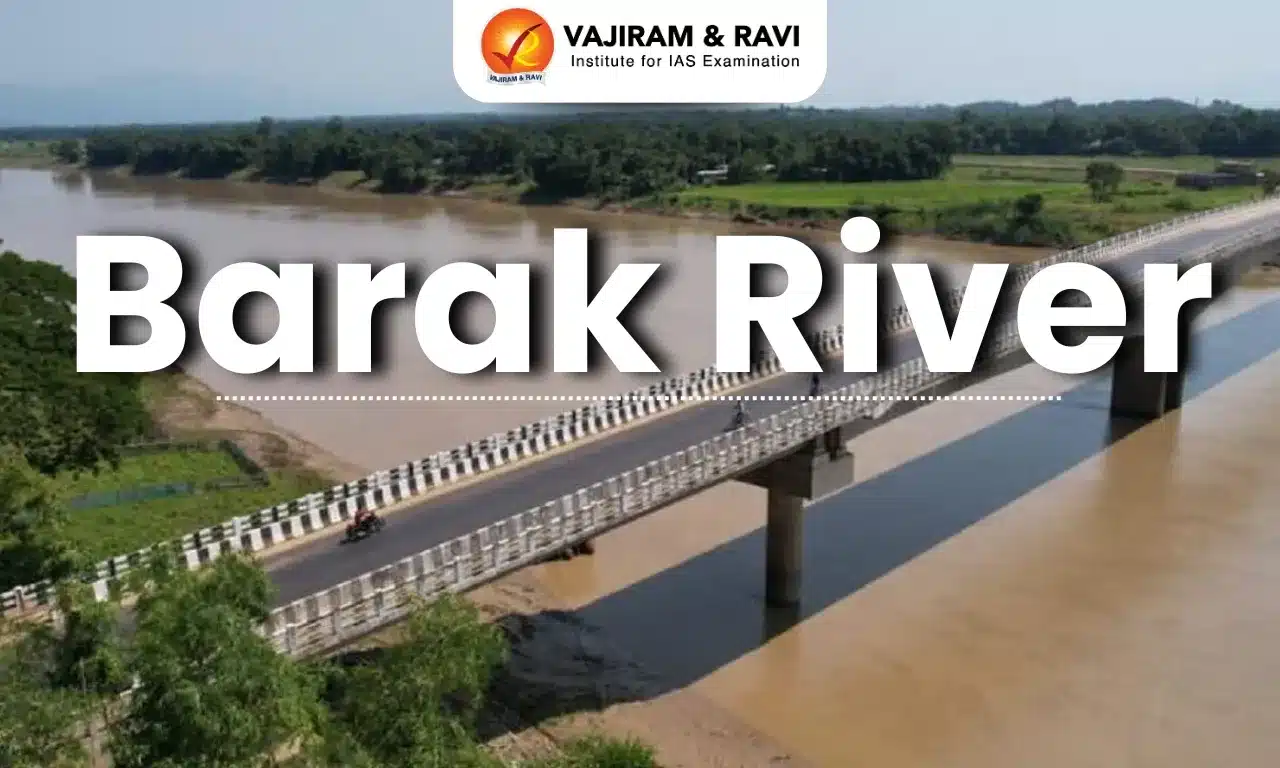
Two Bangladeshi nationals were arrested after allegedly jumping into the Barak River to evade police during an operation in Assam’s Cachar district recently, with two police personnel reportedly injured in the process.

About Barak River

  • It is a transboundary river in India and Bangladesh. 
  • It is the second largest river in Northeast India, after the Brahmaputra. 
  • Course:
    • It rises from the Manipur hills, south of Mao in the Senapati district of Manipur.
    • It flows through the hilly regions of Manipur, along parts of the Manipur–Nagaland and Manipur–Mizoram boundaries, and through Assam before entering Bangladesh. 
    • In Bangladesh, the Barak divides into the Surma and Kushiyara rivers, which eventually form the Meghna River and drain into the Bay of Bengal.  
  • Length: It has a length of about 900 km. It spans 524 km in India, with a significant part along the Indo-Bangladesh border. 
  • The 121-km stretch of the river between Lakhipur and Bhanga in Assam was declared by the Government of India as National Waterway 16.
  • Basin:
    • The Barak River basin, formed by the Barak and its tributaries, drains India, Bangladesh, and Myanmar.
    • In India the basin spreads over states of Meghalaya, Manipur, Mizoram, Assam, Tripura, and Nagaland.
    • It is bounded by the Barail range separating it from the Brahmaputra basin on the north, by the Naga and Lushai hills on the east, and by the Mizo hills and the territory of Bangladesh on the south and west.
    • The entire basin falls in the Eastern Himalayan region of the Agro Climatic Zone. 
    • The major part of the basin is covered by forest.
    • Due to the hilly topography, terrace farming is common in this region.
  • In Assam, the Barak Valley gets its name from the river and includes the districts of Cachar, Hailakandi, and Karimganj, forming the southernmost part of the state. 
    • The valley is home to many tribal and linguistic groups, including Dimasa, Manipuri, Rongmei Naga, and Hmar people and a large proportion of Bengali-speaking people. 
  • Tributaries: The principal tributaries of the Barak are Jiri, Chiri, Modhura, Jatinga, Harang, Dhaleswari, Singla, Longai, Sonai, and Katakhal.
  • There are four major dams, namely Khoupum Dam, Mawphlang Dam, Gumti Hydro Dam, and Myntdu-Leshka Dam.

News: IT

Barak River FAQs

Q1: Which two countries does the Barak River flow through?

Ans: India and Bangladesh.

Q2: Where does the Barak River originate?

Ans: In the Manipur Hills, south of Mao in Senapati district, Manipur.

Q3: Into which two rivers does the Barak divide in Bangladesh?

Ans: The Surma and Kushiyara rivers.

Q4: What is the approximate total length of the Barak River?

Ans: About 900 km.

Q5: Which tribal and linguistic communities inhabit the Barak Valley?

Ans: Dimasa, Manipuri, Rongmei Naga and Hmar communities, along with a large Bengali-speaking population.

Kufri Jamunia

Kufri Jamunia

Kufri Jamunia Latest News

The Indian Council of Agricultural Research- Central Potato Research Institute developed nutrient-rich coloured potato varieties, including Kufri neelkanth, Kufri manik, and Kufri jamunia.

About Kufri Jamunia

  • It is a biofortified table variety purple potato developed by the Indian Council of Agricultural Research- Central Potato Research Institute.
  • It was officially released in 2024.
  • It is a medium-maturing potato variety with medium-tall plants and a semi-compact canopy.
  • Kufri jamunia has demonstrated stable performance in multi-location trials and has been recommended for cultivation in the North Indian plains. 

Salient Characteristics of Kufri jamunia

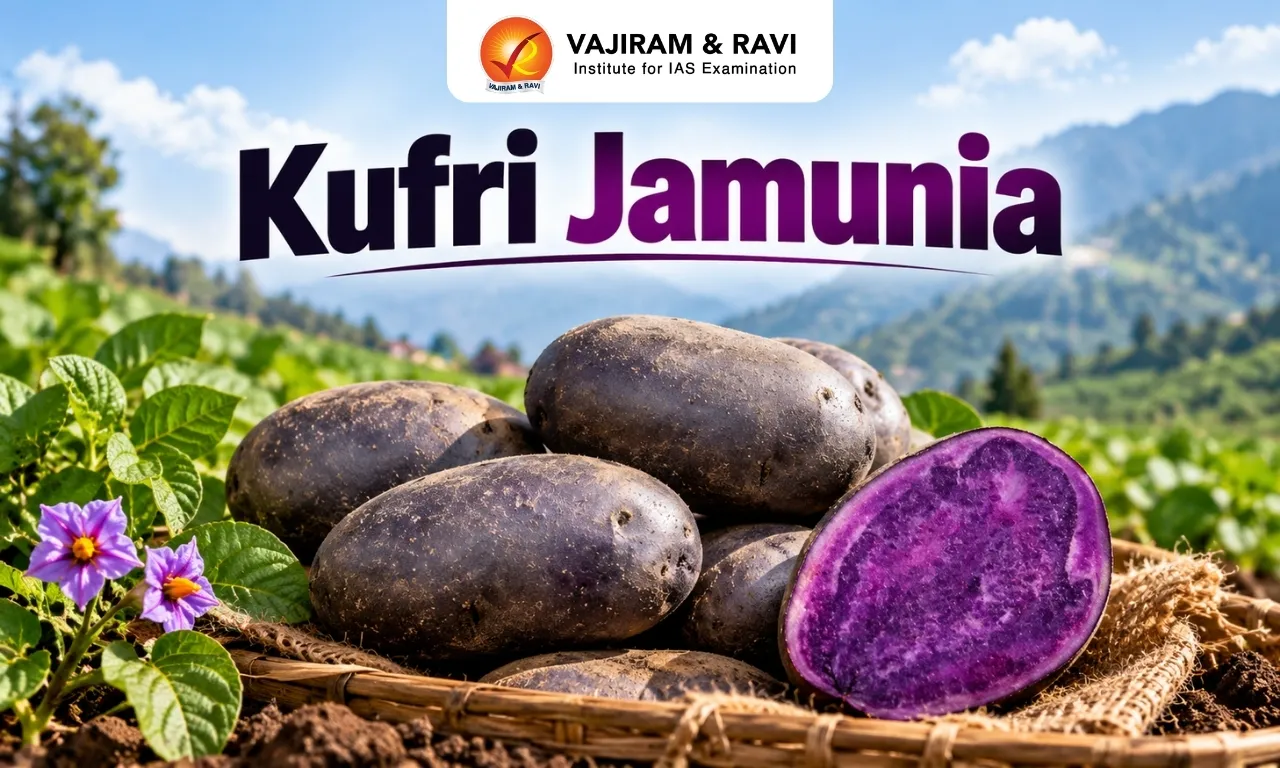
  • Its tubers are dark purple on the skin and purple in the flesh.
  • They are oblong, with shallow eyes and a mealy texture.
  • It shows medium dormancy of around 6-8 weeks. Hence, tubers do not sprout quickly.
  • It possesses good storage quality with low rottage and minimal weight loss.
  • Nutritional Content: The variety contains higher levels of ascorbic acid, anthocyanin, and carotenoids.
  • Its purple flesh indicates high antioxidant content and better nutritional quality. Kufri jamunia also contains enhanced levels of zinc and iron. 
  • Applications: It is suitable for a wide range of culinary applications.

Other Varieties of Potatoes

  • Kufri Neelkanth
    • It was the first purple-skinned specialty potato variety developed by ICAR-CPRI (Central Potato Research Institute), released in 2018.
    • The variety is suitable for cultivation in Punjab, Haryana, Uttar Pradesh, Uttarakhand, Bihar, Madhya Pradesh, and Chhattisgarh.
    • It is known for its high antioxidant content. The variety is suitable for people of all age groups.
  • Kufri manik
    • It was released in 2021.
    • It produces attractive, deep red tubers with a round shape, medium eyes, and yellow flesh.
    • The variety is rich in nutrients and contains high levels of anthocyanin, zinc, and iron.

Source: PIB

Kufri Jamunia FAQs

Q1: What is Kufri Jamunia?

Ans: It is a biofortified table variety purple potato.

Q2: Which organisation developed the Kufri Jamunia?

Ans: It is developed by the Indian Council of Agricultural Research- Central Potato Research Institute.

Barda Wildlife Sanctuary

Barda Wildlife Sanctuary

Barda Wildlife Sanctuary Latest News

As per a recent study, the lions have come back to Barda Wildlife Sanctuary after nearly 144 years of absence.

About Barda Wildlife Sanctuary

  • It is located in the Barda Hills of Gujarat, near the coastal city of Porbandar.
  • Spread over an area of roughly 192.31 square kilometers, it was established in 1979.  
  • Known locally as Jam Barda, it was once a private hunting ground for the royal families of Jamnagar and Porbandar.
  • It is surrounded by agricultural fields, wastelands, and forests, and the terrain of Barda is almost hilly. 
  • Rivers: There are two waterways, the Bileshvary River and the Joghri River, and two dams, Khambala and Fodara.
  • Tribes: Ethnic races such as Maldharis, Bharvads, Rabaris, and Gadhvis live in this region.
  • Vegetation: There are several forest sub-types, such as southern tropical forest, southern dry mixed deciduous forest, and northern tropical thorn forest. 
  • Flora: 
    • The area has the maximum floral diversity in the state (650 plant species). Gorad, Babul, Dhav, Rayan, Ber, Jamun, Amli, Dhudhlo, Bamboo, etc. 
    • Medicinal plants of great use grow profusely within the forested belt of the sanctuary. 
  • Fauna: 
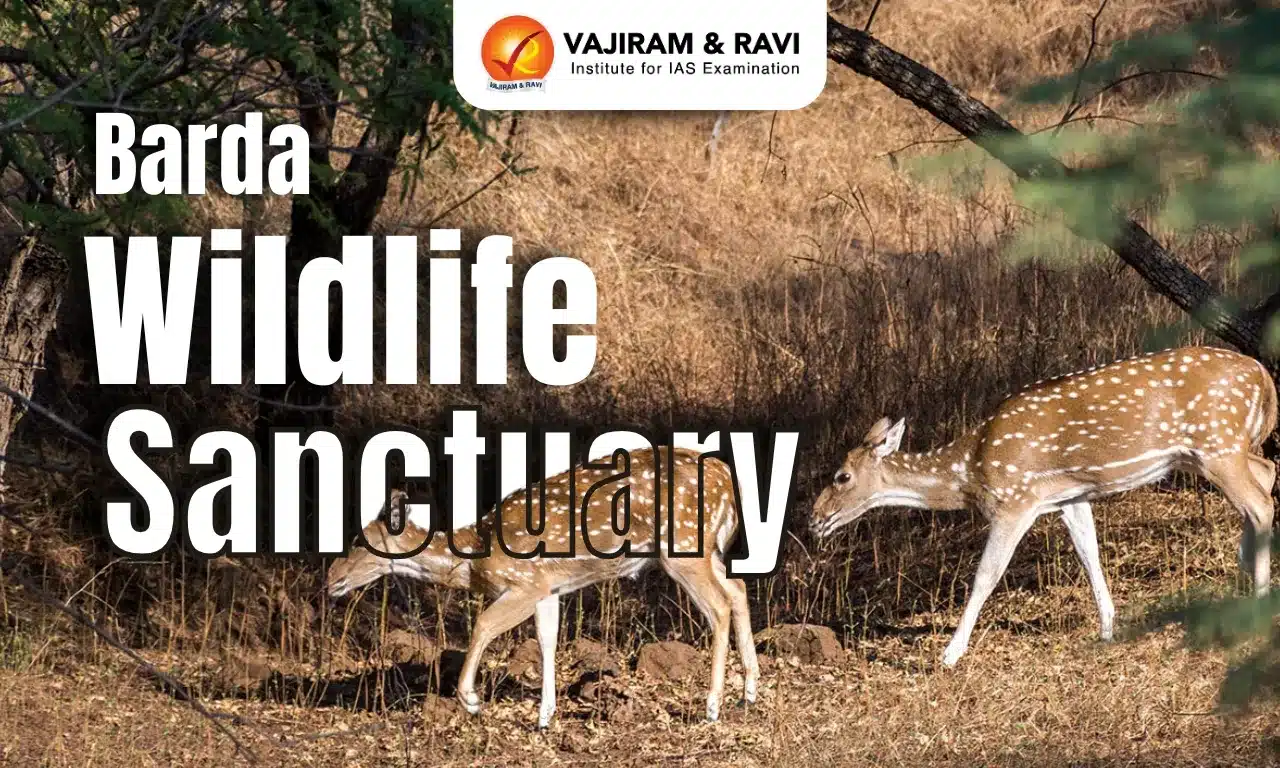
    • It shelters species like leopards, wolves, sambar deer, chinkara, hyenas, and blue bulls (nilgai). 
    • The sanctuary is also a paradise for bird watchers, with numerous resident and migratory birds such as eagles, owls, crested serpent eagles, and partridges found here.
    • The sanctuary is a key area for the conservation of Asiatic Lions.
    • To develop Barda as the second home for the Asiatic lion, the state government implemented the ‘Gir-Barda Project’ in 1979. 
    • It is the first fully protected satellite lion habitat in Gujarat. 
    • It is now home to 17 Asiatic lions, according to recent reports.

News: TOI

Barda Wildlife Sanctuary FAQs

Q1: In which state is Barda Wildlife Sanctuary located?

Ans: Gujarat.

Q2: Which two rivers flow through the Barda Wildlife Sanctuary region?

Ans: The Bileshvary River and the Joghri River.

Q3: Which types of forests are found in Barda Wildlife Sanctuary?

Ans: Southern tropical forest, southern dry mixed deciduous forest and northern tropical thorn forest.

Q4: Which project was launched to develop Barda as a second home for Asiatic lions?

Ans: The Gir-Barda Project.

Income Tax Appellate Tribunal

Income Tax Appellate Tribunal

Income Tax Appellate Tribunal Latest News

Recently, a major automaker company of India said favourable to the Income Tax Appellate Tribunal (ITAT) order and is expected to have a positive tax impact, including interest, of approximately ₹13,000 crore.

About Income Tax Appellate Tribunal

  • It is a quasi-judicial institution set up in January, 1941 and specializes in dealing with appeals under the Direct Taxes Acts. 
  • It adjudicates appeals made under the Income Tax Act of 1961.
  • Initial Structure: It was started in 1941 with six Members constituting three Benches – one each at Delhi, Kolkata (Calcutta), and Mumbai (Bombay).
  • Present Structure: It presently has 63 Benches at 27 different cities.
  • Nodal Ministry: It functions under the Ministry of Law and Justice.
  • Composition 
    • President: The President of the ITAT constitutes a bench from among the members of the ITAT.
    • Member: Each bench has an accountant member and a judicial member.
    • Special Bench: In some cases, a special bench with three or more members may be constituted to dispose of income tax appeals.

Functions of Income Tax Appellate Tribunal

  • Hearing Appeal: It hears appeals concerning orders passed by the income-tax authorities.
  • Dispute Resolution: ITAT serves as the final fact-finding body in tax disputes, offering both taxpayers and the income tax authorities a convenient platform to resolve disputes.
  • It is the second forum to hear income-tax appeals after the Commissioner of Income-tax (Appeals)
  • ITAT functions under the regional High Court’s jurisdiction and must adhere to the rules of the same.
  • ITAT is subordinate to both the region’s High Court and the Indian Supreme Court.
  • The orders passed by the ITAT are final. An appeal lies to the High Court only if a substantial question of law arises for determination.

Source: TH

Income Tax Appellate Tribunal FAQs

Q1: Income Tax Appellate Tribunal works under which ministry?

Ans: Ministry of Law and Justice.

Q2: Income Tax Appellate Tribunal adjudicates appeals under which act?

Ans: It adjudicates appeals made under the Income Tax Act of 1961.

France

France

France Latest News

Recently, France witnessed nationwide protests over the rising cost of living and poor conditions in schools escalated into violence. 

About France

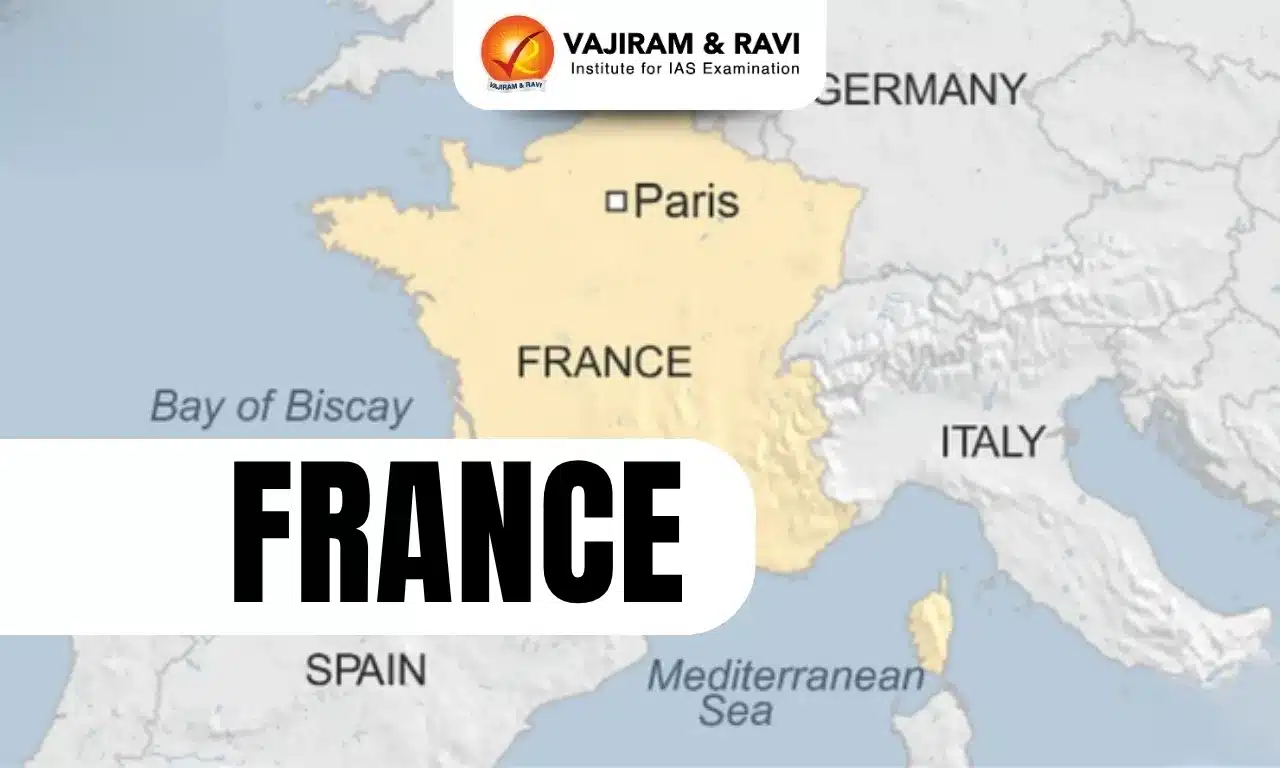
  • Location: It is a country located in North Western Europe.
  • Bordering countries: It is bordered by 7 countries: Belgium, Luxembourg, Germany, Switzerland, Italy, Spain and Andorra.
  • Water bodies: It is bounded by the Bay of Biscay (North Atlantic Ocean) in the west; by the English Channel in the northwest and by the Mediterranean Sea in the south. 
  • Capital City: Paris

Geographical Features of France

  • Climate: The climate in mainland France is temperate, with quite significant regional differences.
  • Major Rivers:  It is drained by Loire (drains into Atlantic ocean ), Seine (drains into English channel).
  • Major Mountains:  Alps (southern France), Jura Mountains (north of Alps), Pyrenees (forms border with Spain).
  • Natural Resources: It consists of Coal, iron ore, bauxite, zinc, uranium, antimony, arsenic, potash, feldspar, fluorspar, gypsum.

Source: TOI

France FAQs

Q1: What is the capital of France ?

Ans: Paris

Q2: What type of climate is found in France?

Ans: The climate in mainland France is temperate, with quite significant regional differences.

Valley of Flowers National Park

Valley of Flowers National park

Valley of Flowers National Park Latest News

Recently, Uttarakhand officials reviewed proposed eco-sensitive zones around Rajaji and Valley of Flowers national parks.

About Valley of Flowers National Park

  • Location: It is located in the state of Uttarakhand.
  • It is a UNESCO World Heritage Site and forms one of the two core zones (the other being the Nanda Devi National Park) of the Nanda Devi Biosphere Reserve.
  • The gentle landscape of the Valley of Flowers National Park complements the rugged mountain wilderness of Nanda Devi National Park. 
  • Together they encompass a unique transition zone between the Zanskar and Great Himalayan ranges.
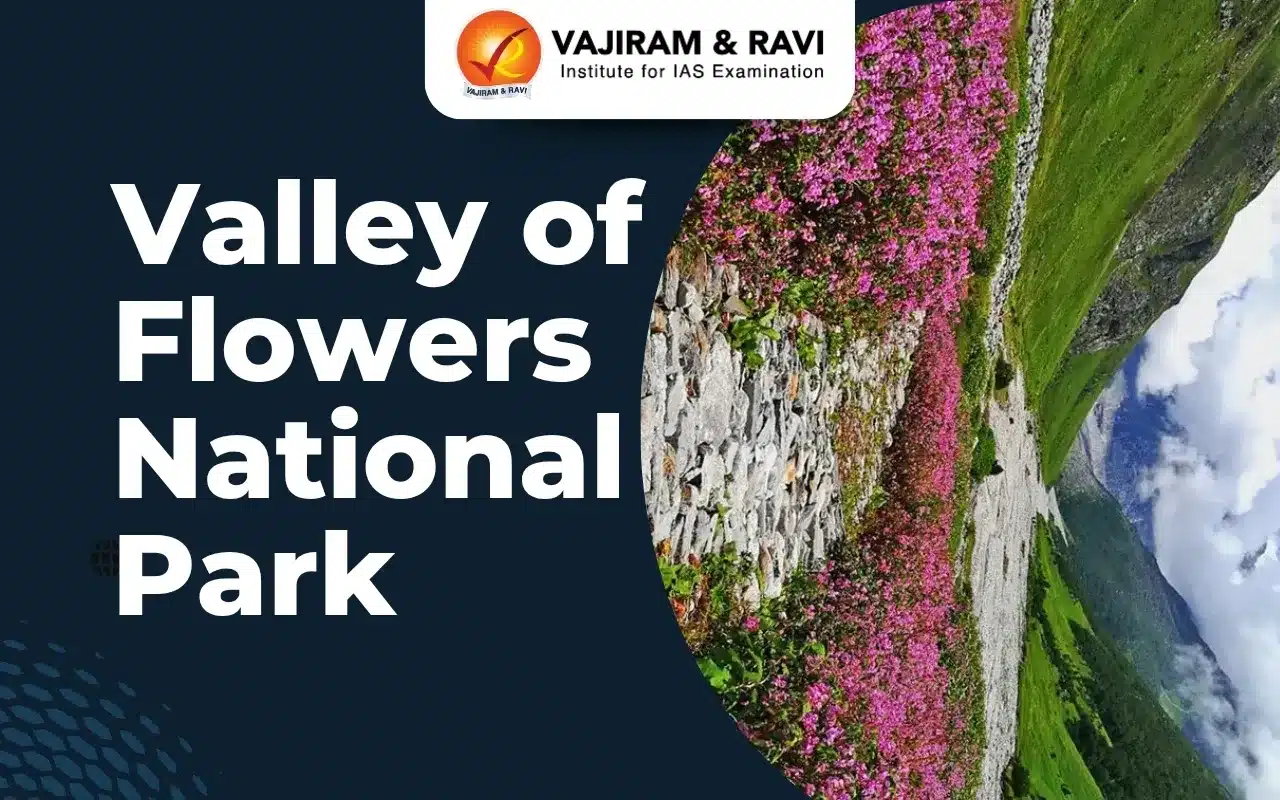
  • It is famous for its alpine meadows and rich biodiversity.
  • Flora 
    • It mainly consists of Exotic flowers (over 600 species) like orchids, poppies, primulas, marigolds, daisies, and anemones are an eye-catching spectacle. 
    • Sub-alpine forests birch and rhododendron cover parts of the park’s area.
  • Fauna: It is home to such rare and amazing wildlife species like the gray langur, the flying squirrel, the Himalayan weasel, black bear, the red fox, the lime butterfly, and the snow leopard.

Source: NIE

Valley of Flowers National Park FAQs

Q1: Where is Valley of Flowers National Park located?

Ans: Uttarakhand

Q2: What type of flora is found in Valley of Flowers National Park ?

Ans: It mainly consists of Exotic flowers (over 600 species) like orchids, poppies, primulas, marigolds, daisies, and anemones are an eye-catching spectacle. 

Enquire Now