Arabian Black Electric Ray

Arabian Black Electric Ray

Arabian Black Electric Ray Latest News

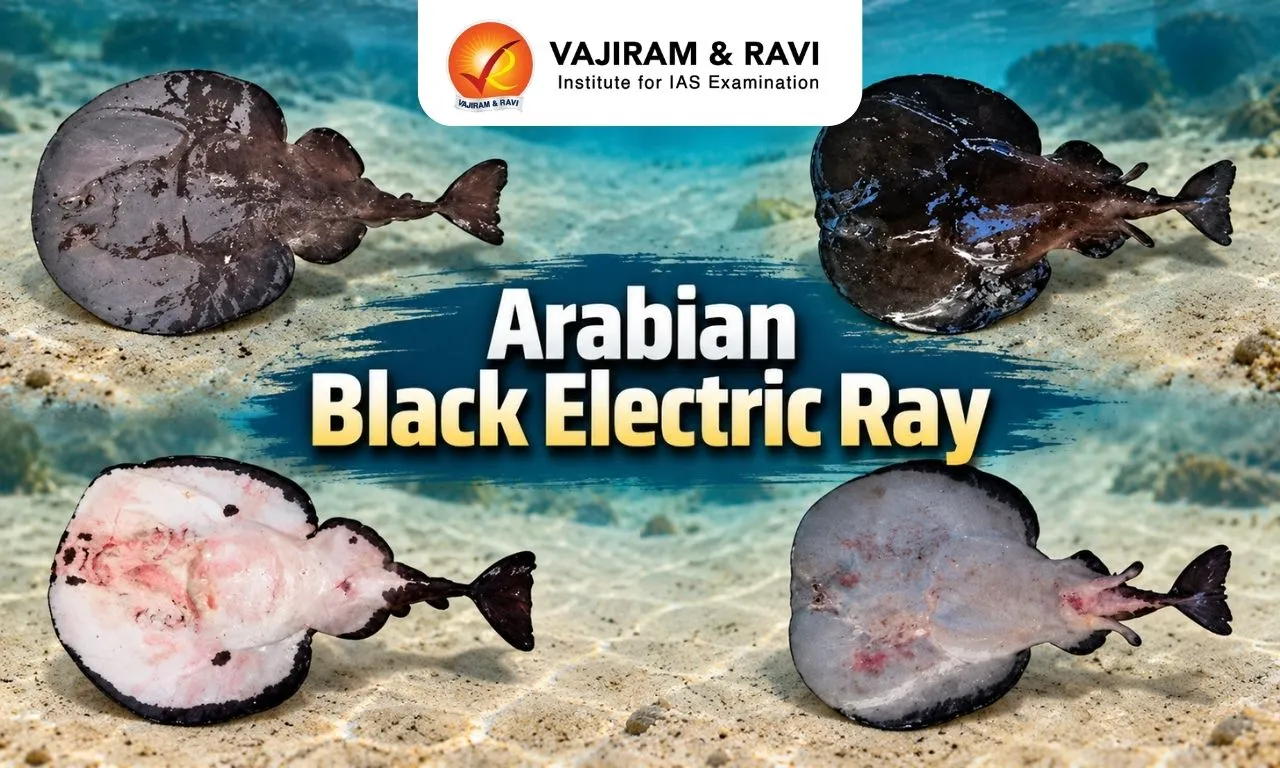
Researchers have discovered a new species of electric ray, named the Arabian Black Electric Ray (Tetronarce ramanamurthyi), in the deep waters of the southeastern Arabian Sea in the north.

About Arabian Black Electric Ray

  • It was discovered in the Arabian Sea.
  • It is the first confirmed record of the genus Tetronarce in the northern Indian Ocean. 
  • Features: It features a uniform dark bluish-black or dark brown upper body surface with a whitish belly, lacking any skin bumps (papillae) around its breathing holes (spiracles).
  • It forms an independent evolutionary lineage well-separated from all other known electric ray species globally.

Key Facts about Electric Ray

  • An electric ray refers to a type of cartilaginous fish capable of producing an electric shock.
  • Appearance: These rays are characterized by their flat bodies and enlarged pectoral fins that are fused to their heads.
  • Habitat& Distribution: The electric rays are found worldwide in tropical, subtropical, and temperate bodies of water and are commonly found to inhabit and prefer shallow waters
  • Diet: These are mesopredators, typically prey on smaller animals 
  • They have electric shock producing ability which helps them to stun their prey.

Source: RM

Arabian Black Electric Ray FAQ's

Q1: What is the scientific name of Arabian Black Electric Ray?

Ans: Tetronarce ramanamurthyi

Q2: Where did Arabian Black Electric Ray found?

Ans: Arabian Sea

Zavodovski Island

Zavodovski Island

Zavodovski Island Latest News

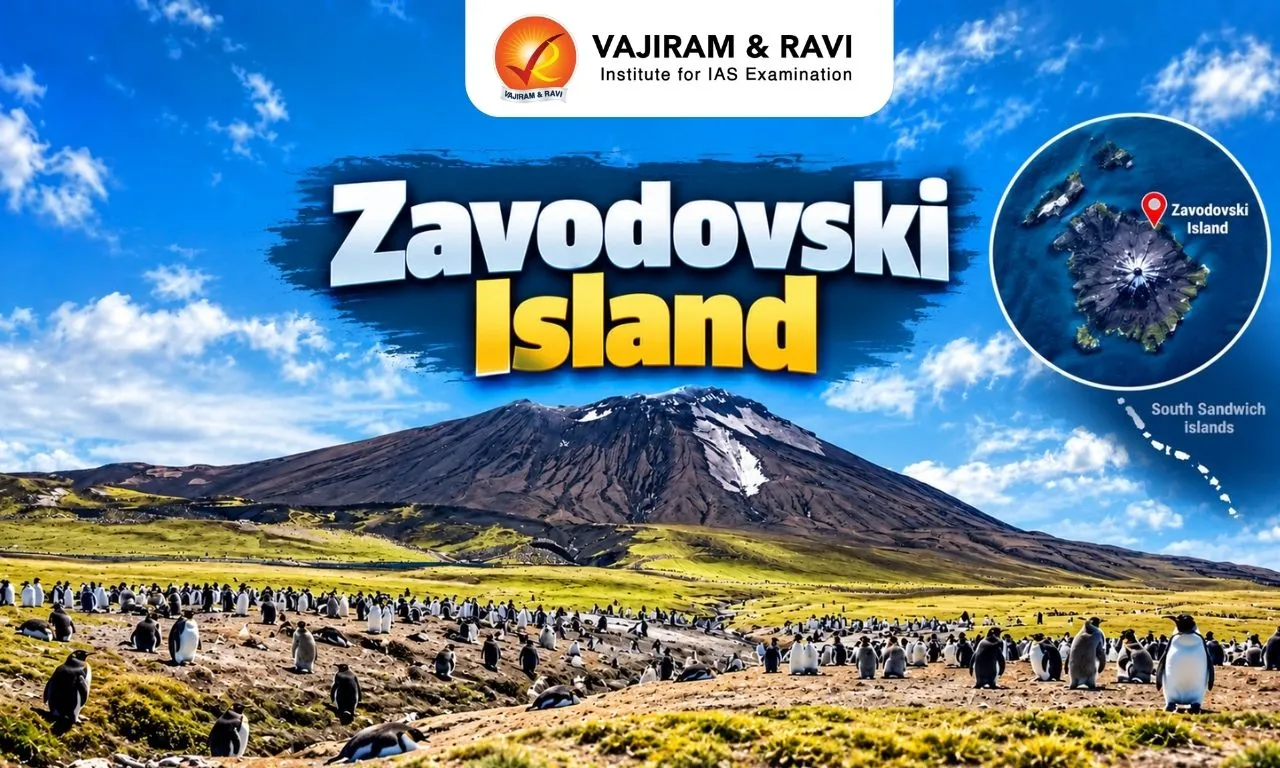
According to research by the British Antarctic Survey (BAS), the number of breeding chinstrap penguins on the Zavodovski Island declined nearly 63% in 14 years.

About Zavodovski Island

  • Location: It is an uninhabited volcanic island situated in the Traversay Islands subgroup of the South Sandwich Islands in the South Atlantic Ocean.
  • It is home to the largest penguin colony in the world and unique terrestrial fauna and flora.
  • Volcano: The basaltic stratovolcano on the island, known as Mount Curry, has a large lava platform extending east from two parasitic cones on the side of the main edifice.

Key Facts about Chinstrap Penguin

  • The chinstrap penguin (Pygoscelis antarcticus ) is a species of penguin that inhabits a variety of islands and shores in the Southern Pacific and the Antarctic Oceans.
  • Appearance: Its name stems from the narrow black band under its head, which makes it appear as if it were wearing a black helmet, making it easy to identify.
  • It is also known as Ringed penguin, Bearded penguin, and Stonecracker penguin, due to its loud, harsh call.
  • Behavior: They are highly social birds, gathering in large colonies, where they live and breed.
  • Diet: It mainly feeds on Antarctic krill, tiny, shrimp-like creatures that live in the ocean and form an important part of the Antarctic food chain.
  • Conservation Status: IUCN Red List: Least Concern

Source: IE

Zavodovski Island FAQs

Q1: Where is Zavodovski Island located?

Ans: South Atlantic Ocean

Q2: What type of penguin is found in Zavodovski Island ?

Ans: Chinstrap penguins

Zuqar Island

Zuqar Island

Zuqar Island Latest News

Yemen’s Houthi rebels recently claimed they are attempting to rescue a boat carrying 14 Indian nationals near Zuqar Island in the Red Sea, alleging that it was targeted by Saudi Arabia.

About Zuqar Island

  • It is a Yemeni island in the southern Red Sea, forming part of the Hanish Islands archipelago. 
  • It is approximately 130 sq.km.  
  • It lies between the coasts of mainland Yemen and Eritrea, near the Bab-el-Mandeb strait, which connects the Red Sea to the Gulf of Aden.  
  • Despite its proximity to the African continent, the island is considered a part of Asia because it sits on the Asian continental shelf.  
  • It has strategic importance because of its location along one of the world’s key maritime routes. 
  • Eritrea captured the island in 1995 after battling Yemeni forces. An international court in 1998 placed the island formally into Yemen’s custody. 
  • The island consists of a shield volcano overlain by basaltic pyroclastic cones and spatter cones, which produce youthful-looking pahoehoe lava flows. 
  • Several small coastal cones and islets surrounding Zuqar Island were formed by phreatic eruptions. 

What are Pahoehoe Lava Flows?

  • Pahoehoe is a type of basaltic lava characterized by a smooth, often shiny, and billowy surface. 
  • This highly fluid lava spreads in thin sheets and forms ropy folds as it continues to flow beneath a hardening crust. 
  • The surface of pahoehoe lava flows can appear gently undulating or broadly hummocky, with liquid lava beneath the surface wrinkling it into tapestry-like folds that resemble twisted rope. 
  • These flows are typically fed internally by streams of liquid lava. 

News: TOI

Zuqar Island FAQs

Q1: Where is Zuqar Island located?

Ans: Zuqar Island is a Yemeni island in the southern Red Sea, forming part of the Hanish Islands archipelago.

Q2: Which strait lies near Zuqar Island?

Ans: The Bab-el-Mandeb Strait lies near Zuqar Island and connects the Red Sea to the Gulf of Aden.

Q3: Why is Zuqar Island strategically important?

Ans: It is strategically important because of its location along a major global maritime route near the Bab-el-Mandeb Strait.

Sakharov Prize

Sakharov Prize

Sakharov Prize Latest News

The International Criminal Court and its officials won the EU’s 2026 Sakharov human rights prize.

About Sakharov Prize

  • It is the European Union’s highest honour dedicated to human rights work.
  • Background:  It was established in 1988 and the inaugural prize was jointly conferred to Nelson Mandela and Anatoli Marchenko.
  • It is named after Soviet physicist and political dissident Andrei Sakharov.
  • It is awarded annually by the European Parliament during its plenary session.
  • This prize consists of € 50 000 endowments and along with an official citation.
  • Focus: Recognizes individuals, groups, or organizations that make an outstanding contribution to defending human rights, freedom of thought, free expression, minority rights, and international law.

Key Facts about International Criminal Court

  • It is a permanent and independent criminal court established to prosecute offenders of serious crimes in the international community.  
  • It is the only permanent international criminal tribunal.
  • It was created by the Rome Statute, which came into force on July 1, 2002. 
  • Mandate: ICC investigates and, where warranted, tries individuals charged with the gravest crimes of concern to the international community.
  • Specifically, the ICC is intended to prosecute the following crimes:Genocide, Crimes against humanity, War crimes and the crime of aggression.
  • Members: There are 125 member countries (China, India, Israel, Russia, and the United States are not ICC parties).
  • Composition
    • Judges: The court has eighteen judges, each from a different member country, elected to non-renewable nine-year terms.
    • The Presidency
      • Consists of three judges (the President and two Vice-Presidents) elected from among the judges.
      • It represents the Court to the outside world and helps with the organization of the work of the judges.

Source: Reuters

Sakharov Prize FAQs

Q1: Which organisation award Sakharov Prize?

Ans: It is the European Union’s highest honour dedicated to human rights work.

Q2: What is International Criminal Court?

Ans: It is a permanent and independent criminal court established to prosecute offenders of serious crimes in the international community.  

Azerbaijan

Azerbaijan

Azerbaijan Latest News

A year after ties between India and Azerbaijan soured over Baku’s alignment with Pakistan during Operation Sindoor, India’s External Affairs Minister (EAM) met with Azerbaijan's top leadership in an attempt to reset bilateral relations.

About Azerbaijan

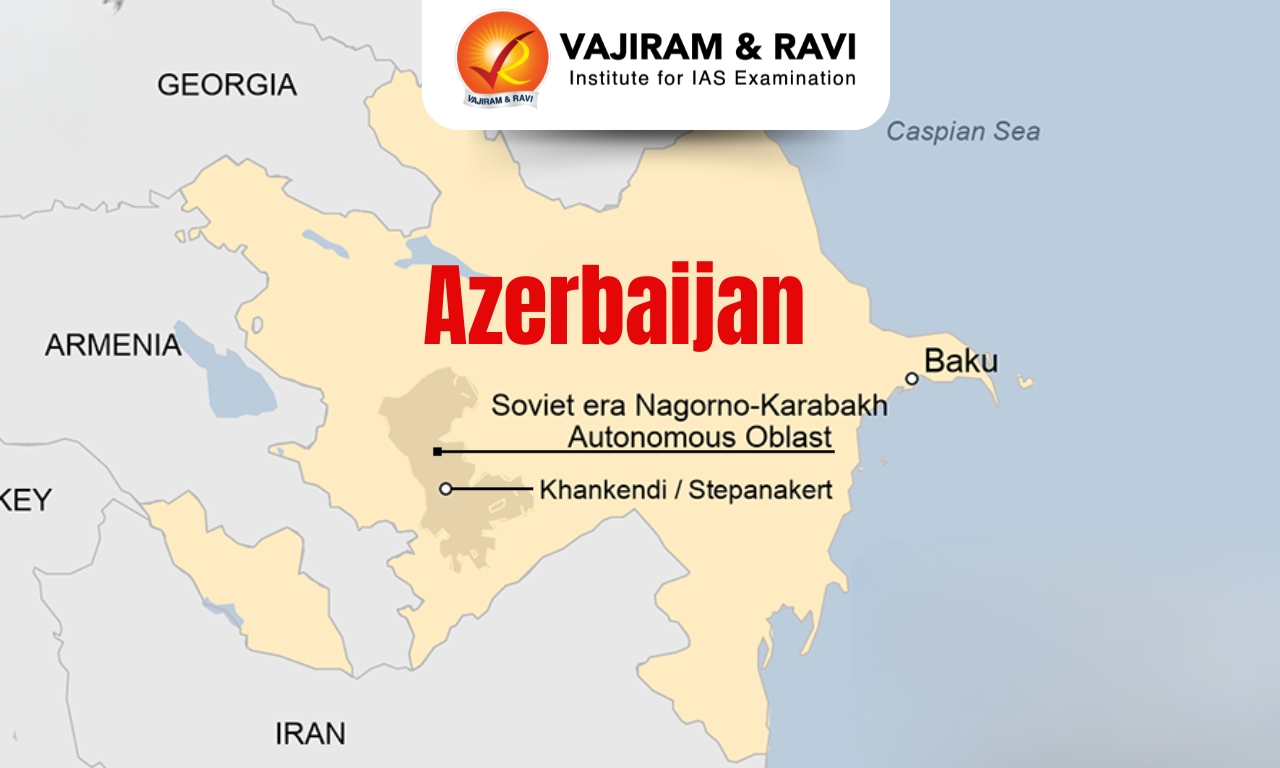
  • Azerbaijan, officially the Republic of Azerbaijan, is located at the junction of Eastern Europe and Western Asia along the southern flanks of the Caucasus Mountains.
  • It is bounded in the east by the Caspian Sea, the world's largest inland body of water.
  • Bordering Countries:  It is bordered by Russia in the north, Georgia in the northwest, Armenia in the west, and Iran in the south.
  • The country is highly mountainous, making human settlement very limited to along rivers and coastlines. 
  • Highest Point: Mount Bazardüzü is the highest peak in the Greater Caucasus Range and the highest mountain in Azerbaijan. 
  • History:
    • At various times Arabs, Persians, Turks, and Mongols dominated the land. 
    • Russia took over Azerbaijan in the early 1800s.  In 1918 Azerbaijan declared independence. 
    • In 1920, however, the new Soviet Union sent troops to take control of Azerbaijan. 
    • At first the Soviets combined Azerbaijan with Georgia and Armenia. 
    • In 1936 Azerbaijan became a separate Soviet republic. 
    • With the breakup of the Soviet Union, Azerbaijan gained independence again in 1991. 
  • Government Type: Presidential Republic 
  • Capital: The capital city, Baku, is famous for its modern architecture and historical sites, including the UNESCO World Heritage-listed Old City. 
    • For its location at 28 m below sea level, Baku is the largest city in the world located below sea level and also the lowest-lying national capital in the world.  
  • Climate: Its climate is highly varied and contains examples of nine out of the world’s eleven climate zones. Most of Azerbaijan is dry, with hot summers and mild winters.  
  • Major Rivers: Alazani, Aras, and Kura Rivers. 
  • Economy: 
    • Azerbaijan’s economy is driven by its natural resources and the service sector. 
    • Its major resources are petroleum (oil) and natural gas.  
    • Other resources consist of gold, silver, iron, titanium, copper, manganese, cobalt, molybdenum, and chromium.
    • The service sector, including information and communication services and tourism, employs almost half of the population.  
  • Currency: Azerbaijani manats (AZN) 
  • People:
    • Most of the country’s people are Azerbaijani, though there are a few Russians, Armenians, and other minority groups. 
    • Most people speak Azerbaijani, a Turkic language. 
    • More than 90 percent of the people are Muslims. 
  • Border Issues: Its relations with neighboring Armenia are tense, especially due to conflict over Nagorno-Karabakh during and following the collapse of the Soviet Union, of which they were both part. 

News: IE

Azerbaijan FAQs

Q1: Where is Azerbaijan located?

Ans: Azerbaijan is located at the junction of Eastern Europe and Western Asia, along the southern flanks of the Caucasus Mountains.

Q2: Which sea lies to the east of Azerbaijan?

Ans: The Caspian Sea lies to the east of Azerbaijan.

Q3: Which countries share land borders with Azerbaijan?

Ans: It is bordered by Russia in the north, Georgia in the northwest, Armenia in the west, and Iran in the south.

Q4: Which mountain is the highest peak in Azerbaijan?

Ans: Mount Bazardüzü is the highest peak in Azerbaijan.

Q5: What is the capital of Azerbaijan?

Ans: Baku is the capital of Azerbaijan.

Locus Coeruleus (LC)

Locus Coeruleus (LC)

Locus Coeruleus Latest News

Previously thought to broadcast the same chemical signal throughout the brain, a new study finds that the locus coeruleus (LC) actually sends targeted messages that help control learning, attention, and behavior, according to new research in mice.

About Locus Coeruleus 

  • The Locus Coeruleus (LC) is a small nucleus (cluster of nerve cells) located in the pons, a part of the brainstem. 
    • The Pons act as a connection between the cerebrum and cerebellum. 
  • The Locus Coeruleus gets its name from the Latin words for "blue place." 
  • Although it contains only a small fraction of the brain's neurons, it produces norepinephrine (NE), a chemical messenger that helps regulate attention, learning, heart rate, and the body's reactions to stress and excitement. 
  • LC is the primary source of norepinephrine to the brain. 
  • Recent Findings:
    • Scientists have long assumed that the LC operates like a loudspeaker, sending essentially the same norepinephrine signal across the brain. 
    • However, in a new study using brain imaging, recordings of neural activity, genetic techniques, and behavioral experiments, researchers discovered that the LC communicates through several distinct pathways. 
    • Rather than broadcasting one general message, it delivers signals to specific destinations, with different groups of neurons responding to different experiences. 
    • Different groups of cells communicate with specific regions of the nervous system. 
    • These pathways determine where signals trigger the release of norepinephrine, creating a much more organized communication network than previously recognized. 
    • Neurons in the upper (dorsal) portion of the LC primarily connect to the cerebral cortex and forebrain. 
    • Meanwhile, cells in the lower (ventral) portion send their signals mainly to the brainstem and spinal cord. 
    • This arrangement allows different parts of the LC to influence separate brain functions. 
  • Why the Discovery Could Matter for Brain Disorders?
    • Norepinephrine plays a central role in regulating attention and mood, making it an important target for medications used to treat depression, anxiety, and ADHD. 
    • Neurons in the LC are also among the earliest brain cells to deteriorate in Alzheimer's disease, suggesting that the new findings could have implications for understanding and treating these conditions. 
    • Current treatments that influence norepinephrine can affect multiple brain circuits at once, sometimes producing beneficial effects in one region while causing unwanted effects elsewhere. 
    • A clearer map of the LC's specialized pathways could help scientists develop therapies that act more selectively on the circuits involved in particular symptoms.

News: SD

Locus Coeruleus FAQs

Q1: What is the Locus Coeruleus (LC)?

Ans: The Locus Coeruleus is a small nucleus, or cluster of nerve cells, located in the pons of the brainstem.

Q2: Which neurotransmitter is primarily produced by the Locus Coeruleus?

Ans: The Locus Coeruleus primarily produces norepinephrine (noradrenaline).

Q3: Why is the Locus Coeruleus important for brain function?

Ans: It helps regulate attention, learning, alertness and the body's responses to stress and excitement.

Q4: What has recent research revealed about how the Locus Coeruleus communicates?

Ans: Recent research has revealed that the Locus Coeruleus communicates through several distinct pathways that deliver signals to specific destinations.

Indo-Tibetan Border Police

Indo-Tibetan Border Police

Indo-Tibetan Border Police Latest News

Recently, the Prime Minister of India extended his greetings to all personnel of the Indo-Tibetan Border Police (ITBP) on their Raising Day.

About Indo-Tibetan Border Police

  • It is a Central Armed Police Force functioning under the Ministry of Home Affairs, Government of India.
  • It guards 3,488 km long India-China borders ranging from the Karakoram Pass in Ladakh to Jachep La in Arunachal Pradesh. 
  • Background
    • It was raised in 1962, in the wake of the Sino-Indian War of 1962, for deployment along India’s border with China’s Tibet Autonomous Region.
    • ITBP was initially raised under the CRPF Act. However, in 1992, parliament enacted the ITBPF Act, and the rules thereunder were framed in 1994.
    • In 2004, ITBP was declared as a full-fledged central armed police force under the Ministry of Home Affairs.
  • Motto: “Shaurya-Dridhata-Karma Nishtha” (Valour – Determination – Devotion to Duty).
  • It is known as one of the most specialized mountain forces in the world, ITBP operates in some of the harshest and most remote areas.
  • ITBP trains its personnel in mountaineering, skiing, and tactical combat, in addition to maintaining readiness for disaster response and relief operations in the Himalayan region. 
  • Headed By: It is headed by a Director General under the Ministry of Home Affairs.
  • Headquarter: New Delhi.

Source: PIB

Indo-Tibetan Border Police FAQs

Q1: What is Indo-Tibetan Border Police?

Ans: It is a Central Armed Police Force functioning under the Ministry of Home Affairs, Government of India.

Q2: What is the motto of Indo-Tibetan Border Police?

Ans: “Shaurya-Dridhata-Karma Nishtha” (Valour – Determination – Devotion to Duty).

Sri Ranganathaswamy Temple

Sri Ranganathaswamy Temple

Sri Ranganathaswamy Temple Latest News

The Madurai Bench of the Madras High Court recently restrained registration authorities from registering documents relating to lands covered by an 1887 deed dedicating properties to the Sri Ranganathaswamy Temple in Srirangam.

About Sri Ranganathaswamy Temple

  • It is a prominent Hindu temple situated at Srirangam near Trichy in Tamil Nadu.
  • This temple lies on an islet formed by the twin rivers Cauvery and Coleroon.
  • It is the biggest functioning Hindu temple in India and is often found ranked amongst the largest religious complexes of the world.
  • Built across an area of 156 acres, this temple is dedicated to Ranganatha, a reclining form of Hindu deity, Lord Vishnu. 
  • It is the foremost of the eight self-manifested shrines of Lord Vishnu.
  • Though the temple has existed since the 2nd century BC, the archaeological inscriptions are available only from the 10th century CE.
  • This temple underwent many changes during the rule of the Cholas, Cheras, Pandiyas, Hoysalas, Vijayanagar kings, and Nayaks of Madurai.
  • In addition, influential Vaishnava leaders like Yamunacarya, Ramanujacarya, and Sudarsanacarya played pivotal roles in shaping the temple’s worship and its enduring legacy. 

Sri Ranganathaswamy Temple Architecture

  • The entire temple complex is a perfect example of Dravidian architecture. 
  • The temple is enclosed by seven concentric walls known as “ Prakaram”, symbolizing the seven planetary systems in Vedic cosmology. 
  • Within these walls, there are twenty-one towering entrances, known as gopurams, each adorned with intricate sculptures and designs. 
  • The primary entrance tower, named the “Rajagopuram,” soars to a remarkable height of 236 feet, making it the largest in Asia. 
  • The vimana over the sanctum of the temple is made up of gold.
  • There is also a royal temple tower, which covers a base area of 32,500 sq. ft. and has a height of 196 ft. 
  • It also comprises a hall containing 1000 pillars. Intricate sculptures are the most attractive part of the hall. The Hall was built during the Vijayanagara period (1336-1565).
  • Inside the temple, one can find inscriptions from the Chola dynasty, accompanied by tales of the Pandya, Hoysala, and Vijayanagara empires that once flourished alongside the Tiruchirappalli rule. 
  • A substantial part of Srirangam town resides within the periphery defined by the three outer walls of the temple complex. 

News: DT

Sri Ranganathaswamy Temple FAQs

Q1: Where is the Sri Ranganathaswamy Temple located?

Ans: The Sri Ranganathaswamy Temple is located at Srirangam near Tiruchirappalli (Trichy) in Tamil Nadu.

Q2: To which Hindu deity is the Sri Ranganathaswamy Temple dedicated?

Ans: The temple is dedicated to Lord Vishnu in his reclining form, known as Ranganatha.

Q3: What is the significance of the Sri Ranganathaswamy Temple in terms of size?

Ans: It is regarded as the largest functioning Hindu temple complex in India.

Q4: Which architectural style is followed by the Sri Ranganathaswamy Temple?

Ans: The temple is an outstanding example of Dravidian architecture.

Indo-Pacific Regional Dialogue (IPRD) 2026

Indo-Pacific Regional Dialogue (IPRD) 2026

Indo-Pacific Regional Dialogue Latest News

The Indian Navy will host the 2026 edition of the Indo-Pacific Regional Dialogue (IPRD) in New Delhi from November 3 to 5.

About Indo-Pacific Regional Dialogue 

  • IPRD is the Indian Navy’s annual apex-level international strategic dialogue. 
  • The idea of an annual IPRD was first conceptualised and conducted in 2018 as the apex-level conference of the Indian Navy.
  • It is organised in association with the National Maritime Foundation (NMF), the Navy’s knowledge partner. 
  • IPRD seeks to translate the broad framework of the Indo-Pacific Oceans Initiative (IPOI) into specific, actionable proposals. 
  • IPRD also supports India’s maritime vision of MAHASAGAR-Mutual and Holistic Advancement for Security and Growth Across Regions.
  • IPRD 2026:
    • It is the eighth edition of the IPRD.
    • Venue: Manekshaw Centre, New Delhi. 
    • Theme: Science, Technology, and Academic Cooperation in the Indo-Pacific. 
    • Notably, IPRD-2026 will expand its focus beyond traditional STEM disciplines to incorporate social sciences, life sciences, and the humanities into maritime deliberations. 
    • The three-day conference will bring together maritime practitioners, scientists, academicians, policymakers, and experts from 18 countries across the Indo-Pacific to formulate actionable proposals for regional cooperation. 
    • Five thematic sessions will be held during the conference. They will focus on
      • joint research, research networks, and human development; 
      • protection of critical maritime infrastructure and enhanced monitoring; 
      • climate resilience and ocean dynamics; 
      • maritime resilience and responsible management; and 
      • dual-use maritime technologies and their implications.
    • The event aims to identify concrete, solution-oriented measures across national, sub-regional, and pan-regional tiers. 

What is the Indo-Pacific Oceans Initiative (IPOI)? 

  • PM Narendra Modi proposed the IPOI at the East Asia Summit held in Bangkok, Thailand, on November 4, 2019.  
  • As an open global initiative, the IPOI draws on existing regional cooperation architecture and mechanisms to focus on seven central pillars. They are: 
    • Maritime security
    • Maritime ecology
    • Maritime resources
    • Capacity building and resource sharing
    • Disaster risk reduction and management
    • Science, technology, and academic cooperation
    • Trade connectivity and maritime transport.

Key Facts about National Maritime Foundation

  • It is the nation’s first maritime think tank for the conduct of independent and policy-relevant research on all ‘matters maritime’.  
  • The foundation was inaugurated on the 15th of February, 2005.
  • It was, from its very inception, designed to create and heighten maritime awareness amongst India’s policymakers, intellectual echelons, and civil society at large.  
  • While the NMF is an independent and autonomous think tank, its intellectual and organisational development is supported by the Ministry of Defence and the Indian Navy. 

News: TH

Indo-Pacific Regional Dialogue FAQs

Q1: What is the Indo-Pacific Regional Dialogue (IPRD)?

Ans: IPRD is the Indian Navy’s annual apex-level international strategic dialogue.

Q2: When was the Indo-Pacific Regional Dialogue first conceptualised and conducted?

Ans: The IPRD was first conceptualised and conducted in 2018.

Q3: Which organisation is associated with organising the Indo-Pacific Regional Dialogue alongside the Indian Navy?

Ans: The National Maritime Foundation (NMF), the Indian Navy’s knowledge partner, is associated with organising the IPRD.

Q4: What is the primary objective of the Indo-Pacific Regional Dialogue?

Ans: It seeks to translate the broad framework of the Indo-Pacific Oceans Initiative (IPOI) into specific, actionable proposals.

Q5: What is the theme of the Indo-Pacific Regional Dialogue 2026?

Ans: The theme is “Science, Technology, and Academic Cooperation in the Indo-Pacific.”

Amur Falcon

Amur Falcon

Amur Falcon Latest News

Recently, the two satellite-tagged Amur Falcons (Falco amurensis) have returned to Manipur after travelling across 23 countries in Asia and Africa.  

About Amur Falcon

  • It is a migratory raptor of the falcon family.
  • Other Names: Eastern Red-footed Falcon, Eastern Red-footed Kestrel, Manchurian Falcon, and Red-legged Falcon.
  • Habitat: It is found across open forests, grasslands, wetlands and agricultural landscapes.
  • Distribution: They breed in southeastern Siberia and Northern China and migrate long distances in large flocks to winter in Southern and East Africa.
    • Along the way, large numbers pass through India, with the biggest congregations seen in the northeastern states mainly in Nagaland, Manipur, and parts of Assam and Arunachal Pradesh.
  • Features
    • The male and female are distinctly different. 
    • The male is a dark, sooty grey, with brownish-red thighs and vent. 
    • When flying, a white lining of the male’s wings stands out against the sooty grey. 
    • The female has a pattern common among many falcon species, with a dark spotted chest and vent against a white background and a darker, grey back. 
    • A distinctive feature of both the male and the female is the orange of the eye-ring, beak base (the cere) and feet. 
    • In addition to speed and strength, these birds are known to have keen eyesight for detecting prey from a distance or during flight.
  • Threats: Hunting during migration and habitat loss at roosting sites, and changing weather patterns.
  • Conservation Status
    • IUCN Red List: Least Concern
    • Wildlife (Protection) Act, 1972:  Schedule IV

Source: News On Air

Amur Falcon FAQs

Q1: What is Amur Falcon?

Ans: It is a migratory raptor of the falcon family.

Q2: Where do we find Amur Falcon?

Ans: It is found across open forests, grasslands, wetlands and agricultural landscapes.

Enquire Now