


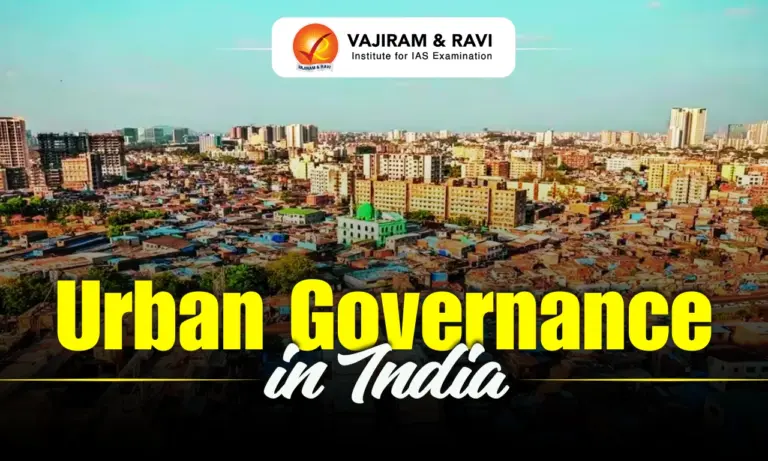
A series of fatal urban disasters in 2026, including the Aliganj (Lucknow) fire that claimed 15 lives and the Malviya Nagar (Delhi) fire, has exposed the growing Urban Governance Crisis in India. These incidents have highlighted how illegal construction, weak enforcement, fragmented institutions and lack of accountability continue to convert preventable risks into human tragedies.
Urban Governance in India
Urban governance refers to the planning, regulation and management of cities through institutions such as Urban Local Bodies (ULBs), Development Authorities and various public agencies. It covers urban planning, land use, infrastructure, public health, disaster management and civic service delivery.
The 74th Constitutional Amendment Act, 1992 sought to establish municipalities as institutions of self-government through Article 243W and the Twelfth Schedule, which assigns 18 municipal functions. However, governance in most Indian cities remains fragmented, centralised and weakly accountable.
With cities contributing nearly two-thirds of India’s GDP and India’s urban population projected to approach 50% by 2047, addressing the Urban Governance Crisis in India is essential for achieving Viksit Bharat.
Nature of the Urban Governance Crisis in India
Recent disasters demonstrate that the Urban Governance Crisis in India extends far beyond inadequate infrastructure.
- The Lucknow fire (2026) occurred in an illegally operating commercial establishment inside a residential locality without functional fire exits despite earlier demolition notices.
- The Delhi Malviya Nagar fire similarly exposed unauthorised construction and poor emergency preparedness.
- Fires in Bhiwadi (Rajasthan) and Virudhunagar (Tamil Nadu) were linked to illegal industrial units operating in violation of safety norms.
- Repeated flooding in Mumbai and Bengaluru, contaminated water-related deaths in Indore, and civic hazards in Noida reveal deeper failures in urban planning and governance.
Despite different political administrations, these incidents reflect similar governance failures.


Reasons for the Urban Governance Crisis in India
The Urban Governance Crisis in India stems from structural, institutional, financial and administrative weaknesses that have undermined the capacity of cities to ensure safe, planned and resilient urban development.
- Institutional fragmentation: Urban governance is divided among municipal corporations, development authorities, public works departments, transport agencies and water boards, leading to overlapping responsibilities and weak coordination. The NITI Aayog report Moving Towards Effective City Government (2026) identifies fragmented governance as a major challenge.
- Weak regulatory enforcement: Despite comprehensive building bye-laws, land-use regulations and fire safety norms, illegal constructions and unsafe commercial activities continue because of poor enforcement, corruption, political patronage and delayed administrative action.
- Unplanned urbanisation: Rapid urban growth has outpaced planning capacity, resulting in mixed land use, inadequate emergency infrastructure, congested neighbourhoods and growing pressure on drainage, roads and public utilities.
- Poor disaster preparedness: Weak fire safety audits, inadequate emergency response systems and limited disaster planning have made cities increasingly vulnerable to fires, floods and other urban disasters.
- Technology-governance gap: Although India possesses technologies such as Artificial Intelligence (AI), Geographic Information Systems (GIS), drones and satellite imagery to detect illegal constructions and monitor compliance, these tools are not systematically integrated into urban governance and regulatory enforcement.
- Limited municipal capacity: Most Urban Local Bodies (ULBs) suffer from inadequate financial autonomy, low municipal revenues and shortages of planners, engineers, architects, fire safety experts and disaster management professionals. The RBI Report on Municipal Finances highlights the need to strengthen municipal fiscal capacity.
- Ethical and accountability deficit: Corruption, administrative negligence and weak accountability mechanisms allow repeated violations to persist with limited consequences, while post-disaster inquiries rarely translate into meaningful institutional reforms.
Consequences of the Urban Governance Crisis in India
Weak urban governance has serious human, economic, social and environmental consequences, undermining the quality and sustainability of urban development.
- Loss of lives and property: Poor enforcement of safety norms increases the frequency of preventable disasters such as fires, building collapses and urban flooding.
- Declining public trust: Repeated governance failures and weak accountability reduce citizens’ confidence in public institutions and regulatory authorities.
- Economic losses: Infrastructure failures, business disruptions and disaster recovery impose significant costs on governments, businesses and households.
- Reduced urban resilience: Inadequate planning and weak disaster preparedness make cities more vulnerable to climate change, extreme weather events and other urban risks.
- Environmental degradation: Unplanned urbanisation, illegal construction and encroachments damage natural drainage systems, green spaces and urban ecosystems.
- Rising social inequality: Vulnerable groups, particularly the urban poor and informal settlements, bear the highest burden of unsafe infrastructure and inadequate civic services.
- Slower sustainable urban development: Weak governance hinders the achievement of SDG 11 (Sustainable Cities and Communities) and India’s vision of Viksit Bharat 2047.
Challenges in Addressing the Urban Governance Crisis
Despite constitutional reforms and multiple urban development initiatives, several challenges continue to impede effective urban governance reforms.
- Incomplete decentralisation: The 74th Constitutional Amendment remains inadequately implemented, with limited devolution of Functions, Funds and Functionaries (3Fs) to Urban Local Bodies.
- Weak municipal capacity: Many ULBs lack financial autonomy, skilled manpower and technical expertise for effective urban planning and service delivery.
- Inter-agency coordination: Overlapping jurisdictions and poor coordination among multiple urban agencies delay decision-making and accountability.
- Political economy constraints: Political interference, corruption and regulatory capture often weaken enforcement against illegal constructions and safety violations.
- Rapid urbanisation: Fast-growing cities continue to outpace planning, infrastructure creation and regulatory oversight.
- Climate and technological adaptation: Integrating climate resilience and digital technologies such as AI, GIS and drones into routine urban governance remains limited.
Way Forward
Resolving the Urban Governance Crisis in India requires strengthening institutions rather than merely introducing new urban schemes.
- Fully implement the 74th Constitutional Amendment by empowering Urban Local Bodies with adequate powers, finances and personnel.
- Clearly define institutional responsibilities to eliminate overlapping jurisdictions and accountability gaps.
- Strictly enforce building bye-laws, land-use regulations and fire safety standards through regular independent audits.
- Integrate AI, GIS, drones and satellite-based monitoring into urban regulatory enforcement and compliance systems.
- Strengthen municipal finances and professionalise urban administration through greater recruitment of planners, engineers and disaster management experts.
- Mainstream disaster resilience, fire safety and climate adaptation into urban planning in line with NDMA Guidelines, the Sendai Framework and SDG 11.
- Promote transparency, digital governance, citizen participation and independent oversight to improve accountability.

 Last updated on Oct, 2026
→ UPSC 2027 Notification will be released on 13 January 2027 at upsconline.nic.in.
→ Check Nobel Prize 2026 Winners List here.
→ Download PIB PRiSM Monthly Magazine 2026 here.
→ Check UPSC Monthly Current Affairs Magazine The Recitals here.
→ Check out the latest UPSC Syllabus here.
→ Download UPSC Model Answers for Mains 2026
→ UPSC Mains Question Paper 2026 is out now for Essay & GS Paper 1, 2, 3 & 4.
→ UPSC Calendar 2027 has been released.
→ Enroll in Vajiram & Ravi’s UPSC Mains Test Series 2027 for structured answer writing practice, expert evaluation, and exam-oriented feedback.
→ Join Vajiram & Ravi’s UPSC Mentorship Program 2027 for personalized guidance, strategy planning, and one-to-one support from experienced mentors.
→ Go through the UPSC Mains Previous Year Papers to enhance your preparation.
→ UPSC has released UPSC Toppers List 2025 with the Civil Services final result on its official website.
→ Also check Best UPSC Coaching in India
Urban Governance in India FAQs
Q1. What is meant by the Urban Governance Crisis in India?+
Q2. What are the major reasons behind the Urban Governance Crisis in India?+
Q3. How has the 74th Constitutional Amendment addressed Urban Governance in India?+
Q4. Why is technology important for addressing the Urban Governance Crisis in India?+
Q5. What is the way forward to overcome the Urban Governance Crisis in India?+
Tags: urban governance in india








