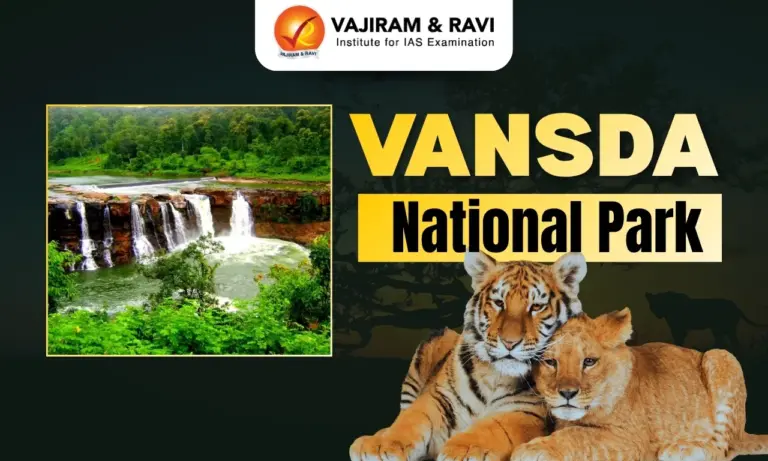
Vansda National Park is one of Gujarat’s richest biodiversity hotspots and an important protected area representing the northernmost extension of the Western Ghats ecosystem. Although it is one of the smallest national parks in the state, it is renowned for its dense tropical moist deciduous forests, perennial streams, rich floral and faunal diversity, and well-preserved natural habitat.
Vansda National Park Historical Background
The forests of Vansda were once part of the princely State of Vansda and were carefully protected by its rulers, who discouraged commercial felling to preserve valuable timber resources. Owing to its exceptional ecological importance, the Government of Gujarat declared the area a National Park in 1979. Even before its notification, tree felling had largely been prohibited since 1952, helping preserve its old-growth forest ecosystem. Today, the park serves as one of Gujarat’s finest examples of tropical moist deciduous forests.
Vansda National Park Location and Geographical Features
Vansda National Park is situated in Navsari district of southern Gujarat, close to the Gujarat-Maharashtra border. It covers an area of 23.99 sq km, making it one of the smallest national parks in Gujarat.
- It lies in the Dang forest region and forms the northern and western limit of the Western Ghats (Sahyadri Range).
- The Ambika River flows through the park, supporting its rich biodiversity.
- The terrain consists of gentle hills, valleys, perennial streams and dense forests.
- The park receives nearly 2,000 mm of annual rainfall, which maintains lush green forests throughout the year.
- It forms a continuous forest landscape with the forests of the neighbouring Dang district, enhancing wildlife movement and ecological connectivity.


Vansda National Park Floral Diversity
The flora of Vansda National Park reflects the rich tropical moist deciduous forests of southern Gujarat and provides an ideal habitat for numerous wildlife species.
- The forest is dominated by Teak (Tectona grandis), along with Bamboo, which together form a dense canopy.
- Other important tree species include Mahuda, Kusum, Khair, Sadad, Sisam, Timru, Behada, Asan, Amla, Shimlo, Humb and Dudhkod.
- More than 440 species of flowering plants have been recorded from the park.
- Colourful orchids are commonly found along the banks of the Ambika River.
- Dense climbers, shrubs, medicinal plants and giant creepers further enhance the ecological richness of the forest.
Vansda National Park Faunal Diversity
The dense forests of Vansda National Park provide suitable habitat for a wide range of mammals, reptiles and birds.
- Leopard is the apex predator and the most important carnivore of the park.
- The park supports mammals such as Dhole (Indian Wild Dog), Sloth Bear, Four-horned Antelope (Chousingha), Barking Deer, Spotted Deer, Wild Boar, Striped Hyena, Hanuman Langur, Rhesus Macaque, Indian Giant Squirrel, Flying Squirrel, Pangolin, Common Palm Civet, Small Indian Civet, and Jungle Cat.
- Reptiles include the Indian Rock Python, King Cobra, Russell’s Viper, Krait and other snakes.
- The park is an important bird habitat with over 150 bird species, including Malabar Trogon, Grey Hornbill, Paradise Flycatcher, Racket-tailed Drongo, Woodpeckers, Emerald Dove, Sunbirds and Peafowl.
- Rich butterfly diversity further enhances the ecological value of the park.
Vansda National Park Ecological Significance
Vansda National Park is one of the few remaining patches of dense natural forests in Gujarat and plays a vital role in conserving the state’s moist deciduous ecosystem.
- Represents the northernmost extension of the Western Ghats biodiversity.
- Conserves one of Gujarat’s best-preserved tropical moist deciduous forests.
- It serves as an important watershed for the Ambika River.
- Maintains ecological connectivity with the forests of the Dang region.
- Provides habitat for several rare mammals, reptiles, orchids and endemic bird species.
- Supports eco-tourism and biodiversity research in southern Gujarat.

 Last updated on Oct, 2026
→ UPSC 2027 Notification will be released on 13 January 2027 at upsconline.nic.in.
→ Check Nobel Prize 2026 Winners List here.
→ Download PIB PRiSM Monthly Magazine 2026 here.
→ Check UPSC Monthly Current Affairs Magazine The Recitals here.
→ Check out the latest UPSC Syllabus here.
→ Download UPSC Model Answers for Mains 2026
→ UPSC Mains Question Paper 2026 is out now for Essay & GS Paper 1, 2, 3 & 4.
→ UPSC Calendar 2027 has been released.
→ Enroll in Vajiram & Ravi’s UPSC Mains Test Series 2027 for structured answer writing practice, expert evaluation, and exam-oriented feedback.
→ Join Vajiram & Ravi’s UPSC Mentorship Program 2027 for personalized guidance, strategy planning, and one-to-one support from experienced mentors.
→ Go through the UPSC Mains Previous Year Papers to enhance your preparation.
→ UPSC has released UPSC Toppers List 2025 with the Civil Services final result on its official website.
→ Also check Best UPSC Coaching in India
Vansda National Park FAQs
Q1. Where is Vansda National Park located?+
Q2. Which type of forest is found in Vansda National Park?+
Q3. Which are the important animal species found in Vansda National Park?+
Q4. Why is Vansda National Park important?+
Q5. Which river flows through Vansda National Park?+
Tags: vansda national park