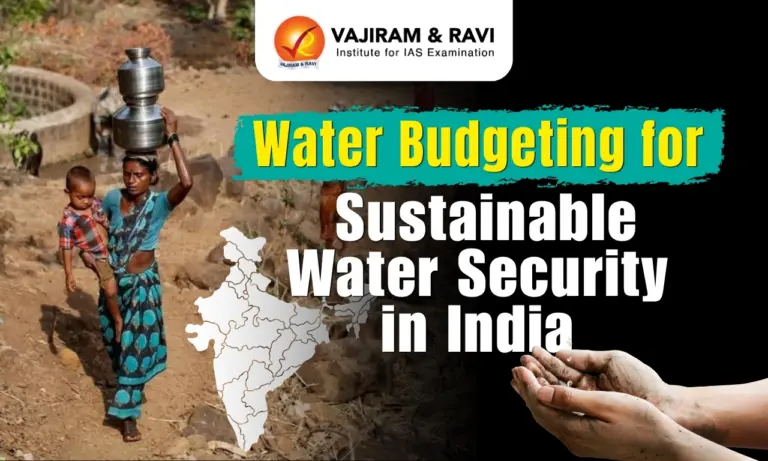
Water budgeting is emerging as a critical governance tool in India to ensure sustainable water security in the face of rising demand, groundwater depletion, and climate variability. By systematically “counting every drop,” it enables scientific planning of water use across agriculture, domestic needs, and livestock, thereby strengthening resilience at the local level and supporting long-term sustainability.
Water Resource in India
- According to the Central Water Commission India receives about 3,880 Billion Cubic Metres (BCM) of annual rainfall, but only around 1,999 BCM is usable water after natural losses.
- India supports 17.5% of the world’s population and 11.6% of global livestock, creating very high pressure on limited water resources.
- Agriculture uses about 80–90% of rural water, making irrigation the biggest driver of demand.
- Major challenges include falling groundwater levels, seasonal water scarcity, and conflicts between agriculture, domestic use, and industry.
These challenges highlight the need to shift from supply-side solutions (like building more dams) to demand-side management, where tools like water budgeting help plan and control water use efficiently.
Water Budgeting: Concept and Mechanism
Water budgeting is a systematic method of estimating and balancing the total water available in a region with its total water demand to ensure sustainable and efficient use of water resources.
Mechanism of Water Budgeting:
It involves the step-by-step process of assessing water availability and demand to ensure balanced, efficient, and sustainable use of water resources at the local level.
- Estimation of Water Availability (Supply Side): Total water availability is assessed from rainfall, surface water bodies (rivers, ponds, tanks), and groundwater recharge. Losses such as evaporation, runoff, and seepage are deducted to arrive at usable water
- Estimation of Water Demand: Total water requirement is calculated across sectors such as agriculture, domestic use, livestock, and small industries (where applicable). This helps understand the pressure on available water resources.
- Water Balance Calculation: A comparison is made between total water availability and total water demand. This helps identify whether a region is in a water surplus or water deficit/stress situation.
- Planning and Decision-Making: Based on the water balance, decisions are taken on crop selection, irrigation methods (drip/sprinkler), and water conservation measures. It supports local-level water security and sustainable resource planning.
- Implementation Support: Gram Panchayats and local institutions use water budgeting to prepare annual water plans and budgets. It also helps in monitoring water use and adopting corrective measures for efficient management.


Significance of Water Budgeting
Water budgeting is important because it promotes scientific, participatory, and sustainable management of water resources by balancing water availability with water demand at the local level.
- Scientific Water Management: Helps assess total water availability from rainfall, surface water, and groundwater against sector-wise demand, enabling evidence-based and data-driven planning.
- Shift towards Demand-Side Governance: Moves water management away from excessive extraction and supply expansion towards efficient use, conservation, and planned allocation of water resources.
- Sustainable Agriculture: Supports crop planning according to local water availability, promotes crop diversification, and encourages efficient irrigation methods such as drip and sprinkler systems.
- Groundwater Conservation: Helps identify water-stressed and over-exploited areas, supports groundwater recharge planning, and reduces unsustainable extraction of aquifers.
- Climate Resilience: Improves preparedness against droughts, erratic rainfall, seasonal shortages, and climate variability by enabling adaptive and location-specific water planning.
- Participatory and Decentralised Governance: Strengthens the role of Gram Panchayats, Gram Sabhas, SHGs, and Water User Associations in local water planning and community-led resource management.
- Balanced Water Allocation: Enables efficient and equitable distribution of water across agriculture, domestic consumption, livestock, fisheries, and other livelihood activities.
- Livelihood and Rural Security: Ensures reliable water availability for agriculture and allied sectors, improving productivity, reducing risks, and strengthening rural livelihoods.
- Technology-Enabled Planning: Digital tools such as the Varuni web application improve accuracy in water assessment, monitoring, and identification of water surplus and deficit areas.
- Supports National Water Missions: Strengthens implementation of programmes like Atal Bhujal Yojana, National Water Mission, and state-level water conservation initiatives focused on sustainable water security.
- Promotes Integrated Water Resources Management (IWRM): Encourages coordinated and long-term management of surface water, groundwater, agriculture, and ecosystems for sustainable development.
Institutional Framework and Key Government Initiatives
India has increasingly institutionalised water budgeting through national missions, state-level programmes, community participation, and technology-driven governance to promote sustainable and decentralised water management.
Atal Bhujal Yojana (Atal Jal)
- Launched: 2019
- Ministry: Ministry of Jal Shakti
- Type: World Bank-assisted Central Sector Scheme
- Objective: Sustainable management of groundwater resources through community participation, behavioural change, and demand-side water management in groundwater-stressed regions.
- Coverage: Implemented across 229 blocks in 7 groundwater-stressed states — Gujarat, Haryana, Karnataka, Madhya Pradesh, Maharashtra, Rajasthan, and Uttar Pradesh.
- Major Features:
- Mandatory preparation of Gram Panchayat-level water budgets and Water Security Plans.
- Focus on demand-side management rather than only increasing water supply.
- Promotion of crop diversification, micro-irrigation (drip and sprinkler systems), and efficient water-use practices.
- Revival and strengthening of traditional water conservation structures such as Johad, Baodi/Bawdi, Tanka, Diggi, Kalyani, and Gokatte.
- Capacity-building programmes for local institutions and communities to improve participatory groundwater governance.
- Major Outcomes:
- More than 8,203 water budgets prepared across participating Gram Panchayats.
- Around 81,700 water conservation and recharge structures were created or restored.
- Demand-side interventions promoted across nearly 9 lakh hectares.
- Several groundwater-stressed blocks recorded measurable improvement in groundwater levels during 2023–25 assessments.
National Water Mission (NWM)
- Launched: 2011 under the National Action Plan on Climate Change (NAPCC)
- Ministry: Ministry of Jal Shakti (erstwhile Ministry of Water Resources)
- Objective: Conservation of water, minimisation of wastage, and promotion of Integrated Water Resources Management (IWRM) for sustainable and equitable water use.
- Key Features:
- Target to improve water-use efficiency by 20%.
- Promotion of basin-level planning, aquifer management, and scientific water budgeting.
- Encourages participatory and decentralised water governance involving local communities and Panchayati Raj Institutions.
- Integrates water conservation with climate adaptation and sustainable development strategies.
- Nari Shakti se Jal Shakti Initiative:
- Promotes women-led participation in water governance through Self-Help Groups (SHGs), Water User Associations (WUAs), and Village Water & Sanitation Committees (VWSCs).
- Strengthens grassroots awareness, water conservation practices, and community ownership of water resources.
Role of Technology in Water Budgeting: Varuni Web Application
- Varuni Web Application is a digital platform developed to prepare scientific and user-friendly block-level water budgets for local water planning and management.
- It was developed under the Indo-German WASCA (Water Security and Climate Adaptation in Rural India) project in collaboration with the Ministry of Jal Shakti, Ministry of Rural Development, and NITI Aayog.
- The platform automatically integrates government data related to rainfall, groundwater, land use, cropping patterns, population, and water resources.
- It uses a cycle-based approach to compare total water availability (supply) with total water demand at the block level.
- Varuni helps identify water surplus and water deficit areas, enabling better planning and prioritisation of interventions.
- It supports local authorities in planning groundwater recharge, rainwater harvesting, crop diversification, water conservation structures, and efficient irrigation methods like drip and sprinkler systems.
- The application uses an automated computational framework, reducing manual intervention and minimising errors in water assessment and planning.
State-Level Innovations
Several states in India have adopted community-based and technology-supported water budgeting models to improve water conservation, groundwater recharge, and drought resilience.
- Maharashtra – Hiware Bazar Model: Community-led water budgeting, watershed development, rainwater harvesting, and restrictions on deep borewells transformed the drought-prone village into a water-secure and climate-resilient model.
- Maharashtra – Jalyukt Shivar Abhiyan (2014): Focused on drought-proofing villages through water conservation, groundwater recharge, geotagging, and village-level water budgeting, resulting in improved groundwater levels and agricultural productivity.
- Rajasthan – Mukhyamantri Jal Swavlamban Abhiyan (2016): Adopted the “Four Waters Concept” and Gram Sabha-based water budgeting to improve groundwater recharge, reduce runoff losses, and enhance water access in drought-prone regions.
- Gujarat – Participatory Groundwater Management: Community participation and local water planning have been promoted in groundwater-stressed areas to encourage efficient irrigation and sustainable groundwater use.
- Karnataka – Watershed-Based Water Planning: Focus on watershed management, tank rejuvenation, and local water budgeting to improve rural water security and groundwater recharge.
- Andhra Pradesh – Community Managed Groundwater Systems: Encouraged farmers’ participation in groundwater monitoring and crop planning based on available water resources.
Challenges in Water Budgeting
Despite strong policy support and successful pilot models, water budgeting in India faces multiple structural, institutional, and implementation-related constraints that limit its scalability and effectiveness.
- Data Gaps and Poor Hydrological Information: Lack of reliable local data on rainfall, groundwater levels, surface water availability, and crop-water demand makes accurate Gram Panchayat-level water budgeting difficult.
- Weak Local Institutional Capacity: Many Gram Panchayats lack trained personnel, technical expertise, and financial resources to prepare, monitor, and implement water budgets effectively.
- Fragmented Governance and Jurisdictional Overlaps: Water governance is divided among multiple departments such as irrigation, agriculture, groundwater, drinking water, and rural development, leading to poor coordination and silo-based planning.
- Limited Community Ownership: In several regions, Gram Sabha participation remains weak, while women, small farmers, and vulnerable groups often remain excluded from water governance and allocation decisions.
- Disconnect Between Water Budgets and Actual Planning: Water budgets are frequently treated as administrative compliance documents rather than integrated planning tools linked with agriculture, MGNREGS, irrigation, and rural development planning.
- Groundwater Over-Extraction and Unsustainable Cropping Patterns: Continued cultivation of water-intensive crops and excessive borewell extraction undermine demand-side water management efforts.
- Climate Variability and Forecast Uncertainty: Irregular monsoons, droughts, floods, and extreme weather events reduce the reliability of static water budgets and complicate long-term planning.
- Digital Divide and Limited Technology Access: Technology platforms like the Varuni web application require internet connectivity, digital infrastructure, and technical literacy, which remain limited in many remote and tribal regions.
- Financial and Infrastructure Constraints: Inadequate funding and poor maintenance of water conservation structures weaken the long-term sustainability of water budgeting initiatives.
- Low Awareness and Behavioural Resistance: Farmers and local communities may resist changes in cropping patterns, irrigation methods, and groundwater usage practices due to economic dependence and lack of awareness.
Way Forward
India can achieve sustainable water security by expanding water budgeting through better planning, community participation, technology use, and climate-resilient water management.
- Expand Water Budgeting Across India: The success of the Atal Bhujal Yojana in 229 groundwater-stressed blocks should be extended to all water-stressed regions of the country.
- Link Water Budgeting with Crop Planning: Water budgets should guide Kharif and Rabi crop planning so that farmers grow crops according to locally available water resources.
- Strengthen Community Participation: Women-led SHGs and Water Users’ Associations (WUAs) should be given training, data access, and greater decision-making roles in local water governance.
- Increase Use of Technology: Digital tools like the Varuni web application should be expanded to all districts and made accessible even in rural areas with poor internet connectivity.
- Revive Traditional Water Conservation Systems: Traditional structures such as Johad, Bawdi, Tanka, and Diggi should be restored and included in watershed and rural development programmes.
- Ensure Convergence of Government Schemes: Schemes such as MGNREGS, PM Krishi Sinchayee Yojana, Jal Jeevan Mission, and PMKSY should work together to support integrated village-level water planning.
- Promote Climate-Resilient Water Planning: Water budgeting should include climate and rainfall variability data to prepare better plans for drought-prone and flood-prone areas.

 Last updated on Oct, 2026
→ UPSC 2027 Notification will be released on 13 January 2027 at upsconline.nic.in.
→ Check Nobel Prize 2026 Winners List here.
→ Download PIB PRiSM Monthly Magazine 2026 here.
→ Check UPSC Monthly Current Affairs Magazine The Recitals here.
→ Check out the latest UPSC Syllabus here.
→ Download UPSC Model Answers for Mains 2026
→ UPSC Mains Question Paper 2026 is out now for Essay & GS Paper 1, 2, 3 & 4.
→ UPSC Calendar 2027 has been released.
→ Enroll in Vajiram & Ravi’s UPSC Mains Test Series 2027 for structured answer writing practice, expert evaluation, and exam-oriented feedback.
→ Join Vajiram & Ravi’s UPSC Mentorship Program 2027 for personalized guidance, strategy planning, and one-to-one support from experienced mentors.
→ Go through the UPSC Mains Previous Year Papers to enhance your preparation.
→ UPSC has released UPSC Toppers List 2025 with the Civil Services final result on its official website.
→ Also check Best UPSC Coaching in India
Water Budgeting for Sustainable Water Security in India FAQs
Q1. What is water budgeting?+
Q2. Why is water budgeting important in India?+
Q3. Which major government scheme promotes water budgeting in India?+
Q4. What is the role of the Varuni Web Application in water budgeting?+
Q5. What are the major challenges in water budgeting?+
Tags: water budgeting