About Wealth Tax
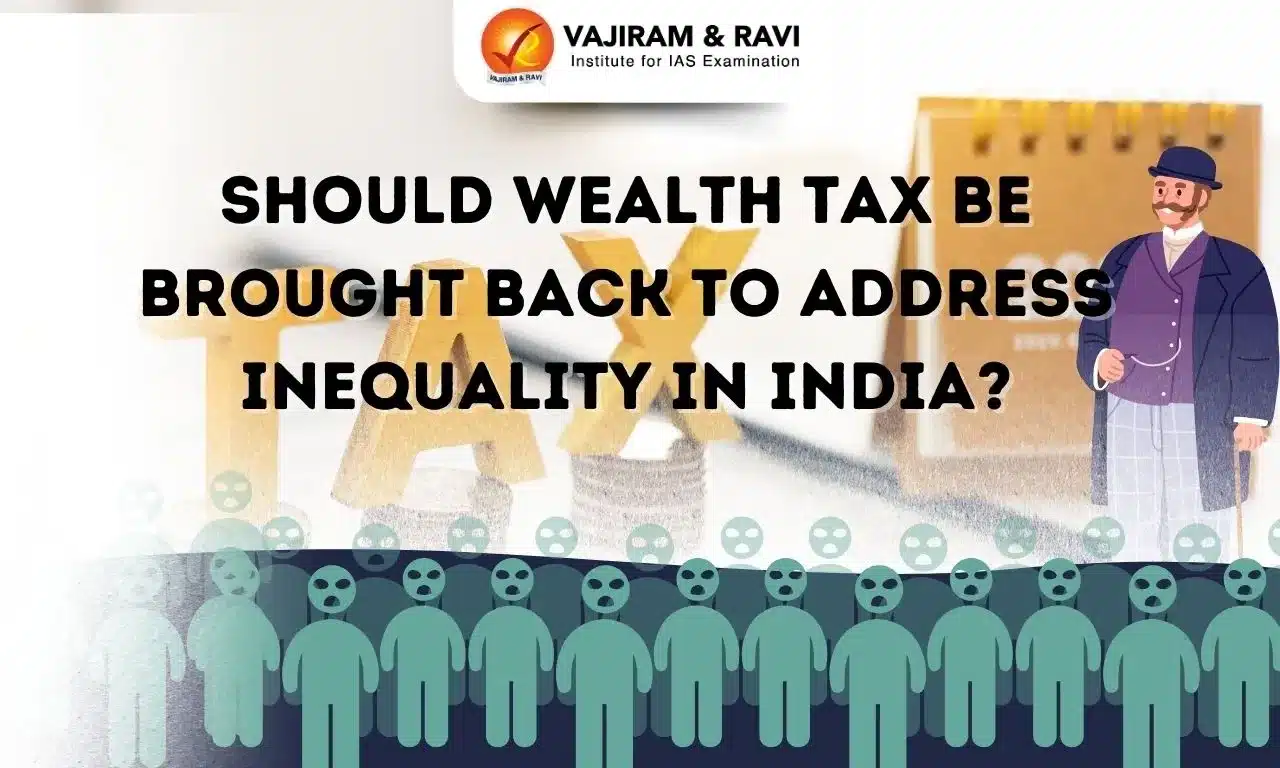
- Wealth Tax is levied on the net market value of various assets owned by an individual, such as cash, bank deposits, shares, fixed assets, personal cars, and real property.
- Globally, several countries like France, Portugal, and Spain impose wealth tax.
- The primary objective of the tax is to target unproductive and non-essential assets of individuals.
Wealth Tax in India
- Introduction: The Wealth Tax Act was introduced in 1957 based on the recommendations of the Kaldor Committee (1955) as a part of tax rationalization measures.
- It imposed a 1% tax on earnings exceeding ₹30 lakh per annum for individuals, Hindu Undivided Families (HUFs), and companies.
- Abolition: Abolished in 2015 due to issues such as Extensive litigation, Increased compliance burden, and High administrative costs.
- Replaced by an increase in the surcharge on the super-rich.
- Replacement measures: The surcharge for individuals with income exceeding ₹1 crore and companies with income over ₹10 crore was increased from 2% to 12%.
Other Relevant Concepts
- Tobin Tax: A tax on financial transactions, especially currency exchanges.
- Pigovian Tax: Levied to correct negative externalities (e.g., pollution tax).
- Laffer Curve: Demonstrates the relationship between tax rates and tax revenue.
- Tax-GDP Ratio: Indicates the tax revenue as a percentage of GDP, critical for fiscal analysis.
Q1) What is the Goods and Services Tax Council?
The GST Council, established through the Constitutional (122nd Amendment) Act, 2016, recommends policies on Goods and Services Tax (GST) to the Union and State governments. It became functional after Presidential assent on September 8, 2016, ensuring cooperative federalism.
Source: TH


 Last updated on Oct, 2026
→ UPSC 2027 Notification will be released on 13 January 2027 at upsconline.nic.in.
→ Asian Games 2026 are being held in Aichi-Nagoya, Japan, from 19 September to 4 October.
→ Check Nobel Prize 2026 Winners List here.
→ Download PIB PRiSM Monthly Magazine 2026 here.
→ Check UPSC Monthly Current Affairs Magazine The Recitals here.
→ Check out the latest UPSC Syllabus here.
→ Download UPSC Model Answers for Mains 2026
→ UPSC Mains Question Paper 2026 is out now for Essay & GS Paper 1, 2, 3 & 4.
→ UPSC Calendar 2027 has been released.
→ Enroll in Vajiram & Ravi’s UPSC Mains Test Series 2027 for structured answer writing practice, expert evaluation, and exam-oriented feedback.
→ Join Vajiram & Ravi’s UPSC Mentorship Program 2027 for personalized guidance, strategy planning, and one-to-one support from experienced mentors.
→ Go through the UPSC Mains Previous Year Papers to enhance your preparation.
→ UPSC has released UPSC Toppers List 2025 with the Civil Services final result on its official website.
→ Also check Best UPSC Coaching in India