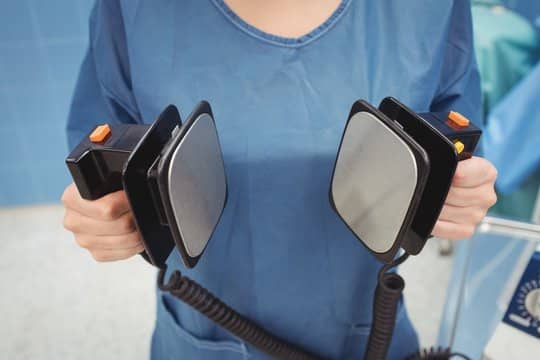
About Defibrillators:
- Defibrillators are devices that send an electric pulse or shock to the heart to restore a normal heartbeat.
- They are used to prevent or correct an arrhythmia, an uneven heartbeat that is too slow or too fast.
- If the heart suddenly stops, defibrillators can also help it beat again.
- There are three types of defibrillators: AEDs, ICDs, and WCDs.
- Automated External Defibrillators (AED):
- An AED is a lightweight, battery-operated, portable device that checks the heart’s rhythm and sends a shock to the heart to restore normal rhythm.
- The device is used to help people having cardiac arrest.
- Implantable Cardioverter Defibrillators (ICDs):
- ICDs are placed through surgery in the chest or stomach area, where the device can check for arrhythmias.
- Arrhythmias can interrupt the flow of blood from your heart to the rest of your body or cause your heart to stop.
- The ICD sends a shock to restore a normal heart rhythm.
- Wearable Cardioverter Defibrillators (WCDs):
- WCDs have sensors that attach to the skin.
- They are connected by wires to a unit that checks your heart’s rhythm and delivers shocks when needed.
- Like an ICD, the WCD can deliver low- and high-energy shocks. The device has a belt attached to a vest that is worn under your clothes.
- Automated External Defibrillators (AED):
- Your provider fits the device to your size. It is programmed to detect a specific heart rhythm.
Q1) What is an arrhythmia?
An arrhythmia is a heart rhythm that isn’t normal. Your heart may be beating too fast when you’re at rest or just not beating in a regular pattern, for example. Arrhythmias range from harmless to serious, with symptoms and without. There are many options to treat arrhythmias, but some don’t need them.
Source: Study finds defibrillators used in just one out of ten cardiac arrests


 Last updated on Oct, 2026
→ UPSC 2027 Notification will be released on 13 January 2027 at upsconline.nic.in.
→ Check Nobel Prize 2026 Winners List here.
→ Download PIB PRiSM Monthly Magazine 2026 here.
→ Check UPSC Monthly Current Affairs Magazine The Recitals here.
→ Check out the latest UPSC Syllabus here.
→ Download UPSC Model Answers for Mains 2026
→ UPSC Mains Question Paper 2026 is out now for Essay & GS Paper 1, 2, 3 & 4.
→ UPSC Calendar 2027 has been released.
→ Enroll in Vajiram & Ravi’s UPSC Mains Test Series 2027 for structured answer writing practice, expert evaluation, and exam-oriented feedback.
→ Join Vajiram & Ravi’s UPSC Mentorship Program 2027 for personalized guidance, strategy planning, and one-to-one support from experienced mentors.
→ Go through the UPSC Mains Previous Year Papers to enhance your preparation.
→ UPSC has released UPSC Toppers List 2025 with the Civil Services final result on its official website.
→ Also check Best UPSC Coaching in India