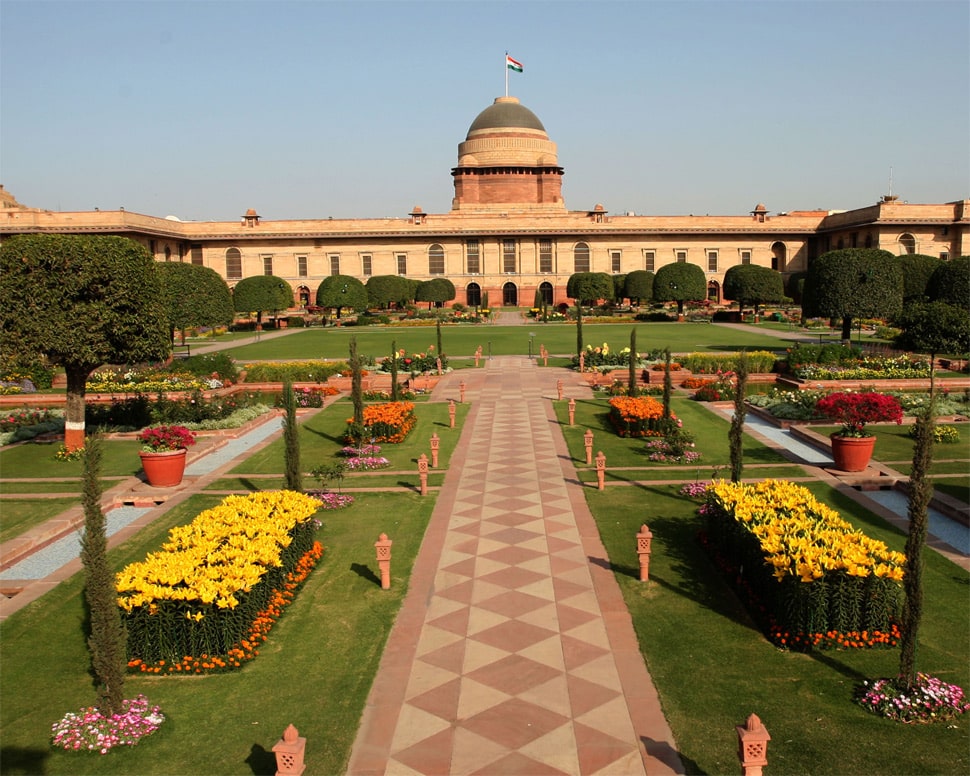
Features of Mughal Gardens:
- These are developed in Islamic architectural style by the Mughals in India and other countries.
- These gardens are frequently seen as a place for relaxation and meditation.
- Examples: The Taj Mahal Garden, Agra Fort, Humayun’s Tomb Garden, and the Red Fort Garden.
- Design:
- This gardening design was influenced by Persian, namely the Charbagh structure.
- Gardens are formal in style; symmetrically designed in rectangular or square plots.
- The garden area is divided into four plots by water channels. These four channels represent four rivers of life.
- The running water provides coolness and freshness to the garden.
- The four plots are planted with trees, shrubs, etc.,
- The axis is straight and central and sometimes represented by trees line.
- The water pool created in the centre with over flowing water serves as the central specimen.
- Fountains, cascades are linked to the central pool to create scenic beauty.
- Mughal gardens are surrounded by a high, robust wall. The wall’s summit is decorated with serrated battlements.
- The entrances are often towering and beautiful. The doors are massive wooden structures studded with hefty iron nails and spikes.
Q1) What is a Charbagh Structure?
Charbagh or Chahar Bagh (Persian: چهارباغ, chahār bāgh, meaning “Four Bāghs” (“four gardens”)) is a Persian and Islamic quadrilateral garden layout based on the four gardens of Paradise mentioned in the Qur’an.
Source: Mughal Gardens renamed as Amrit Udayan: VHP backs move, Opposition has this to say


 Last updated on Oct, 2026
→ UPSC 2027 Notification will be released on 13 January 2027 at upsconline.nic.in.
→ Check Nobel Prize 2026 Winners List here.
→ Download PIB PRiSM Monthly Magazine 2026 here.
→ Check UPSC Monthly Current Affairs Magazine The Recitals here.
→ Check out the latest UPSC Syllabus here.
→ Download UPSC Model Answers for Mains 2026
→ UPSC Mains Question Paper 2026 is out now for Essay & GS Paper 1, 2, 3 & 4.
→ UPSC Calendar 2027 has been released.
→ Enroll in Vajiram & Ravi’s UPSC Mains Test Series 2027 for structured answer writing practice, expert evaluation, and exam-oriented feedback.
→ Join Vajiram & Ravi’s UPSC Mentorship Program 2027 for personalized guidance, strategy planning, and one-to-one support from experienced mentors.
→ Go through the UPSC Mains Previous Year Papers to enhance your preparation.
→ UPSC has released UPSC Toppers List 2025 with the Civil Services final result on its official website.
→ Also check Best UPSC Coaching in India