About GHAR Portal:
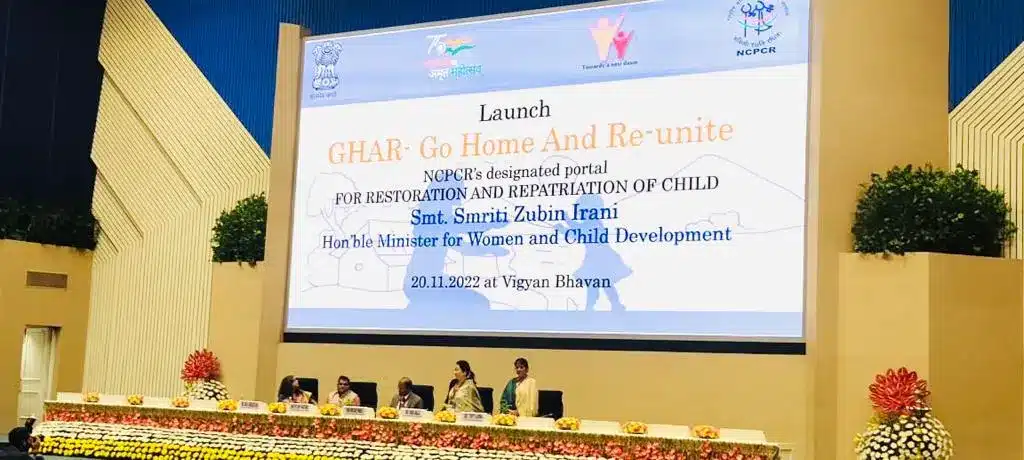
- It is a portal to digitally monitorand track the restoration and repatriation of children according to the protocols under the Juvenile Justice (Care and Protection of Children) Act, 2015, and Rules thereof.
- It has been developed and launched by the National Commission for Protection of Child Rights (NCPCR).
- The following are the salient features of the portal:
o Digital tracking and monitoringof children who are in the Juvenile Justice system and have to be repatriated to another Country/State/District.
o Digital transfer of cases of children to the concerned Juvenile Justice Board/Child Welfare Committee of the State. It will help in the speedy repatriation of children.
o Where there is a requirement of a translator/interpreter/expert, request will be made to the concerned State Government.
o Child Welfare Committees and District Child Protection Officers can ensure proper restoration and rehabilitation of children by digitally monitoring the progress of the case.
o A checklist format will be provided in the forms so that the children who are being hard to repatriate or children who are not getting their entitled compensation or other monetary benefits can be identified.
o List of Government implemented schemes will be provided, so that at the time of restoration, the Child Welfare Committees can link the child with the schemes to strengthen the family and ensure that the child remains with his/her family.
Key Facts about NCPCR:
- It has been constituted by the Government of India under the Commission for Protection of Child Rights (CPCR) Act, 2005, and is mandated to function for theprotection and promotion of child rights.
- It has the following functions:
o Examine and review existing safeguards for the protection of child rights and recommend measures for their effective implementation.
o Report annually and at other intervals to the central government on the effectiveness of these safeguards.
o Investigate violations of child rightsand recommend legal proceedings in appropriate cases.
o Review existing policies, programs, and activities related to child rights and make recommendations for their improvement.
o Promote research in the field of child rights.
o Raise awareness of child rights and available safeguards through various means, such as publications, media, and seminars.
o Inspect institutionswhere children are detained or reside, including juvenile homes, and recommend remedial action if necessary.
o Investigate complaints and take suo motu notice of issuesrelatedto the deprivation and violation of child rights and the non-implementation of laws protecting and developing children.
- The Commission, while investigating, shall have all the powers of a civil court.
- The Commission is further mandated tomonitor the proper and effective implementation of
o Protection of Children from Sexual Offences (POCSO) Act, 2012.
o Juvenile Justice (Care and Protection of Children) Act, 2015.
o Right to Free and Compulsory Education (RTE) Act, 2009.
Q1: What is the Protection of Children from Sexual Offences (POCSO) Act, 2012?
In order to effectively address the heinous crimes of sexual abuse and sexual exploitation of children through less ambiguous and more stringent legal provisions, the Ministry of Women and Child Development championed the introduction of the Protection of Children from Sexual Offences (POCSO) Act, 2012. The Act has been enacted to protect children from offences of sexual assault, sexual harassment and pornography and provide for establishment of Special Courts for trial of such offences and related matters and incidents. The Act was amended in 2019, to make provisions for enhancement of punishments for various offences so as to deter the perpetrators and ensure safety, security and dignified childhood for a child.
Source:GHAR (GO Home and Re-Unite) Portal for Restoration and Repatriation of Child launched by NCPCR


 Last updated on Oct, 2026
→ UPSC 2027 Notification will be released on 13 January 2027 at upsconline.nic.in.
→ Asian Games 2026 are being held in Aichi-Nagoya, Japan, from 19 September to 4 October.
→ Check Nobel Prize 2026 Winners List here.
→ Download PIB PRiSM Monthly Magazine 2026 here.
→ Check UPSC Monthly Current Affairs Magazine The Recitals here.
→ Check out the latest UPSC Syllabus here.
→ Download UPSC Model Answers for Mains 2026
→ UPSC Mains Question Paper 2026 is out now for Essay & GS Paper 1, 2, 3 & 4.
→ UPSC Calendar 2027 has been released.
→ Enroll in Vajiram & Ravi’s UPSC Mains Test Series 2027 for structured answer writing practice, expert evaluation, and exam-oriented feedback.
→ Join Vajiram & Ravi’s UPSC Mentorship Program 2027 for personalized guidance, strategy planning, and one-to-one support from experienced mentors.
→ Go through the UPSC Mains Previous Year Papers to enhance your preparation.
→ UPSC has released UPSC Toppers List 2025 with the Civil Services final result on its official website.
→ Also check Best UPSC Coaching in India