About Wheat Blast:
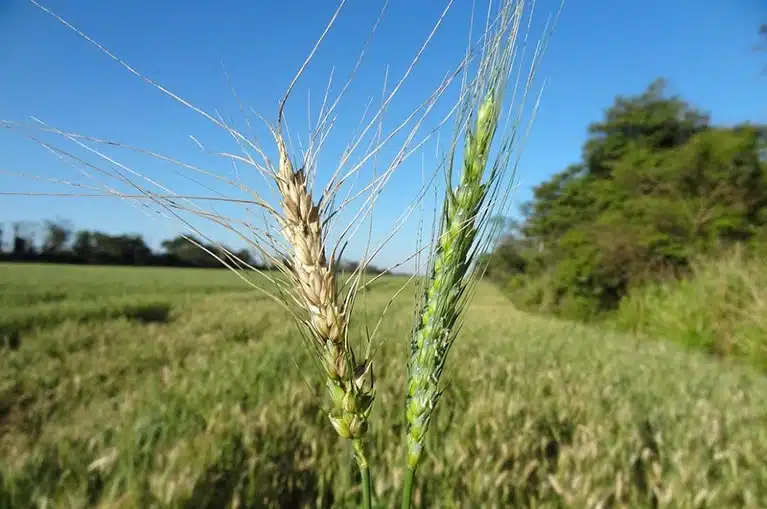
- Wheat blast, caused by the plant fungus Magnaporthe oryzae, is a fast-acting, severedisease of wheat that causes bleaching of the heads.
- Magnaporthe oryzae can infect many grasses, including barley, lolium, rice, and wheat, but specific isolates of this pathogen generally infect limited species; that is, wheat isolates infect preferably wheat plants but can use several more cereal and grass species as alternate hosts.
- It spreads through infected seeds, crop residues, and spores that can travel long distances in the air.
- It thrives in warm and humid conditions, making regions with such climates particularly susceptible.
- The pathogen is also resistant to fungicides.
- The seriousness of the disease is indicated by the fact that crops are burnt to avoid this disease.
- Effects:
o It causes progressive bleaching of the heads,lower yields, and poor seed quality.
o Stems and leaves are discoloured, with dark brown, eye-shaped lesions on leaves.
o Sometimes dark grey spores can be seen.
o It can shrivel and deform the grain in less than a week from the first symptoms.
- History of the Outbreak:
o First found in Brazil in 1985, it spread quickly through South America, infecting around three million hectares of wheat within a decade.
o In 2016, it made it across to Bangladesh, and in 2020, it was confirmed in Africa, in crops in Zambia.
Q1: What are fungi?
Fungi, along with Animalia (animals), Plantae (plants), Protista, Archaea/Archaebacteria, and Bacteria or Eubacteria form the six ‘kingdoms’ of biology. They are eukaryotic organisms; i.e., their cells contain membrane-bound organelles and clearly defined nuclei.Fungi usually reproduce both sexually and asexually. They are found in all temperate and tropical regions of the world where there is sufficient moisture to enable them to grow. They help in breaking down dead organic material, they continue the cycle of nutrients through ecosystems.
Source:Researchers: Wheat blast could reduce production by 13%


 Last updated on Oct, 2026
→ UPSC 2027 Notification will be released on 13 January 2027 at upsconline.nic.in.
→ Asian Games 2026 are being held in Aichi-Nagoya, Japan, from 19 September to 4 October.
→ Check Nobel Prize 2026 Winners List here.
→ Download PIB PRiSM Monthly Magazine 2026 here.
→ Check UPSC Monthly Current Affairs Magazine The Recitals here.
→ Check out the latest UPSC Syllabus here.
→ Download UPSC Model Answers for Mains 2026
→ UPSC Mains Question Paper 2026 is out now for Essay & GS Paper 1, 2, 3 & 4.
→ UPSC Calendar 2027 has been released.
→ Enroll in Vajiram & Ravi’s UPSC Mains Test Series 2027 for structured answer writing practice, expert evaluation, and exam-oriented feedback.
→ Join Vajiram & Ravi’s UPSC Mentorship Program 2027 for personalized guidance, strategy planning, and one-to-one support from experienced mentors.
→ Go through the UPSC Mains Previous Year Papers to enhance your preparation.
→ UPSC has released UPSC Toppers List 2025 with the Civil Services final result on its official website.
→ Also check Best UPSC Coaching in India