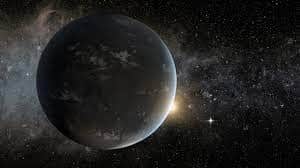
About GJ 1002 b and c:
- The two new planets are named, GJ 1002 b and GJ 1002 c.
- These planets lie in so-called habitable zones, within which water could be found in liquid form, and which is located in the immediate vicinity of the star due to its low luminosity.
- Planet b has a mass slightly higher than Earth’s, is the closer of the two and its year lasts only 10 days.
- Planet c is about a third more massive than Earth and takes about 20 days to orbit the star.
- The two planets were discovered using the radial velocity (RV) method.
What is the Radial Velocity Method?
- This method is based on the detection of variations in the velocity of the central star, due to the changing direction of the gravitational pull from an unseen exoplanet as it orbits the star.
Q1) What are Exoplanets?
An exoplanet is any planet beyond our solar system. Most orbit other stars, but free-floating exoplanets, called rogue planets, orbit the galactic center and are untethered to any star.
Source: Two Earth-like worlds discovered outside Solar System. They could be habitable


 Last updated on Oct, 2026
→ UPSC 2027 Notification will be released on 13 January 2027 at upsconline.nic.in.
→ Check Nobel Prize 2026 Winners List here.
→ Download PIB PRiSM Monthly Magazine 2026 here.
→ Check UPSC Monthly Current Affairs Magazine The Recitals here.
→ Check out the latest UPSC Syllabus here.
→ Download UPSC Model Answers for Mains 2026
→ UPSC Mains Question Paper 2026 is out now for Essay & GS Paper 1, 2, 3 & 4.
→ UPSC Calendar 2027 has been released.
→ Enroll in Vajiram & Ravi’s UPSC Mains Test Series 2027 for structured answer writing practice, expert evaluation, and exam-oriented feedback.
→ Join Vajiram & Ravi’s UPSC Mentorship Program 2027 for personalized guidance, strategy planning, and one-to-one support from experienced mentors.
→ Go through the UPSC Mains Previous Year Papers to enhance your preparation.
→ UPSC has released UPSC Toppers List 2025 with the Civil Services final result on its official website.
→ Also check Best UPSC Coaching in India