


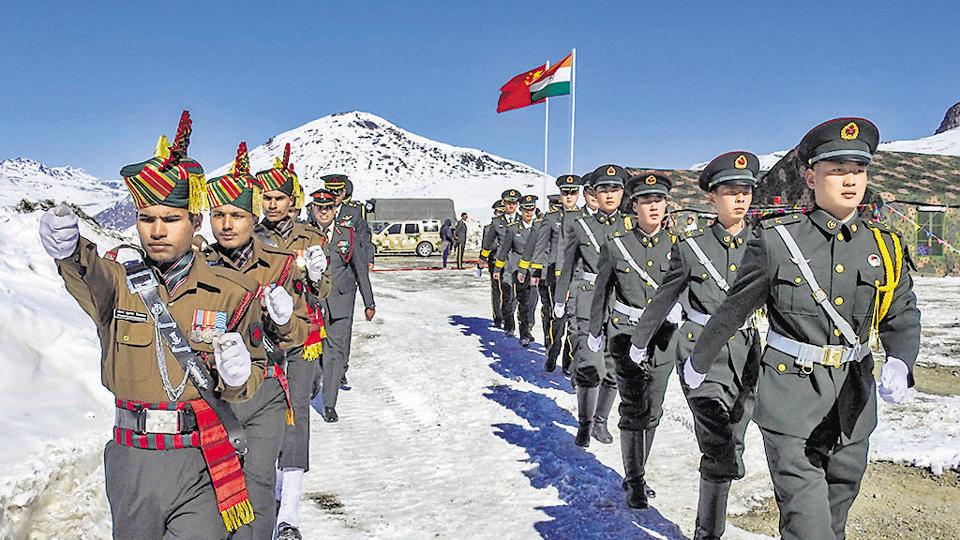
About McMahon Line:
- It is a geographical border between Northeast India and Tibet.
- It is the boundary between China and India, although its legal status is disputed by the Chinese government.
- It was negotiated between Tibet and Great Britain at the end of the Shimla Conference in 1914.
- It is named after Henry McMahon, who was the foreign secretary of British India and the chief negotiator of the convention at Simla.
- The length of this boundary is 890 kilometers.
- It runs from the eastern border of Bhutan along the crest of the Himalayas until it reaches the great bend in the Brahmaputra River, where that river emerges from its Tibetan course into the Assam Valley.
- Though India considers the McMahon Line as the legal national border, China rejects it, contending that Tibet was not a sovereign state and therefore did not have the power to conclude treaties.
What is The Shimla Treaty of 1914?
- It was signed in 1914 by delegates from India and Tibet to establish a clear demarcation between the two countries.
- China was not present in this treaty since Tibet was an autonomous region at the time.
- According to the treaty the McMahon Line is the clear boundary line between India and China.
- The British rulers, on behalf of India, considered Tawang in Arunachal Pradesh and the southern portion of Tibet to be part of India, which the Tibetans consented to.
- As a result, Arunachal Pradesh’s Tawang region became a part of India.
What is LAC?
- LAC is a demarcation line that separates Indian-controlled territory from Chinese-controlled territory.
- India considers the LAC to be 3,488 km long, while the Chinese consider it to be only around 2,000 km.
- It is currently the de-facto border between the two countries.
- The Line of Actual Control (LAC), is divided into three sectors:
- Western (Ladakh, Kashmir),
- Middle (Uttarakhand, Himachal) and
- Eastern (Sikkim, Arunachal): Here, the alignment of the LAC is along the McMahon Line.
Q1) What is Line of Control (LoC)?
(LoC) is a geographical line lying between India and Pakistan’s controlled parts of the former (under the British) Jammu and Kashmir and controlled by the army. This line is not actually a legally recognized international boundary but prevails as per de facto.
Source: US recognises McMahon Line as international boundary between India and China


 Last updated on Oct, 2026
→ UPSC 2027 Notification will be released on 13 January 2027 at upsconline.nic.in.
→ Check Nobel Prize 2026 Winners List here.
→ Download PIB PRiSM Monthly Magazine 2026 here.
→ Check UPSC Monthly Current Affairs Magazine The Recitals here.
→ Check out the latest UPSC Syllabus here.
→ Download UPSC Model Answers for Mains 2026
→ UPSC Mains Question Paper 2026 is out now for Essay & GS Paper 1, 2, 3 & 4.
→ UPSC Calendar 2027 has been released.
→ Enroll in Vajiram & Ravi’s UPSC Mains Test Series 2027 for structured answer writing practice, expert evaluation, and exam-oriented feedback.
→ Join Vajiram & Ravi’s UPSC Mentorship Program 2027 for personalized guidance, strategy planning, and one-to-one support from experienced mentors.
→ Go through the UPSC Mains Previous Year Papers to enhance your preparation.
→ UPSC has released UPSC Toppers List 2025 with the Civil Services final result on its official website.
→ Also check Best UPSC Coaching in India








