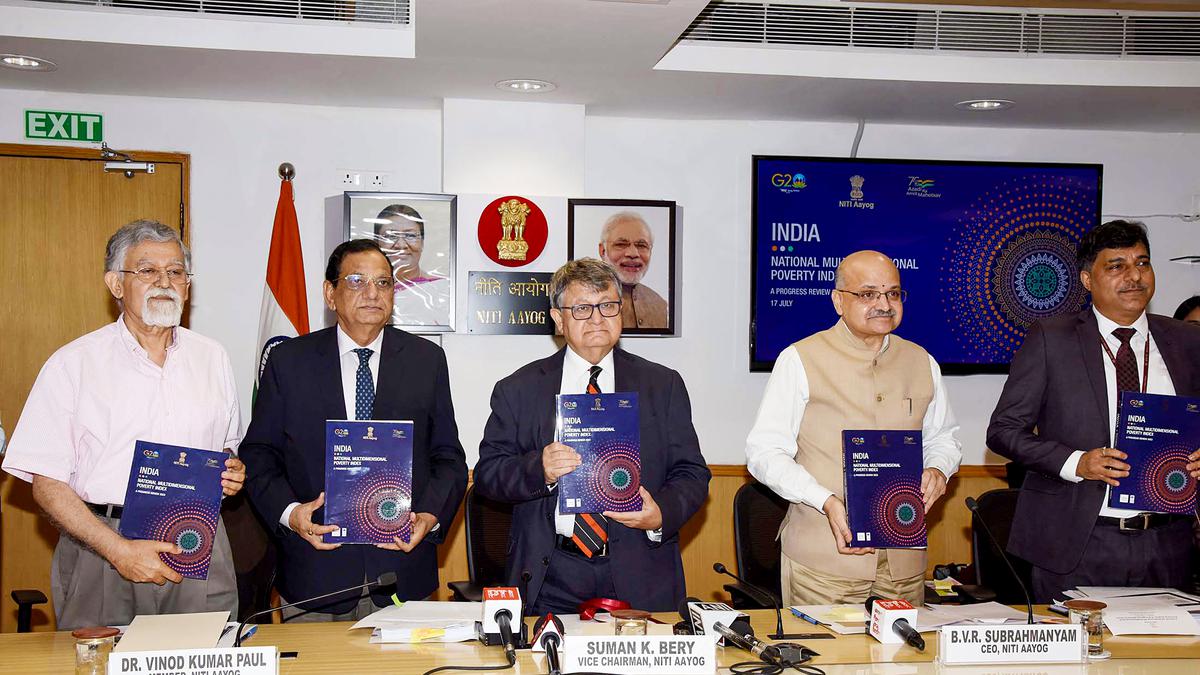
Key Findings of Multidimensional Poverty Index
- It claims that about 13.5 crore people came out of multidimensional poverty during the period, assessed by identifying.
- It said that rural areas witnessed the fastest decline in poverty from 32.59% to 19.28%, primarily due to decrease in the number of multidimensionally poor in States such as Bihar, Uttar Pradesh, Madhya Pradesh, Odisha, and Rajasthan. Delhi, Kerala, Goa and Tamil Nadu have the least number of people facing multidimensional poverty
- Along with the Union Territories. Bihar, Jharkhand, Meghalaya, Uttar Pradesh and Madhya Pradesh top the chart where the percentage of total population who are multidimensionally poor is high.
- Multidimensional poverty in urban areas, during the same period, saw a decrease from 8.65% to 5.27%.
- Uttar Pradesh registered the largest decline in number of poor with 3.43 crore people escaping multidimensional poverty.
- Between 2015-16 and 2019-21, the MPI value has nearly halved from 0.117 to 0.066 and the intensity of poverty has reduced from 47% to 44%.
Key facts about National Multidimensional Poverty Index
- It is prepared based on the latest National Family Heath Survey of 2019-21 and is the second edition of the National Multidimensional Poverty Index (MPI).
- Totally 12 parameters of health, education and standard of living are examined in the report.
- These include nutrition, child and adolescent mortality, maternal health, years of schooling, school attendance, cooking fuel, sanitation, drinking water, electricity, housing, assets, and bank accounts.
- The report follows the Alkire-Foster methodology developed by its technical partners — the Oxford Poverty and Human Development Initiative (OPHI) and United Nations Development Programme (UNDP).
Q1) What is the United Nations Development Programme?
The United Nations Development Programme (UNDP) is the United Nations’ global development network. It was established in 1965 and works in more than 170 countries and territories to eradicate poverty, reduce inequality, and promote sustainable development.
Source: Niti Aayog report claims decrease in multidimensional poverty


 Last updated on Oct, 2026
→ UPSC 2027 Notification will be released on 13 January 2027 at upsconline.nic.in.
→ Check Nobel Prize 2026 Winners List here.
→ Download PIB PRiSM Monthly Magazine 2026 here.
→ Check UPSC Monthly Current Affairs Magazine The Recitals here.
→ Check out the latest UPSC Syllabus here.
→ Download UPSC Model Answers for Mains 2026
→ UPSC Mains Question Paper 2026 is out now for Essay & GS Paper 1, 2, 3 & 4.
→ UPSC Calendar 2027 has been released.
→ Enroll in Vajiram & Ravi’s UPSC Mains Test Series 2027 for structured answer writing practice, expert evaluation, and exam-oriented feedback.
→ Join Vajiram & Ravi’s UPSC Mentorship Program 2027 for personalized guidance, strategy planning, and one-to-one support from experienced mentors.
→ Go through the UPSC Mains Previous Year Papers to enhance your preparation.
→ UPSC has released UPSC Toppers List 2025 with the Civil Services final result on its official website.
→ Also check Best UPSC Coaching in India