


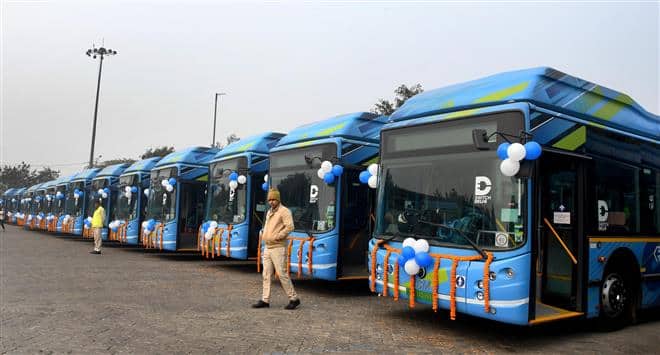
About ‘PM-eBus Sewa’ Scheme
- Under PM-eBus Sewa Scheme, 10,000 e-buses will be deployed across cities in the country.
- Support for Operation:
- Under this scheme, city bus operations will be done on Public Private Partnership (PPP) model.
- This scheme will support bus operations for 10 years.
- States/Cities shall be responsible for running the bus services and making payments to the bus operators.
- The Central Government will support these bus operations by providing subsidy to the extent specified in the proposed scheme.
- Funding:
- It has been allocated a total funding of Rs 57,613 crore.
- Out of this financial provision, the central government will contribute Rs 20,000 crore, while the remaining portion will be covered by the state governments.
- Coverage: The scheme will cover cities with 3 lakhs and above population and priority will be given to cities not having organised bus services.
- There are two segments of the scheme: Augmenting the city bus services and Green Urban Mobility initiatives.
- Augmenting the city bus services:
- Under this, the e-buses will operate under the PPP model and the government will help develop associated infrastructure to provide support for development/upgradation of depot infrastructure
- It will also help cities create behind-the-meter power infrastructure for the e-buses.
- Green Urban Mobility initiatives:
- Bus rapid transport projects would be developed along with non-motorised infrastructure like bike sharing, bicycle lanes.
- Innovative projects like National Common Mobility Card, Intelligent Transit Management System, Multimodal Interchange facilities would also be developed.
Q1) What is the Public Private Partnership (PPP) model?
The Public-Private Partnership (PPP) model is a collaborative approach to project development and service delivery in which both public and private sector entities work together to achieve common goals. PPPs involve the sharing of resources, risks, responsibilities, and rewards between the government (or public sector) and private sector organizations. This model is commonly used to undertake and manage projects or services that require substantial investment, expertise, and efficient management.


 Last updated on Oct, 2026
→ UPSC 2027 Notification will be released on 13 January 2027 at upsconline.nic.in.
→ Check Nobel Prize 2026 Winners List here.
→ Download PIB PRiSM Monthly Magazine 2026 here.
→ Check UPSC Monthly Current Affairs Magazine The Recitals here.
→ Check out the latest UPSC Syllabus here.
→ Download UPSC Model Answers for Mains 2026
→ UPSC Mains Question Paper 2026 is out now for Essay & GS Paper 1, 2, 3 & 4.
→ UPSC Calendar 2027 has been released.
→ Enroll in Vajiram & Ravi’s UPSC Mains Test Series 2027 for structured answer writing practice, expert evaluation, and exam-oriented feedback.
→ Join Vajiram & Ravi’s UPSC Mentorship Program 2027 for personalized guidance, strategy planning, and one-to-one support from experienced mentors.
→ Go through the UPSC Mains Previous Year Papers to enhance your preparation.
→ UPSC has released UPSC Toppers List 2025 with the Civil Services final result on its official website.
→ Also check Best UPSC Coaching in India








