What’s in Today’s Article?
- Why in the News?
- About World Inequality Lab
- Key Takeaways from the Working Paper Published by the WIL
- Key Suggestions in the Working Paper
Why in News?
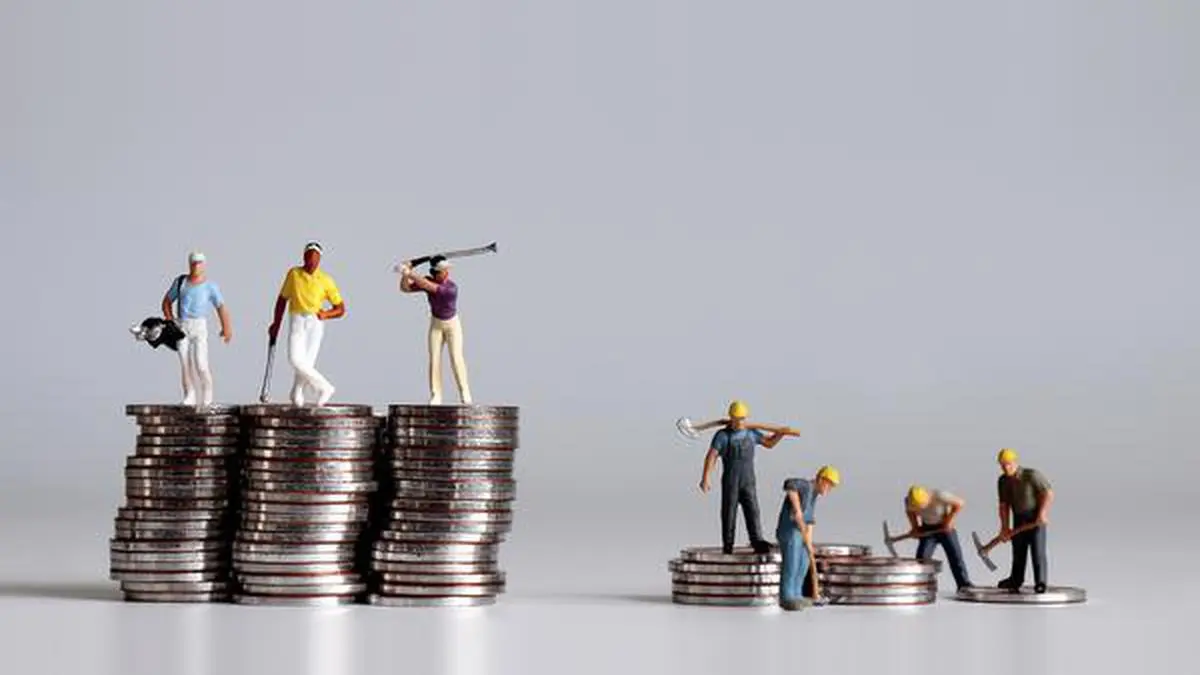
According to a paper released by the World Inequality Lab, the shares of income and wealth of India’s top 1% at 22.6% and 40.1% respectively is at their highest historical levels in 2022-23.


About World Inequality Lab
- The World Inequality Lab (WIL) is a research center at the Paris School of Economics.
- The WIL aims to promote research on global inequality dynamics.
- It works in close coordination with a large international network of researchers (over one hundred researchers covering nearly seventy countries) contributing to the database.
Key Takeaways from the Working Paper Published by the WIL
- The working paper by four economics researchers – Nitin Kumar Bharti, Lucas Chancel, Thomas Piketty, and Anmol Somanchi – has created time series data on income and wealth inequality in India.
- Naming the paper, the “Billionaire Raj”, the authors claimed that the country was now more unequal than even the British Raj.
- As per the report, in the year 2022-23, top 1% income and wealth shares were at their highest ever historical levels in India: 22.6% and 40.1%.
- India’s top 1% income share is among the very highest in the world, higher than even South Africa, Brazil, and the US, the paper said.
- The wealth share of the top 1% was lesser in India than in two of these countries: South Africa and Brazil.
- The paper also highlights the levels of disparity among different income groups.
- According to the paper, the top 1% holds an average of Rs 5.4 crore in wealth, 40 times the average Indian.
- However, the bottom 50% and the middle 40% hold Rs 1.7 lakh (0.1 times national average) and Rs 9.6 lakh (0.7 times national average) respectively.
- At the very top of the distribution, the wealthiest ∼ 10,000 individuals out of 92 million Indian adults own an average of Rs 2,260 crore in wealth, 16,763 times the average Indian.
Key Suggestions in the Working Paper
- The paper has used multiple sources to build its income and wealth inequality estimates.
- India does not have official income estimates and survey based official statistics on wealth.
- The paper recommends multiple policy measures to address the problem of inequality in India.
- They include restructuring of the tax code to account for both income and wealth, and broad-based public investments in health, education and nutrition.
- The report said a “super tax” of 2% on the net wealth of the 167 wealthiest families in 2022-23 would yield 0.5% of national income in revenues.
- It would also create valuable fiscal space to facilitate such investments, besides serving as a tool to fight inequality.
Q1) Who publishes the World Inequality Report?
The report is released by Paris-based World Inequality Lab, a global research initiative.
Q2) What do you mean by Income Inequality?
Income inequality refers to how unevenly income is distributed in a population. The less equal the distribution, the greater the income inequality.

 Last updated on Oct, 2026
→ UPSC 2027 Notification will be released on 13 January 2027 at upsconline.nic.in.
→ Check Nobel Prize 2026 Winners List here.
→ Download PIB PRiSM Monthly Magazine 2026 here.
→ Check UPSC Monthly Current Affairs Magazine The Recitals here.
→ Check out the latest UPSC Syllabus here.
→ Download UPSC Model Answers for Mains 2026
→ UPSC Mains Question Paper 2026 is out now for Essay & GS Paper 1, 2, 3 & 4.
→ UPSC Calendar 2027 has been released.
→ Enroll in Vajiram & Ravi’s UPSC Mains Test Series 2027 for structured answer writing practice, expert evaluation, and exam-oriented feedback.
→ Join Vajiram & Ravi’s UPSC Mentorship Program 2027 for personalized guidance, strategy planning, and one-to-one support from experienced mentors.
→ Go through the UPSC Mains Previous Year Papers to enhance your preparation.
→ UPSC has released UPSC Toppers List 2025 with the Civil Services final result on its official website.
→ Also check Best UPSC Coaching in India