Simla Agreement, also known as the Shimla Agreement, was a landmark pact between India and Pakistan, signed after the 1971 India–Pakistan War to improve relations and resolve disputes peacefully through direct talks. It recognised the Line of Control (LoC) in Jammu & Kashmir, ensured troop withdrawals, and focused on repatriating prisoners of war.
In April 2025, Pakistan announced that it was placing bilateral agreements, including the Simla Agreement, in abeyance after the Pahalgam attack — a move widely reported as a suspension. The announcement nonetheless raised concerns of a breakdown in bilateral channels, possible LoC tensions, and renewed calls in Pakistan to internationalise Kashmir.
Simla Agreement 1972 About
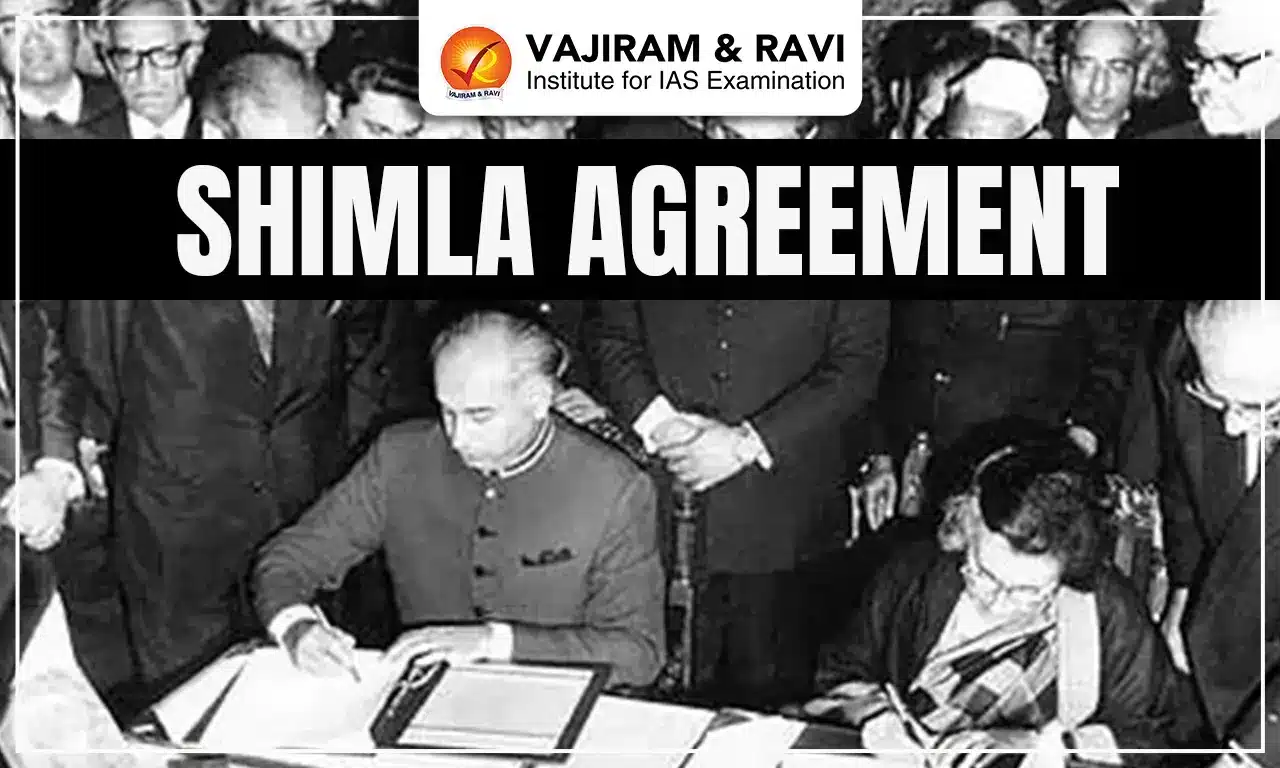
Simla Agreement or Shimla Agreement was signed on 2 July 1972 between Indian Prime Minister Indira Gandhi and Pakistani President Zulfikar Ali Bhutto. It was a 5peace pact to normalise relations after the 1971 war, which led to the creation of Bangladesh.
- Aftermath of 1971 War: The Simla Agreement was signed following the India–Pakistan war that resulted in Bangladesh’s independence and a decisive Indian victory.
- Purpose of Agreement: The Simla Agreement aimed to facilitate troop withdrawals, ensure Prisoners of War (POW) repatriation, and establish a framework for resolving future disputes bilaterally.
Simla Agreements Objectives
Simla Agreement aimed to normalise India–Pakistan relations by resolving disputes, including Jammu & Kashmir, through direct bilateral talks without third-party mediation. It focused on restoring diplomatic and economic ties, avoiding political humiliation by not declaring the ceasefire line as a formal border, and ensuring long-term stability through respect for sovereignty and territorial integrity.
- Bilateral Dispute Resolution: The Simla Agreement provides a framework to resolve Jammu & Kashmir and other disputes through direct India–Pakistan talks, avoiding involvement of third parties.
- Restoration of Ties: It seeks to rebuild diplomatic, economic, and cultural relations between India and Pakistan, reducing hostility and fostering cooperation.
- Ensuring Long-Term Stability: The agreement reinforces respect for sovereignty, territorial integrity, and non-interference, aiming to prevent renewed conflict and focus on development.
Simla Agreement Key Provisions
Simla Agreement or Shimla Agreement contained specific provisions that translated its objectives into concrete commitments, forming the operational framework for peace and cooperation.
- Guidance by the UN Charter: Both countries agreed that their relations would be governed by the principles and purposes of the Charter of the United Nations.
- Recognition of Sovereignty and Territorial Integrity: Both sides pledged to respect each other’s independence, political sovereignty, and recognised boundaries.
- Exclusively Bilateral Dispute Resolution: All disputes, including Jammu & Kashmir, to be resolved through direct bilateral talks or mutually agreed peaceful methods, with no involvement of third parties or international forums.
- Establishment of the Line of Control (LoC): The 1971 ceasefire line in Jammu & Kashmir was re-designated as the LoC, to be respected by both sides without unilateral changes.
- Mutual Troop Withdrawals: Armed forces were to withdraw to their respective sides of the international border and LoC within a set timeline, reducing risks of accidental conflict.
- Repatriation of Prisoners of War (POWs): India agreed to safely return over 90,000 Pakistani soldiers captured during the 1971 war, marking the largest POW repatriation since World War II.
- Renunciation of Force: Both nations committed not to threaten or use force against each other, respecting the LoC and territorial sovereignty.
- Restoration of Normal Relations: Steps were taken to resume postal, telecommunication, trade, travel, and cultural exchanges, promoting people-to-people contact and replacing hostile propaganda with positive engagement.


Simla Agreement Significance
Simla Agreement or Shimla Agreement entrenched bilateralism and created a framework for peaceful dispute resolution after the 1971 war, stabilising the post-war landscape and guiding India–Pakistan diplomacy.
- Bilateralism as Policy: The Simla Agreement mandated that all disputes, including Kashmir, be resolved only through direct talks, blocking third-party mediation.
- LoC Stabilisation: It recognised the post-1971 ceasefire line as the Line of Control, ensuring practical border stability in Jammu & Kashmir.
- Legal and Diplomatic Basis: The Simla Agreement serves as the primary legal framework for India–Pakistan dialogue and conflict resolution.
- Cooperation and Trust-building: The agreement also revived communication, trade, cultural ties, and people-to-people exchanges, enabling soft diplomacy.
Simla Agreement Abeyance
Simla Agreement or Shimla Agreement was rendered abeyant by Pakistan in April 2025 after India abeyanced the Indus Waters Treaty in response to the Pahalgam terror attack. Pakistan retaliated by closing its airspace, sealing the Wagah border, halting trade, and cancelling visa facilities. The abeyance of the Shimla agreement could have the following implications:
- End of Bilateral Talks Framework: Pakistan’s abeyance of the Simla Agreement could weaken the bilateral framework and increase Islamabad’s political pressure to seek international or multilateral forums such as the United Nations.
- Uncertainty along the LoC: It could also weaken recognition of the LoC as a practical boundary, increasing the risk of attempts to alter it.
- Without a peace framework, the risk of proxy attacks, cross-border firing, and skirmishes in Jammu & Kashmir increases.
- Regional Stability at Risk: The Simla Agreement could also heighten the danger of miscalculations between two nuclear-armed neighbours, directly impacting South Asian peace and security.
- More Strategic Flexibility for India: The abeyance may help India by giving scope to take a firmer stance on cross-border terrorism, review its position on Pakistan-Occupied Kashmir (PoK), and recalibrate trade/visa rules in line with security needs.
- Setback to Regional Cooperation: It could weaken forums like SAARC, reducing the scope for joint work on counter-terrorism, trade, and humanitarian efforts.
Simla Agreement Limitations
Simla Agreement or Shimla Agreement’s relevance declined as bilateral efforts failed to resolve mistrust, terrorism, and the Kashmir dispute. Nuclearisation and frequent leadership changes weakened compliance, while limited trade and exchanges showed only superficial trust-building.
- Failed to Achieve Lasting Peace: India-Pakistan bilateral approach could not resolve the Kashmir issue, nor did it stop mistrust and cross-border terrorism.
- Strategic Shifts: After India and Pakistan became nuclear powers in 1998, reliance on dialogue weakened, reducing the agreement’s relevance.
- Weak Enforcement Mechanism: The Simla Agreement had no binding mechanism, making compliance dependent on political will, which changed with leadership.
- Persistence of Hostilities: Armed conflicts like Siachen (1984), Kargil (1999), and frequent ceasefire violations undermined LoC stability.
- Limited Trust-building Outcomes: Trade, cultural exchanges, and people-to-people ties remained shallow due to recurring diplomatic breakdowns.
Simla Agreement Way Forward
Simla Agreement or Shimla Agreement’s abeyance increases the risks of conflict and instability along the LoC. India needs stronger surveillance and countermeasures, alongside community participation in security. At the same time, it must take efforts to balance security with diplomacy.
- Reaffirm Bilateralism: It should continue to pursue direct dialogue with Pakistan, avoiding third-party mediation, in line with the spirit of the Simla Agreement.
- Enhance Surveillance and Border Security: India should deploy satellite imagery, drones, ground radar, and AI analytics for real-time monitoring, while upgrading border fencing with smart sensors in vulnerable LoC sectors.
- Strengthen Coordination and Counter-Drone Capability: It should improve synergy between the Army, police, and intelligence agencies, updating SOPs regularly and using AI-powered systems to tackle drone threats.
- Build International Support: India should engage global partners and forums to highlight Pakistan’s unilateral abeyance as destabilising, positioning itself as a responsible actor committed to peace.
- Maintain Humanitarian Principles: It should continue actions such as prisoner repatriation and avoid steps that worsen humanitarian situations, reinforcing its ethical stance.
Empower Local Communities: India should equip and train Village Defence Committees to assist in intelligence gathering and provide early warnings.

 Last updated on Oct, 2026
→ UPSC 2027 Notification will be released on 13 January 2027 at upsconline.nic.in.
→ Check Nobel Prize 2026 Winners List here.
→ Download PIB PRiSM Monthly Magazine 2026 here.
→ Check UPSC Monthly Current Affairs Magazine The Recitals here.
→ Check out the latest UPSC Syllabus here.
→ Download UPSC Model Answers for Mains 2026
→ UPSC Mains Question Paper 2026 is out now for Essay & GS Paper 1, 2, 3 & 4.
→ UPSC Calendar 2027 has been released.
→ Enroll in Vajiram & Ravi’s UPSC Mains Test Series 2027 for structured answer writing practice, expert evaluation, and exam-oriented feedback.
→ Join Vajiram & Ravi’s UPSC Mentorship Program 2027 for personalized guidance, strategy planning, and one-to-one support from experienced mentors.
→ Go through the UPSC Mains Previous Year Papers to enhance your preparation.
→ UPSC has released UPSC Toppers List 2025 with the Civil Services final result on its official website.
→ Also check Best UPSC Coaching in India
Shimla Agreement 1972 FAQs
Q1. What is the Simla agreement?+
Q2. Who signed the Simla agreement?+
Q3. Why was the Simla agreement signed?+
Q4. What is the significance of the 1972 Simla Agreement?+
Q5. What is the other name of Shimla Agreement?+
Tags: Shimla Agreement Shimla Agreement 1972 UPSC