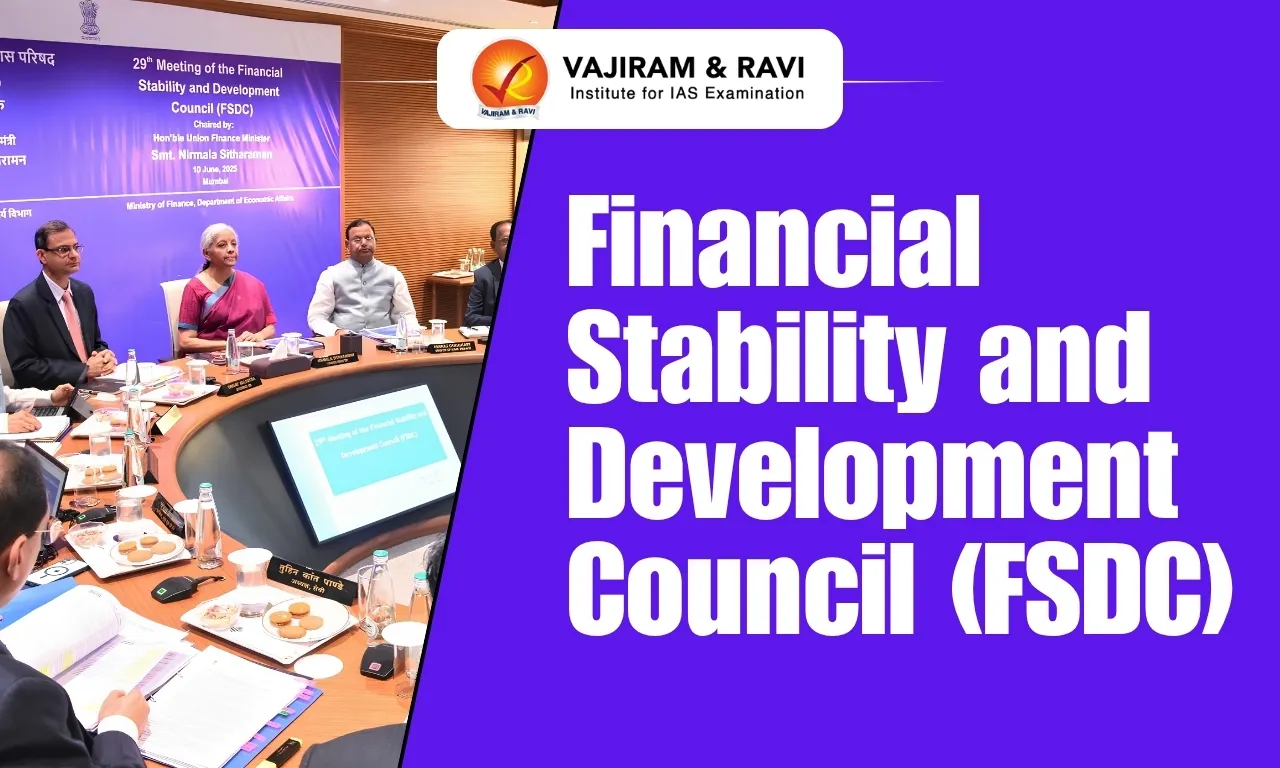
FSDC, or the Financial Stability and Development Council, is India's apex-level institutional mechanism for maintaining financial stability and promoting coordinated development of the financial sector. Established by the Government of India on 30 December 2010, the FSDC facilitates coordination among financial-sector regulators and addresses issues that may affect the stability of India's financial system.
The Financial Stability and Development Council covers areas such as financial stability, financial-sector development, inter-regulatory coordination, financial literacy, financial inclusion and macro-prudential supervision. The Union Finance Minister chairs the Council, while the RBI Governor chairs its Sub-Committee. The Financial Stability and Development Council (FSDC) operates as a non-statutory executive mechanism, rather than under a specific Act of Parliament.
FSDC Full Form And Background
The FSDC full form is Financial Stability and Development Council. The necessity for an institutional structure to protect India's financial system after the global financial crisis of 2008 was the driving force behind its creation.
- Before the Financial Stability and Development Council, inter-regulatory coordination was carried out through the High-Level Coordination Committee on Financial Markets (HLCCFM), chaired by the RBI Governor.
- However, the necessity for a formal process with well-defined responsibilities was brought to light by the financial markets' growing interconnectivity and complexity.
- A stronger institutional framework for financial stability and inter-regulatory coordination was also suggested by a number of expert committees, including the
- RBI Advisory Group on Securities Market Regulation.
- The Committee on Financial Sector Reforms (Raghuram Rajan Committee).
- The Committee on Financial Sector Assessment (CFSA).
- High-Level Expert Committee on Making Mumbai an International Financial Centre.
- As a result, in December 2010, the government replaced the HLCCFM with the Financial Stability and Development Council.
FSDC Composition
The chairperson of the Financial Stability and Development Council (FSDC) is the Finance Minister of India. Its members include the heads of major financial sector regulators and senior government officials to ensure coordinated decision-making across the financial system. The composition includes:
- Finance Minister as Chairperson.
- Governor, Reserve Bank of India (RBI).
- Chairperson, Securities and Exchange Board of India (SEBI).
- Chairperson, Insurance Regulatory and Development Authority of India (IRDAI).
- Chairperson, Pension Fund Regulatory and Development Authority (PFRDA).
- Finance Secretary (where applicable) and Secretaries of the concerned Departments of the Ministry of Finance.
- Secretary, Ministry of Corporate Affairs (MCA).
- Secretary, Department of Economic Affairs (DEA).
- Secretary, Department of Financial Services (DFS).
- Chief Economic Adviser (CEA) to the Government of India.
FSDC Sub-committee
The Financial Stability and Development Council Sub-Committee is chaired by the RBI Governor, which supports the Council and discusses interregulatory matters, sectoral development, and financial stability.
- It includes all financial regulators and representatives of the Ministry of Finance and is the operational arm of the Financial Stability and Development Council.
- It operates through specialised technical groups, such as those focused on interregulatory coordination, financial inclusion, and financial literacy.


Financial Stability and Development Council (FSDC) Functions
The Financial Stability and Development Council performs a coordinating and advisory role in India's financial system by promoting stability, regulatory cooperation and financial inclusion, but it does not issue licences or regulate individual institutions.
- Preserve Financial Stability: By spotting new weaknesses, the Financial Stability and Development Council keeps an eye on macroprudential risks and strives to maintain the stability of India's financial system.
- Boost Coordination Across Regulations: In order to handle problems that span several regulatory jurisdictions and guarantee a coordinated policy response, FSDC makes it easier for financial sector authorities to work together.
- Observe systemically important financial institutions: To reduce systemic risks that could jeopardise general financial stability, monitor systemic risks arising from financial conglomerates and interconnected financial institutions.
- Encourage the Development of the Financial Sector: The Financial Stability and Development Council backs efforts and reforms targeted at enhancing the competitiveness, resilience, and efficiency of India's financial industry in addition to financial stability.
- Promote Financial Literacy and Inclusion: The Financial Stability and Development Council advocates for measures that increase citizens' financial literacy and access to formal financial services. It coordinates the National Strategy for Financial Inclusion (NSFI) and the National Strategy for Financial Education (NSFE).
- Encourage the Exchange of Information: The Financial Stability and Development Council gives government agencies and regulators a shared forum to share information and plan solutions to problems in the financial industry.
FSDC Significance
The significance of the Financial Stability and Development Council (FSDC) lies in its role as a high-level coordination platform that strengthens financial stability, improves regulatory cooperation, promotes inclusion and supports financial-sector development.
- Offers a Comprehensive Regulatory Framework: Coordinated oversight of an increasingly interconnected financial sector is made possible by the Financial Stability and Development Council, which unites all significant financial authorities under a single institutional platform.
- Enhances Monetary Stability: The Financial Stability and Development Council strengthens India's financial sector's resistance to both internal and international shocks by keeping an eye on systemic risks and financial conglomerates.
- Enhances Coordination of Policy: By encouraging efficient cooperation between various financial authorities, the Financial Stability and Development Council helps reduce regulatory gaps and duplication.
- Encourages Financial Development That Is Inclusive: FSDCs' emphasis on financial awareness and inclusion helps to increase access to financial services and foster equitable economic growth.
- Improves Readiness for Emergencies: The institutional framework makes it possible for regulators to recognise new threats early on and react more skilfully in times of financial strain.
- Encourages Prolonged Financial Sector Reforms: The Financial Stability and Development Council serves as a platform for debating and putting into practice policy changes that improve transparency, governance, and the general advancement of India's financial sector.
Financial Stability and Development Council UPSC PYQs
Q1. With reference to ‘Financial Stability and Development Council’, consider the following statements: (UPSC Prelims 2016)
- It is an organ of NITI Aayog.
- It is headed by the Union Finance Minister.
- It monitors macroprudential supervision of the economy.
Which of the statements given above is/are correct?
a) 1 and 2 only
b) 2 only
c) 2 and 3 only
d) 1, 2 and 3
Ans: (c)

 Last updated on Oct, 2026
→ UPSC 2027 Notification will be released on 13 January 2027 at upsconline.nic.in.
→ Check Nobel Prize 2026 Winners List here.
→ Download PIB PRiSM Monthly Magazine 2026 here.
→ Check UPSC Monthly Current Affairs Magazine The Recitals here.
→ Check out the latest UPSC Syllabus here.
→ Download UPSC Model Answers for Mains 2026
→ UPSC Mains Question Paper 2026 is out now for Essay & GS Paper 1, 2, 3 & 4.
→ UPSC Calendar 2027 has been released.
→ Enroll in Vajiram & Ravi’s UPSC Mains Test Series 2027 for structured answer writing practice, expert evaluation, and exam-oriented feedback.
→ Join Vajiram & Ravi’s UPSC Mentorship Program 2027 for personalized guidance, strategy planning, and one-to-one support from experienced mentors.
→ Go through the UPSC Mains Previous Year Papers to enhance your preparation.
→ UPSC has released UPSC Toppers List 2025 with the Civil Services final result on its official website.
→ Also check Best UPSC Coaching in India
Financial Stability and Development Council (FSDC) FAQs
Q1. Is FSDC part of Niti Ayog?+
Q2. Who is the chairman of FSDC?+
Q3. Which committee recommended FSDC?+
Q4. What does FSDC do?+
Q5. Is FSDC a statutory body? +
Tags: financial stability and development council quest upsc economy notes