Railway infrastructure is a critical pillar of India’s transport system, supporting economic growth, national integration, freight movement and regional connectivity. Railway infrastructure in India is undergoing a major transformation through investments in network expansion, electrification, Dedicated Freight Corridors (DFCs), station redevelopment and high-speed rail. Landmark projects such as the Chenab Bridge, the Udhampur-Srinagar-Baramulla Rail Link (USBRL), the Bairabi–Sairang line and the New Pamban Bridge demonstrate India’s growing engineering capabilities and connectivity in challenging terrains.
With the world's fourth-largest railway network and now the second-largest rail freight carrier, Indian Railways sits at an extraordinary inflection point: modernising railway infrastructure at pace while still carrying the weight of decades of under-investment, structural complexity and institutional inertia.
Railway Infrastructure Overview
Indian Railways is one of the world's largest railway networks and serves as the backbone of India's infrastructure system, especially the transport system, facilitating passenger mobility, freight movement, and regional integration. Over the last decade, the sector has witnessed significant investments in capacity expansion, electrification, modernisation, and connectivity projects.
- Extensive Network: Indian Railways operates over 68,000 route km of track, connects 7,000+ stations, and laid 34,428 route km of new track between 2014 and 2025.
- Record Capital Investment: Railway capital expenditure reached ₹2.65 lakh crore in FY2025-26, with over 35,000 km of new lines and 46,000 km of electrification completed in the last decade.
Railway Infrastructure Significance
Indian Railways is not merely a transport system but a key driver of economic growth, social inclusion, sustainability, and national integration. Through freight efficiency, affordable mobility, safety improvements, and strategic connectivity, it plays a vital role in India's development journey.
- Freight and Economic Competitiveness: Indian railway infrastructure has emerged as the world's second-largest rail freight carrier, transporting over 1.6 billion tonnes of freight and supporting industrial growth while reducing logistics costs.
- Dedicated Freight Corridors (DFCs): Eastern and Western DFCs have significantly increased freight train speeds, decongested passenger routes, and enhanced multimodal logistics through PM Gati Shakti Cargo Terminals.
- Affordable and Inclusive Mobility: Carrying around 23 million passengers daily, Indian Railways provides affordable transport and is redeveloping 1,337 stations under the Amrit Bharat Station Scheme as of December 2025.
- Improved Safety Standards: Consequential train accidents declined from 135 in 2014–15 to 14 during 2025–26 up to February 2026, supported by higher safety investments, deployment of CCTV systems, fog safety devices, and modern signalling infrastructure.
- Green and Sustainable Transport: Near-complete electrification, increasing renewable energy use, and the introduction of hydrogen-powered locomotive trials are helping Railways move towards net-zero emissions.
- Digital Transformation: Initiatives such as the RailOne App, station Wi-Fi, digital ticketing, and anti-touting measures have improved passenger convenience and service delivery.


Railway Infrastructure Projects under Development
India is expanding its railway infrastructure to improve freight efficiency, passenger mobility, regional connectivity and integration with PM GatiShakti.
- PM GatiShakti Projects: During the last four years, i.e., FY 2022-23, 2023-24, 2024-25 and FY 2025-26, 300 projects (51 New Line, 17 Gauge Conversion and 232 Doubling) of total length 13,808 km have been sanctioned across Indian Railways under the PM GatiShakti National Master Plan.
- Dedicated Freight Corridors (DFCs): The Eastern and Western Dedicated Freight Corridors (DFCs) together cover 2,843 route-km, with the network now substantially/fully commissioned and operational. The corridors aim to increase freight capacity, reduce transit time and decongest passenger routes.
- New Dedicated Freight Corridors: DPRs for the proposed East Coast, East-West and North-South DFCs are under examination.
- Dankuni–Surat DFC: Announced in the Union Budget 2026-27, the approximately 2,100-km corridor will pass through West Bengal, Jharkhand, Odisha, Chhattisgarh, Maharashtra and Gujarat, with pre-construction activities being fast-tracked.
- Mumbai–Ahmedabad High-Speed Rail (MAHSR): The 508-km bullet-train corridor is being developed through Maharashtra, Gujarat and Dadra & Nagar Haveli. Land acquisition and utility shifting have been completed, while physical progress has crossed 61%; the first service is targeted for August 2027.
- Seven New High-Speed Rail Corridors: The Union Budget 2026-27 announced Mumbai–Pune, Pune–Hyderabad, Hyderabad–Bengaluru, Hyderabad–Chennai, Chennai–Bengaluru, Delhi–Varanasi and Varanasi–Siliguri high-speed rail corridors.
- Udhampur–Srinagar–Baramulla Rail Link (USBRL): The 272-km Himalayan rail project, comprising 36 major tunnels and 943 bridges, was completed and dedicated in 2025, including the Chenab Rail Bridge, the world's highest railway arch bridge.
- Northeast Connectivity: The Bairabi–Sairang railway line was inaugurated in 2025, extending railway connectivity deeper into the Northeast and strengthening regional integration.
- Namo Bharat/RRTS: India's first Regional Rapid Transit System operates at speeds of up to 160 km/h, providing faster regional connectivity between Delhi and Meerut.
Railway Infrastructure Modernisation
Railway infrastructure modernisation focuses on electrification, track capacity, station modernisation, rolling stock, signalling and safety, alongside increased capital expenditure.
- Railway Electrification: Around 99.6% of the Broad Gauge network has been electrified, with 14 Railway Zones and 25 States/UTs achieving 100% electrification.
- Track Expansion & Renewal: Over the past 11 years, more than 35,000 km of new track has been laid, and 69,873 route kilometres (rkm) have been electrified as of March 2026, drastically modernising railway infrastructure.
- Amrit Bharat Station Scheme: More than 1,300 stations have been identified for redevelopment into modern, passenger-friendly transport hubs, with work progressing across the network.
- Rolling Stock Modernisation: More than 4,224 hi-tech LHB coaches were produced during FY 2025-26 up to November 2025, while 164 Vande Bharat services were operational by December 2025.
- Next-Generation Trains: Railways is expanding its Vande Bharat and Amrit Bharat trains, alongside introducing Vande Bharat Sleeper and developing hydrogen-powered railway technology.
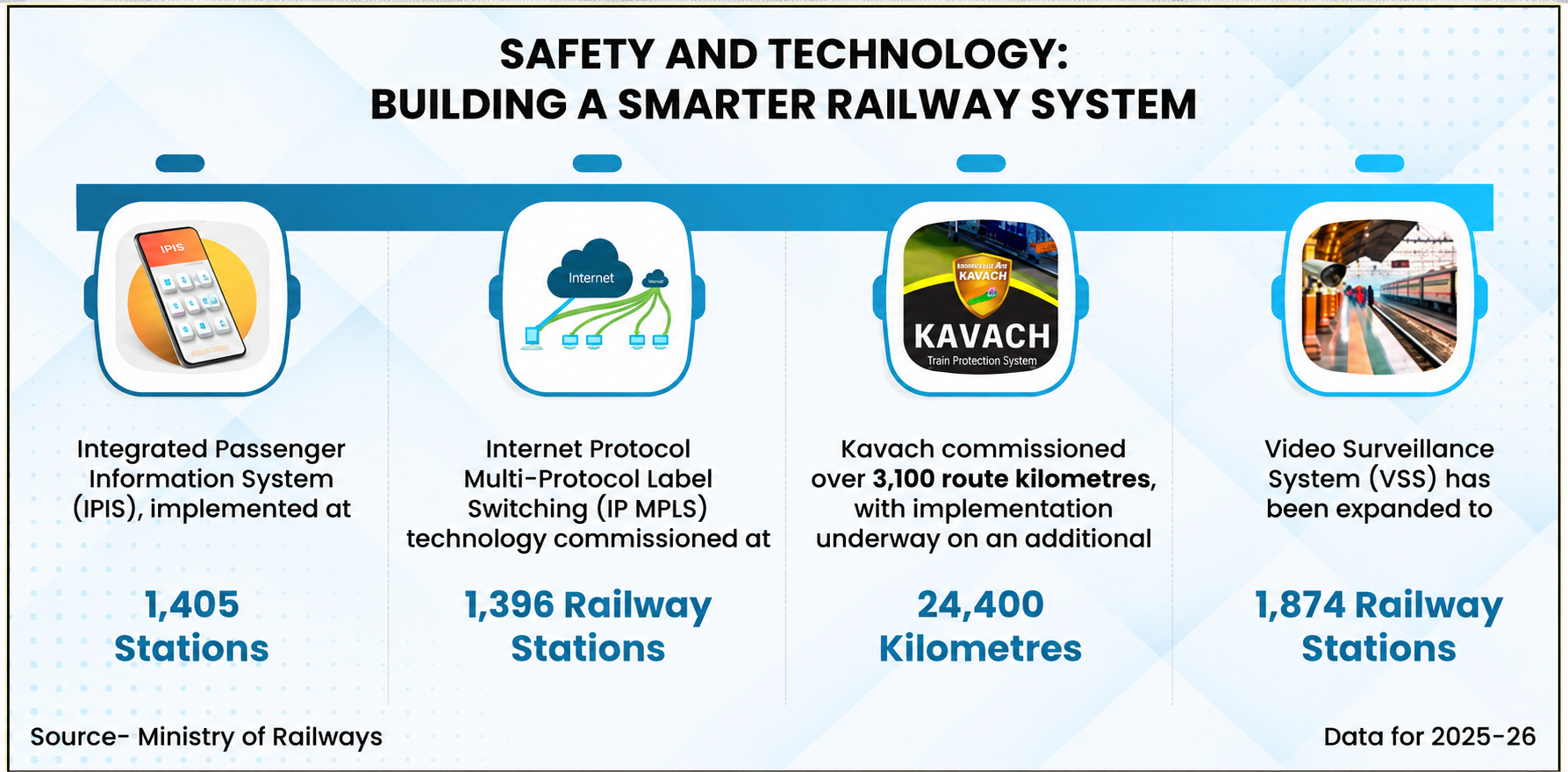
- Safety – Kavach: The indigenous Kavach Automatic Train Protection (ATP) system is being deployed to reduce the risk of train collisions and strengthen railway safety.
- FY 2026-27 Capital Expenditure: Railways received a budget grant of approximately ₹2.93 lakh crore, with major allocations for safety works, rolling stock, new lines, doubling, track renewal and signalling.
- Capex Utilisation: Around ₹1.14 lakh crore had been utilised by July 2026, representing approximately 39% of the FY 2026-27 allocation.
Railway Infrastructure Institutions
Railway infrastructure development is supported by specialised institutions responsible for policy, project execution, technical standards, technology, financing and passenger/freight services.
- Railway Board: The apex administrative body of Indian Railways, responsible for policy, planning, coordination and overall railway administration.
- It was restructured from eight members to five, with functional responsibilities reorganised around Operations, Business Development, HR, Infrastructure and Finance.
- DFCCIL: The Dedicated Freight Corridor Corporation of India Ltd. is an SPV under the Ministry of Railways responsible for the planning, construction, operation and maintenance of Dedicated Freight Corridors.
- NHSRCL: To make railway infrastructure futuristic, the National High Speed Rail Corporation Ltd. is implementing the Mumbai–Ahmedabad High-Speed Rail project, India's first high-speed rail corridor.
- RVNL: The Rail Vikas Nigam Ltd. implements railway infrastructure projects, including new lines, doubling, gauge conversion, electrification and major bridges.
- IRCON International: Undertakes railway infrastructure and construction projects in India and abroad, including major engineering and project-execution works.
- RITES: Provides engineering, consultancy, design, and project management services for railway infrastructure and wider transport connectivity.
- RDSO: The Research Designs & Standards Organisation is the technical research and standardisation arm of Indian Railways, advising on design, safety, technology and technical standards for railway infrastructure needs.
- CRIS: The Centre for Railway Information Systems develops and manages IT and digital systems supporting railway infrastructure operations and services.
- RailTel: The telecom and digital infrastructure arm of Indian Railways, providing telecommunication, broadband and digital connectivity infrastructure.
- IRCTC: Manages online railway ticketing, catering, tourism and related passenger services.
- CONCOR: Facilitates containerised freight transportation and logistics, supporting rail-based multimodal freight movement.
Railway Infrastructure Challenges
Despite significant progress in freight movement, electrification and capital investment, Indian Railways faces challenges such as financial sustainability, network congestion, low freight modal share and safety concerns, which must be addressed to sustain railway modernisation.
- Network Saturation: Major routes such as the Golden Quadrilateral and Golden Diagonal operate beyond capacity, leading to congestion, delays, and reduced maintenance windows.
- Low Freight Modal Share: Railways account for only about 27% of freight transport, significantly lower than road transport, limiting both revenue potential and environmental benefits.
- Financial Stress and Rising Debt: Heavy reliance on borrowings through IRFC and modest growth in passenger and freight revenues continue to strain the financial health of the sector.
- Cross-Subsidisation of Passenger Fares: Low passenger fares and higher freight tariffs reduce rail's competitiveness in freight transport while limiting resources for reinvestment.
- Low Average Train Speeds: Freight trains on conventional routes operate at around 25 km/h, while network congestion prevents passenger trains from achieving higher operational speeds.
- Safety Concerns: Despite a decline in accidents, human errors remain a major cause, and the rollout of the Kavach safety system is still limited relative to the size of the network.
- Project Delays and Execution Issues: Delays in major infrastructure projects, including high-speed rail and freight corridor expansion, continue to affect capacity augmentation and service efficiency.
Railway Infrastructure Way Forward
Indian Railways has laid out a clear long-term roadmap through the National Rail Plan 2030 and the vision of Viksit Bharat@2047. The focus now must shift from planning to effective implementation, ensuring that modernisation, capacity expansion, safety enhancement, and freight growth are achieved at the scale and speed required for a developed India.
- Implement National Rail Plan 2030: Increase rail freight modal share from 27% to 45%, improve freight train speeds to 50 kmph, and strengthen multimodal connectivity through PM Gati Shakti.
- Scale Up Kavach Deployment: Expand India's indigenous Kavach 4.0 safety system across high-density routes to enhance collision prevention and operational safety.
- Develop High-Speed Rail Network: Build 7,000 km of high-speed rail corridors by 2047, including projects such as the Mumbai-Ahmedabad Bullet Train and future Delhi-Varanasi corridors.
- Expand Freight Corridors: Develop new economic, port-connectivity, and high-density freight corridors to decongest existing routes and improve logistics efficiency.
- Modernise Rolling Stock: Introduce Vande Bharat 4.0 and Amrit Bharat 4.0 trains with improved speed, comfort, safety, and passenger amenities.
- Promote PPP and Innovative Financing: Encourage private investment through PPP models, station redevelopment, terminals, and InvIT-based financing to support future expansion.
- Advance Green and Digital Railways: Accelerate renewable energy adoption, hydrogen locomotive trials, net-zero goals, and digital initiatives to improve sustainability and passenger experience.
Railway Infrastructure UPSC PYQs
Q1. Why is Public-Private Partnership (PPP) required in infrastructural projects? Examine the role of the PPP model in the redevelopment of Railway Stations in India. (UPSC Mains 2022)

 Last updated on Oct, 2026
→ UPSC 2027 Notification will be released on 13 January 2027 at upsconline.nic.in.
→ Check Nobel Prize 2026 Winners List here.
→ Download PIB PRiSM Monthly Magazine 2026 here.
→ Check UPSC Monthly Current Affairs Magazine The Recitals here.
→ Check out the latest UPSC Syllabus here.
→ Download UPSC Model Answers for Mains 2026
→ UPSC Mains Question Paper 2026 is out now for Essay & GS Paper 1, 2, 3 & 4.
→ UPSC Calendar 2027 has been released.
→ Enroll in Vajiram & Ravi’s UPSC Mains Test Series 2027 for structured answer writing practice, expert evaluation, and exam-oriented feedback.
→ Join Vajiram & Ravi’s UPSC Mentorship Program 2027 for personalized guidance, strategy planning, and one-to-one support from experienced mentors.
→ Go through the UPSC Mains Previous Year Papers to enhance your preparation.
→ UPSC has released UPSC Toppers List 2025 with the Civil Services final result on its official website.
→ Also check Best UPSC Coaching in India
Railway Infrastructure FAQs
Q1. What is the infrastructure of Railways in India?+
Q2. Why is railway infrastructure important?+
Q3. Which state has no rail?+
Q4. What is Kavach used for?+
Q5. When was KAVACH launched?+
Tags: quest railway infrastructure upsc economy notes