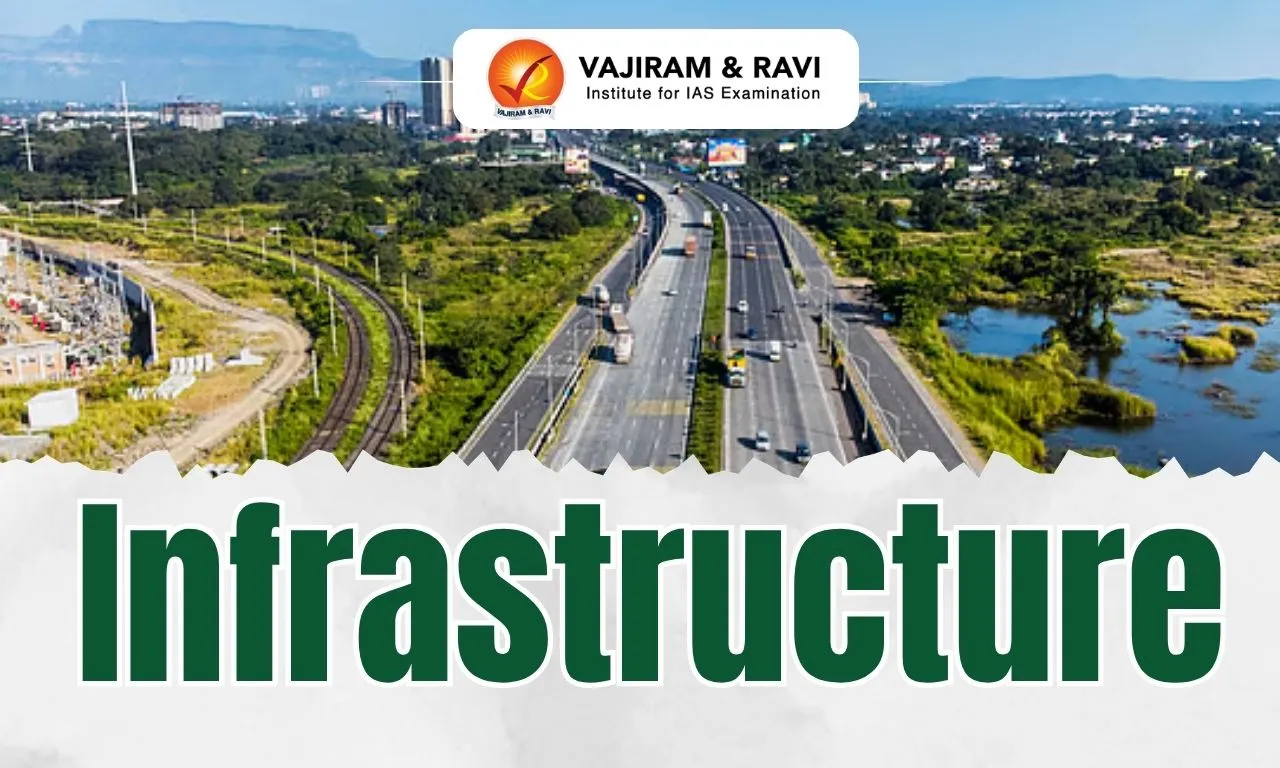
Infrastructure is a fundamental driver of economic growth, industrial development, and social progress. It comprises the physical and digital assets that enable the efficient movement of people, goods, services, and information, including roads, railways, ports, airports, power networks, digital identity systems, and payment platforms.
Over the past decade, India's infrastructure sector has witnessed unprecedented expansion through large-scale investments in transport, logistics and urban development. Flagship initiatives such as the National Infrastructure Pipeline (NIP), PM Gati Shakti, Bharatmala, Sagarmala, and Digital Public Infrastructure (DPI) have strengthened multimodal connectivity and improved ease of doing business. The World Bank has identified India among the top five countries globally for infrastructure-related job creation, economic growth and improving quality of life.
Infrastructure Types
Infrastructure in India can be broadly categorised into Physical, Urban, and Digital infrastructure.
Physical Infrastructure (Transport & Logistics)
It facilitates the seamless movement of goods, people, and services. Through initiatives such as the National Infrastructure Pipeline (NIP), PM Gati Shakti National Master Plan, and the National Monetisation Pipeline (NMP), India is strengthening multimodal connectivity and logistics efficiency.
- Roads & Highways
- Bharatmala Pariyojana: The National Highways network has expanded significantly from 91,287 km in 2014 to 1,46,572 km as of March 2026, substantially improving road connectivity and freight movement across India.
- The length of access-controlled expressways and high-speed corridors has increased from 93 km to 2,636 km, enabling faster, safer, and more efficient transportation.
- The PM Gati Shakti National Master Plan integrates highways with railways, ports, airports, logistics parks, and other transport networks through a GIS-based digital platform, ensuring seamless multimodal connectivity and coordinated planning.
- Under the National Monetisation Pipeline (NMP) 2.0, the highways sector accounts for the largest share (26%) of asset monetisation, generating resources for the development of new transport infrastructure and enhancing private sector participation.
- Railways: India has introduced 164 Vande Bharat trains as of Dec. 2025 and electrified 46,900 km of railway lines since 2014.
-
- The Eastern and Western Dedicated Freight Corridors are over 96% operational, improving freight efficiency.
- Railway projects are coordinated under PM Gati Shakti, while operational assets are monetised through the National Monetisation Pipeline.
- Aviation: Under the UDAN Scheme, 95 regional airports have been operationalised, benefiting over 1.68 crore passengers as of July 2026.
-
- Operational airports increased from 74 in 2014 to 165 in July 2026.
- DigiYatra has been implemented across 38 airports to provide over 10 crore seamless journeys.
- Ports & Waterways: Major ports’ cargo handling capacity nearly doubled from 873 MMTPA in 2014 to 1,728 MMTPA in 2026.
-
- Vessel turnaround time improved from 94 hours to 48.8 hours in 2025-26.
- Inland waterway cargo has increased by 710% under the Sagarmala Programme.
- National waterways increased from 5 in 2014 to 111 in 2026, of which 32 are operational.
- India became the world's No. 1 ship-recycling nation in 2025, with its global share rising from 30.1% (2024) to 35.4% (2025), recycling 2.99 million gross tonnes (GT), up nearly 60% from 1.86 million GT in 2024.
- Port connectivity projects are integrated through PM Gati Shakti.
- The Sagarmala Programme strengthened port-led development, coastal connectivity, and logistics integration.
- Cross-cutting Planning: The NIP covers around 13,000 projects with an estimated investment of ₹185 lakh crore across 33 sectors.
-
- PRAGATI reviewed 382 projects worth over ₹85 lakh crore and resolved 2,958 issues.
- Over 4,220 industrial parks are mapped on the India Industrial Land Bank (IILB).
- 272 plug-and-play industrial parks are operational across the country.
- The BHAVYA scheme was approved in March 2026 to develop 100 new plug-and-play industrial parks.
- BHAVYA Rasayan Scheme was approved on 24 July 2026, with an outlay of ₹3,030 crore. The scheme will be implemented over five years, from FY2026–27 to FY2030–31.
- 7 Pradhan Mantri MITRA Parks have been proposed to strengthen the manufacturing ecosystem.
- Around 20% of NIP projects have been completed, while nearly 45% are under implementation.
- Bridges and Tunnels:
-
- Chenab Bridge (2025): World's highest railway arch bridge, strengthening Jammu–Srinagar connectivity.
- Other important bridges and tunnels include Anji Khad Bridge (2025), Pamban Bridge (2025), Z-Morh/Sonamarg Tunnel (2025), Sudarshan Setu (2024), Atal Tunnel (2020), Dr Syama Prasad Mukherjee Tunnel (2017), etc.
- Metro: The metro network expanded from 248 km in 2014 to over 1,155 km in 2026.
-
- Cities with metro connectivity increased from 5 to 26, while daily ridership crossed 1.15 crore passengers.
- Kolkata operationalised India’s first underwater metro tunnel in 2024.
- Kochi operationalised India’s first Water Metro system, with the first boat launched in December 2021.
Urban Infrastructure
It aims to create sustainable, resilient, and economically vibrant cities by improving water supply, sanitation, mobility, and smart governance.
- AMRUT & AMRUT 2.0: Under AMRUT and AMRUT 2.0, projects worth about ₹2.79 lakh crore have been sanctioned since 2015.
- The mission focuses on water security and universal sewerage coverage.
- It has provided 2.03 crore tap water connections and 1.50 crore sewer connections.
- The programme reduces carbon emissions by nearly 46 lakh tonnes annually.
- Smart Cities Mission: Under the Smart Cities Mission, a total of 7,790 projects (95% of the total) worth ₹1,56,257 crore worth have been completed as of March 2026.
- All 100 Smart Cities now have AI- and IoT-enabled Integrated Command and Control Centres.
- The SWAMIH Fund launched in 2019 delivered over 63,000 homes, benefiting around 2.52 lakh people as of June 2026.
Digital Public Infrastructure (DPI)
India has emerged as a global leader in DPI by leveraging the JAM Trinity (Jan Dhan–Aadhaar–Mobile) and expanding digital connectivity through flagship initiatives.
- Digital Connectivity: BharatNet has connected nearly 2.18 lakh Gram Panchayats (about 97% of the target) with over 7 lakh km of optical fibre. India has 106.58 crore broadband subscribers, while 5G services cover 99.9% of districts through 4.74 lakh towers.
- Digital Identity: More than 144 crore Aadhaar numbers have been generated. Aadhaar enabled over 2,707 crore authentications during 2024–25.
- Digital Economy: UPI processed 21.7 billion transactions worth ₹28.33 lakh crore in January 2026, and ONDC has onboarded over 1.16 lakh retail sellers, promoting open digital commerce.
- Citizen Services: DigiLocker serves 67.63 crore users.
- Platforms such as UMANG and PFMS have strengthened digital governance.
- PFMS has generated savings of over ₹4.31 lakh crore by eliminating fake beneficiaries.
- Digital Health: eSanjeevani has provided teleconsultation services to 45.42 crore patients.
- Platforms such as CoWIN have transformed digital health delivery.
- Emerging Digital Technologies: The India Semiconductor Mission has approved 12 semiconductor projects worth ₹1.64 lakh crore, while ISM 2.0 has been launched to strengthen indigenous semiconductor capabilities.
- The IndiaAI Mission, with an outlay of ₹10,371.92 crore, has expanded national AI compute capacity beyond 45,000 GPUs.
- The Design Linked Incentive (DLI) Scheme supports 24 semiconductor startups, has attracted ₹430 crore in venture capital, and enabled the fabrication of 20 indigenous chips.
- The Digital India Mission is now transitioning towards AI, semiconductors, and frontier technologies after completing 11 years.
Social Infrastructure
Social infrastructure refers to the physical and institutional facilities that support human development, quality of life and social well-being, particularly in health, education and housing. Unlike economic infrastructure such as roads, ports and power, it primarily strengthens human capital, social equity and inclusive growth.
Health Infrastructure
India has increasingly focused on strengthening the health sector to improve primary healthcare, critical-care capacity and pandemic preparedness.
- PM-ABHIM: The Pradhan Mantri Ayushman Bharat Health Infrastructure Mission (PM-ABHIM) was launched on 25 October 2021 with a total outlay of ₹64,180 crore for FY2021-22 to FY2025-26.
- Primary Healthcare: Under its Centrally Sponsored component, the scheme provides for the construction of 17,788 building-less Sub-Centres as Ayushman Arogya Mandirs (AAMs).
- Urban Health Infrastructure: The scheme also envisages 11,024 Urban AAMs in urban areas, particularly focusing on slums and slum-like settlements.
- State-Level Infrastructure: As of July 2025, ₹33,081.82 crore had been approved for States and UTs for strengthening health infrastructure under PM-ABHIM.
- Critical Care: The mission envisaged establishing 35,000 critical-care beds across 600 districts, along with referral facilities in 125 districts, to improve preparedness for health emergencies.
Education Infrastructure
It is critical for improving learning outcomes, employability, innovation and the quality of India's human capital.
- PM Schools for Rising India (PM SHRI): Launched on 5 September 2022 with an outlay of about ₹27,360 crore for 2022–23 to 2026–27.
- It aims to upgrade selected existing government schools into model schools aligned with NEP 2020, equipped with smart classrooms, laboratories, libraries, sports and vocational facilities.
- Samagra Shiksha: It serves as the umbrella scheme for school education, supporting school & teacher development, digital & inclusive education and learning outcomes.
- Higher Education: PM-USHA (Pradhan Mantri Uchchatar Shiksha Abhiyan) succeeded RUSA and is aligned with NEP 2020 to strengthen State higher-education institutions through support for access, equity, quality and employability.
Housing Infrastructure
It is an essential component of social infrastructure because adequate and affordable housing improves living standards, health, sanitation, security and urban inclusion.
- Pradhan Mantri Awas Yojana–Urban (PMAY-U): Launched on 25 June 2015 and expanded through PMAY-U 2.0 in September 2024, it aims to provide affordable pucca houses to eligible urban households.
- As of 12 August 2026, 99.25 lakh houses have been completed, with around 96% of PMAY-U 2.0 houses allotted to women, promoting affordable housing and women’s ownership.
- The programme has promoted alternative and innovative construction technologies, with around 16 lakh houses being constructed using technologies promoted through the Global Housing Technology Challenge.
- Pradhan Mantri Awas Yojana–Gramin (PMAY-G): Launched in 2016, it provides financial assistance of ₹1.20 lakh in plains and ₹1.30 lakh in hilly/difficult areas for rural housing, with convergence with MGNREGS for unskilled labour and Swachh Bharat Mission for sanitation.
- PMAY-G 2.0 has expanded coverage, taking the projected long-term housing requirement to around 4.95 crore houses by 2029.


Infrastructure Importance
Infrastructure is the backbone of economic and social development. It not only supports production, trade, and connectivity but also improves quality of life, promotes inclusion, and strengthens sustainability.
- Economic Growth: Infrastructure investment has a high multiplier effect on Gross Domestic Product (GDP) growth, industrial output, and consumption.
- Public infrastructure capex increased from ₹2 lakh crore (FY 2014-15) to ₹12.2 lakh crore (BE 2026-27).
- Employment Generation: Projects in roads, railways, housing, ports, and the energy sector generate large-scale direct and indirect employment opportunities.
- Periodic Labour Force Survey reports show the construction sector's share of total workers rose from 12.1% in 2020–21 to 13.0% in 2022–23.
- Crowding-In Private Investment: Public infrastructure investment boosts investor confidence and encourages private participation.
- India accounts for over 90% of South Asia’s Private Participation in Infrastructure (PPI) investments.
- Trade Competitiveness: Modern transport infrastructure, Dedicated Freight Corridors, logistics and port infrastructure reduce logistics costs and improve export competitiveness.
- Financial Inclusion: Digital infrastructure through JAM Trinity and DPI enabled Direct Benefit Transfers worth ₹49.09 lakh crore, reducing leakages and improving governance efficiency.
- Urban Quality of Life: Urban initiatives such as the Smart Cities Mission and AMRUT have improved water, sanitation, mobility, and digital infrastructure in cities.
- Regional Balanced Development: Regional connectivity integrates backward and remote regions with major economic and industrial centres, promoting balanced regional development.
- Agricultural Development: Rural infrastructure in roads, cold chains, and warehousing enhances agricultural productivity and farmer incomes.
- National Security: Strategic infrastructure such as border roads, railways, ports, and defence logistics strengthens national security and territorial integration.
Infrastructure Financing
Infrastructure development finance refers to the institutional and policy mechanisms used to mobilise long-term capital for projects, including roads, power, renewable energy and urban infrastructure.
- NaBFID: The National Bank for Financing Infrastructure and Development (NaBFID), established under the NaBFID Act, 2021, is India's fifth All India Financial Institution and began lending operations in December 2022.
- Sectoral Focus: Roads, power and renewable energy account for around 71% of NaBFID's sanctioned loans, while approximately 41% of sanctions are for greenfield projects.
- Production Linked Incentive (PLI) Scheme: It has attracted investments exceeding ₹2.16 lakh crore, generated production worth over ₹20.41 lakh crore, and created 14 lakh+ jobs, thereby strengthening India's industrial infrastructure.
- The National Infrastructure Pipeline (NIP) provides the long-term investment pipeline for infrastructure creation across sectors.
- The Union Budget 2026–27 has introduced new measures such as the Infrastructure Risk Guarantee Fund and City Economic Regions (CERs), reinforcing infrastructure-led growth and balanced urban development.
- Asset Monetisation
- Infrastructure Investment Trusts (InvITs) and Real Estate Investment Trusts (REITs) have unlocked more than ₹1.5 lakh crore by attracting retail and institutional investment.
- The National Monetisation Pipeline (NMP) complements these instruments by monetising brownfield public assets to finance new infrastructure, with NMP 2.0 targeting ₹16.72 lakh crore between FY2026 and FY2030.
PPP Models
Public-Private Partnership (PPP) models are contractual agreements between government and private entities to build, finance, and manage public infrastructure or services. Key models include-
- Build–Operate–Transfer (BOT)
- Build–Own–Operate–Transfer (BOOT)
- Build–Own–Lease–Transfer (BOLT)
- Design–Build–Finance–Operate–Transfer (DBFOT)
- Hybrid Annuity Model (HAM)
- Operate–Maintain–Transfer (OMT)
Infrastructure Challenges
Despite rapid expansion, India’s infrastructure sector continues to face major financial, governance, sustainability, and connectivity-related challenges that affect its efficiency, inclusiveness, and long-term economic growth.
- Infrastructure Financing Gap: India faces a large infrastructure financing requirement under the NIP, while public investment alone remains insufficient despite ₹12.2 lakh crore of capital expenditure in Budget 2026–27.
- Low Private Participation: Private investment remains constrained by revenue uncertainty, toll risks and regulatory instability.
- Financing Risks: Currency volatility and weak investor confidence continue to limit foreign capital inflows despite mechanisms such as the Infrastructure Risk Guarantee Fund.
- Project Delays: Land acquisition, regulatory clearances and weak project planning delay major projects, including metro and railway expansions.
- Logistics Inefficiency: Excessive dependence on road transport and weak multimodal connectivity keeps India's logistics costs high.
- Urban Infrastructure Stress: Rapid urbanisation is placing growing pressure on water, sanitation and transport, particularly in cities such as Bengaluru and Delhi.
- High Carbon Footprint: Expansion of cement, steel and transport sectors continues to increase infrastructure-related emissions.
- Last-Mile Connectivity: Difficult terrain continues to constrain infrastructure development in the Himalayan and Northeast regions, as seen in projects such as the Sivok–Rangpo railway line.
- Digital Infrastructure Divide: Despite rapid 5G and BharatNet expansion, gaps in smartphone access, broadband connectivity and digital literacy persist.
Infrastructure Way Forward
India’s infrastructure transformation has created a strong foundation for economic growth, connectivity, and digital inclusion. However, achieving the vision of Viksit Bharat 2047 requires deeper reforms focused on financing, governance, sustainability, urbanisation, digital inclusion, and global leadership.
- Infrastructure Financing: Shift from budget-dependent financing to blended finance by combining public funds, private capital and institutional investment, supported by the Infrastructure Risk Guarantee Fund.
- Strengthen NaBFID, NIIF, InvITs, REITs and GIFT City to mobilise long-term capital, while scaling green/ESG-linked financing through multilateral partnerships.
- Strengthen PM GatiShakti: Evolve PM GatiShakti from a planning platform into a real-time execution and monitoring framework.
- Strengthen the Network Planning Group to resolve inter-ministerial bottlenecks.
- Digital Infrastructure Inclusion: Shift from mere digital coverage to meaningful, affordable and inclusive digital access.
- Expand digital literacy, affordable devices and vernacular digital services.
- Strengthen PM-WANI and CSCs to improve rural connectivity.
- Climate-Resilient Infrastructure: Make climate-resilient design standards integral to all new infrastructure projects.
- Accelerate green hydrogen and renewable-powered transport infrastructure.
- Urban Infrastructure Governance: Strengthen the City Economic Regions approach for coordinated regional urban development through integration of AI-enabled systems.
-
- Ensure universal water supply, sewerage and basic urban services under AMRUT.
- Improve municipal finances through better property taxation, user charges and creditworthiness.
- Global Digital Infrastructure Leadership: Leverage India Stack Global to promote India's DPI model internationally.
Infrastructure UPSC PYQs
Q1. Why is Public-Private Partnership (PPP) required in infrastructural projects? Examine the role of the PPP model in the redevelopment of Railway Stations in India. (UPSC Mains 2022)
Q2. Investment in infrastructure is essential for rapid and inclusive economic growth."Discuss in the light of India's experience. (UPSC Mains 2021)
Q3. Explain the meaning of investment in an economy in terms of capital formation. Discuss the factors to be considered while designing a concession agreement between a public entity and a private entity. (UPSC Mains 2020)
Q4. With reference to ‘National Investment and Infrastructure Fund’, which of the following statements is/are correct? (UPSC Prelims 2017)
- It is an organ of NITI Aayog.
- It has a corpus of Rs. 4,00,000 crore at present.
Select the correct answer using the code given below:
(a) 1 only
(b) 2 only
(c) Both 1 and 2
(d) Neither 1 nor 2
Ans: (d)

 Last updated on Oct, 2026
→ UPSC 2027 Notification will be released on 13 January 2027 at upsconline.nic.in.
→ Check Nobel Prize 2026 Winners List here.
→ Download PIB PRiSM Monthly Magazine 2026 here.
→ Check UPSC Monthly Current Affairs Magazine The Recitals here.
→ Check out the latest UPSC Syllabus here.
→ Download UPSC Model Answers for Mains 2026
→ UPSC Mains Question Paper 2026 is out now for Essay & GS Paper 1, 2, 3 & 4.
→ UPSC Calendar 2027 has been released.
→ Enroll in Vajiram & Ravi’s UPSC Mains Test Series 2027 for structured answer writing practice, expert evaluation, and exam-oriented feedback.
→ Join Vajiram & Ravi’s UPSC Mentorship Program 2027 for personalized guidance, strategy planning, and one-to-one support from experienced mentors.
→ Go through the UPSC Mains Previous Year Papers to enhance your preparation.
→ UPSC has released UPSC Toppers List 2025 with the Civil Services final result on its official website.
→ Also check Best UPSC Coaching in India
Infrastructure FAQs
Q1. What does infrastructure mean?+
Q2. What is the importance of infrastructure?+
Q3. What are the examples of infrastructure?+
Q4. What are the main types of infrastructure?+
Q5. What is Digital Public Infrastructure (DPI)?+
Tags: infrastructure quest upsc economy notes