Labour reforms in India have evolved from a fragmented, sector-specific framework focused largely on organised industrial employment towards a broader system covering wages, industrial relations, occupational safety and social security. Labour reforms draw their Constitutional foundation from the Concurrent List, enabling both the Union and States to legislate on labour matters, alongside Directive Principles that promote humane working conditions, fair wages and social protection.
Since Independence, successive bodies such as the First and Second National Commissions on Labour, the National Commission on Rural Labour and NCEUS have identified gaps in labour protection and advocated simplification, wider coverage and stronger institutions. These efforts culminated in the four Labour Codes of 2019–20, consolidating 29 central labour laws and representing a major milestone in India's labour reforms.
Labour Reforms Foundation
The constitutional framework establishes both the legislative basis and the broader social objectives for labour reforms in India.
- Concurrent Legislative Responsibility: Labour is primarily placed in the Concurrent List, including Trade Unions and Industrial Disputes, Social Security and Insurance, and Welfare of Labour and Working Conditions, allowing both the Union and States to legislate and making Centre–State coordination essential.
- Fundamental Rights: Articles 14, 16, 19(1)(c), and 21 of the Constitution of India serve as a fundamental constitutional basis for labour reforms and rights.
- Article 14 (Equality before law): Ensures non-arbitrariness and equality, serving as the foundation for principles like equal pay for equal work and preventing workplace discrimination.
- Article 16 (Equality of opportunity): Guarantees equal opportunity in matters of public employment and blocks bias based on race, religion, caste, sex, or descent.
- Article 19(1)(c) (Freedom of association): Grants workers the right to form associations or trade unions, which underpins collective bargaining and union laws.
- Article 21 (Right to life and personal liberty): Broadly interpreted by the Supreme Court of India to include the right to live with human dignity, safe and humane working conditions, and a fair livelihood.
- Directive Principles: Articles 39(a), 39(d) and 39(e) seek adequate livelihood opportunities, equal pay and protection of workers' health and strength.
- Right to Work and Assistance: Article 41 directs the State to provide effective provisions for the right to work, education and public assistance within its economic capacity.
- Humane Working Conditions: Article 42 requires the State to secure just and humane conditions of work and maternity relief.
- Living Wage: Article 43 seeks to secure a living wage and decent conditions of life for workers.
- Workers' Participation: Article 43A promotes workers' participation in the management of industries.
Labour Reforms Commissions
Labour reforms commissions in India have played a crucial role in reviewing existing labour laws, identifying gaps in worker protection and adapting labour policy to changing economic and employment conditions. Successive commissions progressively expanded the focus from organised industry to rural, unorganised and emerging forms of employment, paving the way for comprehensive labour reforms and laws consolidation.
First National Commission on Labour, 1966–1969
The First National Commission on Labour was the first comprehensive post-Independence exercise to examine India's labour system and suggest labour reforms. It reviewed issues affecting both organised and unorganised workers, including wages, industrial relations, social security and working conditions, and recommended labour reforms such as
- Establishment: As part of labour reforms, the Commission was constituted on 24 December 1966 under the chairmanship of Justice P.B. Gajendragadkar and submitted its report in August 1969.
- Workers' Participation: It supported strengthening mechanisms such as Works Committees to encourage consultation and cooperation between employers and workers.
- Industrial Relations: It examined weaknesses in the existing industrial-relations framework and provided groundwork for subsequent reforms relating to industrial disputes and trade unions.
- Wage Policy: It reviewed minimum wages, wage differentials and mechanisms for wage fixation.
- Social Security: It recommended the wider coverage and rationalisation of social security mechanisms, including provident fund and ESI-related arrangements.
- Unorganised Workers: It highlighted the limited legal protection available to workers outside the organised sector, thereby anticipating an issue that became central to later labour reforms.
- Implementation Gap: Only a portion of its recommendations were ultimately implemented as labour reforms, highlighting the recurring gap between labour-policy recommendations and their legislative or administrative execution.
National Commission on Rural Labour, 1987–1991
The National Commission on Rural Labour shifted attention of labour reforms towards agricultural workers, rural labourers and other workers who remained largely outside the factory-centred labour-law framework.
- Focus: It examined the conditions of agricultural, rural, migrant and bonded labour, particularly the vulnerabilities arising from informal employment and weak bargaining power.
- Wage Protection: It recommended a minimum wage for rural workers with a variable component linked to the cost-of-living index and periodic revision.
- Broader Significance: The Commission reinforced the need to extend labour protection beyond organised industry and towards India's predominantly informal workforce.
- Long-term Influence: Its emphasis on a national wage floor anticipated later developments under the Code on Wages, 2019, which provides for a statutory National Floor Wage.
Second National Commission on Labour, 1999–2002
The Second National Commission on Labour revisited India's fragmented labour-law framework three decades after the first Commission and suggested labour reforms. Its recommendations became particularly important for labour reforms because they proposed both legal consolidation and a broader protection framework for unorganised workers.
- Establishment: As part of labour reforms, the Commission was constituted on 15 October 1999 under the chairmanship of Ravindra Varma and submitted its report on 29 June 2002.
- Core Mandate: It was asked to rationalise existing labour laws applicable to the organised sector and recommend umbrella legislation for workers in the unorganised sector.
- Consolidation of Laws: It recommended grouping numerous labour laws into a smaller number of broad codes dealing with wages, industrial relations, social security, and safety and welfare.
- Trade Union Recognition: It proposed a check-off-based system for recognising the bargaining agent, with a union obtaining around 66% support becoming the sole negotiating agent and unions crossing the prescribed lower threshold receiving representation through a negotiating college.
- Compulsory Check-Off: It recommended making check-off arrangements compulsory in establishments employing 300 or more workers.
- Strikes and Lockouts: It proposed treating practices such as go-slow and work-to-rule as misconduct or unfair labour practices under specified circumstances.
- Essential Services: It recommended withdrawal of the Essential Services Maintenance Act (ESMA).
- Unorganised Sector: It called for an umbrella legal framework establishing minimum standards relating to wages, safety and welfare for unorganised workers.
- Wage Boards: It supported continuing and strengthening wage boards for industry-specific wage determination.
- Dispute Resolution: It recommended restructuring labour courts and industrial tribunals to make dispute settlement faster and more effective.
- Legacy: Its recommendation to consolidate numerous labour laws into a limited number of functional Codes became an important conceptual foundation for the four Labour Codes enacted in 2019–20.
NCEUS / Arjun Sengupta Commission, 2004–2009
The National Commission for Enterprises in the Unorganised Sector (NCEUS) brought the informal economy and its workers to the centre of labour reform discussions. It focused particularly on social security, working conditions and livelihood protection for the vast unorganised workforce.
- Establishment: As part of labour reforms, the Commission was constituted on 20 September 2004 under the chairmanship of Dr Arjun Sengupta and was wound up on 30 April 2009.
- Social Security: Its 2006 report recommended dedicated legislation for unorganised workers and proposed a National Social Security Scheme providing minimum protection against risks such as illness, disability, death and old age.
- Working Conditions: Its 2007 report highlighted poor working and livelihood conditions in the unorganised sector and advocated statutory minimum standards of work.
- Informal Economy Definitions: It recommended clearer and more standardised definitions of the informal sector and informal employment, broadly aligned with international labour-statistical standards.
- Employment Strategy: Its later work examined employment generation and livelihood promotion as central components of an inclusive growth strategy.
- Legislative Outcome: Its recommendations contributed to the Unorganised Workers' Social Security Act, 2008, which established National and State Social Security Boards and created a framework for welfare schemes for unorganised workers.
- Long-term Legacy: The 2008 framework was subsequently subsumed into the Code on Social Security, 2020.


Labour Reforms Government Initiatives
India's labour reforms have increasingly shifted towards digital governance, employment facilitation, formalisation, universal social security coverage and simplification of labour regulations. Major initiatives include:
- Shram Suvidha Portal (2014): Simplifies labour-law compliance through unified registration, online returns and transparent inspections.
- The Shram Suvidha Portal 2.0, launched in mid-2026, aims to streamline regulatory processes and align compliance under the New Labour Codes.
- National Career Service (2015): Provides a digital platform for job matching, career counselling, skill information and employment services.
- PM Viksit Bharat Rozgar Yojana: Promotes employment generation, formalisation and expansion of social security coverage.
- e-Shram Portal (2021): Creates a National Database of Unorganised Workers and facilitates access to welfare and social security schemes.
- Pradhan Mantri Shram Yogi Maan-dhan: Provides an assured pension of ₹3,000 per month after 60 years to eligible unorganised workers.
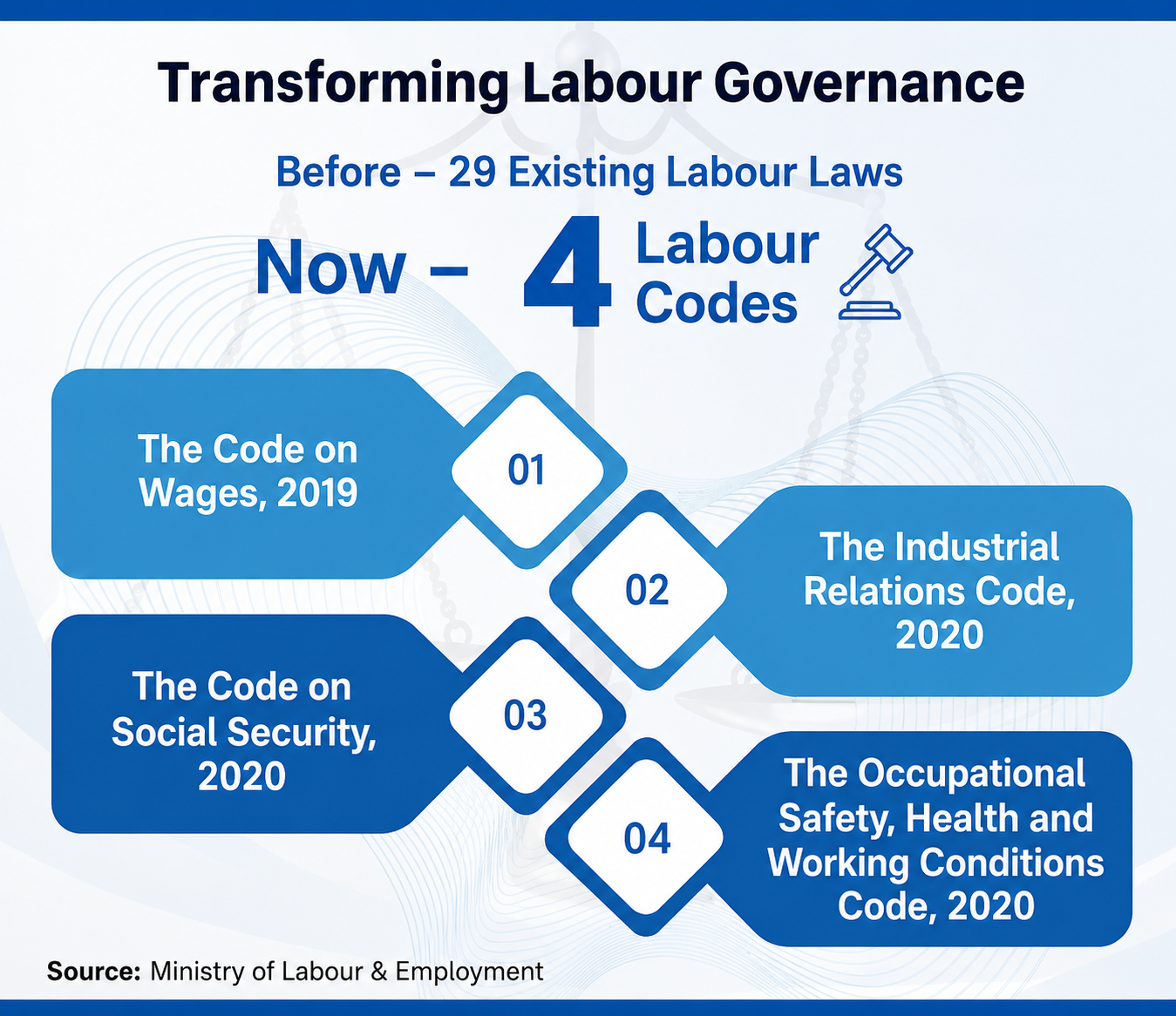
- Four Labour Codes (2019–20): Consolidate 29 central labour laws into four codes covering wages, industrial relations, social security, and occupational safety.
- Labour Welfare & Social Security Schemes: Provide pension, insurance, healthcare and welfare support through schemes such as PM-SYM, Pradhan Mantri Jeevan Jyoti Bima Yojana (PMJJBY), EPFO and ESIC.
Labour Reforms Four Labour Codes
The Labour Codes represent the culmination of several decades of efforts to simplify India's fragmented labour-law structure. They consolidated 29 central labour laws into four broad codes, organised around wages, industrial relations, social security and occupational safety.
Code on Wages, 2019
The Code on Wages seeks to create a more universal and uniform framework for wage regulation while reducing fragmentation among different wage-related laws.
- Consolidation: It subsumes the Payment of Wages Act, 1936; Minimum Wages Act, 1948; Payment of Bonus Act, 1965; and Equal Remuneration Act, 1976.
- Universal Minimum Wages: It extends the statutory framework for minimum wages to all employees, moving beyond the earlier system based largely on scheduled employment.
- National Floor Wage: The Central Government can prescribe a National Floor Wage, below which State-level minimum wages cannot fall.
- Uniform Wage Definition: The Code provides a common definition of wages. If specified allowances exceed 50% of total remuneration, the excess amount is added back to wages for statutory calculations.
- Equal Pay: It reinforces the principle of equal remuneration without discrimination based on gender, including protection for transgender persons.
- Payment Mechanisms: It facilitates modern and digital modes of wage payment.
Industrial Relations Code, 2020
The Industrial Relations Code attempts to balance industrial flexibility with mechanisms for collective bargaining and dispute resolution.
- Consolidation: It combines the Trade Unions Act, 1926; the Industrial Employment (Standing Orders) Act, 1946; and Industrial Disputes Act, 1947.
- Retrenchment Threshold: The threshold for establishments requiring prior government permission for lay-off, retrenchment and closure rises from 100 to 300 workers, subject to States prescribing higher thresholds.
- Standing Orders: Mandatory standing orders apply to establishments employing 300 or more workers, compared with the earlier threshold of 100.
- Strike Notice: A 14-day advance notice requirement for strikes and lockouts is extended to all industrial establishments rather than being confined primarily to public-utility services.
- Restrictions during Proceedings: Strikes and lockouts are restricted during specified conciliation and arbitration proceedings and for prescribed periods thereafter.
- Fixed-Term Employment: Fixed-term employees receive wages and statutory benefits broadly comparable to permanent employees performing similar work, with benefits such as gratuity available on the prescribed basis.
- Reskilling Fund: The Code provides for a re-skilling fund, involving an employer contribution equivalent to 15 days' wages for each retrenched worker.
- Grievance Redressal: The maximum strength of the Grievance Redressal Committee is increased from 6 to 10 members.
- Works Committees: Provision is made for Works Committees in establishments employing 100 or more workers, subject to the statutory conditions.
- Dispute Claims: The Code prescribes a two-year limitation period for specified applications to the Tribunal, replacing the three years applicable to certain direct claims under the Industrial Disputes Act.
Code on Social Security, 2020
The Social Security Code attempts to broaden social security protection beyond conventional employer–employee relationships and incorporate newer forms of work.
- Consolidation: It brings together nine central laws, including legislation concerning EPF, ESI, maternity benefits, employees' compensation and unorganised workers' social security.
- Gig and Platform Workers: It formally recognises the categories of gig workers and platform workers and provides for their registration and inclusion within notified social security schemes.
- Broader Coverage: The framework extends towards unorganised, self-employed, home-based and inter-State migrant workers, subject to the Code and schemes made under it.
- Institutional Mechanism: The National Social Security Board has an expanded role in recommending and monitoring schemes for unorganised, gig and platform workers.
- Social Security Fund: The Code provides for mechanisms to establish social security funds for unorganised, gig and platform workers, including possible contributions or cess from aggregators as prescribed.
- Registration: Provision is made for registration of eligible unorganised, gig and platform workers, including Aadhaar-linked identification subject to statutory requirements.
Occupational Safety, Health and Working Conditions Code, 2020
The OSH Code brings together several laws dealing with workplace safety, health, welfare and employment conditions under a more integrated regulatory framework.
- Consolidation: It subsumes 13 central labour laws, including the Factories Act, Mines Act, Contract Labour Act and Inter-State Migrant Workmen Act.
- Integrated Framework: It creates a common framework covering occupational safety, health and welfare across factories, mines, plantations, docks, construction activities and other specified establishments.
- Registration and Licensing: It provides for a more unified system of registration and licensing for covered establishments and activities.
- Appointment Letters: Employers are required to provide appointment letters to workers, strengthening formalisation and documentary proof of employment.
- Health Protection: Provision is made for periodic health examinations, including free annual health check-ups for workers above the prescribed age threshold.
- Migrant Workers: The Code incorporates provisions concerning inter-State migrant workers, reflecting the need for greater portability and protection of labour rights.
Labour Reforms UPSC PYQs
Q1. Discuss the merits and demerits of the four ‘Labour Codes’ in the context of labour market reforms in India. What has been the progress so far in these regards? (UPSC Mains 2024).

 Last updated on Oct, 2026
→ UPSC 2027 Notification will be released on 13 January 2027 at upsconline.nic.in.
→ Check Nobel Prize 2026 Winners List here.
→ Download PIB PRiSM Monthly Magazine 2026 here.
→ Check UPSC Monthly Current Affairs Magazine The Recitals here.
→ Check out the latest UPSC Syllabus here.
→ Download UPSC Model Answers for Mains 2026
→ UPSC Mains Question Paper 2026 is out now for Essay & GS Paper 1, 2, 3 & 4.
→ UPSC Calendar 2027 has been released.
→ Enroll in Vajiram & Ravi’s UPSC Mains Test Series 2027 for structured answer writing practice, expert evaluation, and exam-oriented feedback.
→ Join Vajiram & Ravi’s UPSC Mentorship Program 2027 for personalized guidance, strategy planning, and one-to-one support from experienced mentors.
→ Go through the UPSC Mains Previous Year Papers to enhance your preparation.
→ UPSC has released UPSC Toppers List 2025 with the Civil Services final result on its official website.
→ Also check Best UPSC Coaching in India
Labour Reforms FAQs
Q1. What are labour reforms?+
Q2. What are the latest labour reforms?+
Q3. How many labour laws were repealed under the new labour codes?+
Q4. What is the new basic salary rule in 2026?+
Q5. What are the 4 new labour codes?+
Tags: labour reforms quest upsc economy notes