
Question
The model of planned economy was adopted in India to address the regional imbalances left behind by colonial rule. Comment
Detailed Solution
Colonial rule produced a dualistic economy, with modern infrastructure & industries concentrated in select regions while large parts of rural & resource-rich India remained underdeveloped. Hence, after independence, India adopted planned development to pursue rapid growth alongside balanced regional development.
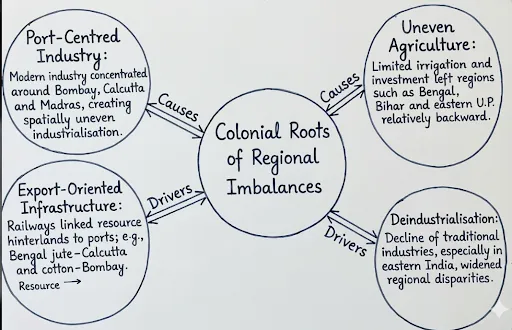
Planning as an Instrument to Correct Regional Imbalances
- Industrial Dispersal: Public-sector investment was deliberately located beyond existing industrial centres; Bhilai, Rourkela & Durgapur steel plants helped create industrial bases in relatively less-developed regions.
- Infrastructure Equalization: Plans prioritised irrigation, power, roads & transport in backward regions; Bhakra-Nangal project supported agricultural and industrial transformation in northwest India.
- Backward-Region Targeting: Planning Commission's 1969 Identification of Backward Areas report proposed objective criteria and fiscal incentives for industrialisation in backward regions.
- Minimum Basic Services: Planning increasingly shifted from merely expanding output towards equitable access to education, health, housing & rural infrastructure; Minimum Needs Programme under Fifth Plan reflected this approach.
- Targeted Regional Assistance: Special programmes & central assistance were directed towards backward districts and difficult regions; Backward Regions Grant Fund (BRGF) was introduced in 2006 to address infrastructure and development deficits.
- Balanced Agricultural Development: Planning sought to spread Green Revolution benefits beyond the north-west; Bringing Green Revolution to Eastern India (BGREI) covered seven eastern States, raising their rice output from 45.65 MT to 57.18 MT between 2009–10 and 2017–18.
Limits of Planned Economy in Removing Regional Imbalances
- Persistent Inter-State Gaps: Planning reduced disparities but did not ensure sustained convergence; Bihar & Jharkhand continue to lag behind Maharashtra & southern States in per-capita income, reflecting persistent spatial inequality.
- Uneven Industrialisation: Public investment could not overcome locational disadvantages; Jharkhand, Bihar & Odisha continued to lag behind industrialised States such as Maharashtra, Gujarat and Tamil Nadu in attracting diversified private investment.
- Unequal Agricultural Gains: Green Revolution initially benefited Punjab, Haryana & western U.P. far more than rain-fed regions of eastern & central India, creating uneven agricultural transformation.
- Resource–Development Paradox: Resource abundance did not guarantee prosperity; Jharkhand, Chhattisgarh & Odisha continued to contain relatively backward regions despite substantial mineral resources; Eleventh Plan explicitly noted this paradox.
- Intra-State Disparities: Planning also failed to eliminate regional pockets of deprivation within developed States; the Twelfth Plan identified Vidarbha in Maharashtra, KBK in Odisha & Bundelkhand in Uttar Pradesh, alongside tribal areas of Jharkhand and Chhattisgarh.
- Geographical Constraints: Himalayan & North-Eastern regions faced persistent development disadvantages due to terrain, connectivity and infrastructure deficits; Twelfth Plan specifically highlighted uneven development across Nagaland, Mizoram, Arunachal Pradesh, J&K, Himachal Pradesh and Uttarakhand.
Thus, planned economy was indeed conceived as an instrument of balanced regional development, but its success was partial. The lesson from India's planning experience is that public investment can create foundations of regional convergence, but sustained convergence requires strong institutions, human capital, connectivity & locally responsive governance.
Last updated on Oct, 2026







