The Asian Development Bank (ADB) is one of the leading multilateral development finance organisations in the world. It is committed to advancing sustainable economic growth, lowering poverty, and raising living standards throughout Asia and the Pacific. ADB has provided member nations with financial support, technical aid, policy recommendations, and regional cooperation projects since its founding in 1966.
Currently, the Asian Development Bank is assisting nations in addressing new issues like food security, energy transition, digital transformation, infrastructure deficiencies, climate change, and disaster resilience. ADB seeks to promote a prosperous, inclusive, resilient, and sustainable Asia-Pacific region through collaborations with governments, the business sector, and international organisations.
ADB Full Form
The Asian Development Bank is referred to as ADB.
- It is a multilateral development bank (MDB) that supports developing nations in Asia and the Pacific via loans, grants, equity investments, technical assistance, and policy support.
- The Asian Development Bank prioritises funding initiatives that produce long-term economic and social benefits over increasing profits, in contrast to commercial banks.
Asian Development Bank History
The history of the Asian Development Bank traces back to the early 1960s, when many Asian nations were dealing with widespread poverty, limited industrialisation, and inadequate infrastructure; the notion of establishing a regional development agency for Asia began to take shape.
- Member nations decided to create a financial organisation devoted to regional development after talks held under the United Nations Economic Commission for Asia and the Far East (ECAFE).
- Important Highlights
- Founded: December 19, 1966
- 31 nations were initially members.
- Takeshi Watanabe was Japan's first president.
- Manila, the capital of the Philippines, was the host nation.
- In its early years, ADB mostly funded rural development, irrigation, and agricultural projects.
- Its activities grew over time to encompass digital development, education, healthcare, transportation, urban infrastructure, renewable energy, and climate action.


Headquarters of Asian Development Bank
The Asian Development Bank's main office is situated in Mandaluyong City, Metro Manila, Philippines. Since its founding, Manila has been the bank's headquarters and continues to be the hub of its international operations.
Asian Development Bank President
The current president of the Asian Development Bank is Masato Kanda (Japan).
- In addition to chairing the Board of Directors, the President of ADB is in charge of the organisation's general administration.
- The President is in charge of ADB's financial management, policy implementation, operational strategy, and interactions with member nations and development partners.
Asian Development Bank Members
The Asian Development Bank’s growing membership is indicative of its increasing significance in meeting Asia's and the Pacific's development demands.
- The bank promotes worldwide collaboration by uniting economies from various regions.
- Under Article 3 of the Agreement Establishing the Asian Development Bank, membership is open to:
- Members and associate members of the United Nations Economic Commission for Asia and the Far East (now ESCAP).
- Other regional countries and non-regional developed countries that are members of the United Nations (UN) or any of its specialised agencies.
- Present membership status is
- ADB has grown considerably from 31 to 69 members.
- 50 regional members.
- 19 non-regional members.
- Non-regional members are nations from North America and Europe that provide resources and knowledge, whereas regional members are those from Asia and the Pacific.
- Since 1966, India has been a founding member.
Asian Development Bank Voting System
The Asian Development Bank's governance structure ensures effective management and open decision-making by combining capital-based voting with inclusive representation. This framework acknowledges member nations' financial contributions to the organisation while allowing them to take part in the formation of policies.
- Each member's voting power is determined by:
- Basic votes allocated equally to all members.
- Share votes based on the number of subscribed capital shares.
- Consequently, nations with more capital contributions have more voting power within the organisation. The Board of Governors, with one representative from each member country, is the highest decision-making body, while a 12-person Board of Directors handles operational and financial affairs.
- Major Influence & Shareholders
- The US and Japan each control around 15.6% of the total shares and voting power.
- People's Republic of China: About 6.4% of all shares.
- India: Approximately 6.3% of all shares.
- Australia: Roughly 5.8% of all shares
Asian Development Bank Objectives
The Asian Development Bank (ADB) has a clear development mandate to promote long-term prosperity throughout Asia and the Pacific. Its goals centre on assisting developing member nations in achieving inclusive, resilient, and sustainable growth while tackling the region's changing economic, social, and environmental issues. Objectives are
- Lowering poverty and raising levels of living.
- Encouraging sustainable and equitable economic growth.
- Funding the construction of infrastructure.
- Encouraging regional integration and collaboration.
- Enhancing environmental sustainability and climatic resilience.
- Promoting involvement from the private sector.
- Encouraging social inclusion and gender equality.
- Enhancing institutional capacity and governance.
- Improving resilience and readiness for disasters.
- Encouraging digital transformation and innovation.
Asian Development Bank Functions
The Asian Development Bank (ADB) provides a wide range of financial and non-financial services to its developing member nations. In addition to loans, it offers policy advice, capacity building, knowledge exchange, and regional collaboration, all of which help nations achieve equitable and sustainable development.
- Financing for Development: For development projects, the Asian Development Bank offers sovereign and non-sovereign loans, grants, guarantees, and equity investments.
- Technological Support: The bank provides governments with technical assistance for project implementation, institutional building, and policy reforms.
- Information Exchange: The Asian Development Bank publishes economic studies, carries out research, and advises member nations on policy.
- Construction of Infrastructure: It provides funding for electricity, water supply, sanitation, urban development, and transportation initiatives.
- Climate Funding: Sustainable infrastructure initiatives, climate adaptation, renewable energy, and disaster risk reduction are all supported by ADB.
- Development of the Private Sector: The bank encourages investments in financial markets, companies, and public-private partnerships (PPPs).
- Regional Collaboration: ADB promotes regional economic integration, trade facilitation, and cross-border connectivity among its member nations.
Asian Development Bank's Development Vision Strategy 2030
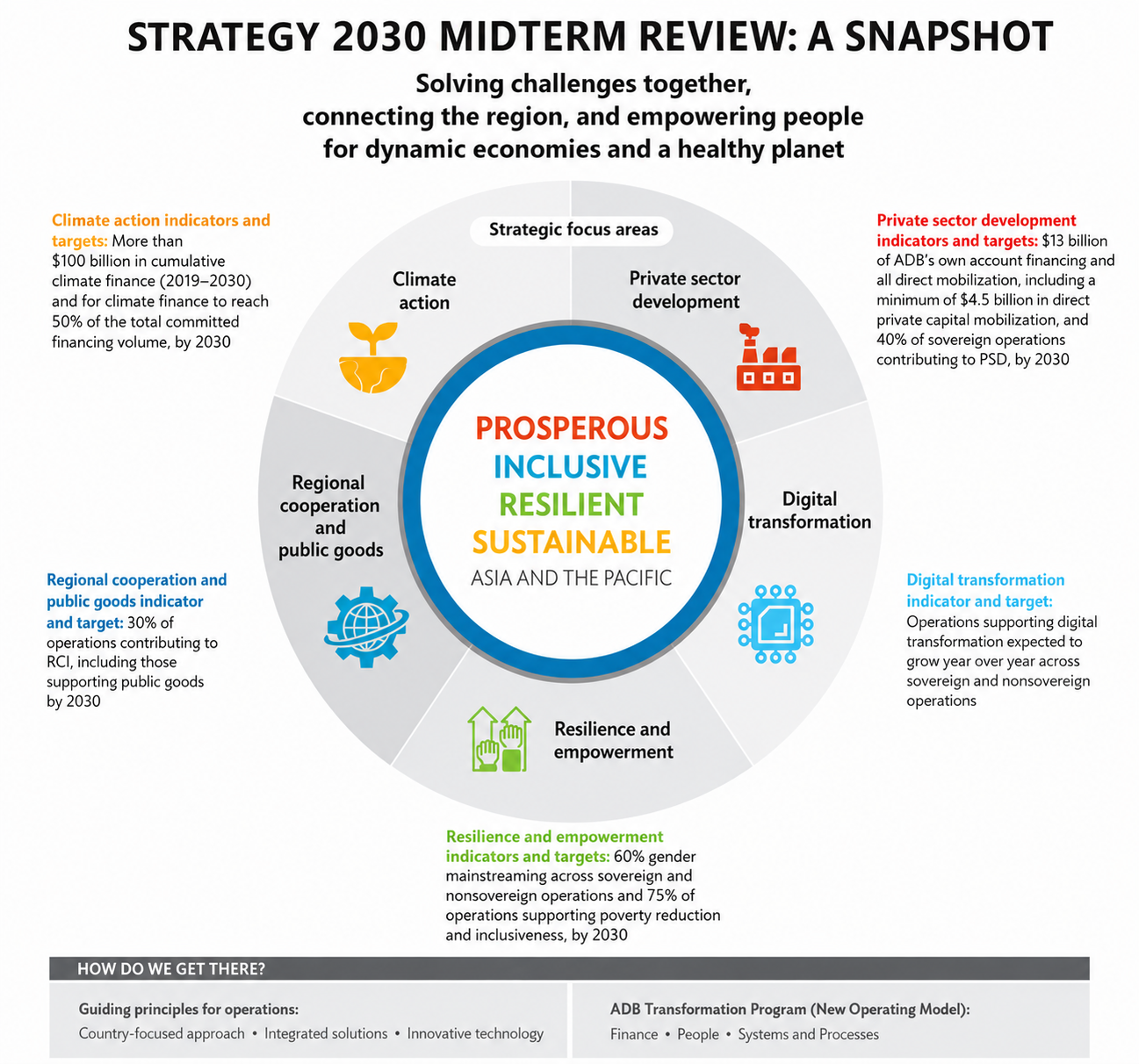
The Asian Development Bank, while continuing its efforts to end extreme poverty, will broaden its goal to achieve a prosperous, inclusive, resilient, and sustainable Asia and the Pacific under Vision Strategy 2030. The strategy seeks to create an area that is prosperous, inclusive, resilient, and sustainable. Strategy 2030's primary focus areas are
- Action on Climate Change: Over $100 billion in total climate finance between 2019 and 2030, and by 2030, climate finance will account for 50% of all committed financing volume.
- Private Sector Development: It will receive $13 billion from ADB's own account financing and all direct mobilisation, including at least $4.5 billion in direct private capital mobilisation, and 40% of sovereign operations will contribute to private sector development.
- Public Goods and Regional Cooperation: By 2030, 30% of operations will support public goods and promote regional collaboration and integration.
- Transformation to Digital: It is anticipated that both sovereign and nonsovereign operations supporting digital transformation will increase annually.
- Empowerment and Resilience: By 2030, 60% of sovereign and nonsovereign activities will incorporate gender, and 75% of operations will promote inclusivity and poverty alleviation.
Asian Development Bank Role in Asia-Pacific Development
The Asian Development Bank (ADB) has played a pivotal role over the past 60 years in promoting sustainable and inclusive development across Asia and the Pacific. By providing financial assistance, technical expertise, policy support, and knowledge solutions.
- Development of Infrastructure: The Asian Development Bank provides funding for renewable energy projects, ports, airports, highways, railroads, and urban infrastructure that enhances economic productivity and connectivity.
- Example: Urban Transport Electrification Project in the Kyrgyz Republic.
- Reducing Poverty: The bank backs initiatives that increase access to livelihood opportunities, clean water, sanitation, healthcare, and education.
- Example: Improving Health Services in Bangladesh through ADB-supported health system strengthening programmes.
- Action on Climate Change: In order to assist nations in making the shift to low-carbon and climate-resilient development, ADB is increasing climate finance and plans to allocate 50% of its yearly committed financing to climate action by 2030.
- Example: Maldives Climate-Resilient Water and Sanitation Project, which strengthens climate adaptation and improves water security.
- Integration of Regions: ADB promotes economic integration throughout Asia and the Pacific through programmes for regional cooperation, trade corridors, and cross-border transportation.
- Example: CAREC Programme, connecting 11 member countries through transport, energy, and trade facilitation projects.
- Growth in the Private Sector: By offering funding, guarantees, and advisory support for development initiatives that are financially viable, ADB encourages private participation.
- Example: Financing renewable energy and infrastructure projects through ADB's Private Sector Operations Department (PSOD)
- Resilience to Disasters: The bank helps member nations become more resilient to pandemics, natural disasters, and other regional emergencies.
-
- Example: Pacific Disaster Resilience Program, which is disaster preparedness and swift financing for Pacific Island countries.
Asian Development Bank and India
India is a founding member and fourth-largest shareholder of ADB, which supports its priorities in urban development, skills, employment, infrastructure, and sustainable growth under the Country Partnership Strategy 2023–2027. ADB-supported projects in India:
- Pradhan Mantri Skilling and Employability Transformation through Upgraded Industrial Training Institutes Programme ($846 million).
- Accelerating Affordable and Inclusive Rooftop Solar Systems Development Programme ($650 million).
- Assam State Tertiary Health Care Augmentation Project (ASTHA – $398.8 million);
- Chennai Metro Rail Investment Project ($240 million).
- Integrated Ecotourism and Sustainable Agri-based Livelihood Development in Meghalaya Project ($77 million).
- Maharashtra Power Distribution Enhancement Programme for Agricultural Solarisation ($500 million).
- Indore Metro Rail Project ($190.6 million).
- Gujarat Skills Development Programme ($109.97 million).
- $98 million loan to support horticultural plant health management in India.
- $42 million loan to improve coastline preservation and increase community resilience in Maharashtra.
Asian Development Bank Reports
The Asian Development Bank (ADB) Publications provide comprehensive economic tracking, development statistics, and strategic forecasts for the Asia-Pacific region
- Asian Development Outlook (ADO): Published [annually/periodically], it offers regional growth analysis, inflation trends, and economic projections for developing Asia, including GDP estimates for India.
- ADB Annual Report: The operational, institutional, and financial outcomes of ADB are fully described in this annual report.
- Asian Economic Integration Report 2026: This paper emphasises how Asia and the Pacific are continuing to expand economic integration. In order to improve resilience and promote inclusive, sustainable integration, it outlines current trends and talks about policy priorities.
- Key Indicators for Asia and the Pacific: provides up-to-date statistical information and Sustainable Development Goals (SDG)-related social, economic, and environmental metrics.
Asian Development Bank UPSC PYQs
Q1. Which one of the following launched the ‘Nature Solutions Finance Hub for Asia and the Pacific’? (UPSC Prelims 2025)
a) The Asian Development Bank (ADB)
b) The Asian Infrastructure Investment Bank (AIIB)
c) The New Development Bank (NDB)
d) The International Bank for Reconstruction and Development (IBRD)
Ans: a

 Last updated on Oct, 2026
→ UPSC 2027 Notification will be released on 13 January 2027 at upsconline.nic.in.
→ Check Nobel Prize 2026 Winners List here.
→ Download PIB PRiSM Monthly Magazine 2026 here.
→ Check UPSC Monthly Current Affairs Magazine The Recitals here.
→ Check out the latest UPSC Syllabus here.
→ Download UPSC Model Answers for Mains 2026
→ UPSC Mains Question Paper 2026 is out now for Essay & GS Paper 1, 2, 3 & 4.
→ UPSC Calendar 2027 has been released.
→ Enroll in Vajiram & Ravi’s UPSC Mains Test Series 2027 for structured answer writing practice, expert evaluation, and exam-oriented feedback.
→ Join Vajiram & Ravi’s UPSC Mentorship Program 2027 for personalized guidance, strategy planning, and one-to-one support from experienced mentors.
→ Go through the UPSC Mains Previous Year Papers to enhance your preparation.
→ UPSC has released UPSC Toppers List 2025 with the Civil Services final result on its official website.
→ Also check Best UPSC Coaching in India
Asian Development Bank FAQs
Q1. What is the full form of ADB?+
Q2. When was the Asian Development Bank established?+
Q3. Where is the headquarters of the Asian Development Bank?+
Q4. How many members does ADB have?+
Q5. Who is the current president of ADB?+
Tags: asian development bank quest UPSC International Relations and Institutions Notes