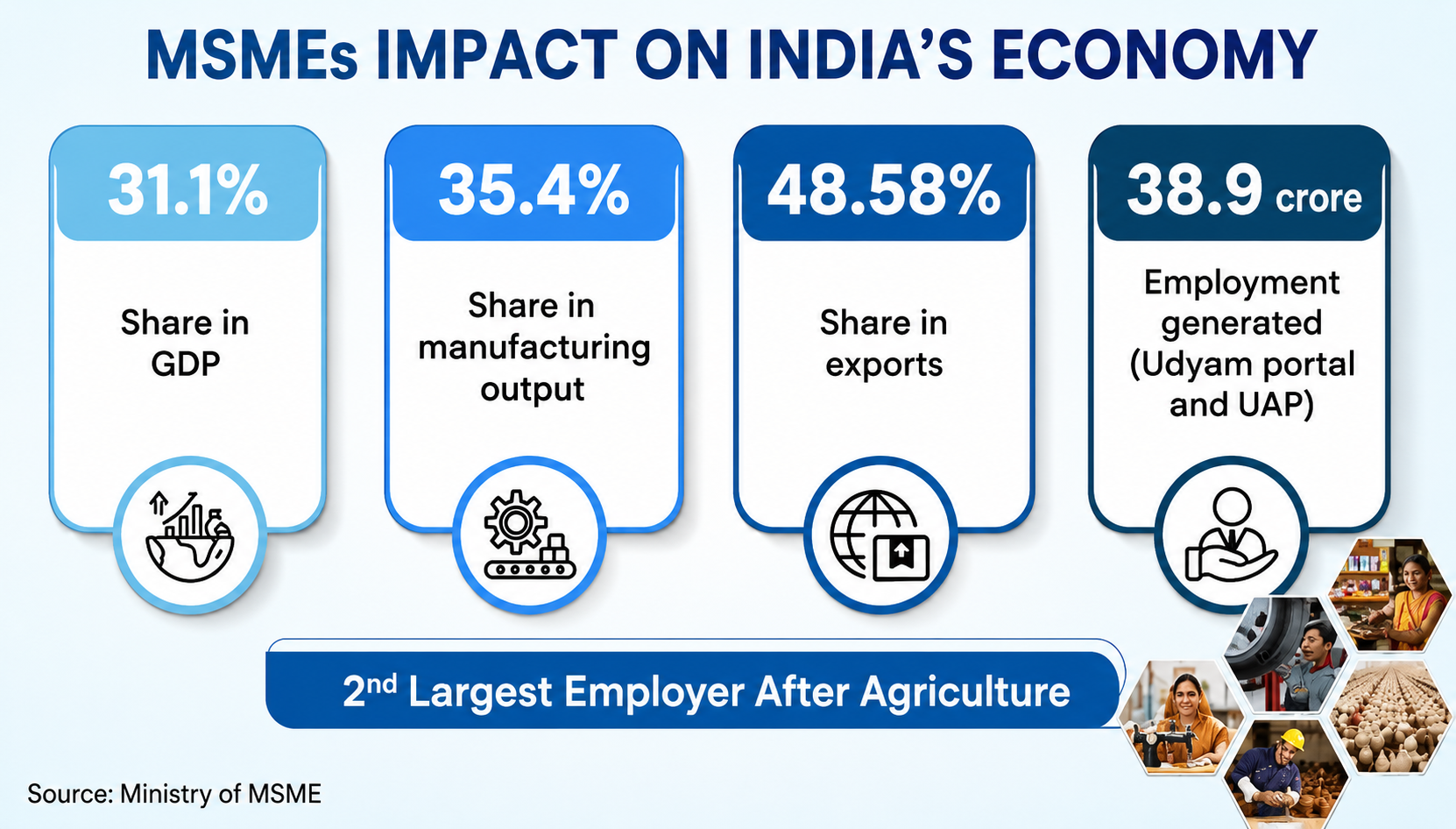
The MSME sector is a vital pillar of India’s economy, contributing 31.1% of GDP, 35.4% of manufacturing output, and 48.58% of exports. It provides livelihoods to around 38.9 crore people, making it the second-largest source of employment after agriculture, while more than 7.47 crore enterprises operate across manufacturing, services and trade. The sector promotes entrepreneurship, supports rural and semi-urban economies, strengthens domestic supply chains, and facilitates India’s integration into global value chains.
MSMEs have also witnessed rapid formalisation, with registrations through the Udyam Registration Portal and Udyam Assist Platform crossing 8.7 crore by June 2026. Strengthening their access to finance, technology, skills, markets and infrastructure is crucial for inclusive and sustainable growth.
MSME Full Form
The full form of MSME is Micro, Small, and Medium Enterprises. Over the past fifty years, the Indian economy's Micro, Small, and Medium-Sized Enterprises (MSME) sector has grown to be a very active and dynamic one.
- They also aid in the industrialisation of rural and underdeveloped areas, which lessens regional disparities and ensures a more equitable distribution of national wealth and income.
MSME Definition
Micro, Small, and Medium Enterprises can be defined as smaller-scale business entities engaged in the production, manufacturing, processing, or servicing of goods and commodities.
- MSMEs range from small manufacturing units, artisans and food-processing enterprises to technology companies, engineering firms and service providers.
- The Micro, Small, and Medium Enterprise sector also serves as an important link between large industries and local economies, as many MSMEs operate as suppliers, vendors, and ancillary units for larger companies.


MSME Classification
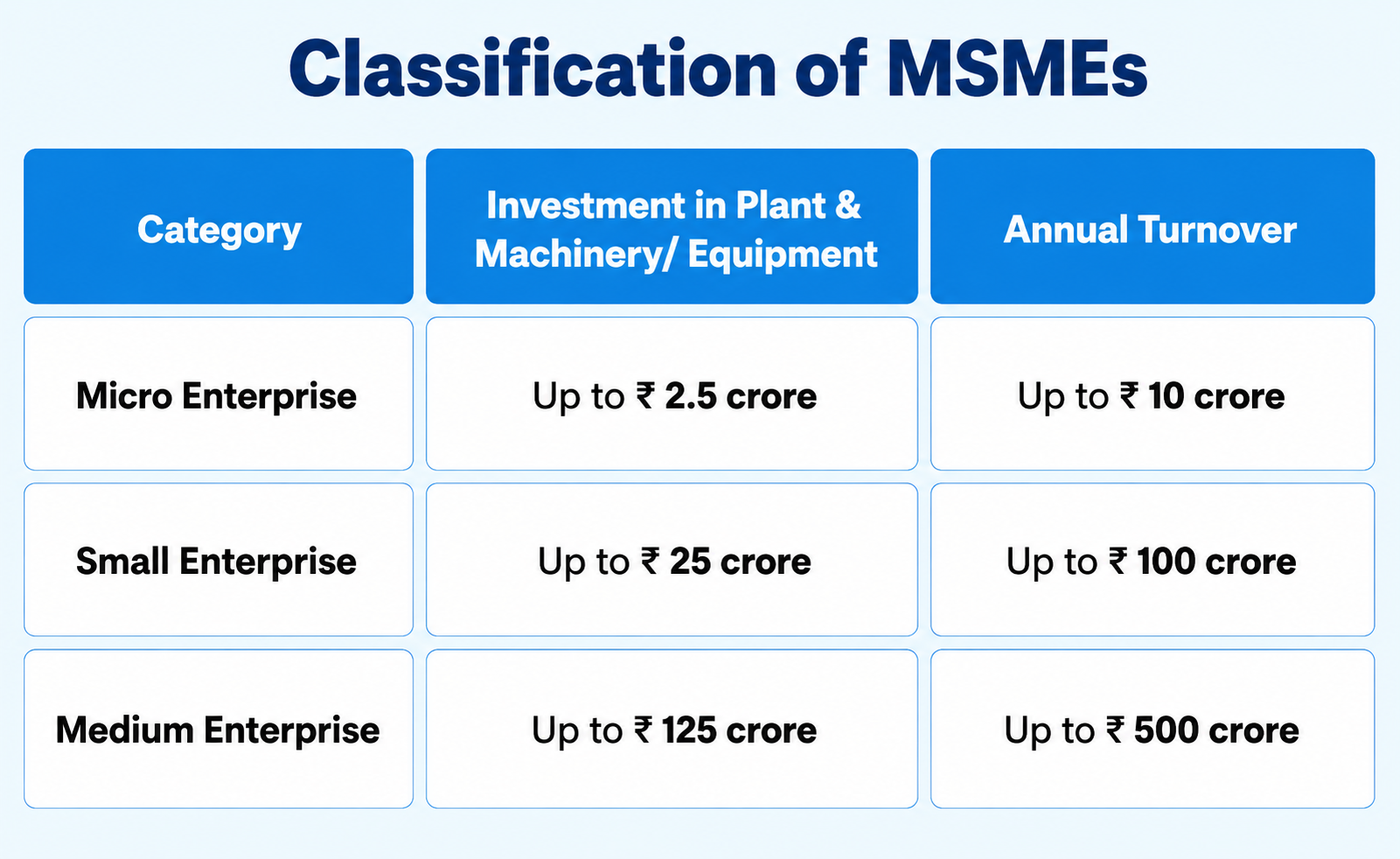
Micro, Small, and Medium Enterprise categorisation is based on a dual-parameter system using investment in plant and machinery/equipment (excluding land and building) and annual turnover. Following the updates effective April 1, 2025, the criteria apply uniformly to both manufacturing and service sectors. Revised classification criteria are
- Micro Enterprise
- Investment: Not more than ₹2.5 crore
- Turnover: Not more than ₹10 crore
- Small Enterprise
- Investment: Not more than ₹25 crore
- Turnover: Not more than ₹100 crore
- Medium Enterprise
- Investment: Not more than ₹125 crore
- Turnover: Not more than ₹500 crore.
MSME Importance
The importance of Micro, Small, and Medium Enterprises in India extends beyond employment generation to strengthening manufacturing, increasing exports, promoting entrepreneurship, supporting formalisation, and ensuring inclusive and balanced economic growth.
- The Foundation of the Indian Economy: The Micro, Small, and Medium Enterprise industry is a major force behind economic growth and industrial development, accounting for almost one-third of the nation's GDP.
- It contributes roughly 35.4% of the nation's manufacturing and 48.58% of its exports.
- Creation of Jobs: The capacity of Micro, Small, and Medium Enterprises to create a huge number of jobs is one of their greatest advantages. Through more than 8.7 crore registered businesses, the industry offers livelihood prospects to nearly 38.9 crore individuals.
- Economy Formalisation: The formalisation of Micro, Small, and Medium Enterprises has advanced because of government programmes like Udyam Registration and the Udyam Assist Portal. There are over 8.7 crore registered businesses as of June 2026, up from about 2.5 crore in March 2024.
- Encouraging Inclusive and Regional Development: By encouraging industrial activity outside of major cities, Micro, Small, and Medium Enterprises are essential in lowering regional economic inequities. They support rural development, better infrastructure, and increased economic inclusion.
- Boosting Supply Chains and Manufacturing: Providing larger companies with raw materials, intermediate goods, and specialised services, the Micro, Small, and Medium Enterprise sector plays a crucial role in India's industrial ecosystem.
- Transformation to Digital: Micro, Small, and Medium Enterprises are adopting digital technology at a significantly higher rate. Nearly 90% of businesses accept digital payments, and 18% have previously used digital lending systems, according to the report.
MSME Challenges
The Micro, Small, and Medium Enterprise sector faces several critical challenges, including limited access to affordable credit, delayed payments from large corporate buyers, and an inability to adopt modern technology.
- Inadequate Formalisation: Formalisation is difficult, especially for micro-enterprises, even if the number of registered businesses has greatly increased.
- Due to a lack of knowledge about the advantages of registration and worries about regulatory monitoring, around 35% of microbusinesses are still unregistered.
- Limited Availability of Reasonably Priced Credit: One of the biggest obstacles for this sector is still getting timely and sufficient financing.
- Although small and medium-sized businesses' reliance on unofficial borrowing has decreased, 12% of microbusinesses still rely on unofficial credit sources, indicating ongoing financing shortfalls.
- Limited Financial Literacy and Management Skills: Many Micro, Small, and Medium Enterprise owners lack the skills to manage their cash flow and inventory, resulting in operational difficulties. The lack of financial skills also hampers their debt management, as they are unable to negotiate for a better interest rate or terms for credit.
- Women-Owned Enterprises Credit Gap: Compared to the sector as a whole, women-led Micro, Small, and Medium Enterprises are more financially constrained.
- The projected 35% credit gap for women-owned businesses highlights the need for more institutional assistance and focused financial inclusion initiatives.
- Incapacity to Access Financial Markets: Micro, Small, and Medium Enterprises are unable to access capital markets due to their size, type of business, and compliance with legal requirements for disclosures and transparency.
- Lack of Skills: For many Micro, Small, and Medium Enterprises, the availability of trained labour continues to be a serious challenge. Productivity, product quality, and the uptake of contemporary technologies are all impacted by a lack of skilled labour.
MSME Government Schemes
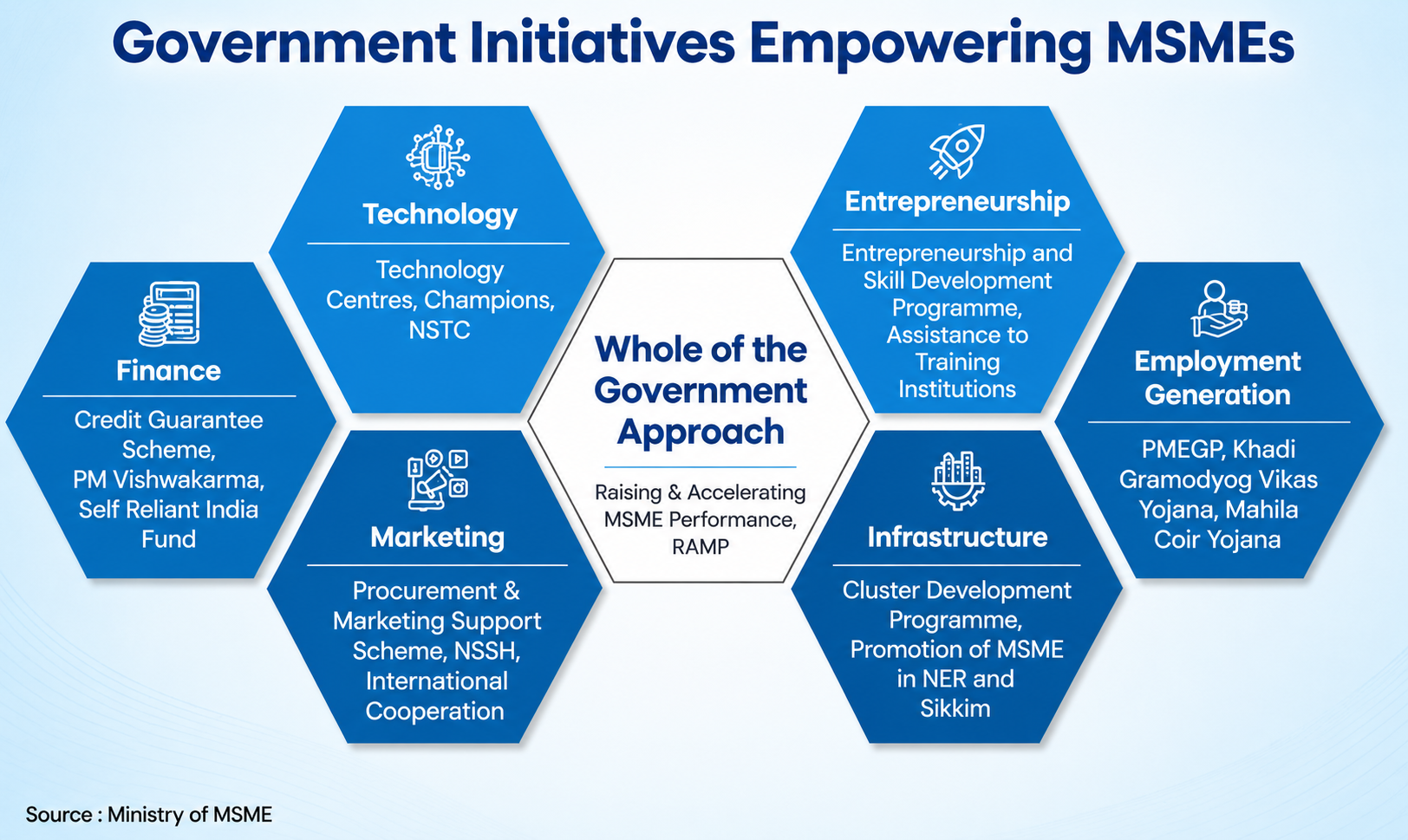
The Government of India has launched a range of targeted initiatives to enhance credit access, encourage entrepreneurship, and improve the competitiveness of MSMEs. These schemes aim to foster sustainable growth while addressing the sector's key financing and capacity-building needs.
- Pradhan Mantri MUDRA Yojana: By offering loans of up to ₹10 lakh, PMMY has been instrumental in strengthening small and micro businesses that are not corporate or agricultural.
- During the Union Budget 2024-25 on July 23, 2024, the finance minister proposed an increase in the loan cap to ₹20 lakh in order to bolster support for prospective entrepreneurs. This new cap was implemented on October 24, 2024.
- PM Vishwakarma Program: Honours and encourages traditional handicrafts and artisans. It offers marketing support, financial aid (up to a ₹3 lakh loan), and talent development.
- Credit Guarantee Scheme for Micro and Small Enterprises (CGTMSE)
- Objective: Government–SIDBI initiative providing collateral-free credit to eligible micro and small enterprises through credit guarantees.
- Mechanism: CGTMSE does not lend directly; it guarantees eligible term loans and working-capital facilities provided by member lending institutions.
- Coverage: Generally 75%–85% of the eligible defaulted amount, depending on the beneficiary category.
- Prime Minister’s Employment Generation Programme (PMEGP): A credit-linked microbusiness startup assistance programme.
- Subsidy – 15–35% of the project's total cost (up to ₹20 lakh for services and ₹50 lakh for manufacturing). Beneficiaries in special categories (SC, ST, women, and ex-servicemen) receive more subsidies.
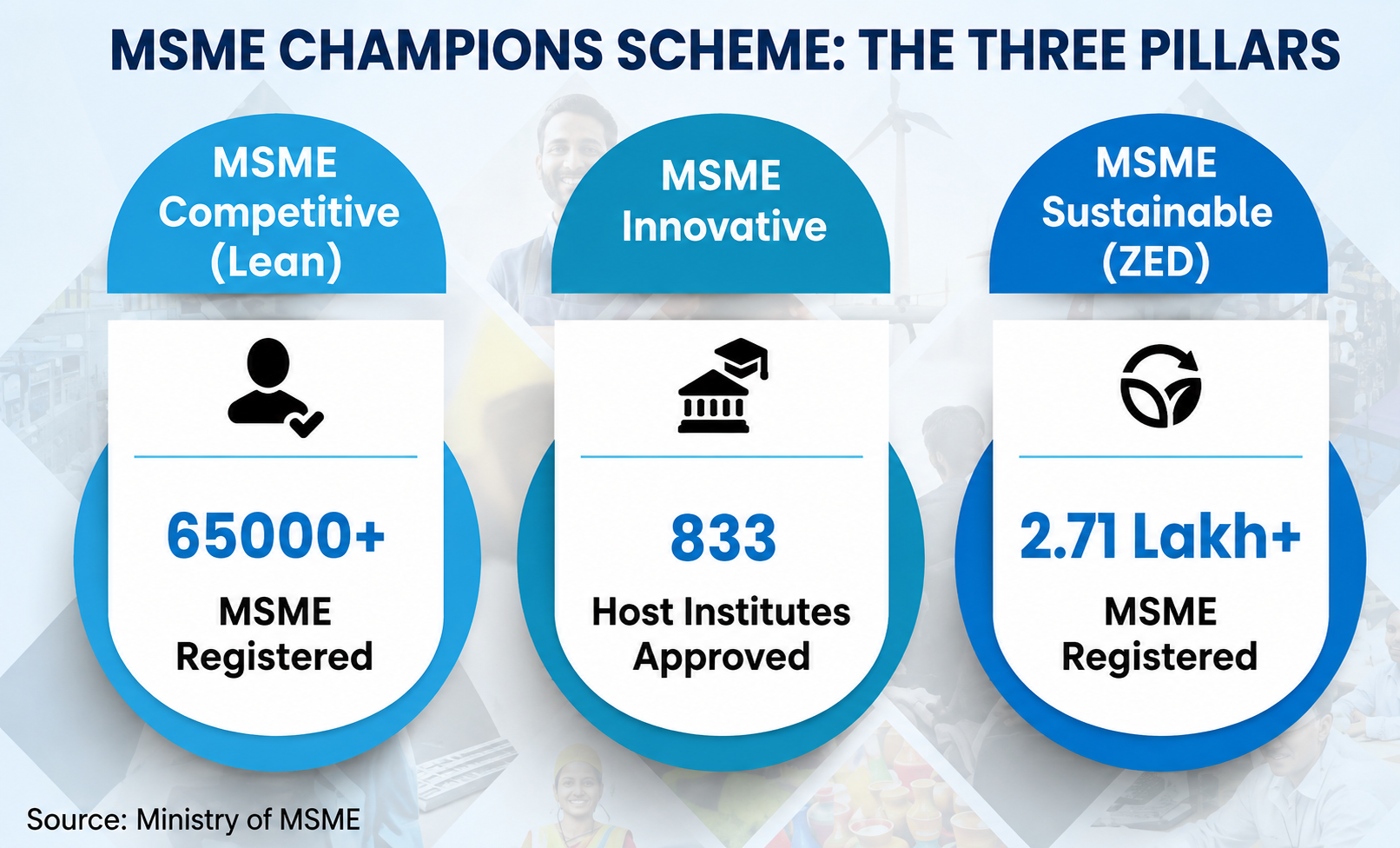
- MSME Champions Program: By enhancing their operations, reducing inefficiencies, boosting competitiveness, and fostering their expansion to attain excellence in both local and foreign markets, the MSME Champions Scheme seeks to identify and promote a small number of businesses.
- Stand Up India: The Stand Up India (SUPI) Scheme helps women and SC/ST business owners establish greenfield ventures by providing bank credit.
MSME Budget 2026–27
A comprehensive series of changes aimed at bolstering the Micro, Small, and Medium Enterprises (MSME) sector is introduced in the Union Budget 2026–2027. Enhancing financial access, promoting innovation, streamlining compliance, and increasing market opportunities are the main priorities. These policies are intended to boost MSMEs' competitiveness and encourage their sustained contribution to India's economic expansion.
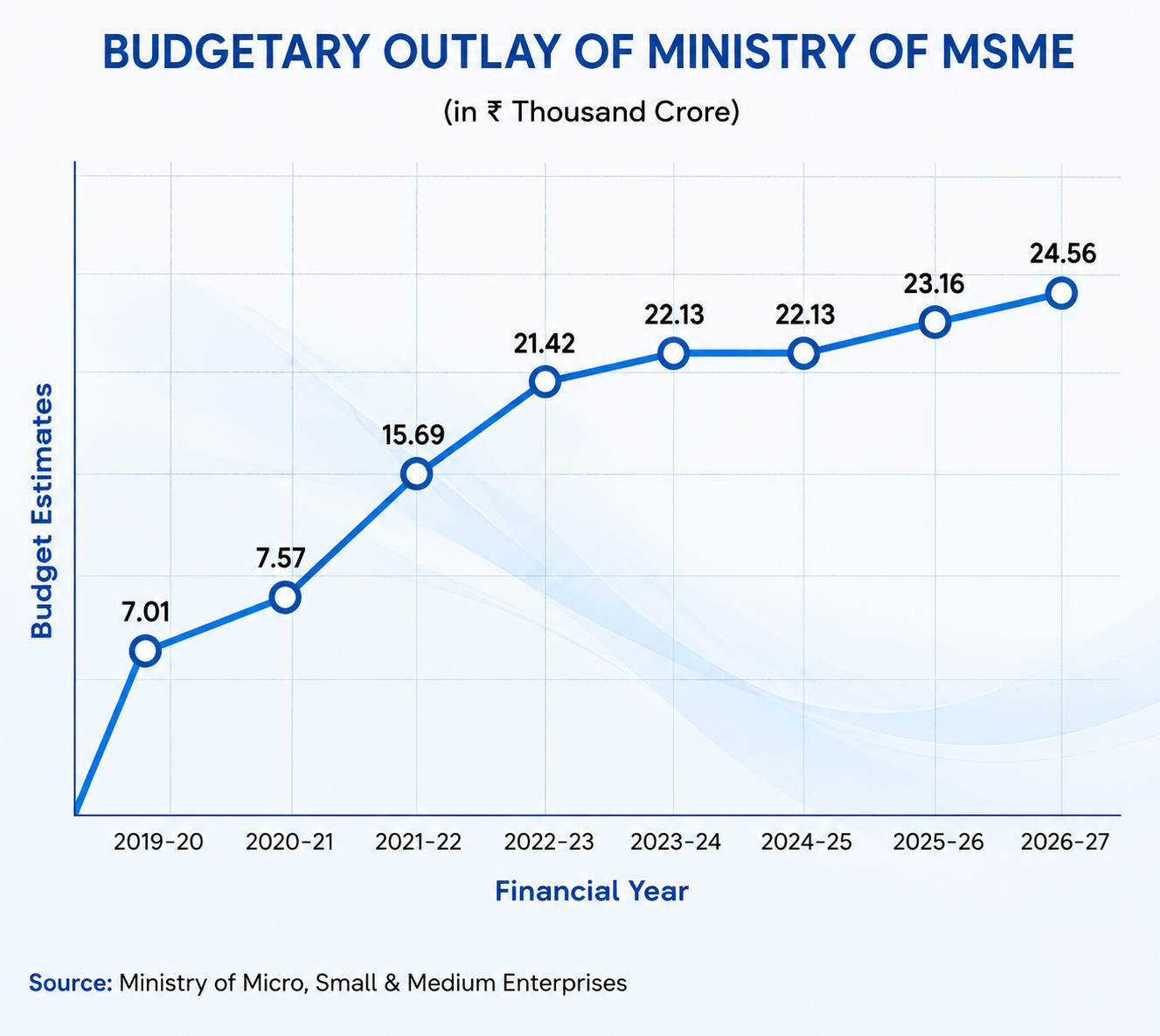
- A Three-Pronged Approach to Developing MSME Champions: Through equity support, liquidity augmentation, and professional assistance, the Budget takes a three-pronged approach to assist MSMEs in becoming globally competitive businesses.
- Equity Assistance for MSME Development: The government has announced a ₹10,000 crore SME Growth Fund to increase access to growth funding. By offering qualified businesses equity-based financial support, the fund seeks to assist high-potential MSMEs.
- Furthermore, an extra ₹2,000 crore would be given to the Self-Reliant India (SRI) Fund, which was established in 2021, to bolster assistance for micro and small businesses.
- Support for Liquidity via TReDS: The Trade Receivables Discounting System (TReDS) is strengthened by the budget to increase MSMEs' access to working capital. Through the platform, more than ₹7 lakh crore has already been liberated.
- Expert Assistance via "Corporate Mitras": The government will work with professional organisations like ICAI, ICSI, and ICMAI to create short-term, useful training programmes in recognition of the difficulties small firms confront with compliance.
- Boost in E-Commerce Exports: The budget suggests lifting the current courier export cap of ₹10 lakh per shipment to assist MSMEs in growing their market share abroad.
MSME Way Forward
- Accelerate the Formalisation of Micro-enterprises: Wider formalisation and better access to government assistance can be promoted by raising awareness, streamlining registration processes, and fostering trust among business owners.
- Expand Timely and Reasonably Priced Credit Access: MSMEs can acquire sufficient and timely financing by strengthening institutional lending, extending credit guarantee systems, streamlining loan procedures, and encouraging digital lending.
- Implement Sector-Specific Financing Techniques: Credit accessibility and company growth can be enhanced by customised credit products and regulatory interventions for industries like food processing, grocery retail, ready-made clothing, and IT/ITeS.
- Improve the Digital Financial System: Utilising digital transaction data helps boost MSMEs' financial inclusion, expedite processing, and enhance credit evaluation.
- Reduce the Credit Divide for Women-Owned Businesses: Increased institutional assistance, better access to formal financing, and targeted financial solutions can all help close the larger credit gap that women-led MSMEs confront and promote inclusive entrepreneurship.
MSME UPSC PYQs
Q1. Faster economic growth requires an increased share of the manufacturing sector in GDP, particularly of MSMEs. Comment on the present policies of the Government in this regard. (UPSC Mains, 2023)
Q2. MSME sector is referred to as the growth engine of the Indian economy. In the light of this statement discuss the challenges and solutions pertaining to the MSME sector in India. (UPSC Mains, 2020)
Q3. Consider the following statements with reference to India (UPSC Prelims 2023)
- According to the 'Micro, Small and Medium Enterprises Development (MSMED) Act, 2006', the 'medium enterprises' are those with investments in plant and machinery between ₹ 15 crore and ₹ 25 crore.
- All bank loans to the Micro, Small and Medium Enterprises qualify under the priority sector.
Which of the statements given above is/are correct?
a) 1 only
b) 2 only
c) Both 1 and 2
d) Neither 1 nor 2
Ans: (b)

 Last updated on Oct, 2026
→ UPSC 2027 Notification will be released on 13 January 2027 at upsconline.nic.in.
→ Check Nobel Prize 2026 Winners List here.
→ Download PIB PRiSM Monthly Magazine 2026 here.
→ Check UPSC Monthly Current Affairs Magazine The Recitals here.
→ Check out the latest UPSC Syllabus here.
→ Download UPSC Model Answers for Mains 2026
→ UPSC Mains Question Paper 2026 is out now for Essay & GS Paper 1, 2, 3 & 4.
→ UPSC Calendar 2027 has been released.
→ Enroll in Vajiram & Ravi’s UPSC Mains Test Series 2027 for structured answer writing practice, expert evaluation, and exam-oriented feedback.
→ Join Vajiram & Ravi’s UPSC Mentorship Program 2027 for personalized guidance, strategy planning, and one-to-one support from experienced mentors.
→ Go through the UPSC Mains Previous Year Papers to enhance your preparation.
→ UPSC has released UPSC Toppers List 2025 with the Civil Services final result on its official website.
→ Also check Best UPSC Coaching in India
MSME FAQs
Q1. What is the full form of MSME?+
Q2. What is the MSME meaning?+
Q3. Which are the government schemes for the MSME sector?+
Q4. Who is eligible under MSME?+
Q5. What is the 45-day MSME rule?+
Tags: msme quest upsc economy notes