The Production Linked Incentive, or PLI Scheme, is a cornerstone of India’s strategy to expand domestic manufacturing, attract investment and move towards increasing manufacturing’s contribution to GDP to 25%. With an incentive outlay of ₹1.91 lakh crore across 14 key sectors, the scheme seeks to enhance production and promote economies of scale, create employment and integrate Indian firms into global value chains.
Beyond financial support, the PLI Scheme encourages industries to strengthen domestic capabilities, adopt advanced technologies and undertake greater innovation. As of the latest figures cited, 836 applications across the 14 sectors have been approved, reflecting significant industry participation. The initiative is therefore helping India transition from conventional factory-led production towards technology-driven, innovation-oriented and globally competitive manufacturing.
PLI Scheme Introduction
PLI's full form is the Production Linked Incentive Scheme. It supports national objectives such as Atmanirbhar Bharat and India's $5 trillion economy. It complements the Make in India and Atmanirbhar Bharat initiatives by promoting large-scale domestic manufacturing and deeper integration into global value chains.
- By promoting domestic manufacturing of gadgets and cell phones, it propels Digital India and lowers the cost of technology.
- Additionally, it is in line with the India Semiconductor Mission, which is supported by a package of 76,000 crore and seeks to boost India's integration into global electronics value chains by offering financial support for investments in semiconductor fabrication, display production, and chip design.
PLI Scheme Objectives
- Expand Domestic Manufacturing Capacity: The PLI Scheme encourages companies to increase production within India and build stronger domestic manufacturing capabilities.
- Attract Investment: The scheme encourages domestic and foreign companies to invest in selected manufacturing sectors and expand production facilities.
- Enhance Exports: The scheme aims to improve the competitiveness of Indian products and increase their presence in international markets.
- Promote Globally Competitive Manufacturing: The scheme supports technology adoption, higher productivity and the development of internationally competitive manufacturing firms.
- Integrate with Global Supply Chains: The scheme helps Indian manufacturers participate more actively in global value chains and international production networks.
- Generate Employment: The expansion of manufacturing under PLI is expected to create direct and indirect employment opportunities.
- Reduce Import Dependence: The scheme promotes domestic production of important goods and components to reduce reliance on imports.
- Encourage Technological Advancement: The scheme incentivises companies to adopt modern technologies and upgrade their manufacturing capabilities.


PLI Scheme Background
PLI was launched in 2020 to boost domestic manufacturing through targeted, performance-based incentives across strategic sectors, starting with Mobile Manufacturing and Specified Electronic Components, Critical Key Starting materials/Drug Intermediaries and Active Pharmaceutical Ingredients and Manufacturing of Medical Devices.
- After its initial success, the scheme was gradually expanded to cover 14 key sectors of the economy, including pharmaceuticals, white goods, vehicles and auto parts, textile products and speciality steel are a few examples.
- Over time, the programme garnered significant attention from both local and international stakeholders, resulting in the approval of numerous projects in industries including textiles, electronics, bulk medicines, and medical devices. For instance, the Union Cabinet approved the ₹15,000 crore PLI initiative for the pharmaceutical industry in February 2021.
- In a similar vein, a ₹25,938 crore PLI programme for the automotive and auto component industries and a ₹120 crore three-year PLI scheme for drones and drone components were approved in September 2021.
PLI Scheme Functions
PLI is a government initiative that offers financial rewards to businesses that produce goods in India. These initiatives aim to lower imports and increase indigenous manufacturing. There are several different types of production-related incentive programmes, such as:
- Tax incentives: Businesses that produce goods in India may receive tax breaks from the government. This could lower production costs and increase the competitiveness of Indian goods in the international market.
- Cash subsidy: Businesses that make goods in India may receive cash subsidies from the government. As a result, Indian goods may become more reasonably priced for customers.
- Loans: Businesses that produce goods in India may be eligible for government loans.
PLI Scheme Working
The PLI Scheme operates through a performance-based incentive mechanism, rewarding eligible manufacturers for meeting specified investment, production and sales conditions.
- Base Year: A specified financial year serves as the reference point against which a company’s subsequent growth in eligible production or sales is assessed.
- Incremental Sales or Production: The incentive is determined by the eligible increase in sales or production achieved by a company compared with the prescribed base-year level.
- Applicable Incentive Rate: A sector-specific incentive percentage is applied to the eligible incremental performance, with rates and calculation methods varying across different PLI schemes.
- Incentive rates range from 4% to 6% of incremental sales over the base year and also vary based on product category (up to 20% for drones).
- Eligibility Conditions: Companies must satisfy prescribed requirements such as minimum investment, turnover, production, net worth or other sector-specific criteria to qualify.
- Scheme Period: Eligible companies receive incentives for a predefined period, generally linked to the investment and production timelines specified under the respective sectoral scheme.
- Application and Selection: Interested companies submit applications through the designated mechanism, after which the concerned ministry or implementing agency evaluates them against the notified eligibility conditions.
- Verification and Disbursement: The implementing authority verifies the company’s investment, production, sales and compliance records before releasing the incentive for the relevant period.
PLI Scheme Features
The PLI Scheme incorporates performance-based incentives, sector-specific requirements and time-bound support to strengthen manufacturing, improve competitiveness and encourage greater domestic value creation.
- Production-Linked Incentives: Incentives are linked to incremental production and/or sales of eligible products.
- Sector-Specific Design: Each of the 14 sectors has its own eligibility criteria, investment thresholds, incentive structure and performance conditions.
- Time-Bound Support: Incentives are generally provided over a defined period after achieving prescribed conditions.
- Scale and Competitiveness: Encourages economies of scale, technology adoption and globally competitive manufacturing.
- Domestic Value Addition: Promotes localisation of components, raw materials and supply chains.
- Export Orientation: Supports integration into global value chains and expansion of manufacturing exports.
- Employment Generation: Encourages investment and expansion of production capacity, supporting direct and indirect employment.
- Fiscal Discipline: Government expenditure is linked to actual performance and eligible production/sales, rather than being an unconditional upfront subsidy.
PLI Scheme Sectors
The PLI scheme, with an outlay of Rs. 1.91 lakh crore (more than US$26 billion), includes 14 important sectors that have been launched to improve India's manufacturing capacity and exports. These industries support the government's larger Atmanirbhar Bharat strategy by bolstering domestic production and increasing exports.
- Mobile Manufacturing and Specified Electronic Components
- Critical Key Starting Materials/Drug Intermediaries & Active Pharmaceutical Ingredients, Manufacturing of Medical Devices
- Automobiles and Auto Components,
- Pharmaceutical Drugs,
- Speciality Steel,
- Telecom & Networking Products,
- Electronic/Technology Products,
- White Goods (ACs and LEDs),
- Food Products,
- Textile Products: MMF segment and technical textiles.
- High-efficiency solar PV modules,
- Advanced Chemistry Cell (ACC) Battery,
- Drones and Drone Components.
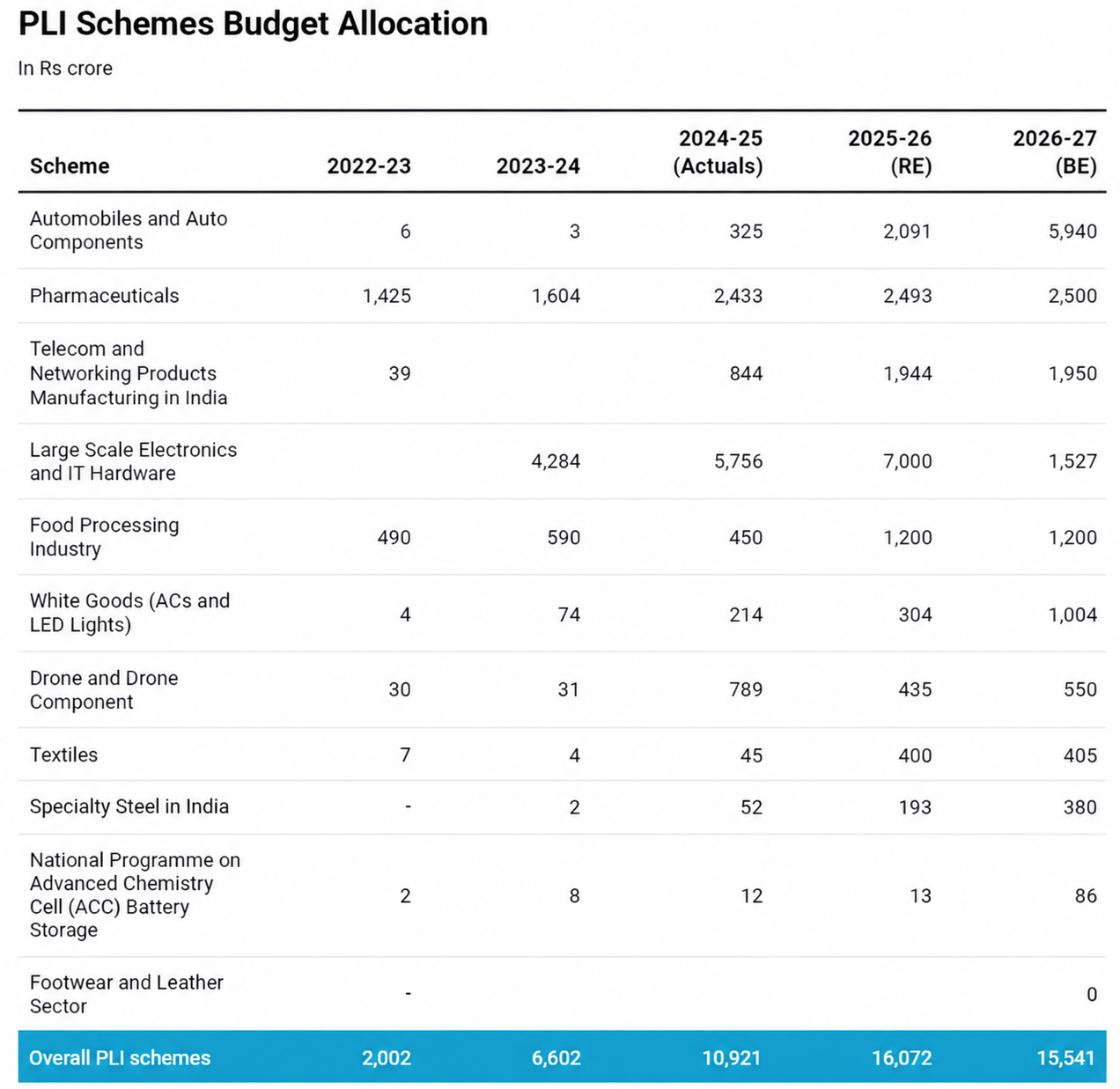
PLI Scheme Budget Allocation
PLI Scheme Achievements
Production Linked Incentive (PLI) Schemes have significantly changed India's manufacturing environment. Actual investments worth ₹2.40 lakh crore have been realised as of 2026. In addition to directly and indirectly creating almost 14.15 lakh jobs, these investments have already resulted in a notable increase in exports of over ₹15.2 lakh crore.
- In addition, the PLI programme has become a significant employer, creating over 14.15 lakh direct and indirect work opportunities while also promoting further ecosystem development in Tier-2 and Tier-3 cities.
- Crucially, the programme has sparked a new wave of foreign direct investment (FDI) into the nation, supporting India as a top location for high-value manufacturing in a changing global environment. Some of the PLI Scheme's top-performing sectors are listed below:
Mobile and Electronic Manufacturing
- Mobile phone production has grown by about 2.4 times since the scheme began, while imports have fallen by nearly 77% and domestic manufacturing now accounts for around 99.2% of phones used in India
- Strong policy support from programmes like the National Policy on Electronics (NPE) 2019 has made the electronics industry a shining example of the PLI strategy's effectiveness.
- Production increased by 146% between FY 2020–2021 and FY 2024–2025, from ₹2.13 lakh crore to ₹5.25 lakh crore.
- The PLI Scheme has encouraged big smartphone manufacturers to move their manufacturing to India. India has become a significant producer of mobile phones as a result.
Vehicles and Auto Parts
- India has drawn investments totalling ₹44,326 crore under the PLI scheme till March 2026 and has created more than 67,820 jobs.
- In order to increase local production of Advanced Automobile Technology (AAT) goods and draw investments in the automobile manufacturing value chain, the Scheme offers financial incentives for 103 categories of AAT components and 19 categories of AAT cars.
Food Preparation
- Up to October 2024, 171 applications were granted under the PLI scheme, resulting in about ₹9,207 crore in investments by March 2026 and 3,29,200 cumulative employment till March 2026
- The programme, which aims to modernise processing facilities, improve the branding of Indian food products, and increase value-added exports, supports programmes like PM-Formalisation of Micro Food Processing Enterprises (PM-FME) and Pradhan Mantri Kisan SAMPADA Yojana (PMKSY).
Pharmaceutical Drugs
- The pharmaceutical sector has achieved cumulative sales exceeding ₹3.64 lakh crore under PLI, while enabling domestic production of 1,931 pharmaceutical products, including 191 bulk drugs manufactured domestically for the first time.
- India's pharmaceutical industry, which was formerly highly reliant on imports for necessary raw materials, is now becoming stronger.
- The nation changed from being a net importer of bulk pharmaceuticals (with a ₹1,930 crore deficit in FY 2021–2022) to a net exporter (with a ₹2,280 crore surplus in FY 2024–2025) thanks to targeted PLI support.
- PLI support has helped establish nearly 55,000 MT of manufacturing capacity for 26 critical APIs, strengthening domestic production of medicines such as Paracetamol, Levofloxacin and Norfloxacin.
PV Solar Modules
- PLI Tranche I and II combined seek to develop approximately 48 GW of fully integrated production capacity under the PLI for High-Efficiency Solar PV Modules.
- Under the broader objectives of Aatmanirbhar Bharat and the National Solar Mission, this is anticipated to strengthen domestic supply chains, lessen reliance on imports, and increase India's energy security.
Semiconductors
- Complementing the broader PLI framework, the government has implemented specific incentives under the India Semiconductor Mission with the goal of creating an independent semiconductor ecosystem by 2030.
- The Union Cabinet has now approved four more production facilities in Odisha, Punjab, and Andhra Pradesh, adding to India's six approved semiconductor projects that are already in various phases of development.
- With an investment of ₹4,600 crore, these projects approved under the India Semiconductor Mission (ISM) are anticipated to directly employ 2,034 skilled workers and boost the larger electronics manufacturing ecosystem, resulting in substantial indirect job creation.
Textiles
- In September 2021, the PLI Scheme for Textiles was authorised with an outlay of Rs. 10,683 crore to encourage the nation's production of MMF Apparel, MMF Fabrics, and technical textiles to help the textile industry grow and become competitive.
- Technical textile exports increased to ₹294 crore from ₹200 crore the year before, while man-made fibre (MMF) exports increased to approximately ₹525 crore in FY 2024–25 (from ₹499 crore in FY 2023–24).
White Products (LED lights and air conditioners)
- With an investment of ₹6,238 crore, the PLI project for white goods was introduced in April 2021 with the goal of converting India from an assembly hub to a high-value manufacturing base.
- The scheme has significantly expanded domestic production of air-conditioner components, with compressor manufacturing capacity rising from 1 million units in 2021 to 10 million units in 2025–26.
- By 2028–2029, it hopes to increase domestic value addition from 20–25% to 75–80%. Incentives totalling ₹6,409 crore have been distributed till March 2026, supporting India's drive for energy-efficient, internationally competitive appliances.
PLI Scheme helping MSMEs
The PLI Scheme has helped the MSME sector in the following ways.
- Integration with Supply Chains: MSMEs can become suppliers of components, parts and services to large PLI-supported manufacturers, creating more stable business opportunities.
- Technology Upgradation: Participation in organised manufacturing networks encourages MSMEs to improve production processes, quality standards and technological capabilities.
- Direct Benefits: More than 176 MSMEs have reportedly received direct benefits under PLI initiatives across sectors such as medical devices, bulk drugs, food processing and textiles.
- Access to Larger Markets: Growing production and export-oriented manufacturing networks can provide MSMEs with opportunities to serve national as well as international markets.
- Growth of MSMEs and Startups: PLI-supported sectors such as drones have created opportunities for smaller firms and startups, contributing to investment, production and employment growth.
- Promotion of Domestic Manufacturing: The scheme encourages the establishment of new manufacturing facilities in India, creating business opportunities for MSMEs as component suppliers and ancillary producers.
- Opportunities in Telecom Manufacturing: Expansion of domestic telecom production under PLI has created greater scope for MSMEs to participate in the supply ecosystem for 4G and 5G equipment.
- Greater Investment and Employment: Rising manufacturing activity under PLI can generate demand for MSME suppliers, supporting investment, capacity expansion and job creation.
PLI Scheme and Make in India Difference
The PLI Scheme and Make in India are both initiatives aimed at strengthening India’s manufacturing sector, but Make in India is a broad industrial policy initiative, while the PLI Scheme is a targeted financial incentive programme designed to reward higher production.
| Basis | Make in India | PLI Scheme |
|
Nature |
A broad policy initiative to promote manufacturing and investment in India. |
A performance-linked incentive programme providing financial rewards to eligible manufacturers. |
|
Launch |
Launched in September 2014. |
Introduced from 2020 onwards, beginning with selected sectors. |
|
Primary Focus |
Creating a favourable environment for manufacturing, investment, innovation and entrepreneurship. |
Increasing production, investment and sales in identified manufacturing sectors. |
|
Sectoral Coverage |
Broadly covers manufacturing and investment across multiple sectors. |
Covers 14 identified sectors, including electronics, pharmaceuticals, automobiles, textiles and speciality steel. |
|
Incentive Mechanism |
Does not primarily operate through direct production-linked cash incentives. |
Provides incentives based on eligible incremental production or sales, according to sector-specific rules. |
|
Main Objective |
Establish India as an attractive global manufacturing and investment destination. |
Expand domestic manufacturing capacity, improve competitiveness and integrate India with global value chains. |
PLI Scheme Challenges
The Production Linked Incentive (PLI) Scheme has become a major endeavour to strengthen India's place in global value chains and increase local manufacturing, but its execution has faced several structural, financial, and administrative obstacles. The following is a discussion of the main issues with the PLI Scheme:
- Complicated Requirements for Eligibility and Compliance: Many businesses, especially smaller ones, find it challenging to comply with the scheme's intricate qualifying rules, investment thresholds, output targets, and domestic value addition standards.
- Slow Execution: The speed of implementation has slowed due to delays in approving beneficiaries and operationalising the scheme, which has prevented some sectors from receiving the intended benefits within the anticipated timeframe.
- Inconsistent Sectoral Outcomes: A few businesses, like mobile phones and IT hardware, have benefited greatly from the PLI Scheme, while a number of other industries have made little headway, leading to unequal industrial development.
- Insufficient Attention to R&D and Innovation: Research, technical innovation, talent development, and the creation of indigenous intellectual property are given relatively less attention under the plan, which primarily incentivises production and sales growth.
- Production Fragmentation Risk: Many companies have received authorisation in some industries, which could result in fragmented production capacity rather than the economies of scale needed for global competitiveness.
- Low Domestic Value Addition and Import Dependence: High reliance on imported components, raw materials and intermediate goods can limit the domestic economic value generated despite rising production.
- Risk of Assembly-led Manufacturing: If companies mainly assemble imported components rather than manufacture critical parts and technologies domestically, India may increase output without developing deeper manufacturing capabilities.
PLI Scheme Way Forward
The PLI scheme’s long-term success will be guaranteed by a comprehensive strategy that includes skill development, infrastructure development, and legislative reforms.
- Simplify the requirements for eligibility and compliance: To promote greater involvement, especially from MSMEs and developing firms, the government should simplify compliance standards, speed approval processes, and eliminate procedural complexity.
- Boost Local Supply Chains: Under the Atmanirbhar Bharat project, more focus should be put on creating domestic raw material and component manufacturing ecosystems to lessen reliance on imports and strengthen supply chain resilience.
- Encourage innovation, research, and development: To boost India's competitiveness internationally, PLI incentives should be combined with more funding for R&D, cutting-edge technology, design skills, and the production of intellectual property.
- Strengthen Integration with MSMEs: Through vendor development programmes, technology transfer, and easier access to financing, large manufacturers funded by the PLI Scheme should be encouraged to incorporate MSMEs into their value chains.
- Enhance Logistics and Infrastructure: Enhancing ports, digital infrastructure, multimodal logistics, industrial corridors, and power supplies will lower manufacturing costs and make doing business in India easier.
- Promote the Development of Skills: The availability of a trained workforce needed for sophisticated manufacturing sectors would be ensured by growing industry-oriented skill development programmes under programmes like Skill India.
- Assure Monitoring and Disbursement on Time: Investor trust will increase, and the plan will be implemented more effectively with a transparent monitoring system that expedites approval and rewards payment.
PLI Scheme UPSC PYQs
Q1. Discuss the rationale of the Production Linked Incentive (PLI) scheme. What are its achievements? In what way can the functioning and outcomes of the scheme be improved? (UPSC Mains 2025)
Q2. Consider the following statements : (UPSC Prelims 2023)
Statement-I: India accounts for 3.2% of global export of goods.
Statement-II: Many local companies and some foreign companies operating in India have taken advantage of India’s ‘Production-linked Incentive’ scheme.
Which one of the following is correct in respect of the above statements?
(a) Both Statement-I and Statement-II are correct and Statement-II is the correct explanation for Statement-I
(b) Both Statement-I and Statement-II are correct and Statement-II is not the correct explanation for Statement-I
(c) Statement-I is correct but Statement-II is incorrect
(d) Statement-I is incorrect but Statement-II is correct.
Ans: (d)

 Last updated on Oct, 2026
→ UPSC 2027 Notification will be released on 13 January 2027 at upsconline.nic.in.
→ Check Nobel Prize 2026 Winners List here.
→ Download PIB PRiSM Monthly Magazine 2026 here.
→ Check UPSC Monthly Current Affairs Magazine The Recitals here.
→ Check out the latest UPSC Syllabus here.
→ Download UPSC Model Answers for Mains 2026
→ UPSC Mains Question Paper 2026 is out now for Essay & GS Paper 1, 2, 3 & 4.
→ UPSC Calendar 2027 has been released.
→ Enroll in Vajiram & Ravi’s UPSC Mains Test Series 2027 for structured answer writing practice, expert evaluation, and exam-oriented feedback.
→ Join Vajiram & Ravi’s UPSC Mentorship Program 2027 for personalized guidance, strategy planning, and one-to-one support from experienced mentors.
→ Go through the UPSC Mains Previous Year Papers to enhance your preparation.
→ UPSC has released UPSC Toppers List 2025 with the Civil Services final result on its official website.
→ Also check Best UPSC Coaching in India
PLI Scheme FAQs
Q1. What is the PLI Scheme?+
Q2. Who is eligible for the PLI scheme incentive?+
Q3. What is the ACC production-linked incentive scheme?+
Q4. What is the full form of the PLI Scheme? +
Q5. How many sectors are covered under the PLI scheme?+
Tags: pli scheme quest upsc economy notes