BIMSTEC (Bay of Bengal Initiative for Multi-Sectoral Technical and Economic Cooperation) is a regional organisation linking South Asia and Southeast Asia through the Bay of Bengal. Established in 1997 as BIST-EC, it has evolved into a seven-member grouping covering economic development, connectivity, security, climate change, agriculture, technology and people-to-people ties. Its institutional framework was strengthened by the BIMSTEC Charter, which entered into force in 2024 and conferred legal personality on the organisation.
The 6th BIMSTEC Summit, held in Bangkok in 2025, adopted the Bangkok Vision 2030 and advanced cooperation in maritime transport, trade, digital connectivity and security. For India, the group is important for advancing its Neighbourhood First, Act East and MAHASAGAR approaches while strengthening regional connectivity, security and cooperation.
BIMSTEC History
The history of BIMSTEC began on 6 June 1997, when Bangladesh, India, Sri Lanka and Thailand signed the Bangkok Declaration to establish a regional framework for economic cooperation.
- Formation as BIST-EC: The organisation was initially called BIST-EC, representing Bangladesh, India, Sri Lanka, and Thailand. The original objective was to promote economic cooperation among countries bordering the Bay of Bengal.
- Myanmar Joining: Myanmar joined on 22 December 1997.
- Following its admission, the grouping was renamed BIMST-EC.
- The name reflected the participation of Bangladesh, India, Myanmar, Sri Lanka and Thailand.
- Nepal and Bhutan joined: Nepal and Bhutan joined the grouping in 2004 during the 6th BIMSTEC Ministerial Meeting in Thailand in July 2004.
- Their admission expanded BIMSTEC to its present seven-member configuration.
- At the First BIMSTEC Summit in Bangkok on 31 July 2004, the group adopted its present name - Bay of Bengal Initiative for Multi-Sectoral Technical and Economic Cooperation.
BIMSTEC Member States
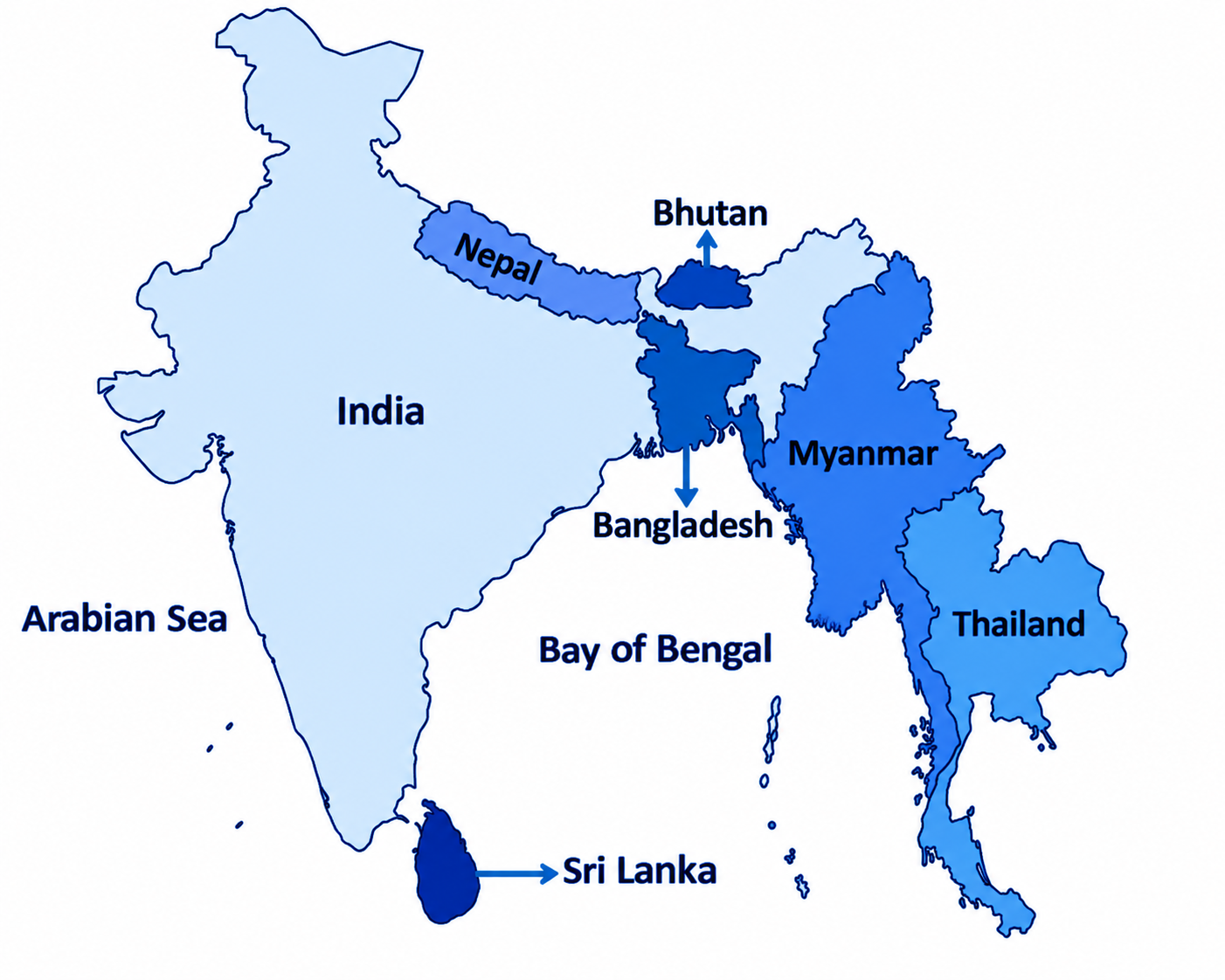
BIMSTEC has seven Member States, which are Bangladesh, Bhutan, India, Myanmar, Nepal, Sri Lanka and Thailand. These countries together connect the South Asian and Southeast Asian regions through the Bay of Bengal.
BIMSTEC Map


BIMSTEC Secretariat
The BIMSTEC Secretariat is headquartered in Dhaka, Bangladesh, and serves as the organisation's institutional centre for coordinating its activities.
- The Secretariat was established in 2014 following the decision of the Third BIMSTEC Summit.
- Location of BIMSTEC Secretariat: Dhaka, Bangladesh.
- The Secretariat supports the organisation's institutional functioning and coordination among its Member States.
BIMSTEC Chairmanship
The BIMSTEC Chairmanship rotates among member states according to the alphabetical order of their English names, with the changeover taking place during a Summit Meeting.
- BIMSTEC Chairmanship Working: The member state holding the Chairmanship hosts the BIMSTEC Summit.
- It subsequently hands over the Chairmanship to the next Member State in alphabetical order.
- The Chair promotes its interests through policy initiatives, coordination, consensus building, and cooperation.
- The Chair also represents BIMSTEC before external partners.
- Current BIMSTEC Chairmanship: Bangladesh has held the BIMSTEC Chairmanship since April 2025 for a two-year term.
BIMSTEC Objectives and Purposes
The objectives of BIMSTEC are centred on accelerating economic growth and social progress, strengthening regional cooperation, improving connectivity and promoting peace and stability in the Bay of Bengal region.
- Promote Economic Development: BIMSTEC seeks to create conditions for rapid economic development by identifying and implementing cooperation projects in agreed areas.
- Accelerate Regional Growth: Promote economic growth and social progress through regional initiatives, cooperation and partnership among Member States.
- Strengthen Technical and Scientific Cooperation: BIMSTEC promotes collaboration and mutual assistance in economic fields, social fields, technical areas, and scientific activities.
- Promote Training and Research: The organisation seeks to facilitate access to training and research facilities, particularly in educational, professional and technical fields.
- Support National Development: BIMSTEC encourages regional projects that complement the national development plans of its Member States and can generate tangible benefits for people.
- Promote Regional-Level Projects: BIMSTEC encourages projects that can be implemented more effectively at the regional level by making use of synergies among Member States.
- Maintain Peace and Stability: BIMSTEC seeks greater cooperation in addressing
- International terrorism
- Transnational organised crime
- Natural disasters
- Climate change
- Communicable diseases
- Eradicate Poverty: Poverty alleviation is an important objective of BIMSTEC, with the organisation seeking to contribute to addressing poverty and developmental issues across the Bay of Bengal region.
- Strengthen Connectivity: BIMSTEC aims to establish multidimensional connectivity and create greater synergy among different connectivity frameworks as a means of supporting economic integration and shared prosperity.
- Promote Trade and Investment: BIMSTEC seeks to use trade and investment as major drivers of economic and social development in the region.
BIMSTEC Sectors of Cooperation
BIMSTEC's sectors of cooperation have evolved from six initial priority areas into seven broad sectors; the Fifth BIMSTEC Summit in 2022 approved seven sectors and their sub-sectors.
- Trade, Investment and Development: A cooperation sector aimed at strengthening economic engagement among Member States.
- Sub-sector: Blue Economy
- Lead Member State: Bangladesh
- Environment and Climate Change: A cooperation sector focused on regional environmental and climate-related concerns.
- Sub-sector: Mountain Economy
- Lead Member State: Bhutan
- Security: A cooperation sector covering common regional security concerns and transnational threats.
- Its sub-sectors are Counter-Terrorism and Transnational Crime, Disaster Management, Energy.
- Lead Member State: India.
- Agriculture and Food Security: A cooperation sector addressing agricultural development and related food-security concerns.
- Its sub-sectors are: Agriculture, Fisheries and Livestock
- Lead Member State: Myanmar.
- People-to-People Contact: A cooperation sector designed to strengthen interaction and connections among the people of Member States.
- Its sub-sectors include: Culture, Tourism, Poverty Alleviation, People-to-People Contact forums, including think tanks and media
- Lead Member State: Nepal.
- Science, Technology and Innovation: A cooperation sector aimed at cooperation in technological, health and human-resource-related areas.
- Its sub-sectors are: Technology, Health, Human Resource Development
- Lead Member State: Sri Lanka.
- Connectivity: A cooperation sector focused on strengthening regional links among Member States.
- Lead Member State: Thailand.
- Additional Sub-Sectors: The 19th Ministerial Meeting in 2023 approved the inclusion of:
- Blue Economy under Trade, Investment and Development
- Mountain Economy under Environment and Climate Change
- Poverty Alleviation under People-to-People Contact
BIMSTEC and India
India's engagement with the group is a key component of its regional diplomacy, linking its Neighbourhood First, Act East and MAHASAGAR approaches while focusing particularly on security, connectivity, disaster management, energy and institutional capacity-building.
- It connects South Asia and Southeast Asia through the Bay of Bengal and brings together seven countries, enhancing the India-Southeast Asian countries'’ relations.
BIMSTEC Importance for India
BIMSTEC is important for India because it provides a platform to deepen cooperation with both South Asian and Southeast Asian countries while strengthening India's economic, security and connectivity interests in the Bay of Bengal region.
- Neighbourhood First: It complements India's efforts to strengthen relations with neighbouring countries.
- Act East Policy: It provides an institutional bridge between India's eastern and northeastern regions and Southeast Asia.
- MAHASAGAR: It supports India's broader vision for cooperation and security in the wider maritime region.
- Maritime security: India uses it to advance cooperation on maritime security and related regional challenges.
- Connectivity: Transport, trade, energy and people-to-people connectivity are major areas of India's engagement.
- Disaster management: India has positioned itself as an important regional first responder and conducts BIMSTEC disaster-management exercises.
- Institution building: India has consistently proposed initiatives to strengthen BIMSTEC's institutional and human capacities.
India's Role in BIMSTEC
India's role in BIMSTEC extends across security, disaster management, energy, transport connectivity, trade, technology and capacity-building.
- Security Cooperation: India leads the security sector, covering counter-terrorism and transnational crime, disaster management and energy security. India has also promoted cooperation in maritime security, cyber security and space.
- Disaster Management: India contributes to disaster preparedness through regular regional exercises and institutional capacity-building.
- BIMSTEC disaster-management exercises have been conducted in 2017, 2020, 2021 and 2025.
- India is establishing the BIMSTEC Disaster Management Centre in India.
- The initiative focuses on strengthening capacity in humanitarian assistance and disaster relief.
- Energy Cooperation: India is leading efforts to strengthen energy connectivity through regional electricity-grid cooperation.
- The BIMSTEC Grid Interconnection initiative is aligned with India's broader vision of interconnected clean-energy systems.
- An MoU on grid interconnection was signed in 2018.
- A coordination committee is working on the technical and commercial aspects of the proposed interconnection.
- The BIMSTEC Energy Centre in Bengaluru supports regional energy cooperation.
- Connectivity: Connectivity is another major area of India's engagement, particularly through transport and maritime links.
- The BIMSTEC Master Plan for Transport Connectivity was endorsed.
- India has supported progress on the India-Myanmar-Thailand Trilateral Highway.
- The BIMSTEC Maritime Transport Agreement was signed in 2025.
- Discussions on a BIMSTEC Motor Vehicle Agreement are continuing.
- Trade and Economic Cooperation: India supports greater regional economic integration through trade facilitation, value-chain development and efforts towards the BIMSTEC Free Trade Area.
BIMSTEC Charter
It is the foundational legal document that officially established the Bay of Bengal Initiative for Multi-Sectoral Technical and Economic Cooperation as an international legal entity.
- Adoption: Signed on March 30, 2022, during the 5th Summit in Colombo, Sri Lanka.
- Legal Personality: Conferred legal personality on BIMSTEC, enabling it to engage with external partners and undertake international agreements and arrangements.
6th BIMSTEC Summit
The Summit was held in Bangkok on 4 April 2025, under the theme of “Prosperous, Resilient and Open BIMSTEC”.
- The Summit brought together the leaders of all seven member states.
- The Summit was particularly significant because the BIMSTEC Charter had entered into force on 20 May 2024, strengthening BIMSTEC's institutional foundation.
- The leaders also recognised the need to revitalise BIMSTEC and make it more effective in delivering tangible benefits to the people of the Bay of Bengal region.
Major Outcomes of the 6th BIMSTEC Summit
The major outcomes of the 6th BIMSTEC Summit are listed below.
- Bangkok Vision 2030: It provides a long-term framework for developing a prosperous, resilient and open BIMSTEC by 2030.
- Maritime Transport Agreement: The group welcomed the Maritime Transport Agreement as an important instrument for improving regional maritime connectivity and supporting cross-border trade.
- Push for Free Trade Area: The 6th Summit renewed the commitment to advance negotiations for the BIMSTEC Free Trade Area (FTA).
- The leaders called for faster progress on the constituent agreements of FTA and emphasised the importance of trade facilitation and customs cooperation.
- New Areas of Cooperation: The Summit incorporated Blue Economy, Mountain Economy and Poverty Alleviation into BIMSTEC's restructured cooperation framework. The respective lead countries were asked to develop plans of action for these areas.
- Digital and Financial Cooperation: The Summit encouraged members to explore digital cross-border payments and trade settlements using local currencies while promoting an inclusive and secure digital economy.
- Strengthening Food and Energy Security: The Summit identified food security and energy security as important components of sustainable regional development.
- The leaders supported stronger agricultural cooperation, including the use of science and technology such as precision farming, while also emphasising energy security and regional cooperation.
- Strengthening Regional Security: The 6th Summit called for closer cooperation against emerging and transnational security threats.
- The Summit also welcomed the establishment of the Home Ministers' Meeting mechanism.
India's Initiatives at the 6th BIMSTEC Summit
India announced several capacity-building and institution-strengthening initiatives at the 6th Summit to deepen practical cooperation among Member States. These included:
- Establishing four BIMSTEC Centres of Excellence in India focusing on:
- Disaster Management
- Sustainable Maritime Transport
- Agriculture
- Traditional Medicine
- BODHI (BIMSTEC for Organised Development of Human Infrastructure) for scholarships and skill development.
- A pilot study on digital public infrastructure needs in the region.
- An assistance programme in cancer care.
- Youth exchange programmes.
- BIMSTEC Games
- India announced the first Games in 2027, coinciding with BIMSTEC's 30th anniversary.
BIMSTEC Challenges
Although the grouping has considerable potential to connect South Asia and Southeast Asia, sustained political will and institutional strengthening are essential for turning this potential into tangible regional cooperation.
- Weak Institutional Capacity: BIMSTEC's institutional capacity remains a major challenge because inadequate resources, limited manpower and weak organisational mechanisms have historically restricted its effectiveness.
- Lack of Sustained Political Will: The lack of consistent political commitment among Member States has been one of the biggest obstacles to BIMSTEC's progress.
- Poor Physical Connectivity: Inadequate physical connectivity remains a significant barrier to deeper economic integration within the region.
- Slow Progress in Trade Integration: The group faces difficulties in converting its potential for regional trade into deeper economic integration because agreements and connectivity initiatives have often progressed slowly.
- Economic and Developmental Asymmetries: Wide differences in the economic, social and political conditions of the members make collective policymaking and implementation more complicated.
- Divergent National Interests: Differences in national interests and strategic priorities can make it difficult for the members to develop common positions and implement regional initiatives.
BIMSTEC Way Forward
The future of the BIMSTEC lies in converting its considerable regional potential into practical cooperation by strengthening connectivity and creating stronger mechanisms for regional integration.
- Strengthen Regional Connectivity: It should make connectivity a central driver of regional integration by improving physical, maritime and multimodal links among its Member States.
- Harness the Blue Economy: It should make greater use of the Bay of Bengal's maritime resources to generate sustainable economic opportunities and strengthen regional cooperation
- Promote Technology and Knowledge Sharing: Technology cooperation should become an important instrument for reducing developmental gaps and improving productivity across the region.
- Strengthen Climate and Environmental Cooperation: It should adopt a stronger regional approach to climate change and environmental security because ecological risks in the Bay of Bengal frequently cross national boundaries.
- Build Stronger Disaster-Management Mechanisms: It should strengthen regional disaster preparedness because its members are exposed to cyclones, floods and other climate-related disasters.
- Accelerate BIMSTEC FTA: Finalise the constituent agreements of the BIMSTEC Free Trade Area, alongside trade facilitation and customs cooperation, to convert connectivity into greater regional economic integration.
- The 6th Summit explicitly called for faster progress on the FTA.
BIMSTEC UPSC PYQs
Q1. Do you think BIMSTEC is a parallel organisation like SAARC? What are the similarities and dissimilarities between the two? How are Indian foreign policy objectives realised by forming a new organisation? (UPSC Mains 2022)
Q2. Match the following pairs: (UPSC Prelims 2026)
| List I – BIMSTEC Centre/Establishment | List II – Location |
|
A. BIMSTEC Cultural Industries Observatory |
1. Noida |
|
B. BIMSTEC Energy Centre |
2. Bengaluru |
|
C. BIMSTEC Centre for Weather and Climate |
3. Colombo |
|
D. BIMSTEC Technology Transfer Facility |
4. Thimphu |
Code: ABCD
a) 3 2 1 4
b) 3 1 2 4
c) 4 2 1 3
d) 4 1 2 3
Ans: (c)
Q3. Consider the following statements in respect of BIMSTEC: (UPSC Prelims 2025)
I. It is a regional organization consisting of seven member States till January 2025.
II. It came into existence with the signing of the Dhaka Declaration, 1999.
III. Bangladesh, India, Sri Lanka, Thailand and Nepal are founding member States of BIMSTEC.
IV. In BIMSTEC, the subsector of tourism is being led by India.
Which of the statements given above is/are correct?
a) I and II
b) II and III
c) I and IV
d) I only
Ans: (d)

 Last updated on Sep, 2026
→ UPSC 2027 Notification will be released on 13 January 2027 at upsconline.nic.in.
→ Check out the latest UPSC Syllabus here.
→ Download UPSC Model Answers for Mains 2026
→ UPSC Mains Question Paper 2026 is out now for Essay & GS Paper 1, 2, 3 & 4.
→ UPSC Calendar 2027 has been released.
→ Enroll in Vajiram & Ravi’s UPSC Mains Test Series 2027 for structured answer writing practice, expert evaluation, and exam-oriented feedback.
→ Join Vajiram & Ravi’s UPSC Mentorship Program 2027 for personalized guidance, strategy planning, and one-to-one support from experienced mentors.
→ Go through the UPSC Mains Previous Year Papers to enhance your preparation.
→ UPSC has released UPSC Toppers List 2025 with the Civil Services final result on its official website.
→ Also check Best UPSC Coaching in India
BIMSTEC FAQs
Q1. What is BIMSTEC? +
Q2. When was BIMSTEC established?+
Q3. How many countries are members of BIMSTEC?+
Q4. Where is the BIMSTEC Secretariat located?+
Q5. Which country leads the security sector in BIMSTEC?+
Tags: bimstec quest UPSC International Relations and Institutions Notes