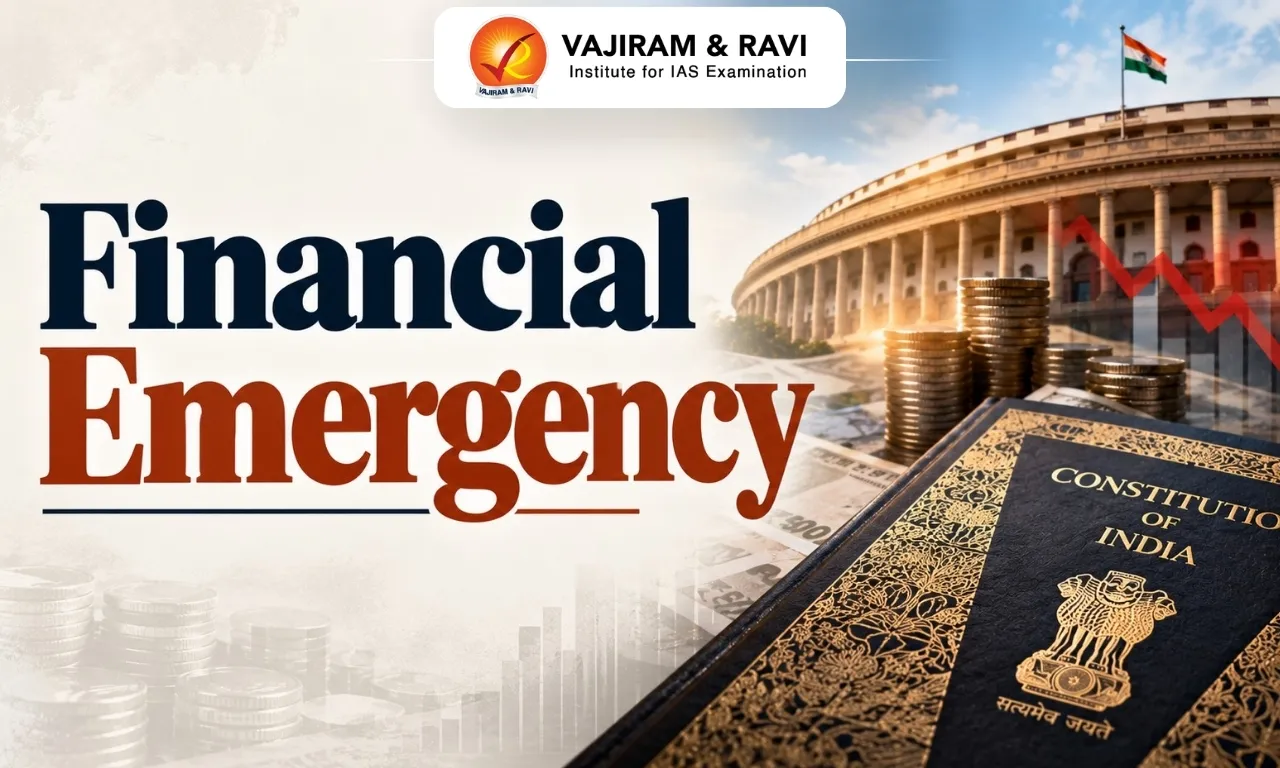
Financial Emergency in India is a rarely invoked yet significant constitutional protection mechanism, enshrined in Article 360 of India's Constitution. Unlike the National Emergency or President’s Rule, it stands apart as the only emergency provision never implemented in India’s constitutional history, highlighting its exceptional and preventive character. The Financial Emergency provisions of indian constitution have been borrowed from the Constitution of Germany (Weimar Constitution), while general emergency concepts also draw heavily from the Government of India Act of 1935
Once proclaimed, it significantly alters the federal balance by concentrating financial authority in the Union. The President can direct states on financial propriety, regulate expenditure, oversee financial legislation, and even reduce the salaries of government employees and judges, thereby suspending the normal fiscal autonomy of states until the emergency is lifted.
Financial Emergency Meaning
Financial Emergency describes circumstances where the financial stability or credit of India, or any part of its territory, is threatened. It represents a grave economic crisis situation that poses a significant risk to the nation's financial well-being and economic security.
- Unlike the National Emergency, this emergency has never been invoked in India, even during serious financial challenges.
- Its presence in the Constitution acts as a safeguard against extreme financial instability and ensures preparedness to protect the nation's economic security.
Financial Emergency Article 360
Financial Emergency Provisions are laid down in Article 360 of the Indian Constitution, which empowers the President of India to take extraordinary measures to restore financial stability during a grave economic crisis. The idea of Financial Emergency is taken from the Weimar Constitution of Germany, demonstrating the framers' intention to learn from international constitutional frameworks to address potential economic crises.
Financial Emergency Judicial Review
Article 360 of the Indian Constitution’s scope of judicial review has evolved through the 38th Constitutional Amendment Act and the 44th Constitutional Amendment Act:
- 38th Amendment Act, 1975: It provided that the satisfaction of the President of India in issuing a Proclamation of Financial Emergency would be final and conclusive. This amendment placed the President’s decision beyond judicial scrutiny, thereby making the Proclamation immune from challenge in any court.
- 44th Amendment Act, 1978: The amendment act reversed the 1975 amendment by removing the bar on judicial review. Consequently, the President’s satisfaction is now subject to judicial scrutiny. Courts can examine whether the Proclamation adheres to constitutional requirements or if it has been issued in a mala fide, arbitrary, or unreasonable manner.


Financial Emergency Proclamation
A financial emergency under Article 360 of the Indian Constitution can be declared when the President of India is convinced that India's financial stability or creditworthiness, or that of any part of the country, is under threat. This allows the Union to take special measures to protect the country’s financial integrity.
Financial Emergency’s Parliamentary Approval
A Proclamation for a financial emergency must be laid before each House of Parliament. Such approval requires only a simple majority in both Houses.
- It ceases to operate after two months unless approved by resolutions of both Houses within that period.
- The proclamation remains in force if the Lok Sabha is dissolved at the time of issue or during the two-month period, but the Rajya Sabha has approved it.
- In such a case, the Proclamation will cease after thirty days from the first sitting of the new Lok Sabha unless approved by it within that period.
Financial Emergency Duration
A financial emergency in India, once approved by both Houses of Parliament, continues indefinitely until it is revoked by the President. There is no maximum time limit prescribed for its operation, nor is repeated parliamentary approval required for its continuation.
Financial Emergency Revocation
A financial emergency under Article 360 of the Indian Constitution can be revoked by the President whenever deemed appropriate by issuing a subsequent Proclamation. Such revocation does not require parliamentary approval and takes effect immediately. The Supreme Court, in cases such as S.R. Bommai v. Union of India (1994), has held that emergency proclamations are not beyond the scope of judicial scrutiny.
Financial Emergency Effects
A financial emergency in India gives the Union government exceptional authority over the country’s fiscal administration when the President is satisfied that the financial stability or credit of India or any part thereof is threatened. The objective is to maintain fiscal discipline, restore economic equilibrium, and safeguard national financial welfare.
- Control over State Finances: The Union government can issue directions to any State to follow financial propriety as specified by the President. This ensures that State-level fiscal practices remain aligned with national priorities and do not threaten overall financial stability.
- Legislative Oversight of Financial Bill: The President can require all Money Bills or other financial Bills passed by State Legislatures to be reserved for presidential consideration before becoming law. This provides the Union with complete oversight over State financial legislation during the emergency period.
- Reduction of Salaries and Allowances: The President may direct a reduction in salaries and allowances of all classes of government servants, including State employees, Union employees, All India Services officers, and constitutional authorities like Supreme Court and High Court judges.
- Fiscal Constraint: Fiscal measures may include increasing taxes, reducing subsidies, or cutting social welfare programmes, causing inflation, higher living costs, and directly impacting common citizens and government beneficiaries.
Financial Emergency Criticisms
Financial Emergency in India is often criticised for concentrating excessive powers in the hands of the Centre, thereby reducing the financial autonomy of states and weakening the federal structure. It is also perceived as a threat to democratic functioning, with its vague grounds creating concerns about potential misuse.
- Vague Definition of Crisis: The Constitution does not clearly spell out what amounts to a “threat to financial stability or credit.” This vagueness leaves too much room for interpretation and raises fears of misuse.
- Centralisation of Power: Once declared, the Centre gains sweeping control over the financial affairs of the states. This weakens the federal spirit of the Constitution and reduces states’ financial autonomy, even if they are not directly responsible for the crisis.
- Lack of Parliamentary Oversight During Declaration: There is insufficient detail about immediate parliamentary scrutiny when a Financial Emergency is first declared.
- Limited Judicial Review Mechanisms: There are minimal provisions for judicial oversight of the President's decision to declare a Financial Emergency.
- Scope for Political Misuse: It could be used as a political tool to weaken opposition-led states by curbing their financial independence, rather than being invoked only in genuine crises.
Financial Emergency UPSC PYQs
Q1: "Discuss the potential impact of a Financial Emergency on state autonomy and governance in India." (UPSC Mains 2020)
Q2: Under which article can a Financial Emergency be declared in India? (UPSC Prelims 2018)
(a) Article 356
(b) Article 352
(c) Article 365
(d) Article 360
Ans: (d)

 Last updated on Sep, 2026
→ UPSC 2027 Notification will be released on 13 January 2027 at upsconline.nic.in.
→ Asian Games 2026 are being held in Aichi-Nagoya, Japan, from 19 September to 4 October.
→ Check out the latest UPSC Syllabus here.
→ Download UPSC Model Answers for Mains 2026
→ UPSC Mains Question Paper 2026 is out now for Essay & GS Paper 1, 2, 3 & 4.
→ UPSC Calendar 2027 has been released.
→ Enroll in Vajiram & Ravi’s UPSC Mains Test Series 2027 for structured answer writing practice, expert evaluation, and exam-oriented feedback.
→ Join Vajiram & Ravi’s UPSC Mentorship Program 2027 for personalized guidance, strategy planning, and one-to-one support from experienced mentors.
→ Go through the UPSC Mains Previous Year Papers to enhance your preparation.
→ UPSC has released UPSC Toppers List 2025 with the Civil Services final result on its official website.
→ Also check Best UPSC Coaching in India
Financial Emergency FAQs
Q1. What is Financial Emergency?+
Q2. What is Article 352 and 356?+
Q3. Has India ever had a Financial Emergency? +
Q4. Which country declared Financial Emergency?+
Q5. Who can declare a Financial Emergency in India?+
Tags: financial emergency quest UPSC Polity Notes