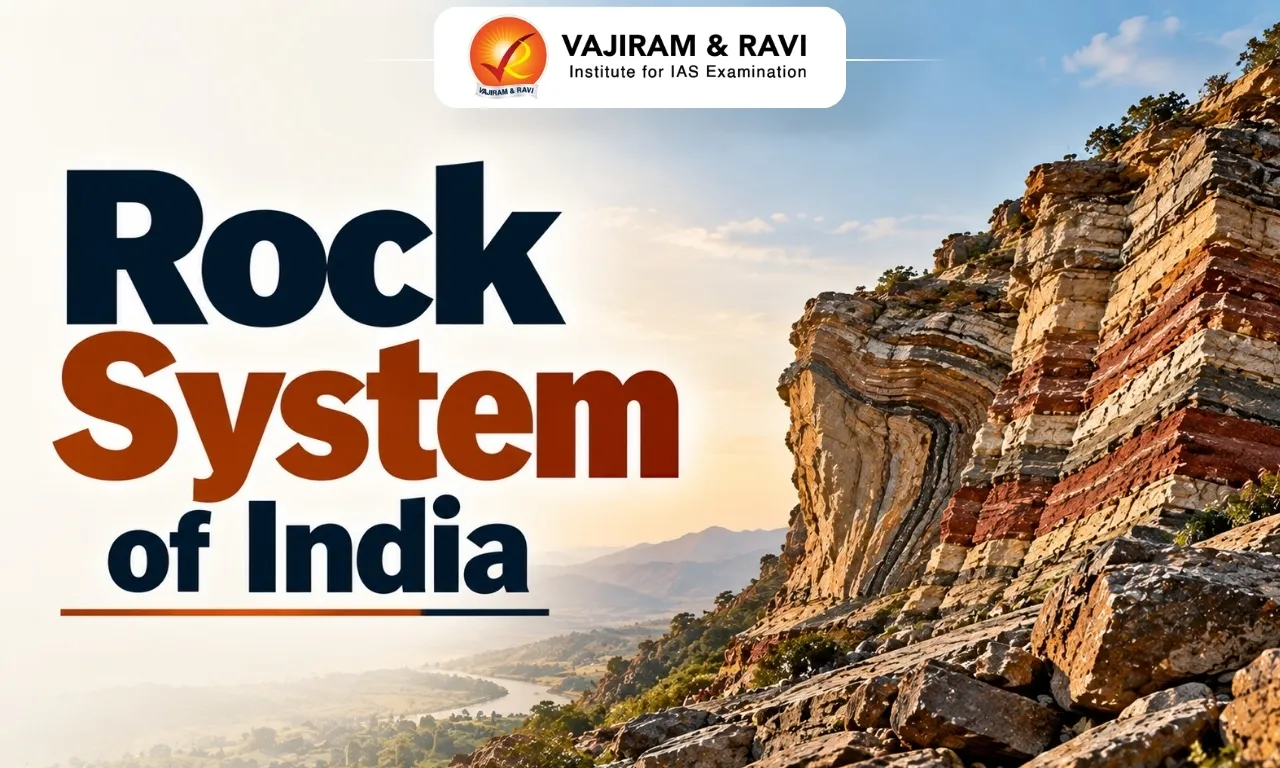
The rock system of India reflects the country’s long and complex geological evolution, with formations belonging to different geological periods and varying in age, origin, composition and distribution. The major rock systems include the Archaean, Dharwar, Cuddapah, Vindhyan, Gondwana, Deccan Trap, Tertiary and Quaternary formations. Ancient crystalline rocks form much of the Peninsular foundation, while younger sedimentary, volcanic and alluvial deposits occur across the plains, coastal regions, Himalayan areas and other geological zones.
These formations influence India’s physiography, soil development, drainage patterns and distribution of natural resources. They are also economically significant because they contain iron ore, manganese, gold, coal, limestone, petroleum, natural gas and other minerals. Understanding rock systems of India is therefore essential for studying its geological structure, physical landscape, mineral resources, agriculture and industrial development.
Rock System of India Meaning
The rock system of India represents diverse geological formations created during different periods, providing the foundation for the country’s relief, mineral resources, soils, drainage and economic activities.
- India possesses a highly complex geological structure because its landmass has evolved through several geological eras.
- Ancient crystalline rocks form the foundation of the Peninsular region, while younger sedimentary, volcanic and alluvial formations occur across different parts of the country. The major rock systems of India are generally studied in chronological order:
- Archaean Rock System
- Dharwar Rock System
- Cuddapah Rock System
- Vindhyan Rock System
- Gondwana Rock System
- Deccan Trap
- Tertiary Rock System
- Quaternary Rock System
- Together, these formations provide evidence of India's geological evolution and help explain the distribution of mountains, plateaus, plains, minerals, soils and natural resources.
Rock System of India Geological Classification
Geological classification of the rock system of India follows their relative age, origin, composition, structural characteristics and distribution across the major geological regions of the country.
| Rock System | Geological Character | Major Resources/Significance |
|
Archaean |
Ancient crystalline and metamorphic rocks |
Iron ore, gold, manganese and other minerals |
|
Dharwar |
Highly metamorphosed formations |
Iron ore, manganese, gold |
|
Cuddapah |
Predominantly sedimentary formations |
Limestone, quartzite and other minerals |
|
Vindhyan |
Extensive sedimentary formations |
Limestone, sandstone and building materials |
|
Gondwana |
Continental sedimentary formations |
Major coal deposits |
|
Deccan Trap |
Extensive basaltic lava formations |
Black soil and plateau formation |
|
Tertiary |
Younger sedimentary formations |
Petroleum, natural gas, coal and other resources |
|
Quaternary |
Recent alluvial and unconsolidated deposits |
Fertile plains, agriculture and groundwater |
Archaean Rock System
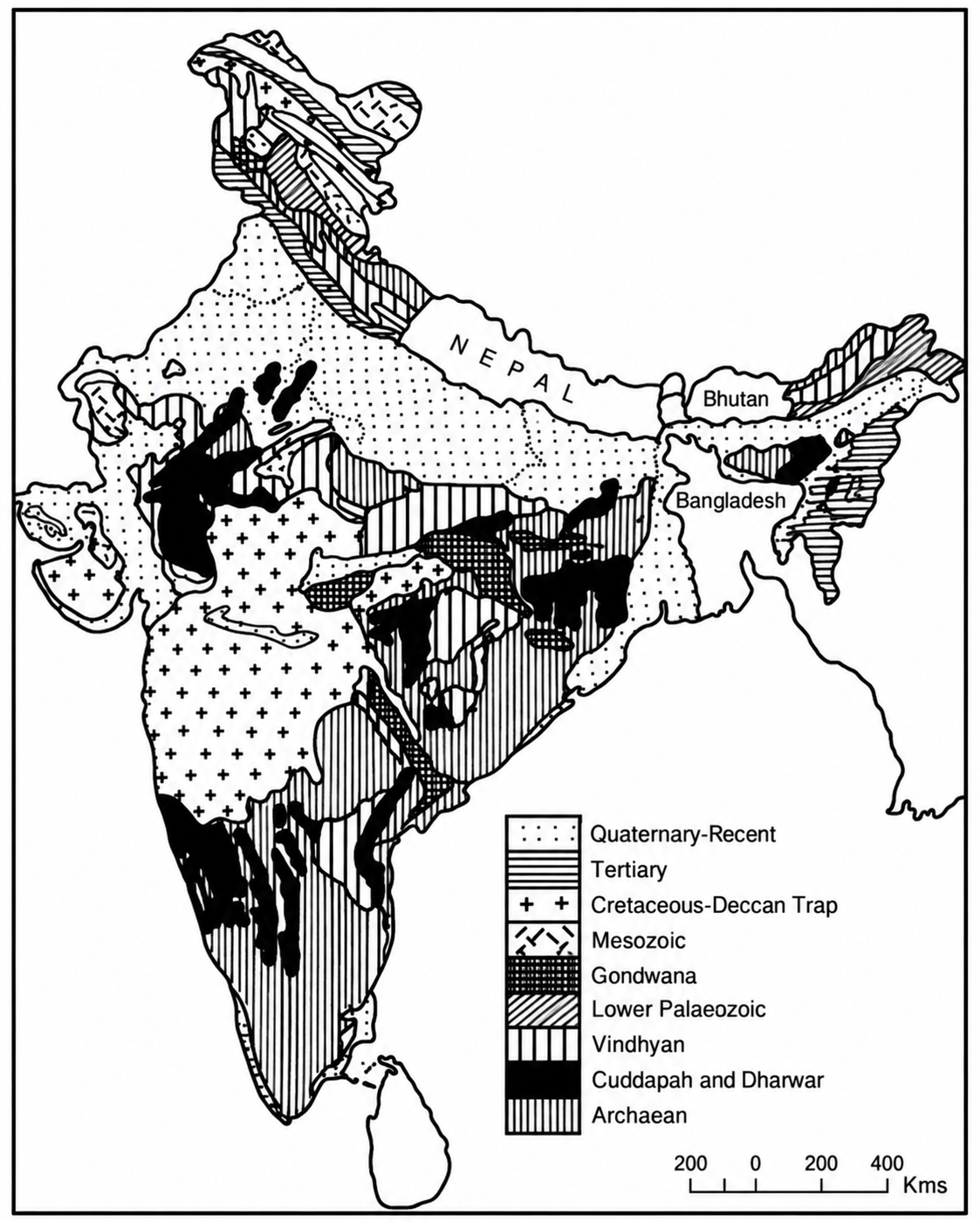
The Archaean Rock System comprises some of India’s oldest geological formations and forms much of the ancient crystalline basement underlying the Peninsular region and its mineral-rich landscapes. Major Features.
- It represents the oldest major rock formation in India's geological history.
- These rocks are largely crystalline and metamorphic in character.
- Common rocks include gneiss, granite, schist and related crystalline formations.
- They have undergone repeated processes of folding, metamorphism, intrusion and erosion.
- Large areas of the Peninsular Plateau are underlain by rocks belonging to this ancient geological foundation.
- These formations are particularly important for metallic mineral resources.
- Distribution: Archaean formations occur extensively in parts of Karnataka, Tamil Nadu, Andhra Pradesh, Telangana, Odisha, Jharkhand, Rajasthan, Madhya Pradesh and adjoining Peninsular regions.
- Economic Importance: The Archaean rocks are associated with important deposits of Iron ore, Manganese, Gold, Copper and other metallic minerals
- They therefore provide an important geological base for India's mining and metallurgical industries.
Dharwar Rock System
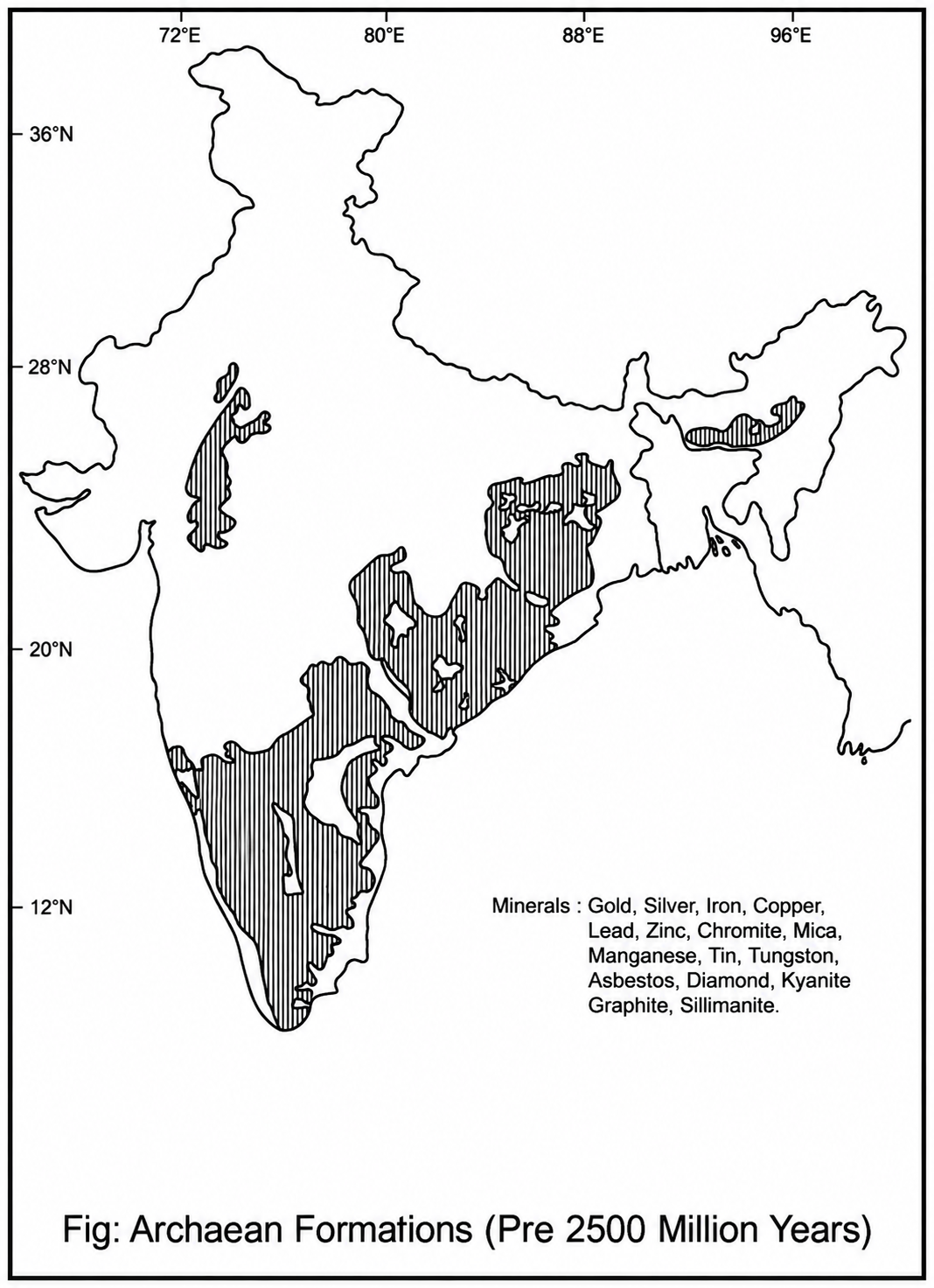
The Dharwar Rock System consists largely of ancient metamorphosed formations and is particularly significant because several major metallic mineral belts of Peninsular India occur within or around these geological formations. Major Features
- The Dharwar system developed from older rocks that underwent sedimentation, igneous activity, folding and metamorphism.
- It contains schists, quartzites, phyllites and banded iron formations.
- The rocks are generally more altered and structurally complex than many younger formations.
- The system is particularly prominent in the southern and central parts of the Peninsular Shield.
- Distribution: Important Dharwar formations occur in Karnataka, Andhra Pradesh, Telangana, Tamil Nadu, Maharashtra, Rajasthan and some other parts of the Peninsular region
- Economic Importance: The Dharwar formations are particularly important for iron ore, manganese, gold, and other metallic minerals.
- The Hutti and Kolar gold regions of Karnataka are important examples associated with the mineral-rich geological environment of the Dharwar region.
Cuddapah Rock System
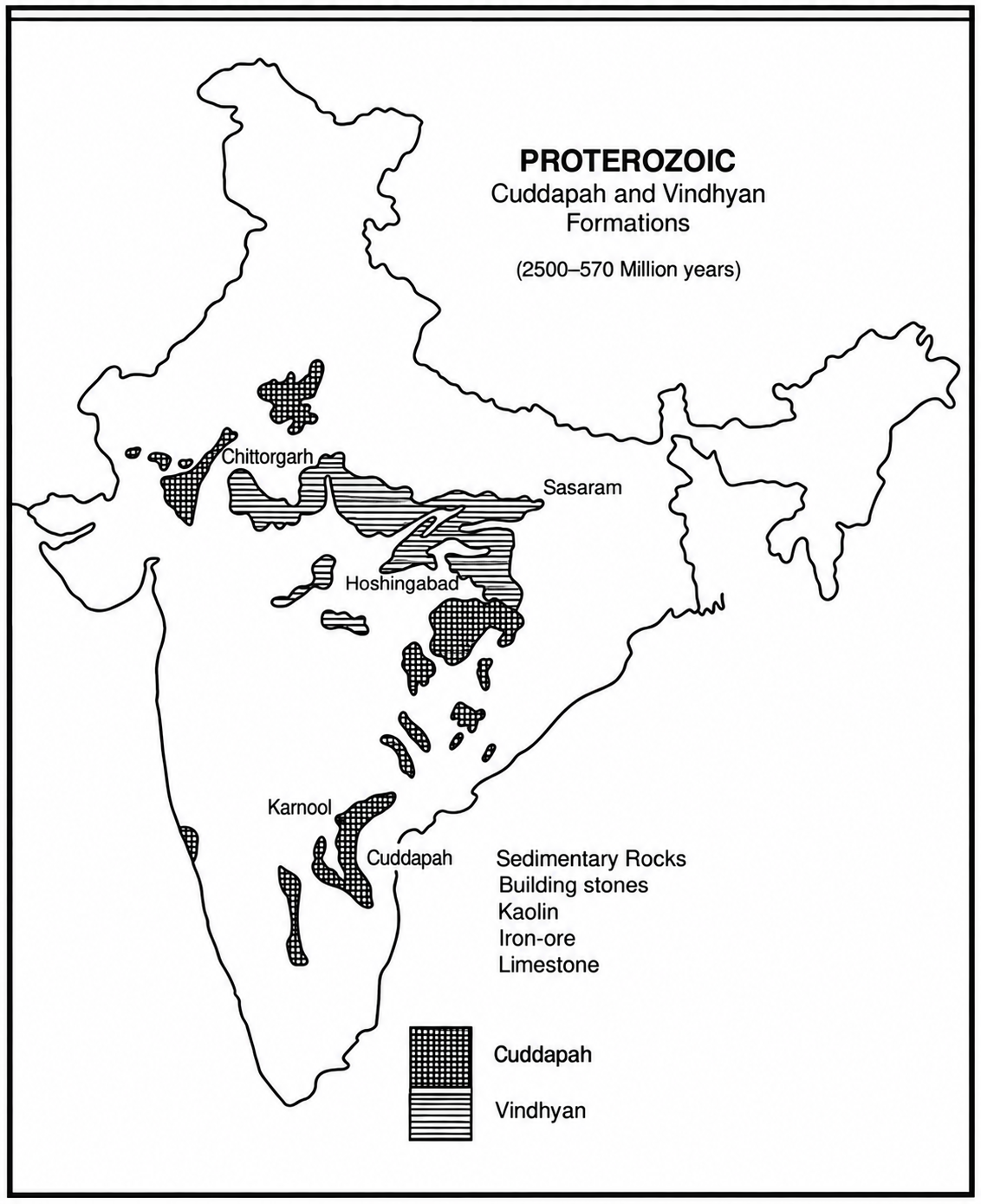
The Cuddapah Rock System consists mainly of ancient sedimentary formations deposited in extensive basins, with important occurrences of limestone, shale, quartzite and related rocks. Major Features
- The system is younger than the Archaean and Dharwar formations.
- It consists predominantly of sedimentary rocks.
- Important rock types include limestone, shale, quartzite, slate, and related formations
- The formations developed within broad sedimentary basins.
- The Cuddapah Basin is one of its most prominent areas.
- Distribution: The system is mainly associated with Andhra Pradesh, Telangana, Karnataka, parts of Rajasthan and other peninsular regions
- Economic Importance: Cuddapah rocks are economically important because they contain limestone, quartzite, building stones, and other industrial minerals.
- Limestone is particularly important for the cement and construction industries.
Vindhyan Rock System
The Vindhyan Rock System is a widespread sedimentary formation of central India, consisting mainly of sandstone, limestone and shale and contributing substantially to construction and industrial resources. Major Features
- It is predominantly sedimentary.
- Major rocks include Sandstone, Limestone, Shale
- The formations are generally well stratified.
- They cover extensive areas of central and northwestern India.
- The system preserves important evidence of India's geological history.
- Distribution: Major occurrences are found in Madhya Pradesh, Rajasthan, Uttar Pradesh, Bihar and adjoining regions
- The Vindhyan ranges and adjoining plateau areas are particularly associated with these formations.
- Economic Importance: Vindhyan formations are important sources of Limestone, Sandstone, Building stones, and industrial raw materials
- Limestone deposits support the cement industry, while sandstone is widely used for construction and architectural purposes.
Gondwana Rock System
The Gondwana Rock System consists mainly of continental sedimentary formations and is especially important because it contains extensive coal-bearing strata that support India’s energy and industrial sectors. Major Features
- Gondwana formations are considerably younger than the ancient crystalline formations.
- They are predominantly sedimentary.
- Important rocks include Sandstone, Shale, Coal, conglomerates and associated sedimentary rocks.
- They developed largely within subsiding continental basins.
- Plant remains accumulated in swampy environments and subsequently contributed to coal formation.
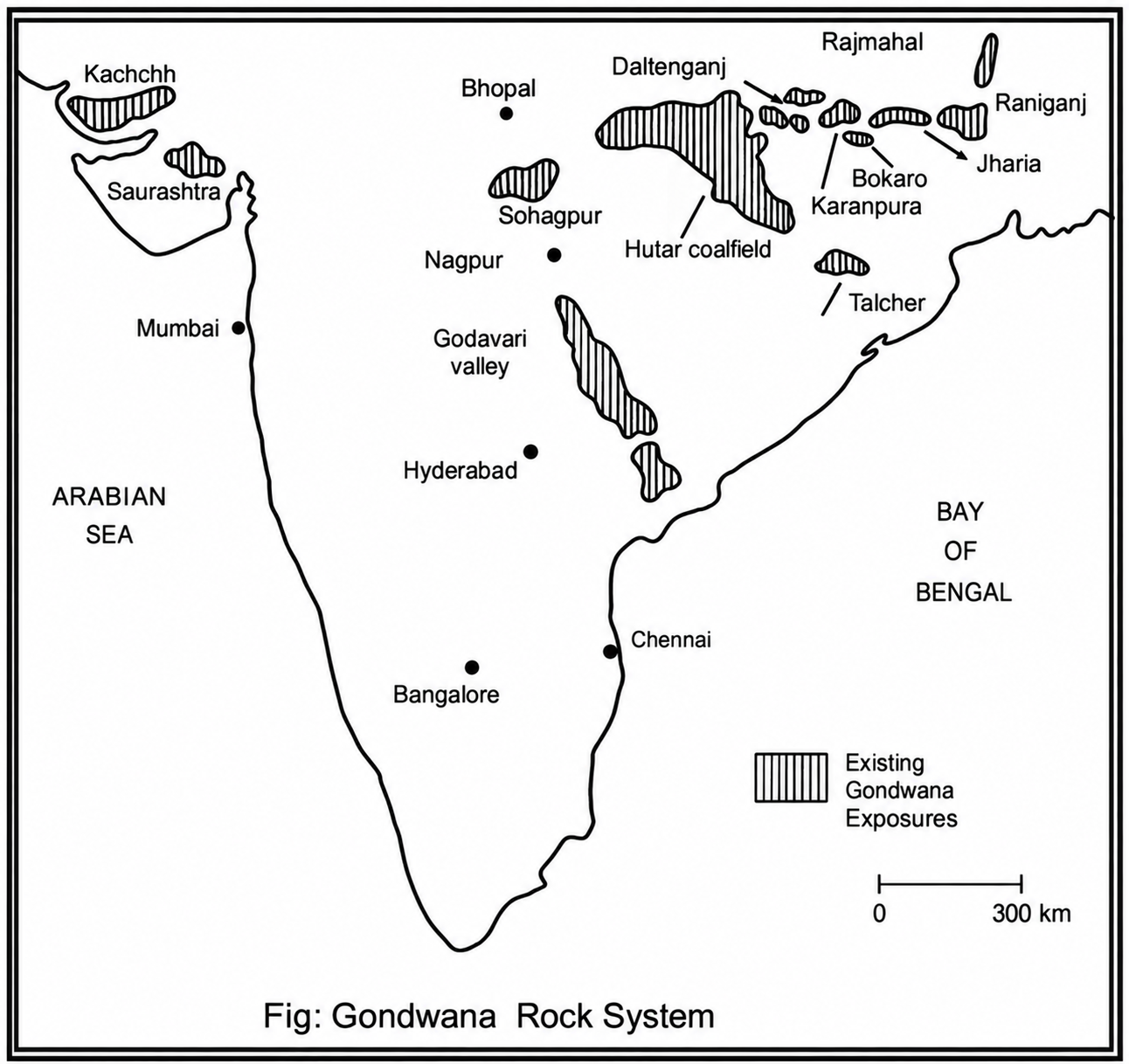
- Distribution: Important Gondwana formations occur in several major river valleys and coal-bearing basins, including Damodar Valley, Mahanadi Valley, Son Valley, Godavari Valley, and Wardha Valley.
- Major Coalfields: Important coalfields associated with Gondwana formations include Raniganj, Jharia, Bokaro, Singrauli, Korba, Talcher, Ib Valley, and Godavari Valley.
- Economic Importance: The most important resource associated with the Gondwana system is coal. Therefore, Gondwana formations have played a major role in India's
- Thermal power generation
- Iron and steel industry
- Industrial development
- Energy supply
Deccan Trap
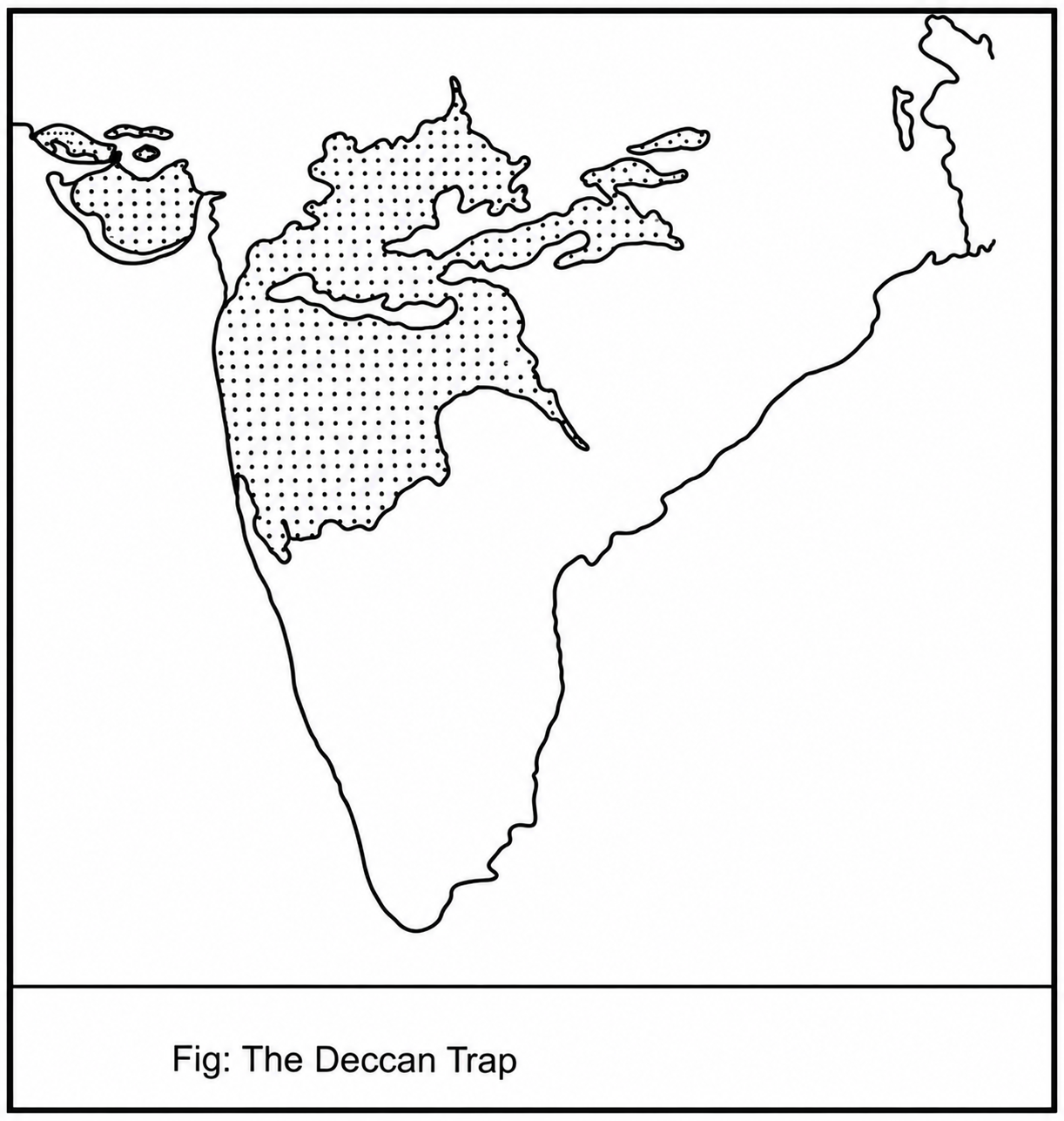
The Deccan Trap is a vast volcanic formation created by successive basaltic lava flows, producing extensive plateau landscapes and contributing to the development of black-soil regions across parts of western and central India. Major Features
- It is mainly composed of basaltic rocks.
- The formation resulted from extensive volcanic eruptions during the Late Cretaceous or early Paleogene period.
- Successive lava flows produced characteristic step-like topography.
- The term “trap” is derived from a Scandinavian word associated with steps, reflecting this stepped landscape.
- The rocks are often arranged in successive horizontal or gently inclined lava layers.
- Distribution: The Deccan Trap covers large areas of Maharashtra, Madhya Pradesh, Gujarat, Karnataka, Telangana, and parts of Andhra Pradesh.
- Importance of Deccan Trap: The weathering of basalt has contributed to the formation of black soils, which are particularly suitable for crops such as cotton.
- The Deccan Trap also strongly influences Plateau relief, Drainage, Soil development, Agriculture, Groundwater occurrence, and regional landscape.
Tertiary Rock System
The Tertiary Rock System comprises comparatively younger geological formations associated with the Himalayan region, northeastern India, coastal areas and several sedimentary basins formed during later stages of India’s geological evolution. Major Features
- These formations are much younger than the ancient Peninsular rocks.
- They are predominantly associated with sedimentary environments.
- Their formation is closely linked with the geological development of the Himalayan and extra-Peninsular regions.
- They include sedimentary sequences deposited in marine, deltaic and terrestrial environments.
- Distribution: Important Tertiary formations occur in the Himalayan region, Assam, Northeastern India, Jammu and Kashmir region, Coastal and offshore sedimentary basins, and other younger geological zones.
- Economic Importance: Tertiary formations are important because several sedimentary basins contain Petroleum, Natural gas, Coal, Limestone, Other sedimentary resources.
- The petroleum and natural-gas-bearing formations of Assam and other northeastern regions are particularly significant.
Quaternary Rock System
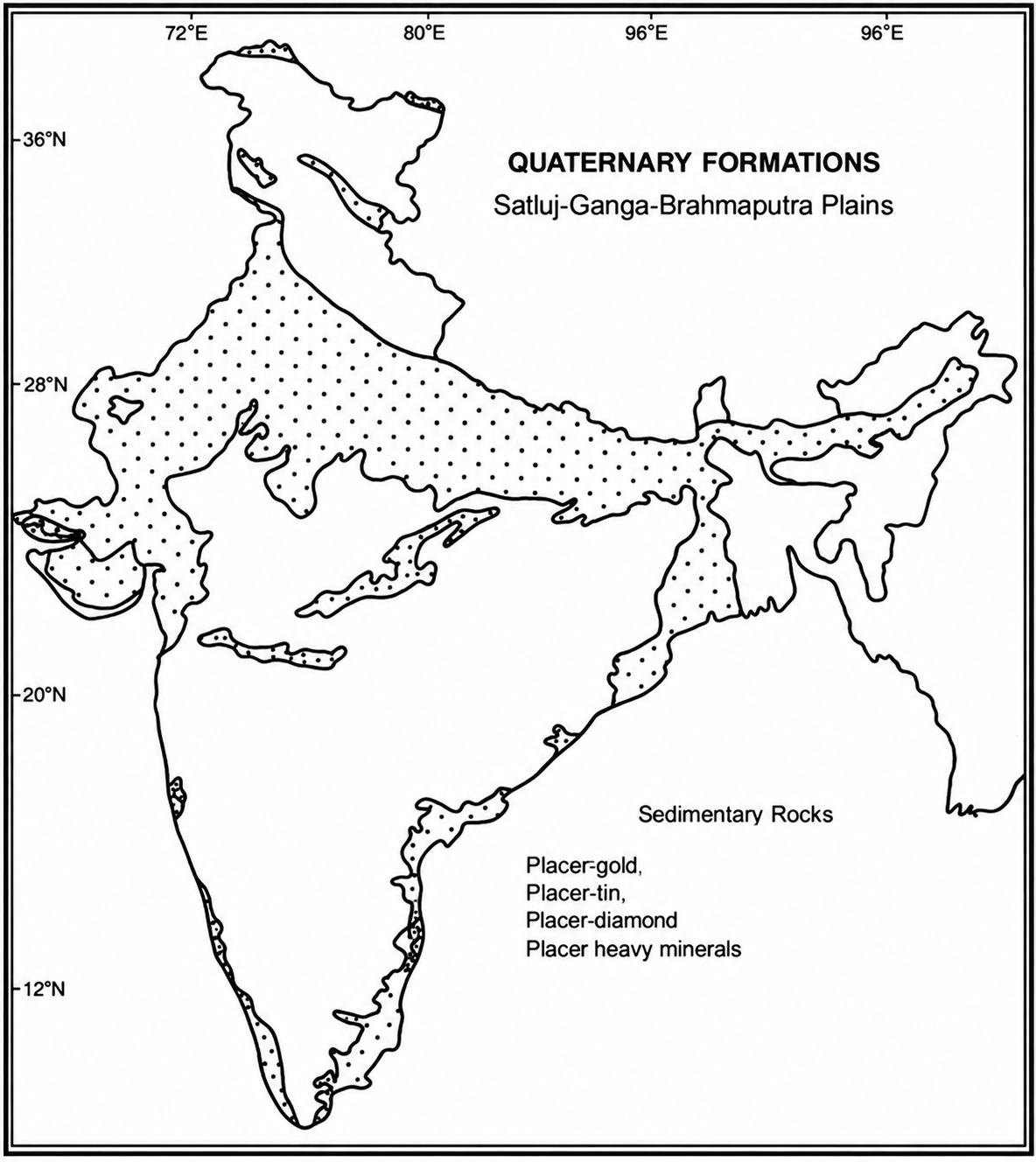
The Quaternary Rock System represents India’s youngest major geological deposits and consists mainly of unconsolidated sediments deposited by rivers, glaciers, wind and coastal processes. Major Features
- Quaternary deposits include Alluvium, Sand, Silt, Clay, Gravel, Recent river and floodplain deposits.
- These formations are especially extensive across the Northern Plains and major river valleys.
- Distribution: Major areas include the Indus Basin, Ganga Basin, Brahmaputra Valley, Northern Plains, Coastal plains, River Deltas, and some arid and semi-arid depositional areas
- Economic Importance: Quaternary deposits are extremely important for agriculture because they form the basis of the fertile alluvial soils of the Northern Plains.
- They support intensive cultivation of Rice, Wheat, Sugarcane, Pulses, Oilseeds, Jute and other crops
- They also influence groundwater availability, settlement patterns and riverine ecosystems.


Rock System of India Economic Importance
The economic importance of the rock system of India extends from mineral extraction and energy production to agriculture, construction, groundwater availability and industrial development. Major Contributions
- Metallic minerals: Ancient crystalline and metamorphic formations are associated with iron, manganese, gold and other metallic minerals.
- Coal: Gondwana formations provide major coal-bearing strata.
- Petroleum and natural gas: Several younger sedimentary basins contain hydrocarbon resources.
- Construction materials: Sandstone, limestone, granite and other rocks support construction activities.
- Cement industry: Limestone-bearing formations provide essential raw material.
- Agriculture: Deccan basalt contributes to black-soil development, while Quaternary deposits support fertile alluvial soils.
- Groundwater: Rock permeability, fractures and geological structures influence groundwater storage and movement.
- Industrial development: Mineral-rich regions have encouraged mining, metallurgy, power generation and manufacturing.
Rock System of India and Physiography of India
The rock system of India provides the geological foundation for India’s major physiographic divisions, influencing the formation of plateaus, mountains, plains, valleys, soils and drainage systems. The relationship can be understood through these examples:
- Peninsular Plateau: Primarily based on ancient crystalline and sedimentary formations.
- Deccan Plateau: Strongly influenced by the basaltic Deccan Trap.
- Northern Plains: Developed over thick layers of Quaternary alluvial deposits.
- Himalayas: Characterised by younger and structurally complex formations associated with tectonic activity.
- Coal-bearing valleys: Closely associated with Gondwana sedimentary formations.
- Coastal and offshore regions: Include younger sedimentary deposits.
Rock System of India and Impact of Climate Change on Geological Processes
Climate change can influence the rock system of India indirectly by altering temperature, rainfall, weathering, erosion, groundwater processes and the stability of exposed geological formations.
- Enhanced weathering: Rising temperatures and changing moisture conditions can accelerate physical and chemical weathering of exposed rocks in some regions.
- Increased erosion: More intense rainfall and extreme precipitation can increase erosion of weathered rock surfaces, particularly in the Himalayas, plateaus and river valleys.
- Glacial retreat: Warming in the Himalayan region can alter freeze–thaw processes, slope stability and sediment generation from mountainous rock formations.
- Freeze–thaw changes: Changes in temperature around the freezing point can modify mechanical weathering in high-altitude Himalayan rocks.
- Chemical weathering: Changes in rainfall, soil moisture and atmospheric CO₂ can influence chemical reactions between water and minerals.
- Landslides and mass wasting: Intense rainfall combined with geological weaknesses, joints and fractures can increase slope instability in mountainous regions.
- Groundwater impacts: Changes in rainfall and recharge can affect groundwater interaction with porous and fractured rocks, particularly in sedimentary and hard-rock regions.
- Coastal impacts: Sea-level rise and stronger coastal processes can increase erosion and weathering of coastal rock formations and cliffs.
Rock System of India and Influence on Climate Change
Over geological timescales, the rock system of India, or India’s geology for that matter, influences the carbon cycle and regional environmental conditions mainly through its effects on carbon storage, weathering, soils, groundwater, vegetation and the distribution of ecosystems and resources.
- Carbon storage through weathering: Chemical weathering of silicate-bearing rocks consumes atmospheric CO₂ over geological timescales and transfers carbon into dissolved and mineral forms.
- Basalt and CO₂ removal: Basaltic formations such as the Deccan Traps contain minerals that react with CO₂ during chemical weathering and mineralisation.
- Rock–soil relationship: Different rock types produce different soils, influencing vegetation, agriculture and terrestrial carbon storage.
- Groundwater storage: Porous sedimentary formations and fractured crystalline rocks provide groundwater reservoirs that support vegetation and ecosystems, indirectly affecting carbon sequestration.
- Influence on vegetation: Geological formations influence soil nutrients, drainage and landscape characteristics, thereby shaping forests and other carbon-storing ecosystems.
- Mineral resources and emissions: Rock systems contain coal, petroleum, natural gas and minerals. Their extraction and use, particularly fossil fuels, contribute significantly to greenhouse-gas emissions.
- Topography and climate interactions: Geological structures create mountains, plateaus, and basins that influence rainfall patterns, drainage, winds, and local climatic conditions.
- Long-term carbon cycle: Rock formation, weathering, sedimentation and mineralisation form part of the geological carbon cycle, which regulates atmospheric CO₂ over very long timescales.
Rock System of India Challenges
The challenges to India’s rock system arise from natural geological processes and human activities such as mining, construction, quarrying and climate-related changes that accelerate rock degradation.
- Mining and quarrying: Intensive extraction of coal, iron ore, limestone, bauxite and other minerals disturbs geological formations and alters natural landscapes.
- Unscientific blasting: Blasting during mining, quarrying and infrastructure construction can increase fractures and destabilise surrounding rock structures.
- Soil and rock erosion: Intense rainfall, river action, wind and surface runoff progressively erode exposed rocks, particularly in fragile and highly weathered regions.
- Landslides in the Himalayas: Geological faults, fractures and weak rock formations combined with heavy rainfall, earthquakes and construction activity increase slope instability.
- Climate change: Changing rainfall patterns, increasing temperatures, glacier retreat and extreme weather events can modify weathering, erosion and mass-movement processes.
- Urbanisation and infrastructure development: Roads, tunnels, dams, railways and settlements can modify natural slopes and expose or disturb geological formations.
- Geological and hydrogeological stress: Excessive groundwater extraction can alter groundwater–rock interactions and contribute to land and ecosystem degradation in vulnerable regions.
- Coastal erosion and sea-level rise: Coastal rock formations are increasingly exposed to wave action, storm surges and changing sea levels.
- Deforestation: Removal of vegetation reduces protection against surface runoff and erosion, accelerating the degradation of weathered rock and soil layers.
- Geological hazards: Earthquakes, volcanic activity, fault movements and other tectonic processes can fracture, deform or destabilise rock formations.
- Unplanned tourism: Construction of roads, hotels and other facilities in mountain and coastal regions can disturb fragile geological landscapes.
- Loss of geological heritage: Unregulated extraction, construction and land-use changes can damage scientifically important geological formations, fossil sites and landscapes.
Rock System of India Way Forward
To preserve the rock system of India, India needs to take some major steps described below.
- Promote scientific and sustainable mining based on geological assessments.
- Prepare geological hazard and landslide susceptibility maps before major infrastructure projects.
- Regulate blasting, quarrying and excavation in ecologically sensitive areas.
- Strengthen slope stabilisation, afforestation and watershed management.
- Integrate geological information into land-use and infrastructure planning.
- Monitor climate-induced changes in Himalayan, coastal and other vulnerable geological regions.
- Promote geological parks and geoheritage conservation.
- Encourage restoration of abandoned mines and degraded quarrying sites.
- Combine modern geological research with local knowledge for region-specific management.
Rock System of India UPSC PYQs
Q1. In which of the following regions of India are shale gas resources found? (UPSC Prelims 2016)
- Cambay Basin
- Cauvery Basin
- Krishna-Godavari Basin
Select the correct answer using the code given below.
a) 1 and 2 only
b) 3 only
c) 2 and 3 only
d) 1, 2 and 3
Ans: (d)
Q2. With reference to two non-conventional energy sources called ‘coalbed methane’ and ‘shale gas’, consider the following statements: (UPSC Prelims 2014)
- Coalbed methane is the pure methane gas extracted from coal seams, while shale gas is a mixture of propane and butane only that can be extracted from fine-grained sedimentary rocks.
- In India, abundant coalbed methane sources exist, but so far no shale gas sources have been found.
Which of the statements given above are correct?
a) 1 only
b) 2 only
c) Both 1 and 2
d) Neither 1 nor 2
Ans: (d)

 Last updated on Oct, 2026
→ UPSC 2027 Notification will be released on 13 January 2027 at upsconline.nic.in.
→ Check Nobel Prize 2026 Winners List here.
→ Download PIB PRiSM Monthly Magazine 2026 here.
→ Check UPSC Monthly Current Affairs Magazine The Recitals here.
→ Check out the latest UPSC Syllabus here.
→ Download UPSC Model Answers for Mains 2026
→ UPSC Mains Question Paper 2026 is out now for Essay & GS Paper 1, 2, 3 & 4.
→ UPSC Calendar 2027 has been released.
→ Enroll in Vajiram & Ravi’s UPSC Mains Test Series 2027 for structured answer writing practice, expert evaluation, and exam-oriented feedback.
→ Join Vajiram & Ravi’s UPSC Mentorship Program 2027 for personalized guidance, strategy planning, and one-to-one support from experienced mentors.
→ Go through the UPSC Mains Previous Year Papers to enhance your preparation.
→ UPSC has released UPSC Toppers List 2025 with the Civil Services final result on its official website.
→ Also check Best UPSC Coaching in India
Rock System of India FAQs
Q1. What is the oldest rock system in India?+
Q2. Where is the Gondwana rock system found in India? +
Q3. Which rock system is associated with India's coal deposits?+
Q4. Which rock system is associated with black soil?+
Q5. Is zircon found in India?+
Tags: quest rock system of india UPSC Geography Notes