
Greenhouse gases are naturally occurring atmospheric gases that absorb and re-emit infrared radiation, helping regulate Earth’s temperature and making the planet suitable for life. The natural greenhouse effect is essential for maintaining habitable conditions; however, human activities have significantly increased the concentration of several greenhouse gases, strengthening heat retention and contributing to global warming and climate change.
The major greenhouse gases include carbon dioxide (CO₂), methane (CH₄), nitrous oxide (N₂O), water vapour and fluorinated gases. Their sources, atmospheric lifetimes and heat-trapping capacities differ considerably. Carbon dioxide mainly comes from fossil-fuel combustion and land-use change, while methane and nitrous oxide are strongly linked to agriculture, energy, and waste. Fluorinated gases primarily originate from industrial activities and have high warming potentials.
Greenhouse Gases Meaning
Greenhouse gases are atmospheric compounds that absorb outgoing heat and influence Earth’s temperature, with their concentration, atmospheric lifetime and heat-trapping ability determining their overall climate impact.
- Greenhouse gases, commonly abbreviated as GHGs, are gases in the atmosphere that absorb infrared radiation emitted by Earth’s surface and influence how much heat the atmosphere retains.
- The principal greenhouse gases relevant to climate change include:
-
- Carbon dioxide (CO₂)
- Methane (CH₄)
- Nitrous oxide (N₂O)
- Water vapour (H₂O)
- Fluorinated or halogenated gases, including HFCs, PFCs, SF₆ and NF₃
- The atmosphere consists mainly of nitrogen and oxygen, but even gases present in relatively small concentrations can have a substantial effect on Earth's climate.
- Importantly, greenhouse gases are not inherently harmful. The natural greenhouse effect keeps Earth sufficiently warm for life.
- The environmental problem arises when human activities substantially increase the concentration of long-lived or highly heat-trapping gases.
Greenhouse Gases Atmospheric Lifetime and Global Warming Potential
The warming influence of a greenhouse gas depends not simply on its quantity but also on how efficiently it absorbs radiation and how long it remains within the atmosphere.
- The Global Warming Potential (GWP) compares the warming effect of a given mass of a greenhouse gas with the equivalent mass of CO₂ over a specified period, commonly 100 years. CO₂ is assigned a GWP of 1.
- CO₂ does not have one single atmospheric lifetime because it continuously moves among the atmosphere, oceans, biosphere and other carbon reservoirs.
- GWP100 values and atmospheric lifetimes for a range of GHGs, based on AR6 WGI, are
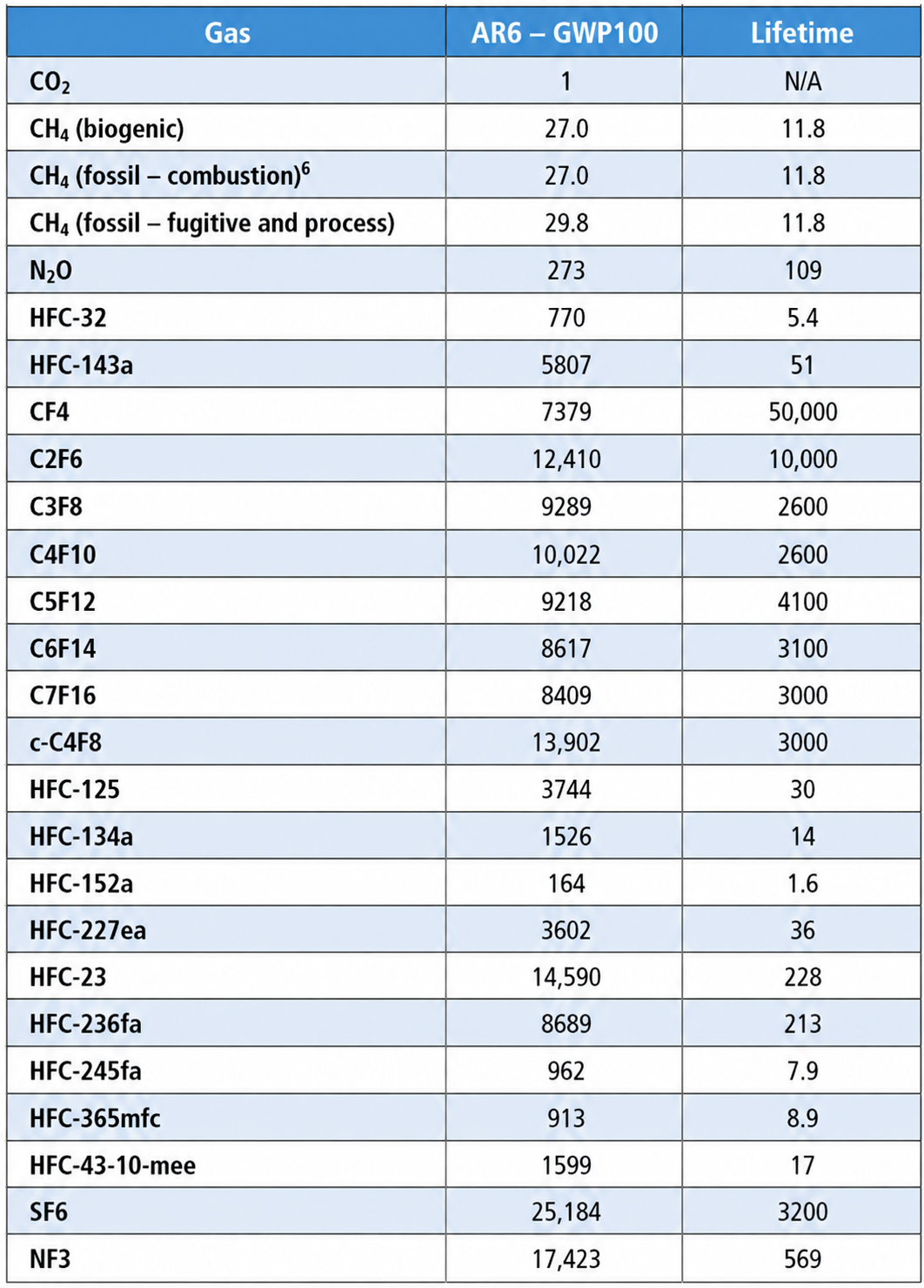
- Greenhouse Gases Measurement: Scientists combine atmospheric observations, ground-based instruments, satellites and emissions inventories to track greenhouse-gas concentrations, sources and changes over time.
- Carbon Dioxide Equivalent (CO₂e): Carbon dioxide equivalent is a common accounting unit that converts emissions of different greenhouse gases into an equivalent amount of CO₂ according to their warming potential over a selected time horizon.
- For example, if a gas has a 100-year GWP of 28, one tonne of that gas is counted as 28 tonnes of CO₂e under that particular metric.


Greenhouse Gases List
The major greenhouse gases differ considerably in their atmospheric concentration, sources, lifetime and warming potential, making each important for understanding climate change and effective emissions reduction strategies.
Carbon Dioxide (CO₂)
Carbon dioxide is the most significant human-caused greenhouse gas because it is released in very large quantities through energy production, industrial activity and land-use changes.
- It is also part of the natural carbon cycle, where plants absorb CO₂ through photosynthesis, and oceans, vegetation and soils exchange carbon with the atmosphere. Major sources include:
- Burning coal, oil and natural gas
- Cement manufacturing
- Deforestation and land-use change
- Burning biomass and forests
- Certain industrial processes
- Atmospheric carbon dioxide has increased substantially over recent decades. The additional CO₂ produced by human activities is the largest contributor to the observed increase in global temperatures.
Methane (CH₄)
Methane is a potent greenhouse gas released primarily from agriculture, fossil-fuel systems and waste. Although its atmospheric concentration is much lower than that of carbon dioxide, each unit of methane produces considerably more warming over 100 years.
- Major sources include:
- Cattle and other ruminant livestock
- Rice cultivation
- Landfills
- Oil and natural-gas production
- Coal mining
- Biomass burning
- Methane has a 100-year Global Warming Potential (GWP) of 28 relative to CO₂ and an average atmospheric lifetime of approximately 12 years. Its shorter atmospheric lifetime means that reducing methane emissions can deliver relatively rapid climate benefits.
Nitrous Oxide (N₂O)
Nitrous oxide is a long-lived greenhouse gas associated particularly with agriculture, where nitrogen fertilisers and manure contribute substantially to emissions. Fossil-fuel combustion, biomass burning and industrial activities are additional sources.
- Major sources include:
- Nitrogen fertilisers
- Manure and other organic fertilisers
- Fossil-fuel and biomass combustion
- Industrial processes
- N₂O has a 100-year GWP of 273 in the latest assessment values used here and an atmospheric lifetime of approximately 109 years. Earlier assessment values commonly cited a GWP of 265 and a lifetime of about 121 years. The variation reflects updates in scientific assessment and methodology.
Water Vapour (H₂O)
Water vapour is the most abundant greenhouse gas in the atmosphere and plays a fundamental role in regulating Earth's temperature. However, unlike carbon dioxide, its atmospheric concentration is strongly controlled by temperature and the water cycle.
- As air becomes warmer, it can hold more water vapour. This additional water vapour can absorb more outgoing infrared radiation and produce further warming, making water vapour an important climate feedback.
- Therefore, water vapour is generally not considered the primary human-controlled driver of long-term climate change. Instead, human-caused warming can increase atmospheric water vapour, which can then amplify the initial warming.
Fluorinated Gases
Fluorinated gases are largely synthetic gases used in various industrial and commercial applications. They are generally emitted in much smaller quantities than CO₂ but can have exceptionally high global warming potentials and, in some cases, remain in the atmosphere for very long periods. Major fluorinated greenhouse gases include:
- Hydrofluorocarbons (HFCs)
- Perfluorocarbons (PFCs)
- Sulphur hexafluoride (SF₆)
- Nitrogen trifluoride (NF₃)
Ozone
Ozone (O₃) acts as a greenhouse gas because its molecular structure allows it to absorb infrared radiation (heat) emitted from the Earth's surface and trap it in the lower atmosphere.
- Tropospheric O₃: Acts as a greenhouse gas and air pollutant; formed through sunlight-driven reactions involving NOₓ and VOCs.
- Stratospheric O₃: Absorbs harmful UV radiation, protecting life.
Short-Lived Climate Pollutants (SLCPs)
SLCPs are powerful greenhouse gases and air pollutants that remain in the atmosphere from days to decades but have a strong short-term warming effect.
- High warming effect: Trap heat much more strongly than CO₂ over shorter timescales.
- Major contributors: Account for up to 45% of current human-caused global warming.
- Major SLCPs: Methane (CH₄), black carbon, tropospheric ozone (O₃) and HFCs.
- Dual impact: Worsen air pollution and climate change, harming human health, ecosystems and crop yields.
Greenhouse Gases Effect
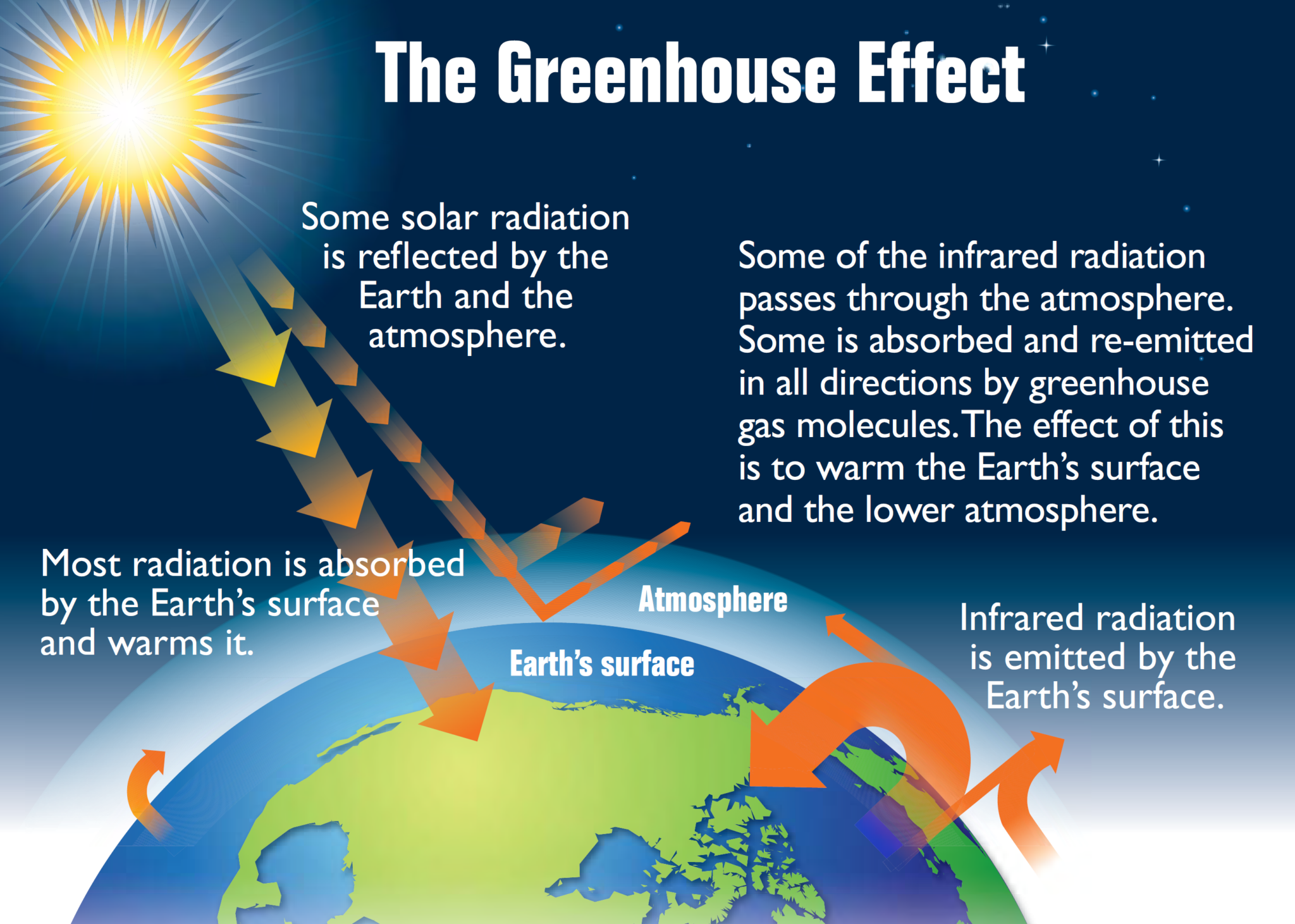
The greenhouse effect is a natural atmospheric process in which greenhouse gases absorb outgoing infrared radiation, helping retain heat and maintain temperatures suitable for life on Earth. Four stages of the greenhouse effect are
- Solar radiation reaches Earth: Energy from the Sun passes through the atmosphere.
- Earth absorbs solar energy: Land and oceans absorb part of this incoming energy and warm up.
- Earth releases infrared radiation: The warmed surface emits energy back toward space as infrared radiation.
- Greenhouse gases absorb some outgoing radiation: Greenhouse gases absorb and re-emit part of this energy, reducing the amount escaping directly into space.
Greenhouse Gases Importance
Greenhouse gases are important because their natural presence regulates Earth's temperature, while changes in their atmospheric concentrations influence the climate system, ecosystems, economies and human societies. The importance of greenhouse gases is
- Maintain Earth's temperature: The natural greenhouse effect prevents Earth from becoming too cold for life.
- Support ecosystems: A stable temperature range enables diverse biological systems to exist.
- Regulate climate: Atmospheric greenhouse gases influence Earth's energy balance.
- Drive climate variability: Changes in their concentration can alter temperature, precipitation and other climate characteristics.
- Provide a climate indicator: Monitoring greenhouse-gas concentrations helps scientists understand changes in the climate system.
- Guide climate policy: GHG measurements provide the basis for emissions inventories, reduction targets and mitigation strategies.
Greenhouse Gases Emissions data
Global greenhouse-gas emissions are commonly expressed in carbon dioxide equivalents, allowing emissions from gases with different warming potentials to be combined into a common accounting framework.
- Total GHG emissions include CO₂, methane, nitrous oxide and smaller quantities of trace gases such as HFCs and SF₆. Global and national emissions are commonly represented in tonnes of CO₂-equivalent.
Global Greenhouse Gas Emissions by Country: Latest EDGAR Data
According to the Emissions Database for Global Atmospheric Research (EDGAR 2026) – developed by the European Commission’s Joint Research Centre (JRC) in collaboration with the International Energy Agency (IEA), covering emissions for 2025 – total worldwide anthropogenic greenhouse gas (GHG) emissions reached a record 54.1 gigatonnes of CO₂ equivalent (GtCO₂e).
- The data highlights a shifting landscape among major global polluters, with absolute growth stabilising in emerging economies while varying across developed nations.
- Top Global Emitters: The top six greenhouse gas emitters – China, the United States, India, the European Union (EU27), Russia, and Indonesia collectively generate roughly 62% of all global emissions while representing 50.1% of the global population and 62.3% of global GDP
Greenhouse Gases Sector-wise Global Trend
Global greenhouse gas (GHG) emissions have risen significantly, reaching 68% above 1990 levels and 33% above 2005 levels in 2025. Compared with 2024, global emissions increased marginally by 1%, with notable variations across sectors. 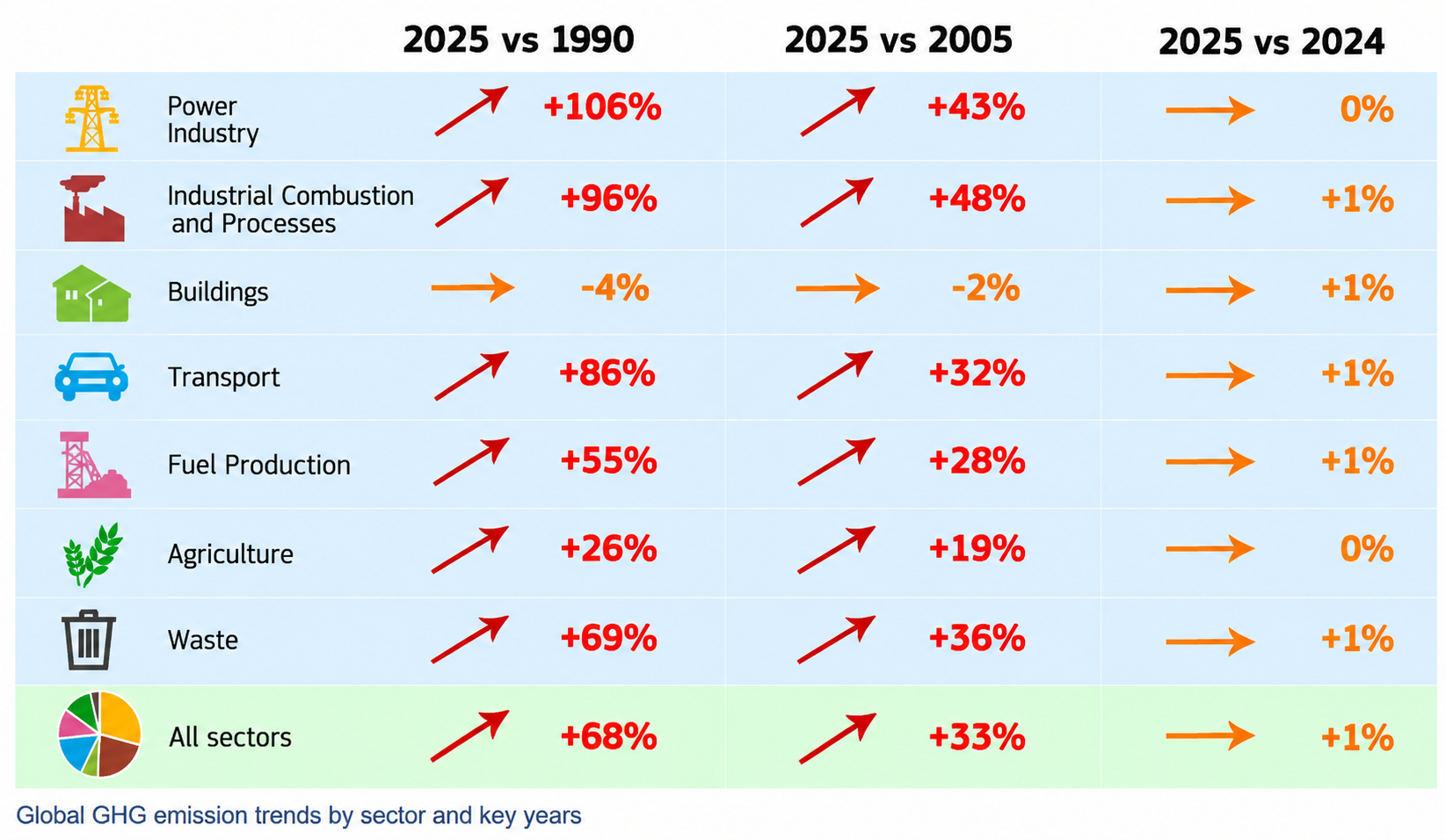
Greenhouse Gases Impact
Excess greenhouse gases intensify planetary warming and contribute to broader climate-system changes, creating environmental, economic and social consequences across regions and sectors. Major impacts
- Global warming: Higher concentrations of greenhouse gases increase heat retention and raise average global temperatures, with 2024 being the warmest year on record.
- Changing precipitation: Warming can alter the distribution and intensity of rainfall and other precipitation.
- Extreme weather: Climate warming can influence the severity and characteristics of some weather extremes.
- Sea-level rise: Warming contributes to changes in oceans and ice systems, affecting sea levels and threatening low-lying coastal areas such as the Sundarbans.
- Ecosystem disruption: Rising temperatures and changing rainfall are shifting species ranges and stressing ecosystems, contributing to coral bleaching in the Great Barrier Reef.
- Agricultural stress: Heat stress and changing rainfall patterns can reduce crop yields; for example, extreme heat during wheat's grain-filling stage can reduce wheat productivity in India.
Greenhouse Gases Mitigation Policies in India
India follows a multi-sectoral approach to reduce GHG emissions through clean energy, energy efficiency, sustainable transport, carbon markets and carbon sinks.
- Updated NDC (NDC 3.0): Targets a 47% reduction in emissions intensity of GDP from 2005 levels by 2035 and 60% cumulative installed electric power capacity from non-fossil sources by 2035, while retaining the Net Zero target by 2070.
- Renewable Energy Expansion: Promotes solar, wind, hydropower and other non-fossil energy sources to reduce dependence on fossil fuels.
- PAT Scheme: Sets energy-efficiency targets for energy-intensive industries and enables trading of Energy Saving Certificates (ESCerts).
- Carbon Credit Trading Scheme (CCTS), 2023: Establishes India’s carbon-market framework through compliance and offset mechanisms for emission reduction and removal.
- National Green Hydrogen Mission: Promotes production and use of green hydrogen to decarbonise hard-to-abate sectors, with a target of 5 MTPA production by 2030.
- Energy Conservation Framework: The Energy Conservation Act, 2001, amended in 2022, supports energy-efficiency measures, carbon markets and non-fossil energy obligations.
- Electric Mobility: Promotes EV adoption, charging infrastructure and cleaner transport to reduce road-transport emissions.
- Biofuel Promotion: Ethanol blending, compressed biogas and other sustainable biofuels help reduce fossil-fuel dependence.
- Mission LiFE: Encourages resource-efficient and sustainable lifestyles through the “Pro-Planet People” approach.
- Green India Mission: Promotes afforestation, ecosystem restoration and enhancement of forest and tree cover to strengthen carbon sinks.
- India Cooling Action Plan (ICAP): Targets lower cooling demand, improved energy efficiency and reduced refrigerant emissions across the cooling sector.
Greenhouse Gases Way Forward
Greenhouse gas (GHG) mitigation refers to the targeted actions, technologies, and policy measures designed to limit or reduce the release of heat-trapping pollutants into the atmosphere. The primary goal of mitigation is to stabilise global temperatures, slow climate warming, and prevent severe ecological and socio-economic impacts. Core Pillars of GHG Reduction;
- Clean Technology: Replacing traditional fossil fuel power plants with clean, renewable energy sources such as solar, wind, geothermal, and hydroelectricity drastically cuts carbon output from the energy grid.
- Energy Efficiency & Smart Technologies: Upgrading building insulation, deploying high-efficiency appliances, and modernising industrial manufacturing processes reduce total power demand without sacrificing productivity.
- Decarbonising Transportation: Transitioning from internal combustion engines to electric vehicles (EVs), expanding low-emission public transit systems, and adopting alternative fuels in aviation and shipping curtail one of the fastest-growing emission sectors.
- Circular Economy: Promoting reduce, reuse, repair, refurbish and recycle practices minimises resource extraction, energy consumption and waste generation, thereby reducing greenhouse gas emissions across product life cycles.
- Sustainable Agriculture & Land Management: Implementing precise fertiliser management reduces nitrous oxide emissions, while optimised livestock feed and improved waste handling cut agricultural methane output.
- Expanding Natural & Technological Carbon Sinks: Protecting existing forests, reforesting degraded lands, restoring coastal wetlands, and investing in technological Carbon Capture and Storage (CCS) pull existing forests directly out of the atmosphere.
Greenhouse Gases UPSC PYQs
Q1. Discuss global warming and mention its effects on the global climate. Explain the control measures to bring down the level of greenhouse gases which cause global warming, in the light of the Kyoto Protocol, 1997. (UPSC Mains 2022)
Q2. Consider the following statements: (UPSC Prelims 2025)
Statement I: Circular economy reduces the emissions of greenhouse gases.
Statement II: Circular economy reduces the use of raw materials as inputs.
Statement III: Circular economy reduces wastage in the production process.
Which one of the following is correct in respect of the above statements?
a) Both Statement II and Statement III are correct and both of them explain Statement I
b) Both Statement II and Statement III are correct but only one of them explains Statement I
c) Only one of the Statements II and III is correct and that explains Statement I
d) Neither Statement II nor Statement III is correct
Ans: (a)
Q3. Consider the following statements: (UPSC Prelims 2025)
Statement I: Studies indicate that carbon dioxide emissions from cement industry account for more than 5% of global carbon emissions.
Statement II: Silica-bearing clay is mixed with limestone while manufacturing cement.
Statement III: Limestone is converted into lime during clinker production for cement manufacturing.
Which one of the following is correct in respect of the above statements?
a) Both Statement II and Statement III are correct and both of them explain Statement I
b) Both Statement II and Statement III are correct but only one of them explains Statement I
c) Only one of the Statements II and III is correct and that explains Statement I
d) Neither Statement II nor Statement III is correct
Ans: (b)
Q4. Consider the following statements: (UPSC Prelims 2025)
I. Carbon dioxide (CO₂) emissions in India are less than 0.5 t CO₂/capita.
II. In terms of CO₂ emissions from fuel combustion, India ranks second in the Asia-Pacific region.
III. Electricity and heat producers are the largest sources of CO₂ emissions in India.
Which of the statements given above is/are correct?
a) I and III only
b) II only
c) II and III only
d) I, II and III
Ans: (c)
Q5. Among the following crops, which one is the most important anthropogenic source of both methane and nitrous oxide? (UPSC Prelims 2025)
a) Cotton
b) Rice
c) Sugarcane
d) Wheat
Ans: (b)

 Last updated on Sep, 2026
→ UPSC 2027 Notification will be released on 13 January 2027 at upsconline.nic.in.
→ Asian Games 2026 are being held in Aichi-Nagoya, Japan, from 19 September to 4 October.
→ Check out the latest UPSC Syllabus here.
→ Download UPSC Model Answers for Mains 2026
→ UPSC Mains Question Paper 2026 is out now for Essay & GS Paper 1, 2, 3 & 4.
→ UPSC Calendar 2027 has been released.
→ Enroll in Vajiram & Ravi’s UPSC Mains Test Series 2027 for structured answer writing practice, expert evaluation, and exam-oriented feedback.
→ Join Vajiram & Ravi’s UPSC Mentorship Program 2027 for personalized guidance, strategy planning, and one-to-one support from experienced mentors.
→ Go through the UPSC Mains Previous Year Papers to enhance your preparation.
→ UPSC has released UPSC Toppers List 2025 with the Civil Services final result on its official website.
→ Also check Best UPSC Coaching in India
Greenhouse Gases FAQs
Q1. What is a greenhouse gas?+
Q2. What are the 5 main greenhouse gases?+
Q3. Are greenhouse gases harmful?+
Q4. Which is a greenhouse gas, N₂O or NO₂?+
Q5. Is H₂O a greenhouse gas?+
Tags: greenhouse gases quest UPSC Environment & Ecology Notes