The National Pension System (NPS) is a contributory, defined-contribution pension framework designed to provide long-term retirement income security through regular savings and market-linked investments. Regulated by the Pension Fund Regulatory and Development Authority (PFRDA), NPS offers subscribers flexibility in choosing pension fund managers, investment options and asset allocation across equity, corporate bonds and government securities.
Introduced for new Central Government employees in 2004, NPS has subsequently expanded to State Government employees, corporate employees and eligible citizens through different participation models. With Tier-I and Tier-II accounts, tax benefits and portability across employment, NPS has emerged as a key pillar of India’s pension architecture. The significance of NPS has further increased with initiatives such as NPS Vatsalya and the Unified Pension Scheme.
National Pension System Overview
The National Pension System is India's flagship pension framework that enables individuals to build a retirement corpus through regular contributions while offering flexibility in investment choices and broad coverage across sectors.
- Evolution: NPS was introduced on 1 January 2004 for new Central Government employees (except the Armed Forces), replacing the Old Pension Scheme (OPS), and was later adopted by most State Governments for new entrants.
- Objective: It is a contributory, defined-contribution pension scheme that aims to provide old-age income security through market-linked investments.
- Regulator: Regulated and supervised by the Pension Fund Regulatory and Development Authority (PFRDA).
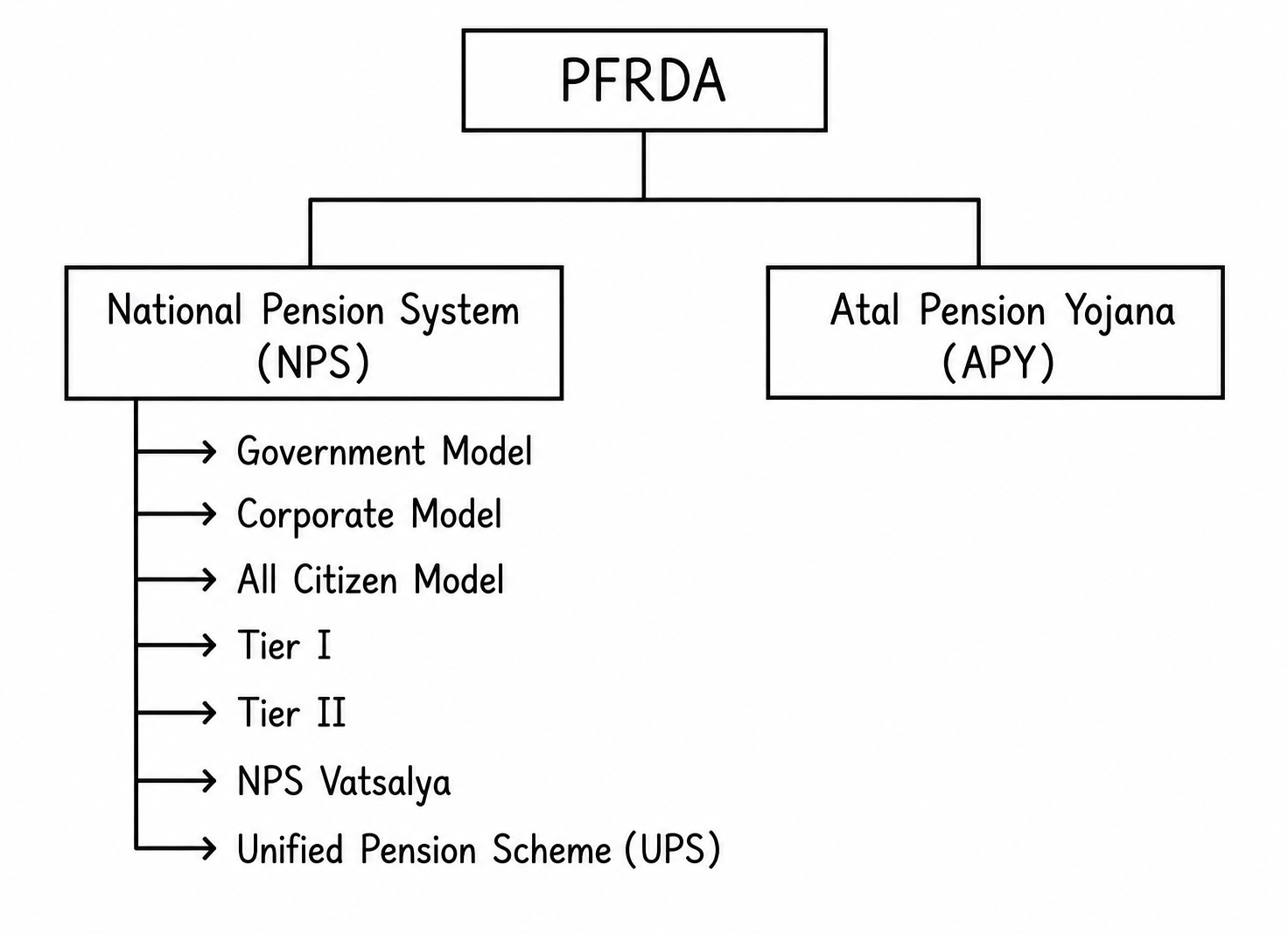
- Models: The National Pension System operates through three models – Government Sector, Corporate Model, and All Citizen Model – covering government employees, private sector employees, and all eligible Indian citizens.
- Eligibility: Open to all eligible Indian citizens (residents, NRI, and OCI).
- Subscribers can open Tier I (retirement account with withdrawal restrictions) and Tier II (voluntary savings account with greater liquidity) accounts.
- Investment Framework: The National Pension System offers investment in equity, corporate bonds, government securities, and other approved asset classes, with the flexibility to choose fund managers and investment options under Active Choice or Auto Choice.
- Government Contribution: For eligible Central Government employees, the Government contributes 14% of Basic Pay plus Dearness Allowance (DA) to the NPS account; however, the pension remains market-linked and is not guaranteed.
- Scale (as of 31 March 2026): The National Pension System has over 2.17 crore subscribers with Assets Under Management (AUM) of approximately ₹15.95 lakh crore, making it India's largest pension savings framework.
NPS Scheme Tax Benefit
Under the old tax regime, the National Pension System subscribers can claim an additional deduction of up to ₹50,000 under Section 80CCD(1B), over and above the combined ₹1.5 lakh limit under Sections 80C, 80CCC and 80CCD(1). Employer contributions to NPS under Section 80CCD(2) are separately deductible, subject to applicable limits.
- Section 80CCD(1B): NPS subscribers can claim an additional deduction of up to ₹50,000 per financial year, over and above the ₹1.5 lakh combined limit under Sections 80C, 80CCC and 80CCD(1).
- Section 80CCE: The aggregate deduction under Sections 80C, 80CCC and 80CCD(1) is capped at ₹1.5 lakh.
- Employer Contribution – Section 80CCD(2): Employer contributions to the NPS Tier-I account are separately deductible, subject to prescribed limits. This deduction is available under both the old and new tax regimes.
- Tier-I Account: NPS tax deductions under Sections 80CCD(1) and 80CCD(1B) relate to contributions to the pension account, subject to applicable conditions.
- Tier-II Account: Ordinary Tier-II contributions do not qualify for tax deduction. However, the Tier-II Tax Saver Scheme (TTS) provides a Section 80C deduction to eligible Central Government NPS subscribers, subject to a three-year lock-in.


National Pension System Models
The National Pension System operates through three participation models to cater to government employees, private sector employees, and individual citizens.
Government Sector Model of NPS
It is designed for Central Government employees (except Armed Forces), employees of state governments that have adopted NPS, and employees of participating autonomous bodies.
- Coverage: NPS applies to all new Central Government employees joining on or after 1 January 2004 and has been adopted by most State Governments for their new recruits.
- Nature: This model is a mandatory defined-contribution pension scheme for covered employees.
- Contribution: Both the employee and the government contribute to the employee's Permanent Retirement Account Number (PRAN). For eligible Central Government employees, the government contributes 14% of basic pay plus Dearness Allowance (DA).
- Fund Management: The pension corpus is managed by Pension Fund Managers (PFMs) under the supervision of PFRDA through the CRA, Trustee Bank, Custodian, and NPS Trust.
Corporate Model of NPS
The Corporate Model extends the National Pension System benefits to employees of registered private and public sector organisations.
- Coverage: It is available to companies, LLPs, partnership firms, trusts, societies, public sector enterprises, government companies, and other eligible organisations registered with PFRDA.
- Nature: A voluntary employer-sponsored retirement savings scheme.
- Contribution: Contributions may be made by the employer, the employee, or both, in mutually agreed proportions.
- Portability: The PRAN-based system allows seamless portability of the NPS account across different employers and sectors.
- Benefits: Offers market-linked returns, tax benefits under applicable provisions, online account access, and professional fund management by PFRDA-regulated intermediaries.
All Citizen Model of NPS
The All Citizen Model enables any eligible Indian citizen to voluntarily save for retirement.
- Coverage: It is open to resident Indians, NRIs, and Overseas Citizens of India (OCI) aged 18-85 years who satisfy KYC requirements and are legally competent to enter into a contract.
- Nature: It is a voluntary, individual pension scheme without any employer requirement.
- Account Structure: The subscribers can open a Tier I retirement account and an optional Tier II savings account.
- Investment Flexibility: Subscribers can choose their Pension Fund Manager, investment pattern, and asset allocation through Active Choice or Auto Choice.
- Investment Options: NPS contributions are invested across Equity (E), Corporate Bonds (C), and Government Securities (G) as per PFRDA-prescribed investment norms.
- Portability: The PRAN remains valid throughout the subscriber's lifetime regardless of changes in employment or place of residence.
National Pension System (NPS): Tier-I and Tier-II Accounts
The National Pension System is structured into two types of accounts – Tier-I and Tier-II. Tier-I is the primary retirement/pension account under NPS, while Tier-II is an optional savings account that provides greater flexibility in withdrawals.
| Tier-I Account | Tier-II Account |
|
It is the primary retirement (pension) account under the National Pension System. |
It is a voluntary and optional savings account under the National Pension System. |
|
It can be opened by all eligible National Pension System subscribers. |
It can be opened only with an active Tier-I account. |
|
It is designed to build a retirement corpus. |
It is meant for flexible savings and investments. |
|
Withdrawals are permitted only as per the NPS Exit and Withdrawal Rules. |
Withdrawals can be made at any time without restrictions. However, certain tax-benefit-linked Tier-II variants can have specific conditions. |
|
Minimum initial contribution: ₹500. Minimum subsequent contribution: ₹500 per transaction. Minimum annual contribution: ₹1,000 per financial year. |
Minimum initial contribution: ₹1000. Minimum subsequent contribution: ₹250 per transaction. There is no minimum annual contribution requirement for the Tier II account, provided your Tier I account is active. |
|
Annual Maintenance Charges (AMC) are applicable. |
No separate Annual Maintenance Charges (AMC) are applicable. |
|
Contributions are invested in the chosen pension fund and scheme. |
Funds can be transferred to the Tier-I account at any time. |
National Pension System Vatsalya
NPS Vatsalya, launched in 2024, is a contributory pension scheme under the National Pension System that enables parents or legal guardians to start pension savings for minors from an early age.
- The minor remains the sole subscriber and beneficiary of the pension account.
- The parent or legal guardian manages the account until the minor turns 18.
- On attaining 18 years, the subscriber may continue in NPS Vatsalya up to 21 years, shift the accumulated corpus to NPS, or exit, subject to applicable rules.
- The scheme promotes early retirement planning by allowing long-term, market-linked wealth creation through the National Pension System framework.
Unified Pension Scheme
The Unified Pension Scheme (UPS) came into effect on 1 April 2025 as an optional pension scheme under the National Pension System for eligible Central Government employees.
- UPS follows a contributory model, with contributions from both the employee and the Central Government.
- UPS provides an assured, inflation-indexed pension, unlike the NPS, where retirement benefits depend on the accumulated corpus and market returns.
- Employees with at least 10 years of qualifying service are eligible for a minimum assured pension of ₹10,000 per month, subject to the prescribed conditions.
- The pension is linked to the employee's qualifying service and last drawn Basic Pay and Dearness Allowance (DA), and Dearness Relief (DR) is payable to protect against inflation.
- In the event of the employee's death after retirement, the legally wedded spouse is entitled to a family pension equal to 60% of the admissible pension.
- The scheme is regulated by the Pension Fund Regulatory and Development Authority (PFRDA).
NPS vs PPF
The National Pension System is a market-linked, retirement-focused savings vehicle whose returns depend on the performance of pension fund managers and financial markets.
- In contrast, the Public Provident Fund (PPF) is a government-backed savings scheme offering interest at rates notified quarterly by the government.
- While PPF serves broader long-term savings goals, NPS is specifically designed for retirement planning.
| Aspect | NPS | PPF |
|
Maturity/Exit |
Exit generally at 60 years/superannuation; continuation possible up to 75 years |
Matures after 15 years |
|
Returns/ Interest |
Market-linked returns; no fixed interest rate |
Government-notified interest rate: 7.10% per annum for July to September 2026. |
|
Minimum Investment |
₹500 per contribution; minimum ₹1,000 annually |
₹500 annually; maximum ₹1.5 lakh annually |
|
Tax Benefits |
Deduction under Section 80CCD, including an additional ₹50,000 under 80CCD(1B), subject to conditions |
Deposit eligible for the Section 80C deduction; interest is tax-exempt. |
|
Withdrawal |
Withdrawal/exit subject to PFRDA rules; premature exit generally involves 20% lump sum and 80% annuitisation, subject to conditions |
Partial withdrawal permitted from the 7th financial year, subject to conditions |
National Pension System Significance
The National Pension System is a voluntary, defined-contribution pension scheme regulated by PFRDA that aims to provide retirement income security through long-term savings. It has emerged as a key pillar of India's pension architecture by promoting fiscal sustainability, financial inclusion, and capital market development.
- Ensures Fiscal Sustainability: NPS shifts pension financing from an unfunded defined-benefit Old Pension Scheme toward a funded defined-contribution framework, thereby improving predictability of government pension liabilities.
- Expands Pension Coverage: NPS covered 2.17 crore subscribers as of 31 March 2026, including government employees, corporate employees, and voluntary subscribers.
- Mobilises Long-term Capital: NPS had Assets Under Management (AUM) of ₹15.95 lakh crore (31 March 2026), channelising long-term household savings into government securities, corporate bonds, and equities.
- Provides Portability and Flexibility: The PRAN-based structure enables seamless portability across jobs and sectors, with flexibility in choosing pension fund managers and asset allocation.
- Promotes Financial Inclusion: Through the All Citizen Model and complementary schemes such as Atal Pension Yojana (APY), the NPS pension architecture expands coverage among informal-sector and low-income workers.
- Strengthens Retirement Security: Initiatives such as NPS Vatsalya and market-linked investment options encourage lifecycle savings and improve retirement preparedness.
- Provides a Robust Institutional Framework: NPS is regulated by PFRDA, ensuring transparent governance, prudent investment management, and investor protection.
- Serves as the Foundation for Pension Reforms: NPS forms the basis of the Unified Pension Scheme (UPS), reflecting its role as India's core pension architecture.
National Pension System UPSC PYQs
Q1. Who among the following can join the National Pension System (NPS)? (Prelims 2017)
(a) Resident Indian citizens only
(b) Persons of age from 21 to 55 only
(c) All State Government employees joining the services after the date of notification by the respective State Governments
(d) All Central Government employees, including those of the Armed Forces joining the services on or after 1st April, 2004
Ans: (c)

 Last updated on Sep, 2026
→ UPSC 2027 Notification will be released on 13 January 2027 at upsconline.nic.in.
→ Asian Games 2026 are being held in Aichi-Nagoya, Japan, from 19 September to 4 October.
→ Check out the latest UPSC Syllabus here.
→ Download UPSC Model Answers for Mains 2026
→ UPSC Mains Question Paper 2026 is out now for Essay & GS Paper 1, 2, 3 & 4.
→ UPSC Calendar 2027 has been released.
→ Enroll in Vajiram & Ravi’s UPSC Mains Test Series 2027 for structured answer writing practice, expert evaluation, and exam-oriented feedback.
→ Join Vajiram & Ravi’s UPSC Mentorship Program 2027 for personalized guidance, strategy planning, and one-to-one support from experienced mentors.
→ Go through the UPSC Mains Previous Year Papers to enhance your preparation.
→ UPSC has released UPSC Toppers List 2025 with the Civil Services final result on its official website.
→ Also check Best UPSC Coaching in India
National Pension System FAQs
Q1. Can I withdraw 100% of the amount from NPS?+
Q2. Can we exit NPS before 10 years?+
Q3. Is the NPS pension for a lifetime?+
Q4. What is the lock-in period for NPS?+
Q5. Can I continue NPS after 60 years?+
Tags: nps quest upsc economy notes