Real Estate Investment Trusts (REITs) are SEBI-regulated investment vehicles that pool capital and invest primarily in income-generating real estate assets, providing investors with market-based access to large-scale properties. REITs are governed by the SEBI (Real Estate Investment Trusts) Regulations, 2014. REITs enable developers to monetise mature commercial assets and recycle capital into new investments. Their Sponsor–Trustee–Manager structure, supported by independent valuation and disclosure requirements, promotes professional management and investor protection.
Real Estate Investment Trusts (REITs) have therefore emerged as an important instrument for institutionalising India's real estate sector, deepening capital markets and mobilising long-term capital. In 2024, the introduction of Small and Medium REITs (SM REITs) has extended the regulated framework even to smaller-scale real estate investment.
Real Estate Investment Trusts About
Real Estate Investment Trusts (REITs) bridge large, illiquid real estate assets and capital-market investors, enabling professional management, asset monetisation, and regular cash-flow distributions.
- Meaning: A REIT is a trust registered with SEBI that pools investor funds and invests in eligible real estate assets, directly or through HoldCos/SPVs
- Regulatory Framework: REITs are governed by the SEBI (Real Estate Investment Trusts) Regulations, 2014, which have been amended periodically; the current regulations were last amended on 18 April 2026.
- Core Purpose: Mobilise long-term domestic and foreign capital for real estate while providing investors with a regulated avenue to participate in income-generating property.
- Capital Recycling: Developers can transfer mature, rent-generating commercial properties to a REIT, unlock capital and deploy the proceeds into new projects or balance-sheet strengthening.
- Investor Access: Investors acquire REIT units representing an economic interest in the underlying portfolio, without directly purchasing or managing large physical properties.
- Asset Monetisation: REITs convert relatively illiquid real-estate assets into market-linked investment instruments, supporting India's broader capital-market and asset-monetisation strategy.
- Small and Medium REITs: The 2024 SM REIT framework brought smaller real estate portfolios and fractional-ownership structures within a regulated framework, with a minimum asset value of ₹50 crore and prescribed investor/disclosure safeguards.
Real Estate Investment Trusts Structure
The Real Estate Investment Trusts (REITs) framework separates sponsorship, fiduciary oversight and professional asset management, with independent valuation and regulatory disclosures supporting investor protection.
- Sponsor: Establishes the REIT and is responsible for its formation and initial asset arrangements. Sponsors and sponsor groups are subject to prescribed minimum holding and lock-in requirements, including the 15% minimum post-issue holding requirement for the prescribed period.
- Trustee: A SEBI-registered debenture trustee that holds the REIT's assets in trust and oversees the activities of the manager in the interests of unitholders.
- Manager: A professional entity responsible for investment decisions, asset acquisition, portfolio management, leasing, financing and regulatory compliance.
- Valuer: An independent eligible professional responsible for valuation of the REIT's real estate assets, supporting accurate NAV determination and investor disclosures.
Real Estate Investment Trusts Features
Real Estate Investment Trusts (REITs) combine regular cash-flow distribution, regulated leverage, professional governance, asset-quality requirements and capital-market access, making them particularly suited to mature income-generating real estate.
- High Cash-Flow Distribution: Real Estate Investment Trusts must distribute at least 90% of Net Distributable Cash Flows (NDCF) to unitholders, subject to the regulatory framework.
- Focus on Operational Assets: At least 80% of the value of REIT assets must be invested in completed and income-generating properties, ensuring a strong focus on operational real estate.
- Regulated Leverage: Aggregate consolidated borrowings and deferred payments are capped at 49% of REIT asset value, with additional safeguards beyond the 25% threshold.
- Sponsor Commitment: Sponsors/sponsor groups must maintain prescribed minimum unitholding and lock-in requirements, ensuring continued accountability.
- Professional Governance: The Sponsor–Trustee–Manager–Valuer structure ensures separation of sponsorship, fiduciary oversight, asset management and independent valuation.
- Capital Recycling: REITs enable developers and institutions to monetise mature real estate assets and redeploy capital into new investments.
- Market-Based Investment: Listed REIT units provide investors with exchange-traded exposure to large-scale real estate without requiring direct ownership or management of physical properties.
- Transparency & Investor Protection: SEBI prescribes regular valuation, financial reporting, disclosures and governance standards to enhance transparency and safeguard unitholders’ interests.
- SM REITs: The 2024 framework regulates smaller real-estate schemes and fractional ownership, with enhanced asset-quality, listing and investor-protection requirements.


Real Estate Investment Trusts Requirements for Registration
The eligibility requirements for REITs and parties to the REITs are provided under REIT Regulations. The REIT and parties to the REIT are required to satisfy these criteria at all times. Some of the major eligibility conditions are as follows:
- The trust deed is duly registered in India under the provisions of the Registration Act, 1908.
- The trust deed has its main objective as undertaking activity of REIT in accordance with REIT Regulations.
- The responsibilities of the trustee, as prescribed under REIT Regulations, have been included in the trust deed.
- Sponsor, Manager and Trustee have been designated and are separate entities.
- No unit holder enjoys superior rights over another unit holder, and there is only a single class of units.
- The parties to the REIT are fit and proper persons.
Requirements for Trustee
- It is registered with SEBI as a Debenture Trustee.
- It is not an associate of the sponsor or the manager.
Requirements for Sponsor(s)
- Collective net worth of not less than INR 100 crores, with each sponsor having a net worth of INR 20 crores.
- The sponsor or its associate has not less than five years’ experience in the development of real estate or fund management in the real estate industry, or if the sponsor is a developer, it must have completed at least two projects.
Requirements for Manager
- It has a net worth of not less than ₹10 crore if the manager is a body corporate/company or net tangible assets of not less than ₹10 crore if the manager is an LLP.
- It (or its associate) has not less than five years’ experience in fund management or advisory services or property management in the real estate industry or development of real estate.
- It has not less than two key personnel with at least 5 years’ experience in fund management or advisory services or property management in the real estate industry or in the development of real estate.
- Not less than half of its directors/members of the governing board are independent directors.
- It has entered into an investment management agreement with the trustee.
Real Estate Investment Trusts in India
India’s listed REIT market began with Embassy Office Parks REIT in 2019 and has since expanded from predominantly commercial-office assets to include retail-focused real estate.
- Embassy Office Parks REIT: India's first publicly listed REIT, primarily focused on Grade-A commercial office assets across major business markets.
- Mindspace Business Parks REIT: A major commercial-office REIT backed by the K Raheja Corp Group, with assets across key Indian office markets.
- Brookfield India Real Estate Trust: A Brookfield-backed REIT focused on institutional-grade commercial office assets in major Indian cities.
- Nexus Select Trust: India's first retail-focused REIT, investing primarily in Grade-A shopping centres and urban consumption assets.
- Knowledge Realty Trust: A large, diversified commercial-office REIT, listed on 18 August 2025, expanding India's institutional office-REIT market.
- Bagmane Prime Office REIT: A commercial-office REIT sponsored by Bagmane Group, listed on 14 May 2026 and currently the sixth and latest listed REIT in India.
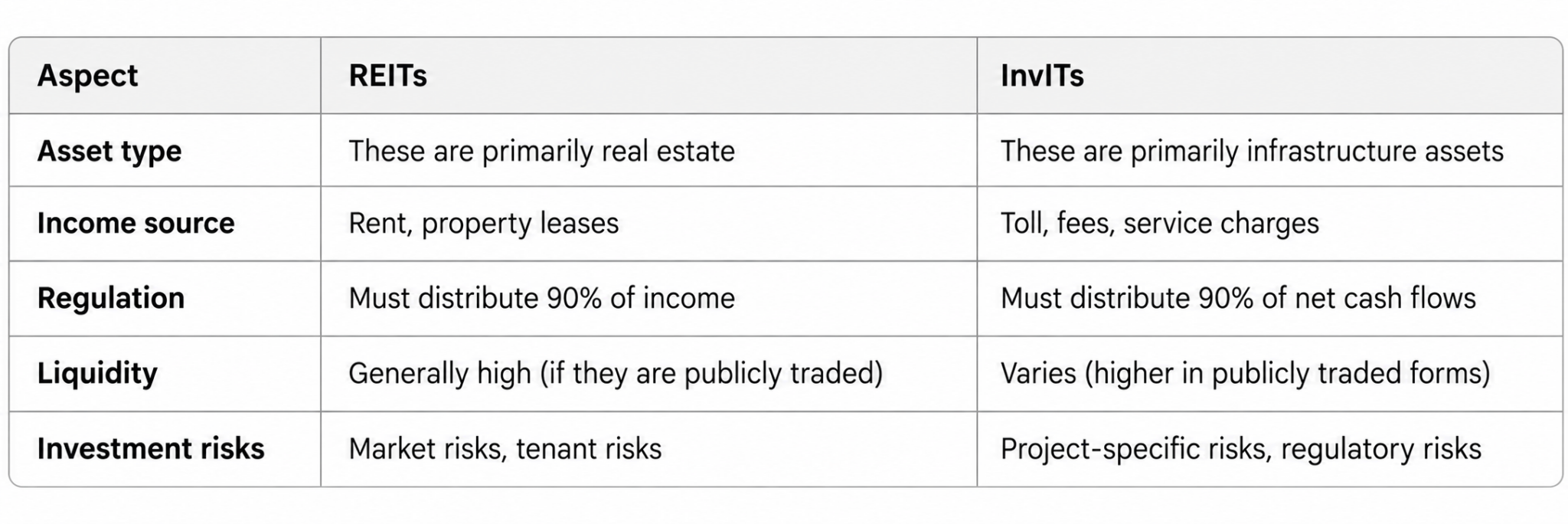
REITs vs InvITs
Infrastructure Investment Trusts (InvITs) are SEBI-regulated pooled investment vehicles, similar to mutual funds, that allow individual and institutional investors to buy units and invest in large, revenue-generating infrastructure assets like highways, power transmission lines, and telecom towers.
Real Estate Investment Trusts Challenges
Real Estate Investment Trusts (REITs), despite their contribution to real-estate financing and capital-market deepening, face challenges related to interest rates, occupancy, liquidity, valuation, concentration and regulatory risks.
- Interest Rate Risk: Rising interest rates can make fixed-income instruments relatively more attractive and increase REIT borrowing costs, potentially affecting valuations and investor demand.
- Occupancy & Rental Risk: Lower occupancy, tenant defaults, lease expiries and subdued rental growth can adversely affect rental revenues and distributable cash flows.
- Liquidity Risk: Although listed units are tradable, relatively lower market depth compared with mainstream equities can make large or rapid exits more difficult.
- Regulatory & Taxation Risk: Changes in regulations, tax policies, land-use norms, SEZ rules or other real-estate policies may affect REIT cash flows and investor returns.
- Valuation Risk: Long-term real estate valuation depends on assumptions relating to rental growth, occupancy, capitalisation rates, interest rates and asset life, creating scope for valuation uncertainty.
- Concentration Risk: India's listed Real Estate Investment Trusts market remains substantially oriented towards commercial office assets, creating exposure to changes in office demand, corporate leasing and hybrid-work patterns.
- Leverage & Refinancing Risk: Higher borrowing, even within regulatory limits, can increase debt-servicing obligations and refinancing risks, particularly during tighter financial conditions.
- Limited Retail Participation: Despite the expansion of listed REITs and SM REITs, limited investor awareness, product complexity and risk perceptions may constrain wider retail participation.
Real Estate Investment Trusts Way Forward
India's Real Estate Investment Trusts market should focus on market deepening, diversification, capital recycling and stronger investor protection.
- Deepen Institutional Participation: Encourage greater participation by pension funds, insurers, mutual funds and other long-term investors to provide stable capital.
- Improve Market Liquidity: Broaden the investor base and strengthen market depth and price discovery to facilitate easier entry and exit.
- Diversify Asset Classes: Expand suitable Real Estate Investment Trusts structures beyond office and retail into warehousing, logistics, data centres, healthcare and rental housing, subject to viability.
- Mainstream SM REITs: Strengthen the 2024 SM REIT framework to develop regulated fractional real estate investment while maintaining robust investor safeguards.
- Strengthen Disclosure & Transparency: Standardise reporting on occupancy, lease expiries, valuation, debt, NDCF and ESG risks for better investor decision-making.
- Promote Capital Recycling: Use REITs to monetise mature commercial and institutional assets and channel the released capital into new investments.
- Strengthen Risk Management: Maintain prudent leverage, undertake regular stress testing and ensure robust contractual arrangements to safeguard cash flows.
- Leverage REITs for Urban Financing: Explore REIT-based monetisation of suitable public and institutional real estate assets to support urban infrastructure development.
- Balance Growth with Investor Protection: Expand the REIT ecosystem while maintaining strong SEBI oversight, independent valuation, governance and unitholder protection.

 Last updated on Oct, 2026
→ UPSC 2027 Notification will be released on 13 January 2027 at upsconline.nic.in.
→ Check Nobel Prize 2026 Winners List here.
→ Download PIB PRiSM Monthly Magazine 2026 here.
→ Check UPSC Monthly Current Affairs Magazine The Recitals here.
→ Check out the latest UPSC Syllabus here.
→ Download UPSC Model Answers for Mains 2026
→ UPSC Mains Question Paper 2026 is out now for Essay & GS Paper 1, 2, 3 & 4.
→ UPSC Calendar 2027 has been released.
→ Enroll in Vajiram & Ravi’s UPSC Mains Test Series 2027 for structured answer writing practice, expert evaluation, and exam-oriented feedback.
→ Join Vajiram & Ravi’s UPSC Mentorship Program 2027 for personalized guidance, strategy planning, and one-to-one support from experienced mentors.
→ Go through the UPSC Mains Previous Year Papers to enhance your preparation.
→ UPSC has released UPSC Toppers List 2025 with the Civil Services final result on its official website.
→ Also check Best UPSC Coaching in India
Real Estate Investment Trusts FAQs
Q1. Is REIT legal in India?+
Q2. What is the 90% rule for REITs?+
Q3. Can you lose money investing in REITs?+
Q4. Are REITs registered with SEBI?+
Q5. What are the top 3 REITs in India?+
Tags: quest real estate investment trusts upsc economy notes