The Kanva Dynasty was a short-lived ruling house that succeeded the Shunga Dynasty in Magadh, generally dated to approximately 73–28 BCE. Founded by Vasudeva Kanva, it is generally associated with the later phase of Magadhan power. The Kanva rulers continued many existing Magadhan administrative traditions, with the king as the central authority.
Their effective territory appears to have been limited mainly to Magadha and adjoining areas. The dynasty weakened due to its limited territorial base and political challenges, eventually giving way to Satavahana power in the Deccan and ending the Kanva phase of Magadhan rule.
Kanva Dynasty Background
The Kanvas emerged during the post-Mauryan period, following the decline of Shunga authority. By the end of Shunga's rule, the kingdom no longer exercised the extensive control associated with the Mauryan Empire. They exercised their authority mainly over Magadha and its surrounding areas, with Pataliputra remaining an important political centre.
Kanva Dynasty Founder
The Kanva dynasty was founded by Vasudeva Kanva, a Brahmin minister of the last Shunga dynasty ruler, Devabhuti. He overthrew Devabhuti and established the Kanva rule around 73 BCE. His accession marked a transfer of power from the Shungas to the Kanvas in Magadha. However, it did not result in the restoration of a large empire comparable to the Mauryan Empire.
Kanva Dynasty Time Period
The dynasty is commonly dated to approximately 73–28 BCE, covering about 45 years. The dynasty had four rulers. Their brief, 45-year reign ended when the Satavahana Dynasty conquered their territory.
Kanva Dynasty Capital
Pataliputra, near modern Patna in Bihar, is traditionally identified as the capital of the Kanvas. This association follows the literary tradition placing the dynasty in Magadha. Vidisha, in present-day Madhya Pradesh, is also discussed in connection with the Kanvas because of coin finds associated with the dynasty.
Kanva Dynasty Rulers
The dynasty had four rulers, who succeeded the Shungas and ruled Magadha for a relatively short period. Much of the information about them comes from the Puranic tradition.
- Vasudeva Kanva: Founder of the dynasty; he overthrew the last Shunga ruler, Devabhuti, and established Kanva rule.
- Bhumimitra: Successor of Vasudeva; Puranic accounts associate him with a long reign and continued Kanva authority in Magadha.
- Narayana: Succeeded Bhumimitra and maintained the dynasty's rule during its later phase.
- Susarman: The last ruler of Kanva dynasty; his reign marked the end of Kanva power, after which the Satavahanas/Andhras emerged as a major political force.


Kanva Dynasty Map and Geographical Extent
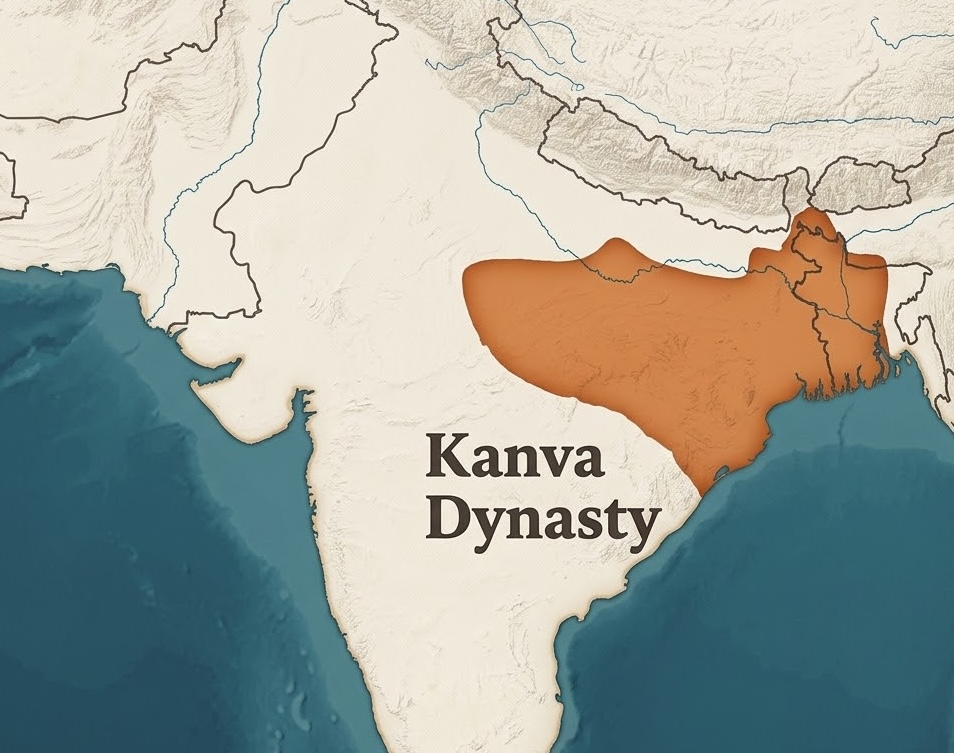
The Kanvas had a relatively limited territorial extent, centred on Magadha in present-day Bihar. Pataliputra remained an important centre of power, while Kanva influence extended into parts of eastern and central India.
- Archaeological and numismatic evidence, particularly Kanva coins found in regions such as Vidisha, suggests that their political or cultural influence reached beyond the core Magadhan territory.
- However, the exact boundaries of the Kanva kingdom remain uncertain because the available historical evidence is limited.
Kanva Dynasty Contemporary Powers
Kanva's contemporaries included powers in northern, western, and southern India, as well as Indo-Greek and other foreign-origin kingdoms in the northwest.
- Indo-Greeks: The Indo-Greek Kingdom controlled parts of northwestern India and interacted with Indian kingdoms during the post-Mauryan period.
- Sakas (Indo-Scythians): Expanded into western and northwestern India, becoming an important regional power.
- Satavahanas (Andhras): Satavahanas emerged as a major power in the Deccan and are traditionally associated with the overthrow of the Kanvas.
Kanva Dynasty Administration
The Kanva administration was monarchical and centred on Magadha, with political authority concentrated in the ruler and the capital at Pataliputra. As the Kanvas ruled a relatively limited territory, their administration appears to have largely continued earlier Shunga-Magadhan practices rather than introducing a distinct administrative system.
Kanva Dynasty Economy
The Kanva economy was primarily agrarian, supported by cultivation, local trade, and craft production in the Magadhan region. The dynasty inherited economic practices from the preceding Shunga period, while coins and archaeological remains provide evidence of monetary circulation and commercial activity.
- Agriculture: Farming remained the principal economic activity, particularly in the fertile Gangetic plains around Magadha.
- Trade and Commerce: The location of Magadha on important land and river routes supported regional trade and movement of goods.
- Coinage: Kanva coins provide important evidence of monetary transactions and the circulation of currency during the period.
Kanva Dynasty Religion
The Kanvas were a Brahmanical dynasty and followed a religious policy broadly similar to that of the Shungas. Vedic religion and traditions received royal encouragement during their rule.
- Vedic religion: Vedic religion was encouraged, continuing the religious orientation associated with the preceding Shungas.
- Buddhism: Buddhism experienced a decline in royal patronage, but Buddhist institutions and traditions continued to exist during the period.
- Religious continuity: The Kanvas broadly followed the religious policy of the Shungas, rather than establishing a radically different religious order.
Kanva Dynasty Art and Architecture
No distinctive Kanva school of art or major architectural programme can be securely reconstructed from the evidence available. The period falls within a broader phase of continuing artistic development after the Mauryas and Shungas.
- Stupa Development: Existing Buddhist stupas were enlarged and embellished with stone railings, gateways, and sculptural reliefs.
- Narrative Sculpture: Sculptors increasingly used continuous and symbolic reliefs to communicate Buddhist stories and religious themes.
Kanva Dynasty Decline
According to the Puranic accounts, the dynasty ended with the overthrow of its last ruler, Susarman, around 28 BCE, traditionally attributed to the Andhras/Satavahanas, who subsequently emerged as an important power in the Deccan.
- Rise of Satavahanas: The Andhras/Satavahanas became increasingly powerful and are traditionally associated with the overthrow of the Kanvas.
- Political Fragmentation: The post-Mauryan period witnessed the rise of independent regional powers, weakening central authority.
- Weakening of Magadhan Power: Magadha no longer exercised the extensive political dominance it had enjoyed under the Mauryas.

 Last updated on Oct, 2026
→ UPSC 2027 Notification will be released on 13 January 2027 at upsconline.nic.in.
→ Check Nobel Prize 2026 Winners List here.
→ Download PIB PRiSM Monthly Magazine 2026 here.
→ Check UPSC Monthly Current Affairs Magazine The Recitals here.
→ Check out the latest UPSC Syllabus here.
→ Download UPSC Model Answers for Mains 2026
→ UPSC Mains Question Paper 2026 is out now for Essay & GS Paper 1, 2, 3 & 4.
→ UPSC Calendar 2027 has been released.
→ Enroll in Vajiram & Ravi’s UPSC Mains Test Series 2027 for structured answer writing practice, expert evaluation, and exam-oriented feedback.
→ Join Vajiram & Ravi’s UPSC Mentorship Program 2027 for personalized guidance, strategy planning, and one-to-one support from experienced mentors.
→ Go through the UPSC Mains Previous Year Papers to enhance your preparation.
→ UPSC has released UPSC Toppers List 2025 with the Civil Services final result on its official website.
→ Also check Best UPSC Coaching in India
Kanva Dynasty FAQs
Q1. Who defeated the Kanva dynasty?+
Q2. Who founded the Kanva dynasty?+
Q3. Who killed Susharma in the Kanva dynasty?+
Q4. Which caste did the Kanva dynasty belong to?+
Q5. Who killed the last ruler of the Kanva dynasty?+
Tags: kanva dynasty quest upsc ancient history notes