Samagra Shiksha Abhiyan is the Government of India’s flagship integrated school-education scheme, covering the entire continuum from pre-school to Class XII. Launched in 2018, it subsumed Sarva Shiksha Abhiyan (SSA), Rashtriya Madhyamik Shiksha Abhiyan (RMSA) and Teacher Education to move from fragmented, stage-specific interventions towards a holistic school-education framework.
Aligned with NEP 2020, the Samagra Shiksha Abhiyan focuses not merely on enrolment but on access, equity, inclusion, foundational learning, quality, learning outcomes, teacher development, vocational education and infrastructure. It also provides the implementation framework for major interventions such as NIPUN Bharat. Its effectiveness, however, depends heavily on State-level capacity, timely fund utilisation, teacher availability, decentralised planning and robust monitoring.
Samagra Shiksha Abhiyan Overview
Samagra Shiksha Abhiyan is an integrated centrally sponsored scheme for school education, launched in 2018 to ensure a holistic and continuous approach to education from pre-school to Class XII.
- Samagra Shiksha Abhiyan was launched in 2018 by the then Ministry of Human Resource Development and is currently implemented by the Ministry of Education, Department of School Education & Literacy (DoSEL).
- Nature: The Samagra Shiksha Abhiyan is an integrated centrally sponsored scheme covering the school-education continuum from pre-school to Class XII, including government and government-aided schools.
- Subsumed Schemes: The Samagra Shiksha Abhiyan brought together Sarva Shiksha Abhiyan (SSA), Rashtriya Madhyamik Shiksha Abhiyan (RMSA) and Teacher Education, thereby reducing fragmentation across different stages of schooling.
- Funding Pattern: The Centre–State sharing ratio is generally 60:40 for most States and Union Territories with legislatures, 90:10 for the specified North-Eastern and Himalayan States/UTs, and 100% Central funding for Union Territories without legislatures
- Continuation and Current Developments: The Samagra Shiksha Abhiyan was continued for 2021–22 to 2025–26 and realigned with the priorities of NEP 2020.
- In January 2026, the Ministry of Education initiated consultations on Samagra Shiksha 3.0 to strengthen school governance, infrastructure, teacher capacity, student entitlements and outcome-based learning.
- The Union Budget 2026–27 also increased the scheme’s allocation over the Budget Estimate for 2025–26.
- Scale: Samagra Shiksha Abhiyan covers approximately 11.68 lakh government and government-aided schools, 15.62 crore students and 57.67 lakh teachers, highlighting its extensive reach across the school-education system.
- NIPUN Bharat: Launched in 2021 for Foundational Literacy and Numeracy (FLN), it operates within the broader Samagra Shiksha Abhiyan framework.
Samagra Shiksha Abhiyan Objectives
Samagra Shiksha Abhiyan aims to ensure equitable, inclusive and quality school education by addressing gaps in access, infrastructure, learning outcomes and teacher capacity.
- NEP 2020 Implementation: The Samagra Shiksha Abhiyan supports states and UTs in implementing NEP 2020 recommendations across the school education system.
- Universal Access & Retention: The Samagra Shiksha Abhiyan seeks to ensure universal access to schooling, reduce dropout and facilitate completion of education up to the secondary and senior-secondary levels.
- Foundational Learning: Samagra Shiksha Abhiyan gives priority to Early Childhood Care and Education (ECCE) and Foundational Literacy and Numeracy, particularly through NIPUN Bharat.
- Quality & Learning Outcomes: Samagra Shiksha Abhiyan promotes activity-based, competency-based and holistic learning with greater emphasis on measurable learning outcomes.
- Equity & Inclusion: Samagra Shiksha Abhiyan aims to bridge social and gender gaps and improve educational opportunities for disadvantaged groups, girls and Children with Special Needs (CWSN).
- Teacher Development: Samagra Shiksha Abhiyan strengthens SCERTs, DIETs and teacher-training systems to improve pedagogical capacity and classroom effectiveness.
- Infrastructure & Minimum Standards: Samagra Shiksha Abhiyan supports classrooms, toilets, drinking water, ramps, electricity, laboratories, libraries, computer facilities and other essential infrastructure.
- Vocationalisation: Samagra Shiksha Abhiyan promotes vocational education, practical exposure and skill development to improve employability and career readiness.


Samagra Shiksha Abhiyan Components
Samagra Shiksha Abhiyan adopts a holistic, integrated approach to school education, addressing infrastructure, learning outcomes, inclusion, teacher capacity and skill development.
- Access & Infrastructure: Financial assistance for school buildings, classrooms, toilets, drinking water, ramps, electrification, boundary walls, laboratories, libraries and computer facilities.
- Foundational Literacy & Numeracy: Supports NIPUN Bharat and interventions to develop foundational reading, writing and numeracy skills.
- ECCE: Promotes Early Childhood Care and Education, particularly at the foundational stage before and around entry into formal schooling.
- Gender & Equity: Kasturba Gandhi Balika Vidyalayas (KGBVs) provide residential schooling support to girls from disadvantaged communities.
- Inclusive Education: Supports Children with Special Needs (CWSN) through accessible infrastructure, assistive resources and inclusive learning arrangements.
- Teacher Education: Strengthens professional development through SCERTs, DIETs and other teacher-education institutions.
- Digital Education: Supports Information and Communication Technology and digital-learning initiatives for technology-enabled teaching and learning.
- Vocational Education: Promotes skill-based courses, practical exposure and integration of vocational education with mainstream schooling.
- RTE Entitlements: Supports free textbooks, uniforms and other entitlements for eligible students.
- Sports & Physical Education: Promotes sports, physical education and holistic development as integral parts of schooling.
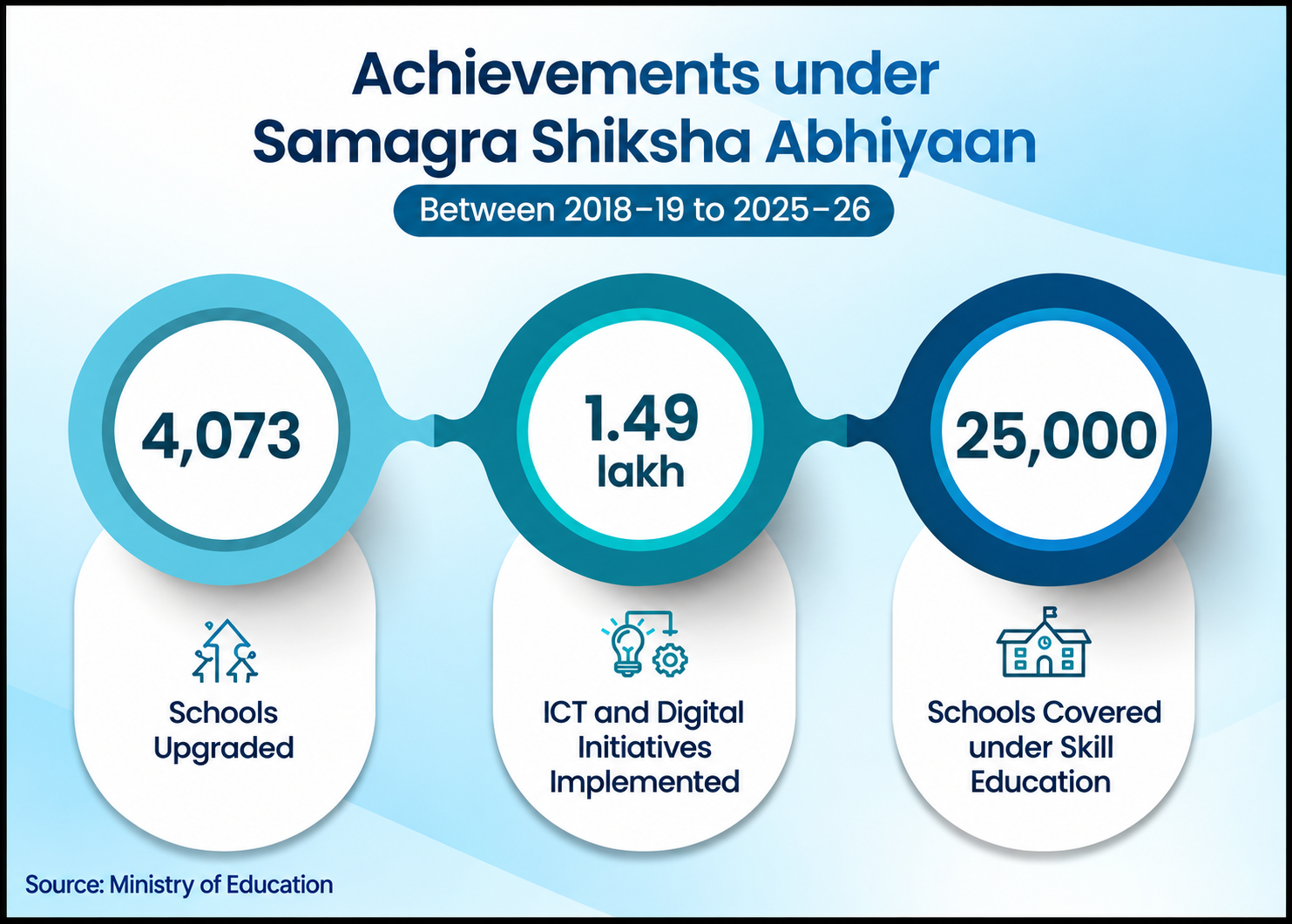
Samagra Shiksha Abhiyan Challenges
Samagra Shiksha Abhiyan faces implementation, financial and institutional challenges that limit its impact on equitable and quality school education.
- Teacher Shortage: Around 10 lakh teacher posts were reported vacant in Samagra Shiksha-funded schools nationally, including approximately 7.5 lakh at the elementary/primary level, creating a major constraint on learning outcomes.
- Unequal Teacher Deployment: CAG findings in West Bengal highlighted single-teacher schools and schools without teachers, along with deployment imbalances, indicating that recruitment must be matched with rational teacher distribution.
- Poor Fund Utilisation: A CAG audit of Odisha’s school education system for 2018–19 to 2022–23 reported that utilisation of funds under Samagra Shiksha ranged between 44% and 50%.
- The audit also highlighted substantial budget surrenders at the broader departmental level, indicating weaknesses in financial planning and implementation.
- Dropout & Socio-economic Barriers: A CAG field survey of 581 out-of-school children in West Bengal found that 53% of surveyed parents cited financial distress as a reason for withdrawal, with early marriage and the desire for early earnings also contributing.
- Weak Decentralised Planning: CAG found that mandated district and block-level planning teams were not constituted in Odisha, weakening the intended bottom-up approach to Samagra Shiksha planning.
- Delayed Delivery of Entitlements: Delays in the distribution of textbooks and uniforms have affected students despite funds being available, pointing to weaknesses in procurement, distribution and accountability.
- Centre–State Coordination Issues: Differences between the Union Government and some States over PM SHRI-linked conditions and funding have created implementation challenges for Samagra Shiksha in certain States.
Samagra Shiksha Abhiyan Way Forward
The way forward should focus on strengthening implementation capacity, improving accountability and ensuring equitable access to quality education.
- Time-bound Recruitment: Vacant teacher positions should be filled through permanent and time-bound recruitment, while excessive dependence on contractual appointments should be reduced.
- Rational Teacher Deployment: Teacher deployment should be aligned with RTE pupil-teacher ratio norms, correcting the coexistence of single-teacher schools with surplus staffing elsewhere.
- Improve Fund Utilisation: States should strengthen financial planning, expenditure monitoring and accountability to ensure that approved funds translate into timely educational interventions.
- Strengthen Decentralised Planning: District and block-level planning structures should be made fully functional to ensure participatory, bottom-up and locally responsive Annual Work Plans.
- Strengthen Monitoring: More frequent school inspections, digital monitoring and outcome-based reviews should be used to identify implementation gaps and ensure timely corrective action.
- Ensure Timely Entitlements: Clear deadlines and accountability mechanisms should be established for the printing and distribution of textbooks, uniforms and other student entitlements.
- Strengthen Vocational Education: Adequate instructors, functional laboratories and a wider range of vocational subjects should be provided in accordance with NEP 2020.
- Address Dropout Causes: Infrastructure interventions should be complemented with financial, social and community support addressing poverty, early marriage and pressure for early employment.

 Last updated on Oct, 2026
→ UPSC 2027 Notification will be released on 13 January 2027 at upsconline.nic.in.
→ Check Nobel Prize 2026 Winners List here.
→ Download PIB PRiSM Monthly Magazine 2026 here.
→ Check UPSC Monthly Current Affairs Magazine The Recitals here.
→ Check out the latest UPSC Syllabus here.
→ Download UPSC Model Answers for Mains 2026
→ UPSC Mains Question Paper 2026 is out now for Essay & GS Paper 1, 2, 3 & 4.
→ UPSC Calendar 2027 has been released.
→ Enroll in Vajiram & Ravi’s UPSC Mains Test Series 2027 for structured answer writing practice, expert evaluation, and exam-oriented feedback.
→ Join Vajiram & Ravi’s UPSC Mentorship Program 2027 for personalized guidance, strategy planning, and one-to-one support from experienced mentors.
→ Go through the UPSC Mains Previous Year Papers to enhance your preparation.
→ UPSC has released UPSC Toppers List 2025 with the Civil Services final result on its official website.
→ Also check Best UPSC Coaching in India
Samagra Shiksha Abhiyan FAQs
Q1. When was Samagra Shiksha launched?+
Q2. What is the coverage of Samagra Shiksha?+
Q3. What is the funding pattern of Samagra Shiksha?+
Q4. How does Samagra Shiksha support NEP 2020?+
Q5. What are the major challenges of Samagra Shiksha?+
Tags: quest samagra shiksha abhiyan UPSC Social Justice Notes