The Ayushman Bharat Digital Mission (ABDM) represents India's effort to build a technology-enabled and interoperable healthcare ecosystem through Digital Public Infrastructure (DPI). It seeks to address the fragmentation of health information, improve continuity of care and enable secure exchange of health records across healthcare providers and institutions. The mission builds upon India's wider digital-governance architecture and aims to make healthcare delivery more accessible, efficient, inclusive, affordable and patient-centric.
By creating common digital registries, health identities and consent-based mechanisms for information exchange, Ayushman Bharat Digital Mission (ABDM) seeks to reduce organisational and geographical silos in healthcare. Its significance extends beyond digitisation of records, as it provides the institutional and technological architecture for data-driven healthcare, portability of services, better health governance and improved coordination between citizens, providers and policymakers.
Ayushman Bharat Digital Mission Background
The Ayushman Bharat Digital Mission emerged from India's broader efforts to use digital technology to address structural weaknesses in healthcare delivery. Its evolution reflects a gradual shift from fragmented health-information systems towards an integrated and interoperable digital-health architecture.
- National Health Policy, 2017: The National Health Policy, 2017, articulated the need for a National Digital Health Authority to regulate, develop and deploy digital health across the continuum of care and promote an integrated health-information system.
- J. Satyanarayana Committee: The Ministry of Health and Family Welfare constituted the J. Satyanarayana Committee to develop an implementation framework for the National Health Stack, which contributed to the preparation of the National Digital Health Blueprint (NDHB).
- National Digital Health Mission Pilot: The National Digital Health Mission (NDHM) was initially piloted from 15 August 2020 in six Union Territories.
- Rebranding: NDHM was subsequently renamed the Ayushman Bharat Digital Mission (ABDM) to align the initiative with the broader Ayushman Bharat framework.
- National Rollout: ABDM was launched nationwide on 27 September 2021, transforming the earlier pilot into a national digital-health programme.
Ayushman Bharat Digital Mission Objectives
The objectives of Ayushman Bharat Digital Mission (ABDM) extend beyond merely digitising health records and seek to establish an integrated ecosystem that improves healthcare delivery, governance and accessibility.
- Digital Health Infrastructure: Ayushman Bharat Digital Mission (ABDM) seeks to establish state-of-the-art digital health systems capable of managing core health data and facilitating its seamless exchange.
- Creation of Registries: Ayushman Bharat Digital Mission (ABDM) aims to establish digital registries for health facilities, healthcare professionals, health workers, drugs and pharmacies, thereby creating reliable sources of information.
- Open Standards: Ayushman Bharat Digital Mission (ABDM) promotes the adoption of open and interoperable standards across digital-health stakeholders.
- Personal Health Records: Ayushman Bharat Digital Mission (ABDM) seeks to establish a system of personal health records that can be accessed by individuals and healthcare providers based on informed consent.
- Health Applications: ABDM encourages the development of enterprise-level digital health applications to strengthen healthcare delivery and support health-related SDGs.
- Cooperative Federalism: ABDM follows the principle of cooperative federalism by working with states and union territories for adoption and implementation of digital-health systems.
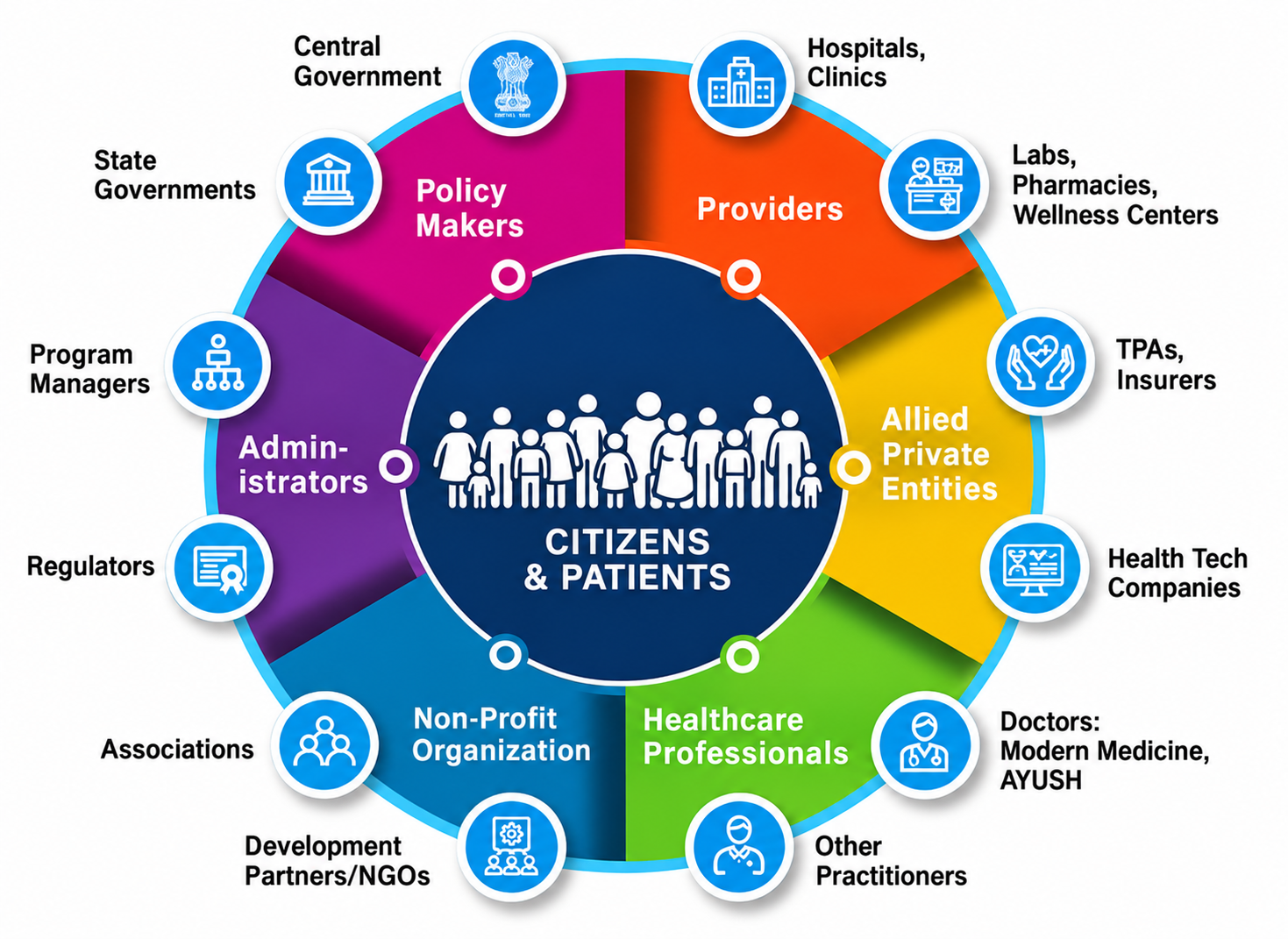
- Private-Sector Participation: ABDM seeks to facilitate participation of private healthcare providers and technology companies alongside public health authorities.
- National Portability: ABDM aims to enable individuals to access and use health services across geographical and institutional boundaries.
- Clinical Decision Support: ABDM promotes the use of Clinical Decision Support systems to help healthcare professionals make better-informed clinical decisions.
- Data-Driven Governance: It seeks to strengthen health-sector management through health-data analytics, research and evidence-based policymaking.
- Governance Efficiency: Ayushman Bharat Digital Mission (ABDM) aims to improve the efficiency and effectiveness of healthcare governance at different levels.
- Quality Assurance: ABDM supports mechanisms for improving and monitoring the quality of healthcare services.
- ABDM also supports a broader commitment to Universal Health Coverage (UHC) by making healthcare delivery more accessible, coordinated and efficient.
- Integration of Existing Systems: ABDM seeks to strengthen existing health-information systems by bringing them into conformity with defined standards and enabling their integration with the ABDM ecosystem.
- The ABDM ecosystem is shown in the diagram below.


Ayushman Bharat Digital Mission Impact
Ayushman Bharat Digital Mission’s (ABDM) impact can be assessed through the expansion of digital health identities, linked health records and participation of healthcare facilities and professionals. The scale-up indicates growing adoption, although the quantity of digital records does not by itself guarantee effective longitudinal healthcare.
- ABHA Creation: The number of ABHA accounts increased from approximately 14.7 crore in 2021 to 30.4 crore in 2022, 50.6 crore in 2023, 72.2 crore in 2024 and 84.5 crore in 2025.
- By around September 2026, ABHA creation had crossed 97.61 crore, indicating rapid expansion of the digital-health identity ecosystem.
- Gender Representation: Women reportedly accounted for approximately 49.75% of ABHA holders, indicating relatively broad participation across genders.
- Saturation: Certain Union Territories, including the Andaman & Nicobar Islands, Ladakh, Lakshadweep and Dadra & Nagar Haveli and Daman & Diu, were reported to have achieved full saturation in ABHA creation.
- Record Linkage: Health records linked with ABHA increased from approximately 50 crore in February 2025 to 67.19 crore in August 2025 and subsequently crossed 119.95 crore health records as of 17 September 2026.
- The pace of record linkage indicates accelerating adoption, with the number of linked records reportedly increasing by nearly 10 crore every two to three months.
- Digital Ecosystem: More than 450 public and private health-tech solutions have reportedly integrated with the ABDM ecosystem, expanding its reach across healthcare platforms.
- Health Facilities: As of September 2026, approximately 5.78 lakh health facilities had been registered in the Health Facility Registry.
- Healthcare Professionals: Around 11 lakh healthcare professionals had been registered in the Health Professional Registry during the same period as of September 2026.
Ayushman Bharat Digital Mission Challenges
Ayushman Bharat Digital Mission (ABDM) faces challenges in achieving widespread awareness, user trust, equitable access and effective integration across India's diverse healthcare ecosystem.
- Limited Public Awareness and Outreach: Many citizens have limited understanding of ABDM and often confuse it with AB PMJAY, indicating inadequate awareness of its purpose and benefits.
- Compared with AB PMJAY, ABDM has received relatively limited public-facing promotion, making it difficult to communicate its role in digitising health records and enabling an integrated digital-health ecosystem.
- Data Privacy Concerns: Participants expressed apprehension about sharing sensitive health information, particularly records relating to mental health and other highly personal medical conditions, even when digital safeguards are provided.
- Trust Deficit: Concerns that no digital system can guarantee complete protection against data breaches can discourage citizens from adopting ABDM and sharing their health information.
- Aadhaar-Related Concerns: Some users are hesitant to use ABDM applications because of concerns surrounding Aadhaar linkage and the sharing of personal information, reflecting the need for greater transparency and trust.
- Low Perceived Necessity: Individuals who rarely require healthcare services may not consider ABDM applications essential, resulting in need-based rather than sustained adoption.
- State-Level Variation: Differences between State and Central healthcare schemes can create confusion regarding eligibility, entitlements and access, while uneven implementation can produce varying user experiences across States.
- Digital Divide: Limited digital literacy, connectivity, and access to devices can prevent vulnerable and digitally excluded populations from fully benefiting from ABDM.
Ayushman Bharat Digital Mission Way Forward
ABDM should focus on building public trust and ensuring inclusive adoption rather than merely expanding digital infrastructure. This requires stronger awareness, privacy safeguards, user-centric design and wider digital inclusion.
- Strengthen Public Awareness: Conduct wider public campaigns to clearly explain the purpose, features and benefits of ABDM, similar to the awareness campaigns undertaken for AB-PMJAY.
- Leverage widely used social media platforms to disseminate information about ABDM and reach diverse population groups.
- Also, use schools and colleges as channels for spreading awareness about digital health and ABDM, particularly among younger populations.
- Improve Data-Privacy Safeguards: Strengthen data-protection mechanisms and clearly communicate how sensitive health information is secured and used.
- Ensure Transparent Consent: Provide clear information about consent and give users greater control over the sharing of their health records.
- Build User Trust: Address concerns around Aadhaar linkage, data security and potential misuse of health information through transparent communication and stronger safeguards.
- Demonstrate Tangible Benefits: Communicate the practical advantages of ABDM - such as portable health records, easier record management and continuity of care - to improve perceived usefulness and adoption.
Ayushman Bharat Digital Mission UPSC PYQs
Q1. With reference to Ayushman Bharat Digital Mission, consider the following statements: (UPSC Prelims 2022)
- Private and public hospitals must adopt it.
- As it aims to achieve universal health coverage, every citizen of India should be part of it ultimately.
- It has seamless portability across the country.
Which of the statements given above is/are correct?
(a) 1 and 2 only
(b) 3 only
(c) 1 and 3 only
(d) 1, 2 and 3
Ans: (b)

 Last updated on Oct, 2026
→ UPSC 2027 Notification will be released on 13 January 2027 at upsconline.nic.in.
→ Check Nobel Prize 2026 Winners List here.
→ Download PIB PRiSM Monthly Magazine 2026 here.
→ Check UPSC Monthly Current Affairs Magazine The Recitals here.
→ Check out the latest UPSC Syllabus here.
→ Download UPSC Model Answers for Mains 2026
→ UPSC Mains Question Paper 2026 is out now for Essay & GS Paper 1, 2, 3 & 4.
→ UPSC Calendar 2027 has been released.
→ Enroll in Vajiram & Ravi’s UPSC Mains Test Series 2027 for structured answer writing practice, expert evaluation, and exam-oriented feedback.
→ Join Vajiram & Ravi’s UPSC Mentorship Program 2027 for personalized guidance, strategy planning, and one-to-one support from experienced mentors.
→ Go through the UPSC Mains Previous Year Papers to enhance your preparation.
→ UPSC has released UPSC Toppers List 2025 with the Civil Services final result on its official website.
→ Also check Best UPSC Coaching in India
Ayushman Bharat Digital Mission FAQs
Q1. What is ABDM?+
Q2. When was the Ayushman Bharat Digital Mission launched?+
Q3. What is ABHA?+
Q4. Is ABHA mandatory?+
Q5. Are ABHA records safe?+
Tags: ayushman bharat digital mission quest UPSC Social Justice Notes