Universal Health Coverage (UHC) seeks to ensure that every individual can access quality promotive, preventive, curative, rehabilitative and palliative healthcare without suffering financial hardship. It is a core component of SDG 3.8 and rests on three interlinked dimensions of population coverage, service coverage and financial protection. In India, Universal Health Coverage is significant given the coexistence of a large disease burden, high out-of-pocket expenditure and substantial rural-urban and interstate disparities in healthcare access.
India has progressively moved towards UHC through initiatives such as the National Health Mission, etc., while recent National Health Accounts indicate a decline in Out-of-Pocket Expenditure (OOPE). However, inadequate public financing, workforce shortages and limited coverage of outpatient services continue to constrain universal and equitable healthcare.
Universal Health Coverage Overview
Universal Health Coverage is not merely insurance coverage; it represents a broader health-system goal of ensuring equitable access to comprehensive, quality healthcare with adequate financial protection.
- Definition: Universal Health Coverage means that all individuals and communities receive the health services they need, of sufficient quality, without being pushed into financial hardship.
- Sustainable Development Goals (SDGs): Universal Health Coverage is embedded in SDG Target 3.8, which seeks universal access to essential health services, financial risk protection and affordable medicines and vaccines.
- Population coverage: Universal Health Coverage seeks to ensure that all sections of society, particularly vulnerable and disadvantaged groups, are included in the healthcare system.
- Service coverage: It encompasses the entire continuum of care, including promotive, preventive, curative, rehabilitative and palliative services.
- Financial protection: Healthcare should be financed in a manner that prevents catastrophic and impoverishing out-of-pocket expenditure.
- Quality and equity: Coverage must translate into accessible, affordable, quality and equitable care, rather than merely enrolment in an insurance scheme.
- Monitoring: SDG monitoring uses the UHC Service Coverage Index (3.8.1) and the indicator on financial hardship due to health spending (3.8.2).
Universal Health Coverage Day
Universal Health Coverage Day is observed annually on 12 December to highlight the importance of universal access to quality healthcare and financial protection. It provides a global platform to advocate for health systems that leave no one behind.
- Origin: The day commemorates the 2012 United Nations resolution calling for accelerated progress toward universal health coverage.
- Significance: It highlights health inequalities, the financial hardship caused by medical expenditure, and gaps in access to essential health services.


Universal Health Coverage Evolution
The evolution of UHC reflects a gradual shift from the idea of “Health for All” through primary healthcare towards an integrated framework combining universal access, quality services and financial protection.
Global Evolution
- Alma-Ata Declaration (1978): The Alma-Ata Declaration placed comprehensive primary healthcare and the goal of “Health for All” at the centre of global health policy.
- WHA Resolution (2005): The World Health Assembly formally endorsed universal coverage of health services with financial risk protection, giving UHC greater global policy recognition.
- WHO World Health Report (2010): The World Health Organisation highlighted stronger public financing, improved tax efficiency, innovative financing and development assistance as important pathways towards universal health coverage.
- HLEG on UHC (2011): India’s High Level Expert Group proposed principles including universality, equity, comprehensiveness, financial protection, quality, accountability and continuity of care.
- SDGs (2015): Universal Health Coverage was formally incorporated into the 2030 Sustainable Development Agenda through SDG Target 3.8.
- UN High-Level Meeting (2019): The UN reaffirmed universal health coverage as a critical component of sustainable development and called for accelerated global action.
- Revised monitoring framework (2025): The UN Statistical Commission approved a revised global UHC monitoring framework centred on service coverage and financial protection.
India Evolution
India's approach has progressively expanded from strengthening public-health infrastructure towards integrated primary care, financial protection and digital health systems.
- Bhore Committee (1946): The Bhore Committee in India provided an early blueprint for a publicly financed and comprehensive health system and is regarded as an important conceptual precursor to UHC in the Indian context.
- NRHM/NHM (2005): The National Rural Health Mission, later expanded into the National Health Mission, strengthened public-health infrastructure, human resources and service delivery.
- RSBY (2008): The Rashtriya Swasthya Bima Yojana introduced large-scale government-supported health insurance for poor households, although its impact on OOPE remained limited.
- National Health Policy (2017): The policy adopted an explicit UHC orientation and set a target of increasing public health expenditure to 2.5% of GDP.
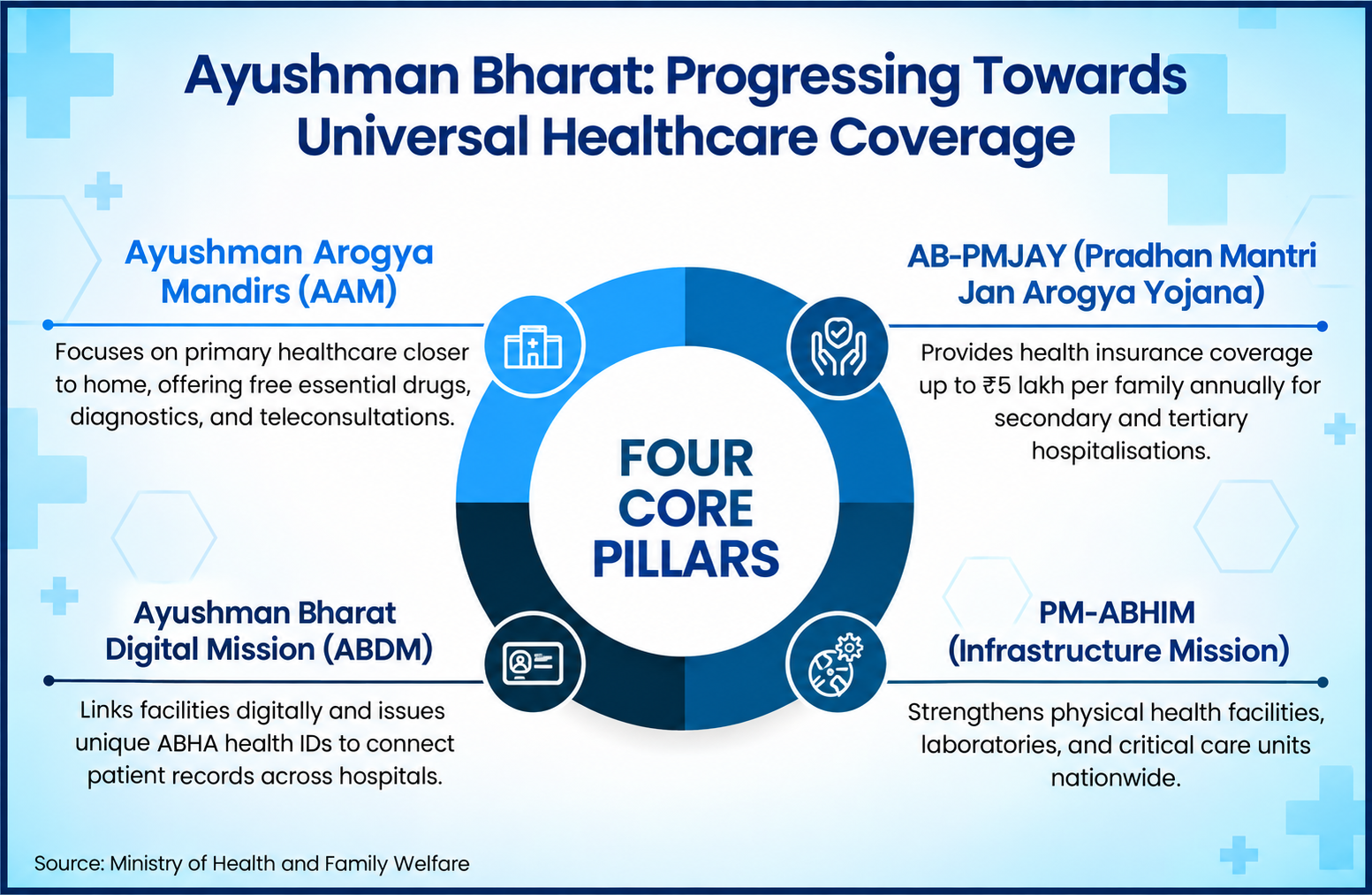
- Ayushman Bharat (2018): Ayushman Bharat introduced two complementary pillars, namely Ayushman Arogya Mandirs for comprehensive primary care and PM-JAY for hospitalisation-based financial protection.
- ABDM (2020 onwards): The Ayushman Bharat Digital Mission sought to create interoperable digital health infrastructure through health IDs, electronic health records and digital health services.
Universal Health Coverage and India’s Initiatives
India has adopted a multi-dimensional approach to UHC, combining primary healthcare, financial protection, health-system strengthening and digital health rather than relying on insurance alone.
- National Health Mission (NHM): NHM, comprising National Rural Health Mission (NRHM) and National Urban Health Mission (NUHM), strengthens public health infrastructure, human resources and delivery of affordable and equitable primary and secondary healthcare, particularly for vulnerable populations.
- The Accredited Social Health Activist (ASHA) scheme is a national public health initiative launched in 2005 under the NHM that acts as a crucial link between rural and urban communities and the public health system.
- National Health Policy (NHP), 2017: The policy provides the broader UHC framework by emphasising universal access to affordable and quality healthcare and targeted public health expenditure of 2.5% of GDP.
- Ayushman Bharat: Launched in 2018 with an explicit UHC objective, Ayushman Bharat follows a continuum-of-care approach by integrating comprehensive primary healthcare with financial protection for secondary and tertiary care.
- Ayushman Arogya Mandirs (AAMs): Formerly Health and Wellness Centres, AAMs upgrade Sub-Centres and Primary Healthcare Centres to provide universal and free comprehensive primary healthcare, including NCD care, mental health, oral and eye care, rehabilitation, palliative care, essential drugs and diagnostics.
- Ayushman Bharat–PM-JAY: PM-JAY provides ₹5 lakh per family per year for secondary and tertiary hospitalisation, offering cashless and portable financial protection to eligible poor and vulnerable households, with the scheme also extended to all citizens aged 70 years and above.
- Ayushman Bharat Digital Mission (ABDM): ABDM seeks to build an interoperable digital health ecosystem through digital health records and connected health infrastructure, improving continuity and portability of care.
- Pradhan Mantri Ayushman Bharat Health Infrastructure Mission (PM-ABHIM): Launched in 2021, PM-ABHIM strengthens health infrastructure, disease surveillance, critical-care capacity and public-health preparedness across primary, secondary and tertiary levels.
- e-Sanjeevani: The national telemedicine service expands access to specialist consultations and healthcare services in remote and underserved areas, helping bridge geographical barriers to care.
Universal Health Coverage Significance
Universal Health Coverage is important not only for improving health outcomes but also for advancing social justice, poverty reduction, human capital and national resilience.
- National Health Accounts (NHA 2022-23): According to NHA 2022–23, Government Health Expenditure was 1.43% of GDP (1.48% using the new GDP series), while its share in Total Health Expenditure was 43.7%.
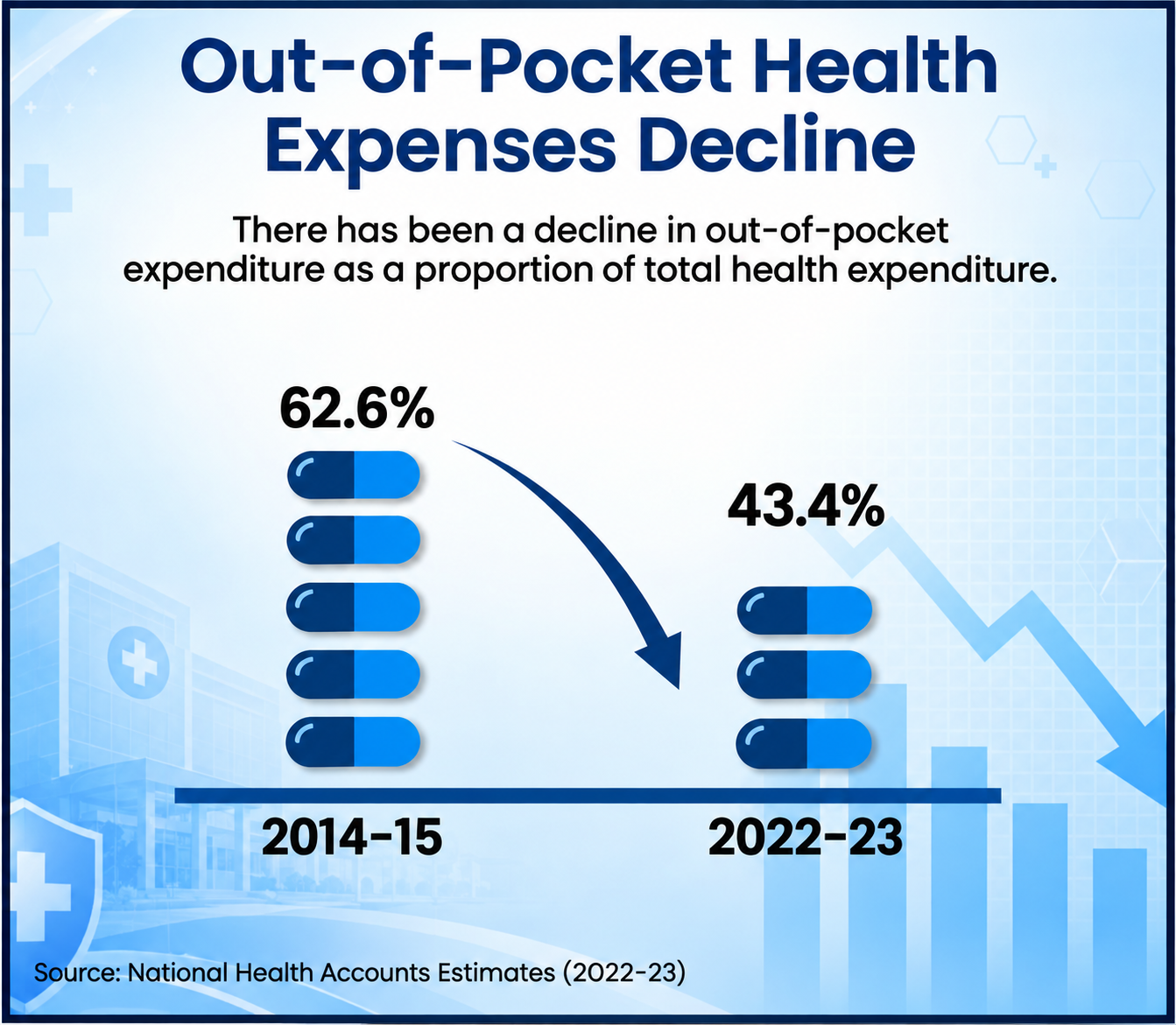
- Also, OOPE has declined substantially over the longer term, from 62.6% of total health expenditure in 2014-15 to 43.4% in 2022-23, although it increased from 39.4% in 2021-22.
- Health equity: Universal Health Coverage reduces healthcare inequalities by ensuring that access is determined by health needs rather than income, geography or social status.
- Poverty reduction: Financial protection prevents medical expenditure from pushing households into poverty, with around 2.1 billion people globally facing financial hardship from health spending in 2022.
- Human capital: A healthier population improves productivity, learning outcomes and labour-force participation while reducing income losses caused by illness.
- Health security: Strong and universal health systems strengthen the capacity to detect, prevent and respond to epidemics and pandemics.
- Social justice: UHC operationalises the principle that essential healthcare should be available to everyone without discrimination based on their ability to pay.
- Constitutional significance: The Supreme Court of India has interpreted the right to health as an aspect of the right to life under Article 21, while Article 47 directs the State to improve public health and nutrition.
- Attaining SDGs: UHC acts as an accelerator for multiple other global sustainable development goals described in points below.
- End Poverty (SDG 1): Protects families from being impoverished or pushed deeper into poverty by catastrophic medical bills.
- Zero Hunger (SDG 2): Good health allows parents to work and provide adequate nutrition, reducing malnutrition and stunting.
- Gender Equality (SDG 5): Empowers women and girls through reliable access to reproductive and maternal health services.
- Decent Work and Economic Growth (SDG 8): A healthy workforce reduces absenteeism, boosts productivity, and builds sustainable human capital.
- Reduced Inequalities (SDG 10): Bridges the healthcare gap for marginalised, rural, and low-income populations, embodying the UN promise to "leave no one behind".
- Fiscal efficiency: A well-regulated healthcare system can improve resource allocation and use regulation and competition to improve efficiency within the large private healthcare sector.
Universal Health Coverage Challenges
Despite significant progress, UHC remains constrained by inadequate financing, unequal access, shortages of health personnel, high OOPE and gaps in the design and regulation of healthcare delivery.
- Inadequate public financing: India’s Government Health Expenditure remains around 1.43–1.48% of GDP (2022–23), below the National Health Policy target of 2.5%, limiting the capacity to provide comprehensive publicly financed healthcare.
- Persistently high out-of-pocket expenditure: Although OOPE has declined substantially to 43.4% of Total Health Expenditure in 2022–23 from 64.2% in 2013–14, expenditure on medicines, diagnostics and outpatient care continues to impose a significant financial burden on households.
- Insurance does not ensure comprehensive financial protection: Hospitalisation-focused schemes such as PM-JAY do not adequately cover routine outpatient care, medicines, diagnostics and long-term treatment, while evidence from Rashtriya Swasthya Bima Yojana (RSBY) also showed that insurance coverage did not substantially reduce OOPE.
- Unequal access and regional disparities: Healthcare access and quality vary significantly across states, rural-urban areas and socioeconomic groups, as qualified health professionals and private healthcare facilities remain disproportionately concentrated in urban and economically developed regions.
- Shortage and maldistribution of health workforce: India continues to face shortages of doctors, nurses and allied health professionals, with substantial rural-urban disparities in health-worker availability, weakening the delivery of quality primary and specialised care.
- Private-sector dominance and weak regulation: The private sector provides a large share of healthcare in India, while regulatory mechanisms remain inadequate to consistently ensure quality, affordability, price transparency and accountability.
- Inadequate primary and outpatient care: The growing burden of NCDs such as diabetes, hypertension and mental health conditions requires continuous outpatient and preventive care, whereas the existing system remains relatively hospitalisation-centric.
- Weaknesses in PPPs and governance: Several public-private healthcare initiatives have faced challenges related to governance, accountability, sustainability and quality, demonstrating that PPPs alone cannot substitute for strong public health-system capacity.
- Gaps in comprehensive care and measurement: Limited availability of reliable data on rehabilitative, palliative and long-term care makes it difficult to assess the full extent of UHC and design an India-specific measure covering service coverage, financial protection and equity.
- Global progress remains inadequate: Globally, the UHC Service Coverage Index improved from 54 in 2000 to 71 in 2023, but the pace of improvement slowed considerably; around 4.6 billion people were not fully covered by essential health services in 2023, while poorer populations continue to face disproportionately greater financial hardship.
Universal Health Coverage Way Forward
India’s next phase of UHC should shift from coverage expansion to comprehensive, equitable and financially sustainable healthcare, with greater emphasis on primary care and public financing.
- Increase public financing and financial protection: India should raise public health expenditure towards the NHP-2017 target of 2.5% of GDP and expand coverage of outpatient care, medicines and diagnostics to reduce OOPE.
- Thailand’s tax-funded Universal Coverage Scheme demonstrates the effectiveness of strong public financing and risk pooling.
- Make primary healthcare the foundation: Ayushman Arogya Mandirs should provide comprehensive preventive, promotive and NCD care, with effective referral linkages to PM-JAY hospitals.
- Rwanda’s community-based healthcare model and frontline health workers offer a useful example of taking essential services closer to underserved populations.
- Strengthen health workforce and regulation: India should expand and equitably distribute doctors, nurses and allied health professionals while strengthening regulation of private providers to ensure quality, affordability and accountability.
- Use digital and data systems for equity: ABDM, telemedicine and interoperable health records should be scaled to improve continuity and portability of care, while UHC monitoring should measure service coverage, financial protection, quality and equity, rather than insurance enrolment alone.
- Promote cooperative federalism: The Union and States should coordinate on financing, standards, workforce deployment and service delivery, with greater attention to rural, poor and otherwise underserved populations to reduce regional inequalities.
Universal Health Coverage UPSC PYQs
Q1. Consider the following pairs (UPSC Prelims 2020)
|
Sl. No. |
International agreement/set-up |
Subject |
|
1. |
Alma-Ata Declaration |
Healthcare of the people |
|
2. |
Hague Convention |
Biological and chemical weapons |
|
3. |
Talanoa Dialogue |
Global climate change |
|
4. |
Under2 Coalition |
Child rights |
Which of the pairs given above is/are correctly matched?
(a) 1 and 2 only
(b) 4 only
(c) 1 and 3 only
(d) 2, 3 and 4 only.
Ans: (c)

 Last updated on Sep, 2026
→ UPSC 2027 Notification will be released on 13 January 2027 at upsconline.nic.in.
→ Asian Games 2026 are being held in Aichi-Nagoya, Japan, from 19 September to 4 October.
→ Check out the latest UPSC Syllabus here.
→ Download UPSC Model Answers for Mains 2026
→ UPSC Mains Question Paper 2026 is out now for Essay & GS Paper 1, 2, 3 & 4.
→ UPSC Calendar 2027 has been released.
→ Enroll in Vajiram & Ravi’s UPSC Mains Test Series 2027 for structured answer writing practice, expert evaluation, and exam-oriented feedback.
→ Join Vajiram & Ravi’s UPSC Mentorship Program 2027 for personalized guidance, strategy planning, and one-to-one support from experienced mentors.
→ Go through the UPSC Mains Previous Year Papers to enhance your preparation.
→ UPSC has released UPSC Toppers List 2025 with the Civil Services final result on its official website.
→ Also check Best UPSC Coaching in India
Universal Health Coverage FAQs
Q1. What is universal health coverage?+
Q2. What are the three pillars of universal health coverage?+
Q3. What is the universal health coverage service coverage index?+
Q4. How to achieve universal health coverage in India?+
Q5. What is the vision of universal health coverage?+
Tags: quest universal health coverage UPSC Social Justice Notes