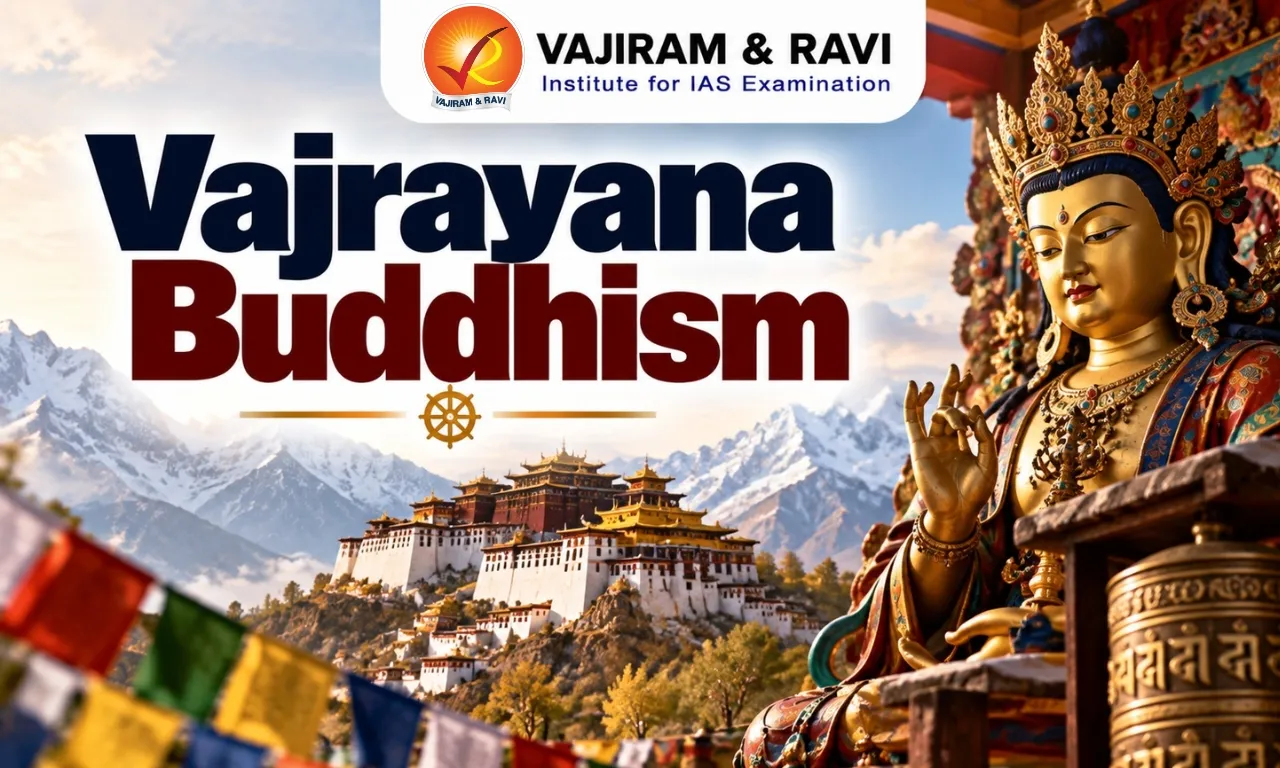
Vajrayana Buddhism, or the “Diamond Vehicle”, is an esoteric tradition that emerged within the wider Mahayana Buddhist tradition in India. It is distinguished by its emphasis on tantric practices, mantras, mudras, meditation, visualisation, and initiation by a spiritual teacher as means of attaining enlightenment. Its development marked a significant evolution in Buddhist thought and practice, particularly in medieval India.
A distinctive feature of Vajrayana is its use of tantric methods to transform ordinary experiences, emotions and perceptions into supports for spiritual practice and awakening. From its Indian roots, Vajrayana spread to Tibet, Nepal, Bhutan, Mongolia, and parts of Central and East Asia, giving rise to diverse traditions. In Tibet, Vajrayana became integrated into several major Buddhist traditions, especially the Nyingma, Kagyu, Sakya and Gelug schools.
Vajrayana Buddhism (Tantric Buddhism) Origin
Vajrayana Buddhism emerged in India between the sixth and eleventh centuries CE. It evolved in the later stages of Indian Buddhism, when Mahayana teachings began to combine ritual, meditation, mantra recitation, mandalas, and tantric literature.
- It is not completely independent from Mahayana Buddhism. Instead, it is widely regarded as a specialised, esoteric branch of Mahayana Buddhism.
- Vajrayana practitioners and Mahayana Buddhists have the same ultimate goal: Buddhahood for the benefit of all sentient beings. However, Vajrayana asserts that sophisticated tantric methods, when practised under the supervision of a skilled teacher, can speed spiritual advancement.
Vajrayana Buddhism Meaning
The term "Vajrayana" combines "vajra", meaning "diamond", "adamantine", or "thunderbolt", with "yāna", meaning “vehicle” or "path". Thus, Vajrayana is commonly translated as the “Diamond Vehicle", “Adamantine Vehicle", or “Thunderbolt Vehicle". The vajra symbolises something indestructible, powerful, clear, and pure. In Vajrayana thought, it commonly symbolises the indestructible, adamantine quality of awakened wisdom and the inseparability of method and wisdom.
Vajrayana Buddhism Founder
There is no single historical founder of Vajrayana Buddhism in the same sense as Gautama Buddha being the founder of Buddhism. Vajrayana gradually developed within the broader Mahayana Buddhist tradition, particularly in India between approximately the 6th and 8th centuries CE, although its roots and development span a longer period.
Vajrayana Buddhism Other Names
Vajrayana Buddhism is also known as the Diamond Vehicle, Thunderbolt Vehicle, and a variety of other traditional and descriptive terms. Common alternate names include the following:
- Tantric Buddhism: It is named for its usage of Buddhist tantras (scriptures that outline ritual and yogic practices).
- Esoteric Buddhism: Buddhist traditions that employ specialised ritual, meditation and tantric practices transmitted through initiation and teacher-guided instruction.
- Mantrayana ("Mantra Vehicle"): Emphasises the central practice of chanting sacred sounds (mantras) to concentrate the mind.
- Guhyamantrayana ("Secret Mantra Vehicle"): A traditional designation emphasising the esoteric or secret transmission of tantric Buddhist teachings and practices.
- Tantrayana ("Tantra Vehicle"): Another direct reference to tantric ritual practice.
Vajrayana Buddhism Symbol
One of the most important symbols of Vajrayana Buddhism is the vajra. A vajra is a ritual object shaped like a sceptre or thunderbolt. During rituals, practitioners often use a vajra along with a bell. The vajra symbolises indestructibility and awakened awareness. When paired with the bell, the vajra commonly represents skilful means or compassionate method, while the bell represents wisdom; together they symbolise the unity of method and wisdom.


Vajrayana Buddhism Beliefs
Vajrayana retains the fundamental teachings of Buddhism while developing distinctive tantric methods. It accepts core Buddhist and Mahayana teachings. Its core beliefs include the following:
- The Diamond (Vajra): The vajra symbolises the indestructible or adamantine nature of reality and awakened awareness. Vajrayana philosophy remains grounded in the Mahayana understanding of emptiness (śūnyatā).
- Buddha-Nature: Many Vajrayana traditions draw on the Mahayana doctrine of Buddha-nature, understood in different ways across Buddhist philosophical traditions as the potential or basis for awakening.
- Turning Poison into Medicine: Vajrayana employs transformative practices in which afflictive emotions and ordinary experiences can be transformed into wisdom rather than simply rejected. This principle is sometimes expressed metaphorically as “turning poison into medicine".
- Faster Enlightenment: Vajrayana presents tantric practice as a potentially rapid path to Buddhahood, and some Vajrayana traditions hold that complete awakening may be attained within a single lifetime through advanced tantric practice.
Vajrayana Buddhism Practices
Vajrayana Buddhism is characterised by a distinctive combination of tantric philosophy, ritual practice, and symbolic methods aimed at spiritual transformation. Its major characteristics include:
- Mantras: Sacred syllables and formulas are repeatedly recited as part of meditation and ritual practice.
- Mudras: Symbolic hand gestures are used during religious rituals and meditation.
- Mandalas: Sacred geometric representations are used as visual aids for meditation and contemplation.
- Vajra Symbolism: The vajra, symbolising indestructibility and spiritual power, is a central ritual object and gives the tradition its name. The bell (ghanta) is commonly paired with the vajra and represents wisdom.
- Guru–Disciple Tradition: Transmission of specialised teachings takes place through an established relationship between teacher and practitioner.
- Bodhisattva Ideal: Vajrayana retains the Mahayana emphasis on attaining enlightenment for the benefit of all sentient beings.
- Two-Truth Framework: Vajrayana inherits the Mahayana distinction between conventional truth and ultimate truth and integrates it into its tantric philosophical framework.
Vajrayana Buddhism Deities
Vajrayana Buddhism has a diverse range of Buddhas, Bodhisattvas, female deities, and tantric meditation deities, each representing particular dimensions of wisdom, compassion, or spiritual transformation. These figures are primarily understood as objects of visualisation and meditation, rather than creator gods.
- Vairocana: Associated with the Dharmadhātu and the all-encompassing nature of Buddhist wisdom; one of the Five Cosmic Buddhas.
- Akshobhya: Represents the transformation of anger into mirror-like wisdom.
- Ratnasambhava: Associated with equanimity and the transformation of pride into wisdom.
- Amitabha: Represents discriminating wisdom and is associated with the Pure Land of Sukhavati.
- Amoghasiddhi: Associated with accomplishing enlightened activity and transforming jealousy into wisdom.
Vajrayana Buddhism Schools
Vajrayana Buddhism in Tibet developed into four major schools—Nyingma, Kagyu, Sakya, and Gelug. Although all four share the broader Buddhist teachings, they differ in their historical lineages and particular systems of practice.
- Nyingma: The oldest major Tibetan Buddhist tradition, tracing its origins to the first period of Buddhist transmission to Tibet in the eighth and ninth centuries. It is strongly associated with Padmasambhava and is particularly known for Dzogchen (Great Perfection) teachings.
- Kagyu: Established through an oral or “whispered” lineage, with the Indian yogi Tilopa as an important source of its specific practices. Its teachings emphasise Vajrayana tantric practices and Mahamudra, with figures such as Naropa, Marpa, Milarepa and Gampopa playing major roles in its transmission.
- Sakya: Founded in the 11th century, the tradition takes its name from Sakya Monastery, established in 1073 by Khön Könchok Gyalpo. Its distinctive teaching system is Lamdre (“Path and Its Fruit”).
- Gelug: The youngest of the four major Tibetan Buddhist traditions, founded by Tsongkhapa (1357–1419). Tsongkhapa established Ganden Monastery in 1409. The tradition emphasises monastic discipline, philosophical study and the Lamrim (“Stages of the Path”).
Vajrayana Buddhism Spread
Vajrayana Buddhism spread beyond its Indian roots through tantric teachers, monastic networks, royal patronage, and the movement of Buddhist texts and practices. The major stages of its spread can be summarised as follows:
- Eastern Indian Centres: Eastern and northeastern Indian regions, particularly Bengal, Bihar, Odisha and Assam, became important centres of Buddhist tantric practice, while Kashmir also played a major role in the development and transmission of tantric Buddhism.
- Tibetan Transmission: Vajrayana teachings moved from India into Tibet, particularly through Indian tantric teachers and Buddhist scholars.
- Padmasambhava: The Indian master Padmasambhava is traditionally associated with transmitting tantric Buddhist teachings to Tibet and became an important figure in the formation of Tibetan Buddhism.
- Teacher–Disciple Networks: Indian gurus and their Tibetan disciples helped transmit tantric teachings, rituals, and practices across the Himalayas.
- Cultural Adaptation: In Tibet, Indian Buddhist traditions interacted with existing Tibetan religious and cultural traditions and developed distinctive Tibetan forms of Buddhism.
- Wider Himalayan Influence: Vajrayana traditions developed distinctive forms in the Himalayan region, including Tibet, Nepal and Bhutan, while Tibetan Buddhism later became highly influential in Mongolia and other parts of Inner Asia.
Vajrayana Buddhism vs Mahayana Buddhism
Both Vajrayana Buddhism and Mahayana Buddhism share core Mahayana ideals such as the Bodhisattva path, compassion and pursuit of Buddhahood, but differ in their methods, emphasis and forms of practice.
| Aspect | Mahayana Buddhism | Vajrayana Buddhism |
|
Nature |
Broad Buddhist tradition emphasising the Bodhisattva path |
Tantric/esoteric development of Mahayana |
|
Goal |
Attainment of Buddhahood for the benefit of all beings |
Same goal, pursued through specialised tantric methods |
|
Approach |
Emphasises wisdom, compassion, meditation and philosophical cultivation |
Adds tantric rituals, visualisation and symbolic practices |
|
Key Practices |
Meditation, ethical conduct, study of sutras and cultivation of the six perfections |
Mantras, mudras, mandalas, deity visualisation and tantric meditation |
|
Role of Teacher |
Teachers are important for instruction and transmission. |
Guru/teacher has a particularly central role in initiation and tantric transmission |
|
Texts |
Primarily Mahayana sutras such as the Prajnaparamita and Lotus Sutra |
Includes Mahayana sutras as well as Tantras and related esoteric texts |
|
Symbolism |
Uses Buddhist symbols and images |
Makes extensive use of vajra, bell, mandalas and tantric deity imagery |
|
Geographical Association |
Historically widespread across East and Central Asia |
Associated with Tibet, the Himalayan region and Mongolian/Tibetan Buddhist traditions. |
Vajrayana Buddhism Books
Important texts associated with Vajrayana include a large body of Tantras, commentaries and ritual manuals. Some well-known works and collections include:
- Guhyasamāja Tantra
- Hevajra Tantra
- Cakrasaṃvara Tantra
- Kālacakra Tantra
Vajrayana Buddhism Decline
The decline of Vajrayana Buddhism in India was gradual and resulted from a combination of institutional, political, and social changes rather than a single event.
- Decline of Monastic Institutions: The destruction and decline of major Buddhist monastic centres such as Nalanda, Vikramashila and Odantapuri severely disrupted institutional networks supporting Buddhist education, scholarship and tantric transmission.
- Loss of Royal Patronage: The weakening of Buddhist-supporting political powers, particularly after the decline of the Pala dynasty, reduced financial and institutional support for major monasteries.
- Competition and Assimilation: Buddhism also experienced increasing competition and interaction with other religious traditions, while the weakening of its monastic institutions, changes in patronage and political upheavals reduced its institutional presence in much of India.

 Last updated on Sep, 2026
→ UPSC 2027 Notification will be released on 13 January 2027 at upsconline.nic.in.
→ Asian Games 2026 are being held in Aichi-Nagoya, Japan, from 19 September to 4 October.
→ Check out the latest UPSC Syllabus here.
→ Download UPSC Model Answers for Mains 2026
→ UPSC Mains Question Paper 2026 is out now for Essay & GS Paper 1, 2, 3 & 4.
→ UPSC Calendar 2027 has been released.
→ Enroll in Vajiram & Ravi’s UPSC Mains Test Series 2027 for structured answer writing practice, expert evaluation, and exam-oriented feedback.
→ Join Vajiram & Ravi’s UPSC Mentorship Program 2027 for personalized guidance, strategy planning, and one-to-one support from experienced mentors.
→ Go through the UPSC Mains Previous Year Papers to enhance your preparation.
→ UPSC has released UPSC Toppers List 2025 with the Civil Services final result on its official website.
→ Also check Best UPSC Coaching in India
Vajrayana Buddhism FAQs
Q1. What is Vajrayana Buddhism?+
Q2. What are the main beliefs of Vajrayana Buddhism?+
Q3. What's the difference between Mahayana and Vajrayana?+
Q4. Which countries practice Vajrayana Buddhism?+
Q5. What is another name for Vajrayana Buddhism?+
Tags: quest upsc ancient history notes vajrayana buddhism