The Central Adoption Resource Authority (CARA) is India’s apex statutory body for regulating and promoting in-country and inter-country adoption. Established in 1990 and granted statutory status under the Juvenile Justice (Care and Protection of Children) Act, 2015, CARA seeks to ensure that adoption is conducted through a transparent, child-centric and legally safeguarded process. It functions under the Ministry of Women and Child Development and serves as India’s Central Authority under the Hague Convention, 1993.
Through the CARINGS portal, CARA facilitates registration, matching and monitoring of adoption cases. Despite institutional reforms, challenges such as long waiting periods, limited availability of legally free children, uneven institutional capacity and legal duality with the Hindu Adoption and Maintenance Act continue to affect the adoption ecosystem.
Central Adoption Resource Authority Overview
The Central Adoption Resource Authority provides the institutional framework for ensuring that adoption in India is legal, transparent and centred on the best interests of the child.
- Legal Status: Statutory body under Section 68 of the Juvenile Justice Act, 2015, as amended in 2021.
- Nodal Ministry: The Central Adoption Resource Authority functions under the Ministry of Women and Child Development (MWCD).
- Origin: The Central Adoption Resource Authority was established in 1990 as an autonomous body and received statutory status under the JJ Act, 2015.
- International Role: The Central Adoption Resource Authority is India’s Central Authority under the Hague Convention of 1993 on inter-country adoption; India ratified the Convention in 2003.
- Legal Framework: The Central Adoption Resource Authority is governed primarily by the Juvenile Justice Act, 2015, and Adoption Regulations, 2022.
- Scope: The Juvenile Justice (Care and Protection of Children) Amendment Act, 2021, effective from 1 September 2022, transferred adoption-order jurisdiction from courts to District Magistrates, including Additional District Magistrates, under the amended adoption provisions.
- Digital Platform: CARINGS (Child Adoption Resource Information and Guidance System) provides a centralised platform for registration of Prospective Adoptive Parents (PAPs) and children legally free for adoption.
- Institutional Structure: The adoption framework involves CARA at the national level, State Adoption Resource Agencies (SARAs) at the state level, District Child Protection Units (DCPUs), Specialised Adoption Agencies (SAAs), and Child Welfare Committees (CWCs), which perform complementary functions.
- 2021 Reform: Under Section 61, adoption orders were shifted from courts to District Magistrates/Additional District Magistrates to expedite proceedings.
- Parallel Legal Frameworks: Adoptions under the Hindu Adoption and Maintenance Act, 1956, are governed by HAMA, while adoptions under the JJ Act are governed by the JJ Act and Adoption Regulations. Section 56(3) expressly excludes HAMA adoptions from the JJ Act.
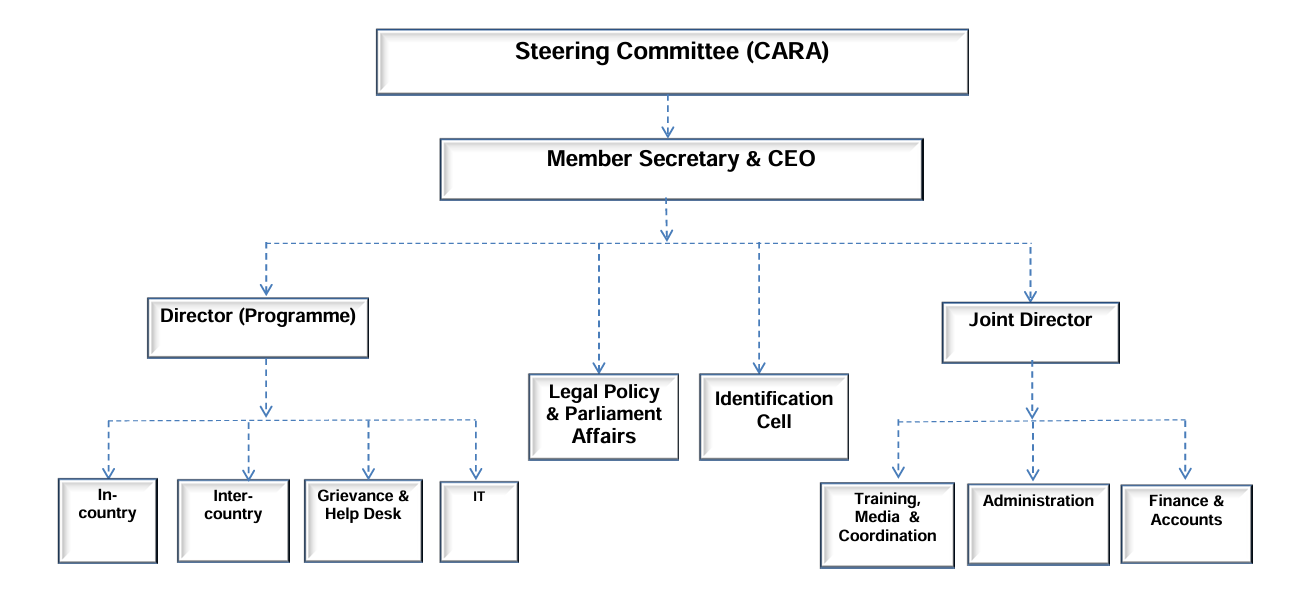
Central Adoption Resource Authority Organisation Chart
The organisation chart of the Central Adoption Resource Authority is shown below.


Central Adoption Resource Authority Functions
Under Section 68 of the Juvenile Justice Act, 2015, CARA performs regulatory, promotional and coordinating functions to ensure safe and lawful adoption within India and across borders.
- Facilitate in-country Adoption: The Central Adoption Resource Authority promotes domestic adoption and facilitates interstate adoption in coordination with State Adoption Resource Agencies.
- Regulate Inter-country Adoption: Regulates adoption of Indian children by foreign nationals and NRIs in accordance with prescribed safeguards.
- Frame Regulations: Formulates and periodically updates adoption regulations and procedures.
- Hague Convention Functions: Performs the functions of India’s Central Authority under the Hague Convention, 1993.
- Centralised Registration: Maintains the central adoption system through CARINGS, linking PAPs with children legally free for adoption.
- The Child Welfare Committee (CWC) is the authority that declares a child legally free for adoption, not the Central Adoption Resource Authority (CARA).
- Inter-country Documentation: Processes/issues of NOCs and conformity certificates in inter-country adoption cases as prescribed under the Adoption Regulations and the Hague Convention framework.
- Eligibility & Standards: Prescribes eligibility requirements and procedural safeguards for Prospective Adoptive Parents (PAPs).
- Agency Regulation: Recognises, regulates and monitors Specialised Adoption Agencies and coordinates with authorised adoption agencies and foreign authorities in inter-country adoption.
- Post-adoption Support: Prescribes and facilitates pre- and post-adoption counselling, follow-up and support through authorised adoption agencies and other functionaries.
- Capacity Building: Provides training and capacity-building support to District Magistrates/ADMs and adoption functionaries.
- Child Categorisation: Facilitates the adoption process for orphaned, abandoned and surrendered children who are declared legally free for adoption by the Child Welfare Committee, in accordance with the JJ Act and Adoption Regulations.
Central Adoption Resource Authority Challenges
The Central Adoption Resource Authority faces challenges of demand–supply imbalance, procedural delays and institutional limitations, requiring a more child-centric, efficient and transparent adoption system.
- Demand–Supply Mismatch: A large gap exists between the number of Prospective Adoptive Parents and the smaller number of children legally free for adoption; many children in institutional care cannot enter the adoption pool because of ongoing tracing, inquiry, documentation or legal-status procedures.
- Procedural Delays: Documentation, Home Study Reports, matching and legal formalities continue to create lengthy waiting periods despite the 2021 shift of adoption orders to District Magistrates.
- Institutional Capacity Gaps: Shortages of trained personnel and uneven capacity across SAAs, CWCs and DCPUs affect timely processing, counselling and child-care services.
- Children Left in Institutional Care: Delays in tracing parents, completing enquiries and declaring children legally free for adoption can result in prolonged institutionalisation.
- Low Adoption of Older & Special-needs Children: Preference for younger children leaves older children and children with special needs with fewer adoption opportunities and longer waiting periods.
- Inter-country Adoption Challenges: Extensive documentation, NOCs, home studies and coordination with foreign authorities can make inter-country adoption administratively complex.
- Legal Duality with HAMA: The coexistence of the JJ Act and HAMA creates distinct legal routes for adoption, requiring greater clarity regarding their respective scope, procedures and interaction with inter-country adoption safeguards.
- Risk of Informal Adoption & Trafficking: Informal and unauthorised adoption arrangements can bypass statutory safeguards and create risks of child trafficking, exploitation and loss of legal protection.
Central Adoption Resource Authority Way Forward
The Central Adoption Resource Authority should combine institutional strengthening, procedural efficiency and legal clarity with a child-centric approach, ensuring timely access to safe, permanent and nurturing family care.
- Expand the Adoption Pool: Conduct regular identification drives in Child Care Institutions (CCIs) and fast-track tracing, inquiry and declaration of eligible children as legally free for adoption.
- Reduce Procedural Delays: Ensure time-bound processing by District Magistrates (DMs) and adoption agencies while streamlining documentation, matching and approvals through end-to-end digital integration of the Child Adoption Resource Information and Guidance System (CARINGS).
- Strengthen District & Institutional Capacity: Provide DMs with dedicated adoption support teams and strengthen Specialised Adoption Agencies (SAAs), Child Welfare Committees (CWCs), District Child Protection Units (DCPUs) and State Adoption Resource Agencies (SARAs) through adequate staffing and training.
- Adopt a Child-Centric Approach: Prioritise the best interests, emotional well-being and long-term development of the child through professional pre- and post-adoption counselling.
- Promote Adoption of Older & Special-needs Children: Conduct targeted awareness campaigns and provide medical, therapeutic and financial support to families adopting children requiring additional care.
- Strengthen Inter-country Adoption: Ensure faster processing of No Objection Certificates (NOCs) and Conformity Certificates while strengthening coordination with foreign Central Authorities and Indian diplomatic missions under Hague Convention safeguards.
- Harmonise the Legal Framework: Clarify the interface between the Hindu Adoption and Maintenance Act (HAMA), 1956 and the Juvenile Justice (Care and Protection of Children) Act, 2015, particularly regarding registration, relocation and international recognition of adoptions.
- Enhance Transparency & Child Protection: Publish updated CARINGS data on Prospective Adoptive Parents (PAPs), children legally free for adoption and waiting periods, while strengthening monitoring to prevent informal adoption, unauthorised placements and child trafficking.

 Last updated on Sep, 2026
→ UPSC 2027 Notification will be released on 13 January 2027 at upsconline.nic.in.
→ Asian Games 2026 are being held in Aichi-Nagoya, Japan, from 19 September to 4 October.
→ Check out the latest UPSC Syllabus here.
→ Download UPSC Model Answers for Mains 2026
→ UPSC Mains Question Paper 2026 is out now for Essay & GS Paper 1, 2, 3 & 4.
→ UPSC Calendar 2027 has been released.
→ Enroll in Vajiram & Ravi’s UPSC Mains Test Series 2027 for structured answer writing practice, expert evaluation, and exam-oriented feedback.
→ Join Vajiram & Ravi’s UPSC Mentorship Program 2027 for personalized guidance, strategy planning, and one-to-one support from experienced mentors.
→ Go through the UPSC Mains Previous Year Papers to enhance your preparation.
→ UPSC has released UPSC Toppers List 2025 with the Civil Services final result on its official website.
→ Also check Best UPSC Coaching in India
Central Adoption Resource Authority FAQs
Q1. What is CARA?+
Q2. Which ministry controls CARA?+
Q3. What is CARINGS?+
Q4. Who issues adoption orders after the 2021 amendment?+
Q5. What is CARA’s role in inter-country adoption?+
Tags: central adoption resource authority quest UPSC Social Justice Notes