The National Food Security Act 2013 represents a major transformation in India's approach to food security by shifting from a welfare-oriented model to a rights-based framework. The Act, enacted on 5 July 2013, legally guarantees specified foodgrain and nutritional entitlements to a large section of the population through the TPDS and allied programmes.
The National Food Security Act 2013 adopts a life-cycle approach, extending nutritional support to pregnant women, lactating mothers and children, while also creating institutional mechanisms for transparency, grievance redressal and accountability. The NFSA has therefore institutionalised food access as a legal entitlement rather than a discretionary benefit. However, challenges relating to targeting errors, cereal-centricity, digital exclusion, etc. continue to shape the contemporary debate on reforming India's food-security architecture.
National Food Security Act 2013 Major Features
The National Food Security Act 2013 establishes a rights-based framework for food security in India by defining the population to be covered, specifying household-level entitlements and creating mechanisms for nutritional support and accountability. Its design combines union-level policy determination with state-level implementation.
- Rural and Urban Coverage: The National Food Security Act 2013 provides for coverage of up to 75% of the rural population and 50% of the urban population, together covering approximately 67%, or two-thirds of India's population.
- The statutory coverage corresponds to approximately 81.35 crore persons, based on the 2011 Census population.
- State-wise coverage was determined using the then Planning Commission's methodology based on NSS Household Consumption Survey 2011–12 data.
- Antyodaya Anna Yojana (AAY): AAY covers the poorest of the poor households and provides 35 kg of food grains per household per month, irrespective of household size.
- Priority Households (PHH): PHH beneficiaries are entitled to 5 kg of food grains per person per month, making the household's total entitlement dependent on the number of eligible members.
- Original Pricing: The Act originally provided subsidised foodgrains at ₹3/kg for rice, ₹2/kg for wheat and ₹1/kg for coarse grains for the initial period specified under the Act.
- Current Pricing: Since 1 January 2023, NFSA foodgrains for AAY and PHH beneficiaries have been provided free of cost, with this arrangement subsequently extended for five years from January 2024.
- Women as Household Heads: The Act provides that the eldest woman of the household, aged 18 years or above, should be treated as the head of the household for issuing ration cards. This gives the NFSA an important gender-empowerment dimension within welfare administration.
- Pregnant Women and Lactating Mothers: Under Section 4 of the National Food Security Act (NFSA), 2013, pregnant women and lactating mothers are legally entitled to free nutritional meals through local Anganwadi and a cash maternity benefit of not less than ₹6,000 paid in instalments
- Cash benefits are primarily channelled through schemes like the Pradhan Mantri Matru Vandana Yojana (PMMVY) and supplemented by programmes like the Janani Suraksha Yojana (JSY).
- Children and Malnourished Children: Children aged 6 months to 6 years receive supplementary nutrition through Anganwadi services.
- Eligible children aged 6–14 years receive school meals under the applicable programme.
- Higher nutritional norms apply to malnourished children up to six years.
- Nutritional Security: Through these provisions, the NFSA adopts a life-cycle approach, linking foodgrain security with maternal, child and nutritional security rather than focusing only on calorie availability.
- Compensation for Non-Delivery: If foodgrains or meals are not provided, the beneficiary is entitled to a food security allowance from the concerned state government. This turns non-delivery from a mere administrative failure into a situation with a statutory remedy.
- Transparency and Social Audit: The Act requires disclosure of PDS-related records, social audits and Vigilance Committees at different levels, including the state, district, block and Fair Price Shop levels.
- Grievance Redressal: It provides for District Grievance Redressal Officers and State Food Commissions to address complaints and enforce beneficiary rights.
- Section 38: Section 38 empowers the Central Government to issue directions to States/UTs for effective implementation, providing a Union-level accountability mechanism within an otherwise largely State-implemented delivery structure.
National Food Security Act 2013 Achievements
The National Food Security Act 2013 has strengthened India's food-security architecture not only by expanding legal entitlements but also by improving portability, digitisation, and PDS functioning.
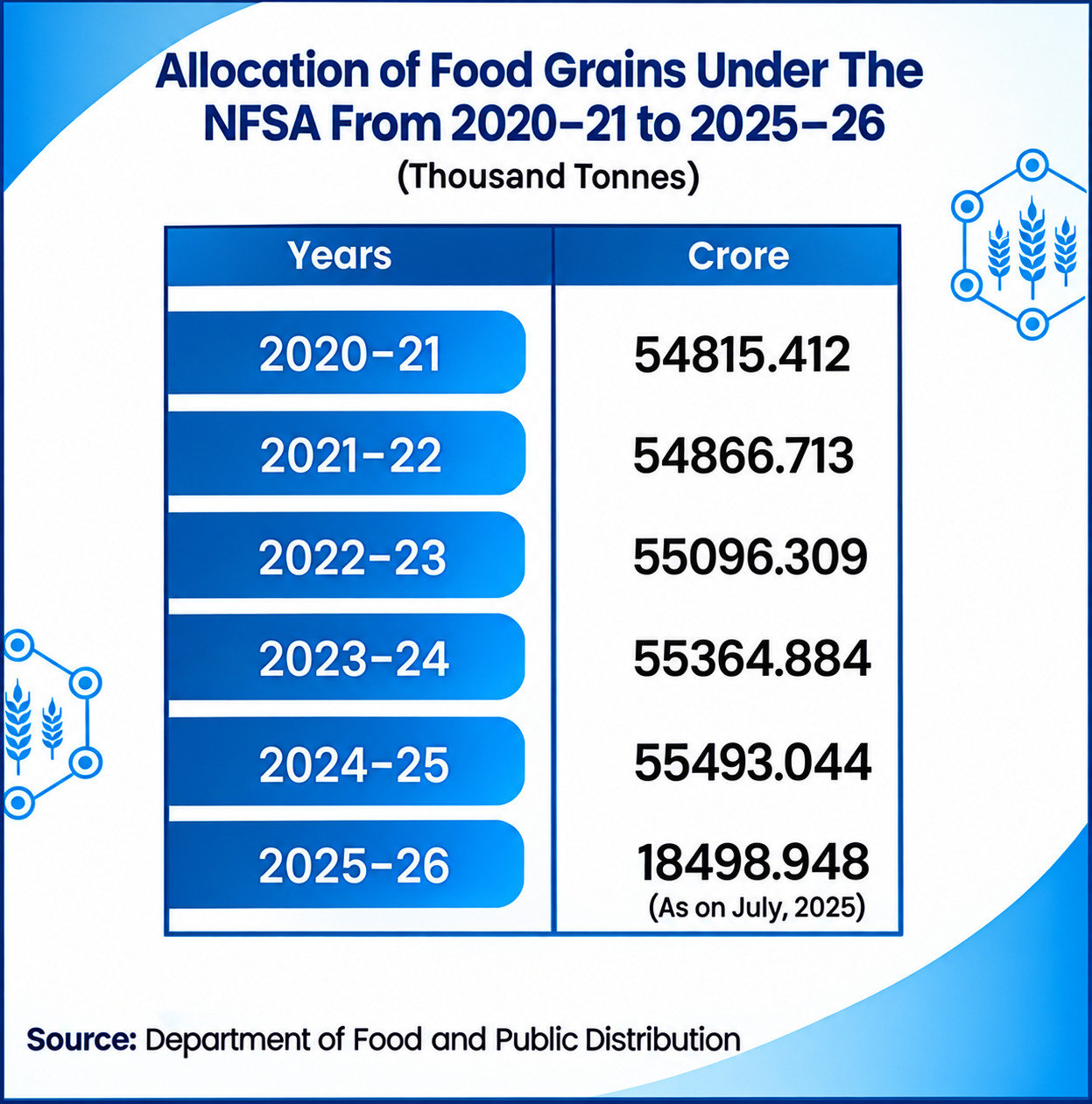
- Large-Scale Social Protection: The NFSA has created one of the world's largest food-based social safety nets, with around 80 crore people receiving foodgrain entitlements under the current framework.
- Rights-Based Food Security: The Act transformed food access from a primarily discretionary welfare measure into a legal entitlement, supported by grievance-redressal and accountability mechanisms.
- PDS Expansion and Reduced Leakages: Evidence combining data from the Household Consumption Expenditure Survey (HCES 2022–23) and administrative foodgrain allocations indicates a transformative shift in India's Public Distribution System (PDS) over the last decade.
- Significant Drop in Grain Leakage: Estimated PDS foodgrain leakages have drastically declined from 41.7% in 2011–12 to between 24% and 28% in 2022–23 (depending on the specific analytical model and treatment of the COVID-era PMGKAY-free grain scheme).
- Massive Expansion in Beneficiary Reach: Concurrently, the system has become far more inclusive. The proportion of Indian households actively purchasing or receiving grains from the PDS surged from around 40% in 2011–12 to nearly 70% to 75% in 2022–23.
- Role of State-Level Reforms: Experiences of Chhattisgarh, Odisha and Bihar demonstrate that improvements in PDS performance cannot be attributed to technology alone; measures such as local procurement, doorstep delivery, digitisation, community participation and better Fair Price Shop management have also played an important role.
- Migrant Inclusion: ONORC has helped to address the portability problem faced by internal migrants, allowing beneficiaries to access their ration entitlements outside their home districts or states.
- Digital Transformation: Digitisation of ration cards, Aadhaar seeding and ePoS automation have improved authentication, transparency and transaction-level monitoring, while helping reduce duplication and certain forms of leakage.


National Food Security Act 2013 Challenges
Despite significant improvements in foodgrain delivery, portability and PDS digitisation, the National Food Security Act 2013 continues to face challenges related to coverage, nutrition, targeting, technology, fiscal sustainability and implementation capacity. The key challenge is to ensure that a rights-based food-security system remains inclusive, nutritionally adequate, efficient and accessible.
- Outdated Coverage Base: The NFSA's coverage ceiling continues to be linked to the 2011 Census, even though population size and the spatial distribution of poverty have changed substantially.
- This creates the possibility of exclusion of eligible households and strengthens the case for periodically updating the beneficiary base using current demographic data.
- Cereal-Centric Design: The NFSA primarily guarantees rice, wheat and coarse grains, with limited emphasis on pulses, protein-rich foods, edible oils and dietary diversity.
- Thus, the framework remains more oriented towards calorie security than comprehensive nutrition security, despite India's continuing challenges of malnutrition and micronutrient deficiencies.
- Digital Exclusion and Authentication Failures: Although ePoS and Aadhaar-based authentication have improved transparency, biometric failures, poor connectivity, device malfunction and worn fingerprints can prevent genuine beneficiaries from accessing their entitlements.
- Therefore, digitisation must be accompanied by reliable offline and alternative authentication mechanisms.
- Procurement, Storage and FCI Inefficiencies: The Shanta Kumar Committee (2015) highlighted concerns relating to high carrying costs, storage losses, excessive dependence on CAP storage, inadequate decentralised procurement and inefficiencies in FCI operations.
- These issues can reduce the cost-effectiveness of maintaining large foodgrain reserves.
- Fiscal Sustainability: The large food subsidy and the cost of maintaining substantial buffer stocks create a continuing trade-off between food-security entitlements and fiscal sustainability.
- Uneven State Capacity: The effectiveness of Vigilance Committees, social audits, grievance-redressal mechanisms and Fair Price Shop monitoring varies across States because of differences in administrative capacity and local institutional quality.
- AAY Entitlement Inequity: The flat 35 kg per household per month AAY entitlement creates an intra-category disparity because household size is not considered.
- While smaller households receive a relatively higher per-capita entitlement, larger vulnerable households receive a lower per-capita quantity, raising questions about the equity of the existing entitlement structure.
National Food Security Act 2013 Way Forward
Reforming the National Food Security Act (NFSA) 2013 is essential to ensure inclusive, efficient and nutrition-sensitive food distribution. The focus must be on updating beneficiary coverage, strengthening delivery mechanisms, improving procurement and storage, and safeguarding entitlements to achieve equitable and sustainable food security.
- Update the Beneficiary Base: Use the latest Census and updated demographic data to revise NFSA coverage and reduce exclusion caused by continued reliance on the 2011 population base.
- Move Towards Nutrition Security: Gradually diversify the NFSA basket by piloting pulses, millets, fortified foods and other nutritionally important commodities, thereby shifting from cereal and calorie security towards comprehensive nutrition security.
- Strengthen Beneficiary Identification: Introduce periodic, technology-assisted verification and dynamic inclusion mechanisms to correct exclusion and inclusion errors without creating excessive documentation barriers for vulnerable groups.
- Ensure Alternative Authentication: Provide offline or alternate authentication mechanisms, including appropriate manual overrides and proxy/family-member authentication with audit trails, so that biometric or connectivity failures do not deny legitimate entitlements.
- Reform Procurement and Storage: Expand decentralised procurement, modern silo storage, scientific stock rotation and efficient FCI management to reduce carrying costs and post-harvest losses while maintaining adequate food-security reserves.
- Protect the Rights-Based Character: Any reform of AAY entitlements should include a no-loss safeguard so that correcting household-size inequities does not reduce the existing entitlement of vulnerable households without adequate justification.
- Deepen Portability: Build upon the success of ONORC by exploring greater portability and convergence across nutrition-related programmes, particularly for migrant children and families who remain more geographically dependent on services such as ICDS and school meals.
- Strengthen Accountability: Improve the functioning of social audits, Vigilance Committees, Food Commissions and grievance-redressal systems so that statutory entitlements are matched by effective institutional accountability.
National Food Security Act 2013 UPSC PYQs
Q1. With reference to the provisions made under the National Food Security Act, 2013, consider the following statements: (UPSC Prelims 2018)
- The families coming under the category of 'below poverty line (BPL)' only are eligible to receive subsidised food grains.
- The eldest woman in a household, of age 18 years or above, shall be the head of the household for the purpose of issuance of a ration card.
- Pregnant women and lactating mothers are entitled to a 'take-home ration' of 1600 calories per day during pregnancy and for six months thereafter.
Which of the statements given above is/are correct?
(a) 1 and 2
(b) 2 only
(c) 1 and 3
(d) 3 only.
Ans: (b)

 Last updated on Oct, 2026
→ UPSC 2027 Notification will be released on 13 January 2027 at upsconline.nic.in.
→ Check Nobel Prize 2026 Winners List here.
→ Download PIB PRiSM Monthly Magazine 2026 here.
→ Check UPSC Monthly Current Affairs Magazine The Recitals here.
→ Check out the latest UPSC Syllabus here.
→ Download UPSC Model Answers for Mains 2026
→ UPSC Mains Question Paper 2026 is out now for Essay & GS Paper 1, 2, 3 & 4.
→ UPSC Calendar 2027 has been released.
→ Enroll in Vajiram & Ravi’s UPSC Mains Test Series 2027 for structured answer writing practice, expert evaluation, and exam-oriented feedback.
→ Join Vajiram & Ravi’s UPSC Mentorship Program 2027 for personalized guidance, strategy planning, and one-to-one support from experienced mentors.
→ Go through the UPSC Mains Previous Year Papers to enhance your preparation.
→ UPSC has released UPSC Toppers List 2025 with the Civil Services final result on its official website.
→ Also check Best UPSC Coaching in India
National Food Security Act 2013 FAQs
Q1. Which state of India first passed the Food Security Act?+
Q2. Which state of India has high food security?+
Q3. What is NFSA eligibility?+
Q4. What are the main challenges to food security in India?+
Q5. What are the four pillars of food security?+
Tags: national food security act 2013 quest UPSC Social Justice Notes