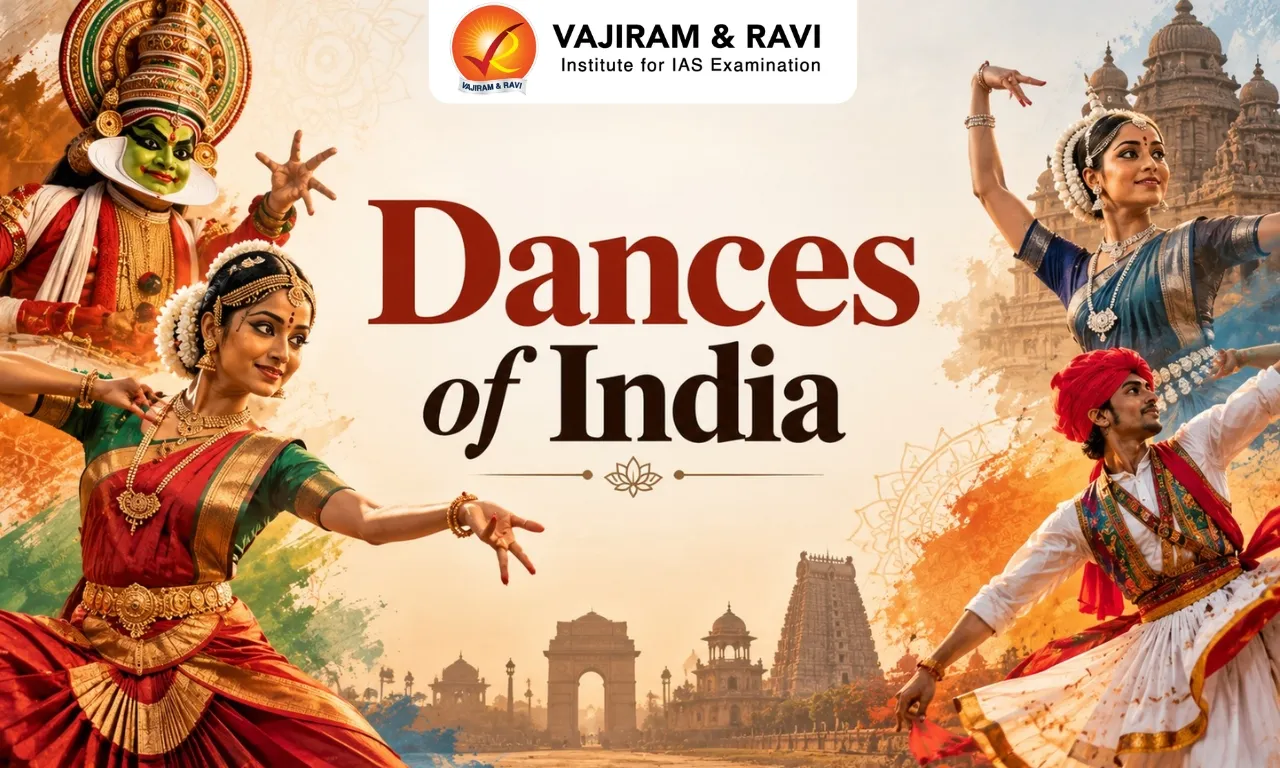
Dances of India express the country’s cultural diversity through movement, rhythm, storytelling, music, and community participation. They range from the structured techniques of Bharatanatyam and Kathak to the collective celebrations of Garba, Bihu, and numerous tribal traditions. Indian dance is both a performing art and a way of transmitting cultural knowledge across generations.
Indian dances are broadly classified into classical, folk, and tribal dance forms, although these categories can overlap. Contemporary and modern dance traditions have also evolved through interactions with traditional and international styles. From the intricate footwork of Kathak to the graceful movements of Manipuri, the energetic Bhangra of Punjab and the colourful Garba of Gujarat, dances of India reflect the country's cultural diversity.
Dances of India About
Indian dance is an integral part of India’s performing arts, with historical roots in prehistoric rock paintings, the Indus Valley Civilisation and ancient religious and literary traditions. Dances performed in India are thought to have originated from Vedic dances and rituals dating back to around 5000 B.C.E.
- The Bhimbetka Caves in Madhya Pradesh's Vindhya Hill region are filled with images of dancers in various poses and group choreographies created by hunter-gatherers. Rather, like most other disciplines of knowledge, their origins are attributed to deities.
- The bronze Dancing Girl figurine from Mohenjo-daro (c. 2500 BCE) provides archaeological evidence of artistic representation of the human body, although it cannot establish the origin of any specific dance form.
- Over centuries, dance evolved through temple rituals, devotional practices, royal patronage, and community celebrations.
- An important milestone in its history was the composition of the Nāṭyaśāstra, attributed to Bharata Muni and generally dated by scholars to between approximately the 2nd century BCE and the 2nd century CE, though its precise date remains debated.
- This Sanskrit treatise systematically discusses drama, dance, music, gestures, stagecraft, and aesthetics, including rasa (aesthetic experience) and bhava (emotional expression).
- Indian dance traditions subsequently developed in diverse regional settings, broadly encompassing classical forms based on established artistic conventions and folk and tribal forms rooted in local customs, festivals, agricultural cycles and community life.
Popular Dances of India
India has a complex tapestry of traditional dances, which are essentially divided into classical and folk genres. Bharatanatyam from Tamil Nadu is well-known for its precise footwork and expressive gestures.
- Kathak, a Northern Indian dance style, emphasises quick spins and rhythmic foot motions.
- Beyond traditional forms, vibrant folk dances flourish across the country. These include the high-energy Bhangra of Punjab, the rhythmic Garba of Gujarat, and the delicate Ghoomar of Rajasthan.
Traditional Dances of India
Traditional dances of India preserve knowledge through repeated practice, teaching, and participation. Classical traditions commonly involve systematic instruction under a teacher, while many folk and tribal forms are learned within families and communities. These methods can overlap. Their themes include:
- Stories drawn from regional literature and mythology.
- Agricultural activities and seasonal change.
- Weddings, festivals, and social relationships.
- Community memory, identity, and traditional occupations.
- Spiritual beliefs and relationships with the natural environment.
Basic Aspects of Dances of India
Indian dance combines movement, rhythm, emotional expression, and storytelling. Classical dance traditions use established concepts such as Nritta, Nritya, Natya, and Abhinaya, while hand gestures and the Guru–Shishya Parampara help preserve and transmit artistic knowledge across generations.
- Nritta, Nritya and Natya: These represent three dimensions of Indian classical dance. Nritta involves pure rhythmic movements, Nritya combines movements with emotional expression, while Natya presents stories and characters through dramatic performance.
- Abhinaya: It refers to the techniques used to communicate emotions, ideas, and stories through dance. It includes body movements (Angika), speech and song (Vachika), costumes and makeup (Aharya), and inner emotional expression (Sattvika).
- Mudras or Hastas: These are symbolic hand gestures used to represent objects, actions, characters, and emotions. Their meanings depend on the context of the performance, and traditional texts such as the Abhinaya Darpana explain their use in Indian classical dance.
- Guru–Shishya Parampara: This traditional teacher–disciple system involves the transmission of dance techniques, artistic knowledge, and performance traditions through continuous guidance and practice.
- It plays an important role in preserving the distinctive styles and cultural heritage of Indian dance.


Types of Dances in India
Indian dances can be broadly classified into three major categories: classical, folk, and tribal dances.
- Classical Indian Dances: Classical dances are highly systematised forms governed by established techniques, movements, expressions and traditions, generally requiring prolonged training under a guru.
- Major forms include Bharatanatyam, Kathak, Kathakali, Kuchipudi, Odissi, Manipuri, Mohiniyattam and Sattriya.
- Indian Folk Dances: Folk dances are generally community-based performances associated with festivals, seasons, marriages, social occasions, and local traditions.
- Examples include Bhangra, Giddha, Garba, Bihu, Ghoomar, and Dandiya.
- Tribal Dances: Tribal dances emerge from the cultural and social life of tribal communities and are commonly performed during festivals, rituals, seasonal events, and community celebrations.
- Their forms are closely connected with local customs and collective participation.
Classical Dances of India
Indian classical dances are codified dance traditions that combine rhythm, bodily movements, facial expressions, gestures, music, and dramatic representation. Rooted in the Nāṭyaśāstra and regional cultural traditions, they have evolved into distinct styles with their own techniques, themes, and performance conventions.
- Bharatanatyam (Tamil Nadu): Known for precise footwork, geometric postures, expressive abhinaya, and themes drawn from Hindu devotional traditions.
- Kathak (North India): Characterised by intricate footwork, rapid spins, rhythmic compositions, and storytelling through gestures and facial expressions; it developed through both temple and court traditions.
- Kathakali (Kerala): A dance-drama distinguished by elaborate costumes, facial make-up, stylised movements, and dramatic enactment of episodes from Indian epics.
- Kuchipudi (Andhra Pradesh): Combines dance, music and drama, traditionally presenting stories from Hindu mythology through expressive acting and rhythmic movements.
- Odissi (Odisha): Recognised for its characteristic tribhanga posture, graceful movements and sculptural poses, with strong connections to Odisha’s temple traditions.
- Manipuri (Manipur): Known for gentle, rounded movements and devotional themes, particularly episodes associated with Radha-Krishna and the Ras Leela tradition.
- Mohiniyattam (Kerala): A graceful solo dance traditionally performed by women, marked by soft movements, expressive gestures and themes centred on devotion and love.
- Sattriya (Assam): Originated in the Vaishnavite monasteries (Sattras) of Assam and was systematised by Srimanta Sankardeva; it combines dance, drama and devotional expression.
Folk Dances of India
Folk dances are community-based dance traditions that emerge from the everyday life, customs, festivals, occupations and religious practices of different regions. Unlike classical dances, they are generally less rigidly codified and are transmitted largely through community participation and cultural traditions.
- Bhangra (Punjab): Traditionally associated with the agricultural cycle and harvest celebrations; characterised by energetic movements and the use of the dhol.
- Giddha (Punjab): A traditional women's dance performed through rhythmic movements, clapping and boliyan (short folk verses).
- Garba (Gujarat): A circular community dance traditionally associated with Navratri and devotion to the feminine divine.
- Dandiya Raas (Gujarat): Performed with decorated sticks (dandiyas), particularly during Navratri, combining coordinated movements with rhythmic music.
- Ghoomar (Rajasthan): A traditional dance known for graceful circular movements, swirling costumes, and group participation, particularly during festive and ceremonial occasions.
- Bihu (Assam): Associated with the Bohag Bihu festival and the agricultural cycle; it expresses youthful energy, celebration, and community life.
- Lavani (Maharashtra): A vibrant performance tradition combining dance with Marathi folk music, rhythm, and expressive movements; traditionally accompanied by the dholki.
- Rouf (Jammu and Kashmir): A women's group dance traditionally performed during festivals and seasonal occasions, marked by synchronised movements.
- Dalkhai (Odisha): A prominent folk dance of western Odisha, traditionally performed mainly by women during festivals and accompanied by folk songs and instruments.
- Cheraw (Mizoram): Known as the bamboo dance, in which dancers perform coordinated steps between moving bamboo poles.
Tribal Dances of India
Tribal dances are closely woven into the social, ritual, and cultural life of tribal communities. They integrate dance with music, costumes, festivals, and traditional beliefs, while also serving as a means of preserving community identity and transmitting cultural knowledge across generations.
North India
The Himalayan region has distinct tribal dance traditions shaped by local customs, community ceremonies, and traditional beliefs.
- Dhumal (Jammu & Kashmir): Associated with the Wattal community, Dhumal forms part of the region’s traditional tribal dance practices and reflects collective community participation.
- Dhurang and Dhuring (Uttarakhand): These dances are associated with Bhotiya communities and are traditionally connected with death ceremonies, demonstrating the ritual dimension of tribal dance traditions.
South India
Southern tribal dances reflect the close relationship between community life, traditional music, and collective cultural expression.
- Dhimsa (Andhra Pradesh): A traditional dance associated with tribal communities of the eastern Deccan region, representing collective participation through coordinated movements.
- Koya Dance (Telangana and Andhra Pradesh): Associated with the Koya tribal community, the dance forms part of their traditional cultural expression and community celebrations.
East India
Eastern India, particularly Odisha and Jharkhand, has a wide variety of tribal dances associated with different communities and occasions.
- Dalkhai (Odisha): A prominent tribal dance tradition of western Odisha, particularly associated with the cultural traditions of the region.
- Dhemsa (Odisha): Associated with the Koraput region, Dhemsa is an important tribal dance tradition of southern Odisha and is performed as part of community cultural practices.
- Dhap and Ghumra (Odisha): These are among the tribal dance traditions associated with Kalahandi, where dance and traditional musical practices form an important part of community culture.
- Changu (Odisha): Associated with the Juang tribe, Changu represents the close connection between tribal dance and indigenous musical traditions.
- Dandari (Odisha): A traditional dance of western Odisha, reflecting the community-based character of tribal performance traditions.
- Painka (Odisha): Associated with tribal communities of western Odisha, including the Paudi Bhuiyan, and forms part of the region's traditional dance repertoire.
- Karma (Jharkhand and Odisha): A widely practised tribal dance tradition extending across several states, including Odisha, Jharkhand, Madhya Pradesh and Chhattisgarh.
West & Central India
Central and western India contain tribal dance traditions that express the distinctive cultural identity and social life of communities such as the Baiga, Gond and Korku.
- Baiga Dance (Madhya Pradesh): Dance and music constitute an important part of Baiga cultural traditions, reflecting the community's collective cultural expression.
- Matki (Madhya Pradesh): Listed among the dance traditions of the region, Matki represents the diversity of traditional dance practices in central India.
- Parvi Nach (Maharashtra): A traditional dance form associated with tribal communities of Maharashtra, reflecting the region's distinctive cultural practices.
- Bihawoo (Maharashtra): A Korku tribal marriage dance associated with the Melghat region, illustrating the role of dance in tribal ceremonies and social life.
North-East India
The North-East has exceptionally diverse tribal traditions, where dance, music, costumes, and community rituals are closely interconnected.
- Bawdo Chham (Arunachal Pradesh): Included among the tribal dance traditions of Arunachal Pradesh and reflects the region's distinctive indigenous performance culture.
- Cheraw (Mizoram): A prominent traditional dance of Mizoram, recognised for its coordinated performance and distinctive use of bamboo poles.
- Chang Lo (Nagaland): A traditional dance associated with the Chang community, forming part of Nagaland's indigenous cultural traditions
Dances of India Significance
Dances of India are not merely performing arts; they function as vehicles of cultural transmission, community identity, and social expression. Classical, folk, and tribal traditions preserve regional histories, beliefs, music, costumes and customary practices while adapting to changing social contexts.
- Cultural Heritage: Dances preserve diverse regional traditions, customs, myths, and artistic practices, transmitting them across generations.
- Community Identity: Folk and tribal dances strengthen collective identity and social cohesion, particularly through group performances during festivals and ceremonies.
- Religious Expression: Several dance traditions communicate devotional themes, mythology, and spiritual beliefs, linking performing arts with religious traditions.
- Social Integration: Collective performances during festivals, marriages, and community occasions create opportunities for participation and social interaction.
- Historical Continuity: Dance traditions provide insights into the historical evolution of Indian society, including changing religious, regional, and cultural influences.
- Promotion of Diversity: The coexistence of numerous regional dance traditions reflects India's cultural pluralism and unity in diversity.
- Economic Opportunities: Dance supports livelihoods for performers, musicians, costume makers, teachers, and other associated cultural practitioners.
- Cultural Diplomacy: Indian classical and folk dances serve as instruments of cultural exchange and international representation, contributing to India's cultural presence abroad.
Dances of India State-wise
India’s dance forms reflect its rich cultural diversity, regional traditions, religious beliefs, and community practices. Each state has distinctive classical, folk and tribal dances that preserve its history, customs and artistic heritage.
| State/UT | Important dance forms |
|
Andhra Pradesh |
Kuchipudi, Dhimsa, Veeranatyam |
|
Arunachal Pradesh |
Aji Lamu, Ponung, Popir |
|
Assam |
Sattriya, Bihu, Bagurumba |
|
Bihar |
Jat-Jatin, Bidesia, Jhijhiya |
|
Chhattisgarh |
Panthi, Raut Nacha, Sua |
|
Goa |
Fugdi, Dhalo, Dekhni |
|
Gujarat |
Garba, Dandiya Raas, Tippani |
|
Haryana |
Dhamal, Phag, Loor |
|
Himachal Pradesh |
Nati, Nati Kulluvi, Chham |
|
Jharkhand |
Chhau (Seraikella region), Paika, Jhumair |
|
Karnataka |
Yakshagana, Dollu Kunitha, Veeragase |
|
Kerala |
Kathakali, Mohiniyattam, Thiruvathirakali, Theyyam |
|
Madhya Pradesh |
Matki, Rai, Grida |
|
Maharashtra |
Lavani, Koli, Lezim |
|
Manipur |
Manipuri (Ras Leela), Pung Cholom, Lai Haraoba |
|
Meghalaya |
Wangala, Nongkrem, Shad Suk Mynsiem |
|
Mizoram |
Cheraw, Khuallam, Chheihlam |
|
Nagaland |
Chang Lo, Zeliang, Naga war dances |
|
Odisha |
Odissi, Mayurbhanj Chhau, Ghumura |
|
Punjab |
Bhangra, Giddha, Sammi |
|
Rajasthan |
Ghoomar, Kalbelia, Bhavai, Kachhi Ghodi |
|
Sikkim |
Singhi Chham, Maruni, Yak Chham |
|
Tamil Nadu |
Bharatanatyam, Karagattam, Kummi, Kavadi Attam |
|
Telangana |
Perini Shivatandavam, Lambadi, Gusadi |
|
Tripura |
Hojagiri, Garia, Lebang Boomani |
|
Uttar Pradesh |
Kathak, Raslila, Charkula |
|
Uttarakhand |
Chholiya, Jhora, Chhapeli |
|
West Bengal |
Purulia Chhau, Gambhira, Dhunuchi |
|
Andaman and Nicobar Islands |
Nicobari dances, tribal community dances |
|
Chandigarh |
Bhangra, Giddha |
|
Dadra and Nagar Haveli and Daman and Diu |
Tarpa, Bhawada, Dhol |
|
Delhi |
Bhangra, Kathak and regional folk traditions |
|
Jammu and Kashmir |
Rouf, Dumhal, Kud |
|
Ladakh |
Jabro, Shondol, Cham |
|
Lakshadweep |
Kolkali, Parichakali, Lava |
|
Puducherry |
Garadi, Bharatanatyam and Tamil folk dances |
Dances of India Challenges
Indian dance traditions are living forms of cultural heritage, sustained through performers, communities and intergenerational transmission. However, changing lifestyles, economic pressures and modern media have created challenges for their continuity and community-based practice.
- Declining Community Participation: Industrialisation, changing lifestyles and new media can reduce collective participation in traditional performances, weakening their connection with local communities.
- Weak Intergenerational Transmission: Traditional knowledge depends heavily on learning from experienced practitioners. When younger generations move away from traditional cultural spaces or show less interest, transmitting specialised techniques and associated practices becomes difficult.
- Economic Insecurity of Artists: Many traditional performers face limited and irregular livelihood opportunities, making sustained practice difficult, particularly where performances depend on local patronage.
- Commercialisation and Standardisation: Adaptation for tourism, entertainment and mass media can alter traditional forms. Excessive commercialisation may separate a dance from its original social, ritual or cultural context. UNESCO highlights the need to safeguard traditions while allowing them to remain living and evolving practices.
- Changing Cultural Spaces: Urbanisation and migration can reduce the village, temple or community spaces in which traditional dances were historically practised and transmitted.
- Limited Institutional Coordination: Effective preservation requires cooperation among communities, governments, cultural institutions, universities and NGOs. UNESCO's work in India stresses community participation and stakeholder coordination in safeguarding intangible cultural heritage.
Dances of India Government Measures
The Government of India has adopted measures combining institutional support, financial assistance, training, documentation and cultural promotion to preserve India’s classical, folk and tribal dance traditions.
- Sangeet Natak Akademi: The Akademi works for the preservation and promotion of Indian dance, including classical, folk and tribal traditions, through institutions, projects, festivals, research and recognition of artists.
- Financial Assistance to Institutions: SNA provides grants to cultural institutions involved in music, dance, drama, folk and tribal arts. Assistance can support teachers and students, artist fees, productions, regular performances and specialised training.
- Safeguarding Intangible Cultural Heritage: The Ministry of Culture’s scheme supports documentation, training, workshops, performances, database creation, and dissemination of India’s intangible cultural traditions, including performing arts.
- Dedicated Dance Institutions: Institutions such as Kathak Kendra, New Delhi, and Jawaharlal Nehru Manipur Dance Academy, Imphal, provide structured training in major classical dance traditions.
Dances of India UPSC PYQs
Q1: Which one of the following was the latest inclusion in the Intangible Cultural Heritage List of UNESCO? (UPSC Prelims 2024)
a) Chhau dance
b) Durga Puja
c) Garba dance
d) Kumbh Mela
Ans: (c)
Q2: With reference to the famous Sattriya dance, consider the following statements :
- Sattriya is a combination of music, dance and drama.
- It is a centuries-old living tradition of Vaishnavites of Assam.
- It is based on classical Ragas and Talas of devotional songs composed by Tulsidas, Kabir and Mirabai.
Which of the statements given above is/are correct? (UPSC Prelims 2014)
(a)1 only
(b)1 and 2 only
(c)2 and 3 only
(d)1, 2 and 3
Ans: (b)
Q3: Consider the following pairs :
- Garba: Gujarat
- Mohiniattam: Odisha
- Yakshagana: Karnataka
Which of the pairs given above is/are correctly matched? (UPSC Prelims 2014)
(a)1 only
(b)2 and 3 only
(c)1 and 3 only
(d)1, 2 and 3
Ans: (c)

 Last updated on Oct, 2026
→ UPSC 2027 Notification will be released on 13 January 2027 at upsconline.nic.in.
→ Check Nobel Prize 2026 Winners List here.
→ Download PIB PRiSM Monthly Magazine 2026 here.
→ Check UPSC Monthly Current Affairs Magazine The Recitals here.
→ Check out the latest UPSC Syllabus here.
→ Download UPSC Model Answers for Mains 2026
→ UPSC Mains Question Paper 2026 is out now for Essay & GS Paper 1, 2, 3 & 4.
→ UPSC Calendar 2027 has been released.
→ Enroll in Vajiram & Ravi’s UPSC Mains Test Series 2027 for structured answer writing practice, expert evaluation, and exam-oriented feedback.
→ Join Vajiram & Ravi’s UPSC Mentorship Program 2027 for personalized guidance, strategy planning, and one-to-one support from experienced mentors.
→ Go through the UPSC Mains Previous Year Papers to enhance your preparation.
→ UPSC has released UPSC Toppers List 2025 with the Civil Services final result on its official website.
→ Also check Best UPSC Coaching in India
Dances of India FAQs
Q1. What are 10 popular dances in India?+
Q2. What is the dance of 29 states in India?+
Q3. What are 20 different types of dance? +
Q4. What are the 10 most popular dances?+
Q5. What are 20 popular Indian dance forms?+
Tags: dances of india quest UPSC Art and Culture Notes