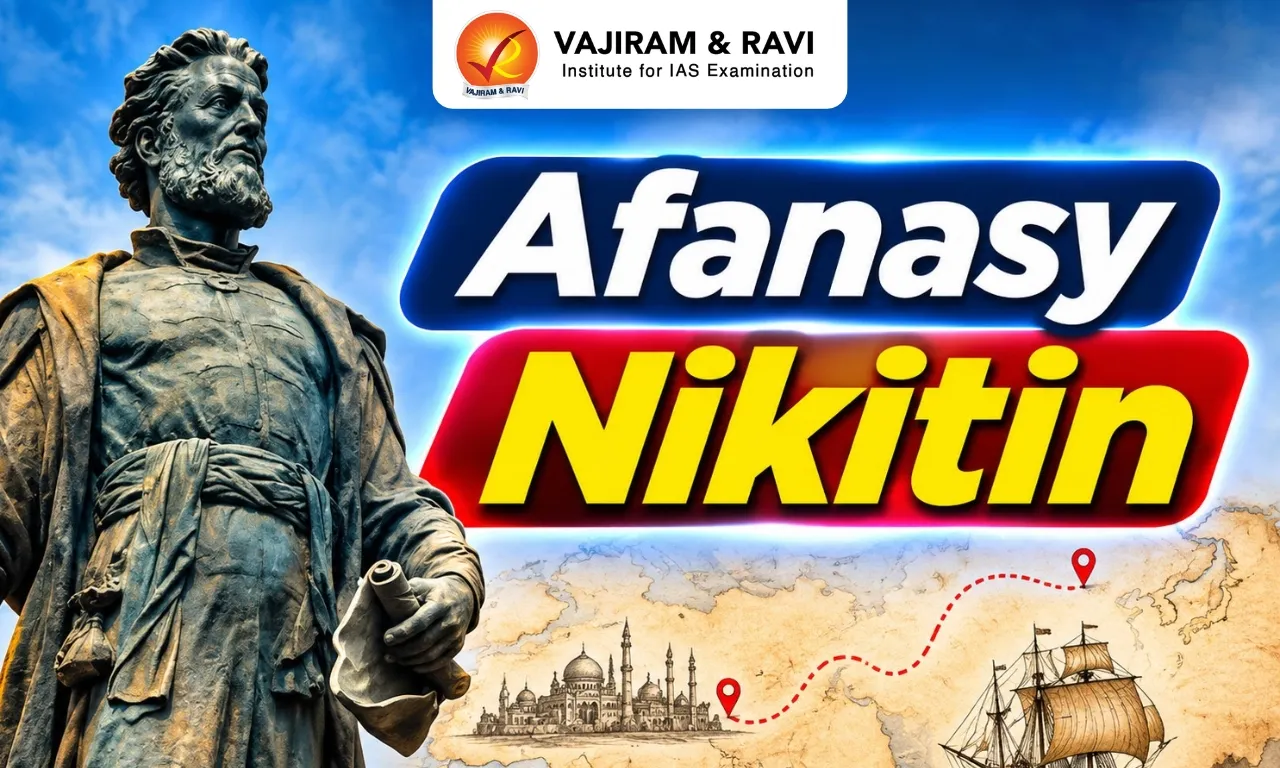
Afanasy Nikitin was a 15th-century Russian merchant and traveller from Tver, Russia, who reached India in 1469 during the Bahmani period. His Voyage Beyond Three Seas describes his journey through Cambay, Chaul, Junnar, Bidar and Parvat (Srisailam), providing observations on Indian society, religion, trade and political conditions.
Afanasy Nikitin's account records social customs, food, dress, religious practices, pilgrimage, markets, commodities, and Bahmani–Vijayanagara conflicts. It also highlights India’s commercial activity and early India–Russia contacts, making his writings a valuable foreign source for understanding 15th-century India.
Afanasy Nikitin About
Afanasy Nikitin, also known as Athanasius Nikitin, was a Russian merchant and traveller who visited India during the 15th century. He is remembered for his travelogue, Journey Beyond Three Seas, which provides valuable information about the political, social, religious and economic conditions of mediaeval India.
- Nikitin travelled to India when the Deccan region was largely under the Bahmani Sultanate, while the Vijayanagara Empire was a major rival power in southern India.
- His account offers a rare perspective on Indian society from the viewpoint of a Russian merchant who travelled thousands of kilometres to explore trading opportunities.
- Unlike royal ambassadors and religious scholars, Nikitin was primarily motivated by commercial interests. His observations included local customs, clothing, agricultural practices, markets, religious traditions, royal ceremonies and military conflicts.
Afanasy Nikitin Books
Athanasius Nikitin is best known for his travelogue, Journey Beyond Three Seas. It chronicles his travels from Russia to Persia and India during the 15th century. The account provides valuable insights into medieval India's political, social, religious and economic conditions, particularly under the Bahmani Sultanate.
Afanasy Nikitin Seamount
The Afanasy Nikitin Seamount is an underwater mountainous feature in the Central Indian Ocean named after the Russian traveller. It is geographically distinct from the Indian places described in his travelogue. The seamount has attracted attention because of cobalt-rich ferromanganese crusts. Such deposits are relevant to discussions on critical minerals, seabed exploration, resource security, and marine governance.
Afanasy Nikitin in India
Nikitin embarked on a trading journey to India in 1466 in pursuit of commercial prospects. He travelled along the Volga and crossed the Caspian Sea, visiting places in the Caucasus region. He travelled from Tver through the Black Sea, Caspian Sea, Persia, and Hormuz before reaching western India.
- Arrival: He reached western India in 1469, carrying a horse that he intended to sell, as horses were not bred in India in sufficient numbers.
- Places Visited: He visited Dega, Cambay (Khambhat), Chaul, Junnar, Bidar, Gulbarga and Parvat (Srisailam). He also wrote about Calicut and Ceylon, though scholars doubt whether he personally visited these places.
- Visit of the Bahmani Sultanate: Afanasy Nikitin visited India during the reign of Muhammad Shah III (1463-1482) of the Bahmani Sultanate; Bidar was its capital.
- Bahmani-Vijayanagara Relations: Nikitin recorded the conflict between the Bahmani Kingdom and the Vijayanagara Empire; the available source does not establish that Nikitin personally visited Vijayanagara.
- Duration: He spent nearly three years in India and left India in 1472, sailing from the port of Dabhol in Maharashtra on his journey back to Russia.


Afanasy Nikitin Observation of India
Athanasius Nikitin's travelogue provides information about several dimensions of medieval Indian life. His observations can be broadly divided into political, social, religious and economic conditions.
Political Conditions
Afanasy Nikitin visited India during a period of political competition in the Deccan. The Bahmani Sultanate was a major regional power, while the Vijayanagara Empire challenged its influence across parts of southern India. His observations provide insights into the political and military environment of the time.
- Power of the Bahmani Sultanate: Nikitin described Bidar, the Bahmani capital, and recorded details about the ruler's palace, officials, guards and royal ceremonies.
- Role of Powerful Officials: His writings mention influential political and military figures, including Malik-at-Tujjar, commonly associated in historical accounts with Mahmud Gawan, the powerful minister of the Bahmani Sultanate.
Social Conditions
Athanasius Nikitin paid close attention to clothing, food, worship, pilgrimage, and relations among different communities. His descriptions show curiosity about practices unfamiliar to a Russian visitor.
- Clothing and Dress: He observed differences in clothing between ordinary people and members of the elite. His descriptions include garments such as the dhoti, while his accounts of aristocratic clothing mention richer fabrics and additional garments.
- Social Hierarchies: Nikitin noted differences between wealthy elites and ordinary people, particularly in clothing and lifestyle. His account suggests that social position influenced access to luxury goods and the outward display of wealth.
- He noted restrictions involving dining and marriage among different groups.
- Religious Diversity: He described different religious communities and noted differences in worship, food habits and social interaction. His writings demonstrate that religious practices were an important part of everyday life.
- His visit to Parvat gave him an opportunity to observe pilgrimage, temple architecture, religious imagery and worship.
Economic Conditions
Economic activity was one of the most important subjects in Nikitin's travelogue because he travelled primarily as a merchant. His observations highlight the importance of maritime commerce, horse trading, textile markets, agriculture and regional exchange.
- Horse Trade: Nikitin brought a horse to India because horses were valuable commodities in the subcontinent. The demand for imported horses was linked to military requirements and the limitations of breeding suitable warhorses locally.
- Textile Trade: Nikitin described markets selling brocade, silk and other goods. These observations demonstrate the importance of textiles in the commercial life of the Deccan.
- Despite India's reputation for wealth, Nikitin noted difficulties associated with trading, including transport risks and expenses.
- Agricultural Practices: He observed seasonal agricultural activities, including ploughing and sowing. His descriptions refer to the cultivation of wheat, rice, pulses and other food crops, illustrating the importance of agriculture to the regional economy.
- Maritime Trade: His journey through Hormuz and western Indian ports demonstrates the importance of maritime routes connecting India with West Asia and other trading regions.
- Ports such as Cambay and Chaul were important points of contact between inland production centres and overseas markets.
- Regional Markets: Nikitin described markets in Bidar and other settlements, noting the availability of horses, textiles and various commodities. His account shows how commercial centres supported the movement of goods across different regions.
Afanasy Nikitin Account Significance
Afanasy Nikitin’s account is an important foreign description of 15th-century India, providing insights into its society, religion, economy, trade, and political life.
- A Rare Russian Account of India: Athanasius Nikitin is remembered as one of the earliest known Russian travellers to reach India. His account provides evidence of contact between Russia and the Indian subcontinent before Vasco da Gama's arrival in India in 1498.
- Source for Medieval Deccan History: His descriptions of Bidar, Junnar and the Bahmani political establishment provide valuable information about the Deccan during the 15th century. These observations complement Indian chronicles, inscriptions, archaeological evidence and other travellers' accounts.
- Information on Socio-economic Life: His writings contain details about clothing, food, religious practices, pilgrimage and social differences. It also demonstrates how commercial interests encouraged long-distance travel and interaction between different societies.

 Last updated on Nov, 2026
→ UPSC 2027 Notification will be released on 13 January 2027 at upsconline.nic.in.
→ Check Nobel Prize 2026 Winners List here.
→ Download PIB PRiSM Monthly Magazine 2026 here.
→ Check UPSC Monthly Current Affairs Magazine The Recitals here.
→ Check out the latest UPSC Syllabus here.
→ Download UPSC Model Answers for Mains 2026
→ UPSC Mains Question Paper 2026 is out now for Essay & GS Paper 1, 2, 3 & 4.
→ UPSC Calendar 2027 has been released.
→ Enroll in Vajiram & Ravi’s UPSC Mains Test Series 2027 for structured answer writing practice, expert evaluation, and exam-oriented feedback.
→ Join Vajiram & Ravi’s UPSC Mentorship Program 2027 for personalized guidance, strategy planning, and one-to-one support from experienced mentors.
→ Go through the UPSC Mains Previous Year Papers to enhance your preparation.
→ UPSC has released UPSC Toppers List 2025 with the Civil Services final result on its official website.
→ Also check Best UPSC Coaching in India
Afanasy Nikitin FAQs
Q1. Who was Afanasy Nikitin? +
Q2. Which book did Nikitin write? +
Q3. Did Afanasy Nikitin visit India?+
Q4. Which country was Afanasy Nikitin from?+
Q5. Which Russian traveller visited Bahmani Kingdom?+
Tags: afanasy nikitin quest upsc ancient history notes