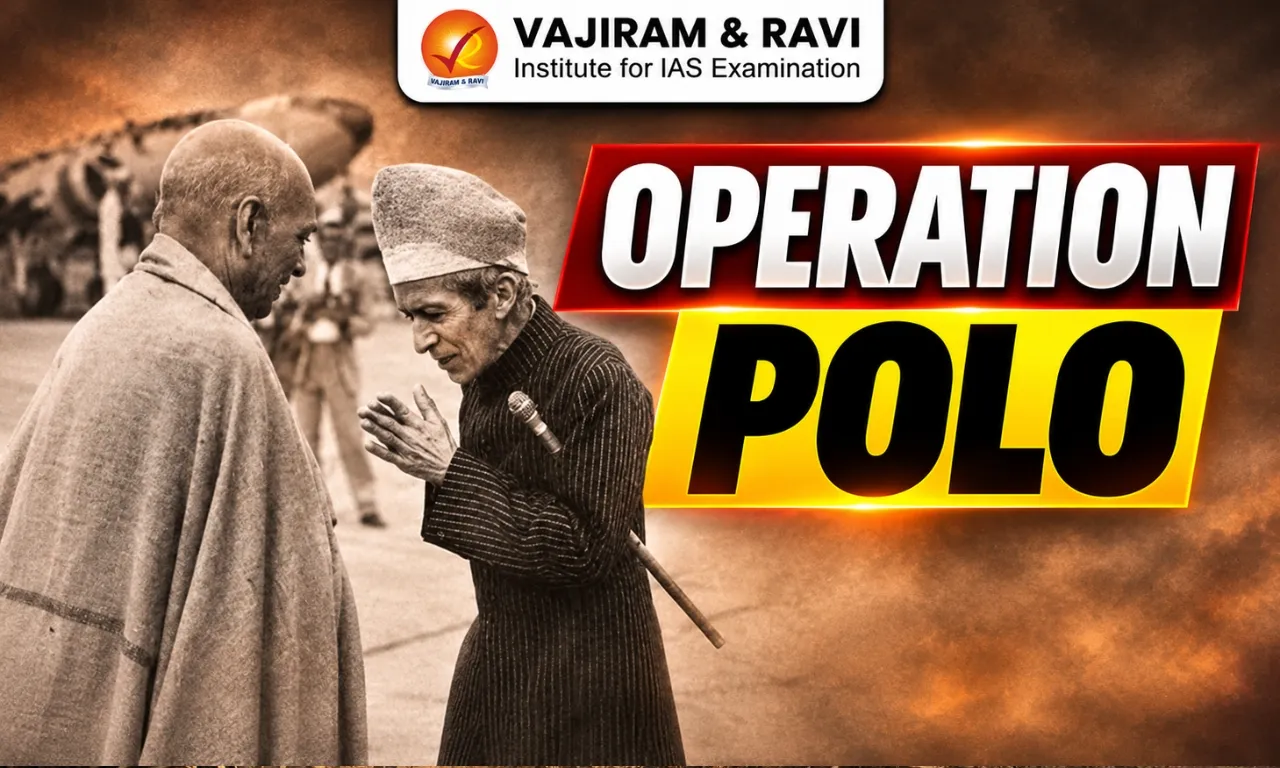
Operation Polo 1948, also known as the Hyderabad Police Action, was a military operation conducted by the Indian Army in September 1948 to annex the princely state of Hyderabad into the newly independent Union of India. The operation, which lasted from September 13 to 18, 1948, followed the Nizam of Hyderabad's initial refusal to accede to India amid rising tensions, including communal violence led by the paramilitary group known as the Razakars.
Indian forces, under the leadership of figures like Sardar Vallabhbhai Patel, swiftly overpowered Hyderabad's defences, leading to the Nizam's surrender and a ceasefire on September 17, 1948. Operation Polo remains a pivotal event in post-independence history, symbolising India’s determination to preserve sovereignty and political integration.
Operation Polo 1948 About
Operation Polo, often referred to as the "Police Action", was a military operation launched by the Indian Armed Forces on 13 September 1948. The objective was to integrate the princely state of Hyderabad into the Indian Union after its ruler, the Nizam, sought independence rather than joining India or Pakistan post-independence.
Operation Polo Date and Year
The Indian government launched Operation Polo on 13 September 1948. The operation lasted five days and concluded with the surrender of Hyderabad's forces on 17 September 1948. The Nizam subsequently announced Hyderabad's accession to the Indian Union.
- Operation Polo Start Date: 13 September 1948.
- Operation Polo End Date: 17 September 1948.
Instrument of Accession of Hyderabad
The Instrument of Accession of Hyderabad was signed by Nizam Osman Ali Khan on September 25, 1948, formally integrating the princely state into India. Following India's independence in 1947, the Nizam initially resisted integration, seeking independence or alignment with Pakistan. This triggered internal unrest and ultimate military intervention via Operation Polo, leading to Hyderabad's accession.
Operation Polo 1948 Background
In 1947, when British rule in India ended, princely states were given the option to join either India or Pakistan or remain independent. Hyderabad, a princely state not directly under British rule, chose not to merge with India after Independence. The Nizam of Hyderabad, Mir Osman Ali Khan, rejected the idea of joining India and declared Hyderabad an independent nation on August 15, 1947.
- In November 1947, the Nizam signed a standstill agreement with India, maintaining the status quo between both sides for one year.
- The agreement stipulated that India would not exert authority over Hyderabad during the period, and the conditions present at the time of signing would remain unchanged.
- In June 1948, Lord Mountbatten proposed the "Heads of Agreement" deal, offering Hyderabad autonomy under Indian rule.
- India agreed to the deal, but the Nizam rejected it, insisting on complete independence or dominion status under the British Commonwealth of Nations.


Events Preceding Operation Polo 1948
The Nizam of Hyderabad's attempts to establish an independent constitutional monarchy failed, leading to internal conflict with India. Rising tensions, fuelled by the Razakars' violent actions, prompted Sardar Vallabhbhai Patel to initiate military action (Operation Polo) on September 13, 1948. The causes for Operation Polo of 1948 are given below:
- Negotiations for Independence: The Nizam of Hyderabad proposed making Hyderabad a constitutional monarchy within the Commonwealth of Nations. This was rejected by Lord Louis Mountbatten, the last viceroy of India.
- After British rejection, the Nizam negotiated with European nations and tried to purchase Goa from the Portuguese for sea access.
- Internal Conflict: Prime Minister Jawaharlal Nehru preferred diplomacy to prevent Hyderabad's secession, while Deputy Prime Minister Sardar Vallabhbhai Patel favoured military action.
- Rise of the Razakars: The Razakars, led by Syed Kasim Rizvi, gained control in Hyderabad, surpassing the Nizam's authority. Rizvi sought an independent state with Muslim supremacy, eliminating opposition, including communists, Congress members, Telangana rebels, and moderate Muslims.
- United Nations and Violence: The Nizam attempted, unsuccessfully, to seek intervention from the United Nations. Meanwhile, the Razakars unleashed communal violence, causing many Hindus to flee Hyderabad.
- Date for the Operation: Set for September 13, despite objections from General Sir Roy Bucher, India's Chief of Staff, citing concerns over opening another front after the Kashmir conflict.
- Military Action: A skirmish between the Indian Army and Hyderabadi forces at Kodad led Sardar Vallabhbhai Patel to initiate military action (Operation Polo) against Hyderabad.
Operation Polo 1948 Key Events
Indian forces launched a decisive military campaign on September 13, 1948, entering Hyderabad and swiftly securing key locations, including Naldurg Fort. Over the following days, heavy resistance from Razakar units was crushed, leading to the Nizam's ceasefire on September 17, marking the end of the conflict. The detailed explanation is given below:
- September 13, 1948: Indian forces entered Hyderabad and engaged in their first battle at Naldurg Fort on the Solapur-Secunderabad Highway.
- The Indian 7th Brigade defeated the 1st Hyderabad Infantry and secured the Naldurg Fort.
- By the end of the day, Indian troops inflicted heavy casualties and captured significant territory on the Western Front.
- September 14, 1948: Indian forces advanced from Umarge to the town of Rajeshwar, 48 km east. Aerial reconnaissance revealed ambush positions, prompting Tempest airstrikes to clear the route, allowing ground troops to reach and secure Rajeshwar by the afternoon.
- September 15, 1948: A company of 3/11 Gurkhas was left to occupy Jalna, while the rest of the force advanced to Latur and then Mominabad. There, they encountered the 3 Golconda Lancers, who offered minimal resistance before surrendering.
- September 16, 1948: The main resistance came from Razakar units ambushing Indian troops in urban areas, using the terrain to their advantage until the Indians brought in their 75 mm guns. The artillery successfully forced the Razakars into submission.
- September 17, 1948: The Indian army entered Bidar. At the same time, the 1st Armoured Regiment reached Chityal, 60 km from Hyderabad, while another unit captured the town of Hingoli.
- The Razakars and the Hyderabadi military had been defeated with heavy casualties. The Nizam then declared a ceasefire, resulting in the annexation of Hyderabad.
Operation Polo 1948 Leaders
Several political and military figures played significant roles in the events surrounding Operation Polo 1948.
- Sardar Vallabhbhai Patel: Union Home Minister and Deputy Prime Minister who strongly pushed for and authorized the police action to integrate Hyderabad.
- Jawaharlal Nehru: Prime Minister of India who initially had reservations about military action due to potential communal fallout but supported the state's integration.
- Mir Osman Ali Khan: He was the seventh and last ruling Nizam of Hyderabad. He sought to maintain Hyderabad's independence after British rule ended but eventually accepted integration into the Indian Union.
- Major General J.N. Chaudhuri: Commander of the main western assault thrust from Solapur who later administered Hyderabad post-surrender.
- Major General Syed Ahmed El Edroos: He was the commander-in-chief of the Hyderabad State Forces. He surrendered to Indian forces on 17 September 1948, bringing the military campaign to an end.
- Qasim Razvi: He was the leader of the Razakars and an influential figure in the Majlis-e-Ittehadul Muslimeen. He supported the Nizam's demand for an independent Hyderabad and opposed its accession to India.
Operation Polo 1948 Aftermath
After Operation Polo, the Indian military detained thousands, including Razakars, Hindu militants, and communists, often based on local informants settling personal disputes. This led to the detention of nearly 18,000 individuals, which caused overcrowding in jails and strained the criminal justice system. Key events following the operation include:
- On September 18, 1948, General Joyanto Nath Chaudhuri led an armoured column into Hyderabad. The Hyderabad army, under Major General El Edroos, surrendered to Indian forces.
- The Nizam abdicated after the surrender, and the princely state of Hyderabad ceased to exist. The Nizam signed the Instrument of Accession, formally merging Hyderabad into India.
Operation Polo 1948 Significance
Operation Polo was a significant event in India's history that played a crucial role in the unification of the newly independent nation. It underscored the challenges involved in integrating princely states and demonstrated the Indian government's firm measures to maintain national unity.
- Consolidation of India's Territorial Integrity: It played a pivotal role in unifying post-independence India by integrating one of the largest princely states, preventing potential fragmentation and ensuring the country's sovereignty over its internal territories.
- Promotion of National Unity: By decisively incorporating Hyderabad, the operation demonstrated India's resolve to maintain a cohesive nation-state, averting the risk of foreign influence or secessionist movements in the region.
- Ending Communal Violence: The action halted the Razakars' campaigns of terror against the local population, particularly Hindus, and helped stabilise the region by curbing potential large-scale communal conflicts.
- Strengthening Democratic Governance: It facilitated the transition from monarchical rule under the Nizam to integration within India's democratic framework, paving the way for modern administrative reforms in the region (now parts of Telangana, Andhra Pradesh, Karnataka, and Maharashtra).
- Historical and Symbolic Importance: Often viewed as a "police action" rather than a full war due to its brevity and limited scale, it remains a symbol of India's post-colonial consolidation efforts.
- In recent years, it has been commemorated in Telangana as "Hyderabad Liberation Day" or "Praja Palana Day" to honour the integration.
Operation Polo 1948 Outcomes
Operation Polo resulted in the successful integration of Hyderabad into the Indian Union, ending the autocratic rule of the Nizam and establishing democratic governance. This operation reinforced India's territorial and political unity, setting a precedent for the seamless integration of other princely states. The outcomes of the operation Polo are explained below:
- Integration of Hyderabad: The state of Hyderabad officially became part of the Indian Union.
- End of Autocracy: The Nizam's rule concluded, and democratic governance was introduced.
- Disintegration: The Hyderabad state was dissolved, and its regions merged with Andhra, Mysore, and Bombay states.
- Strengthened Unity: The operation reinforced India's territorial and political unity, setting an example for integrating other princely states.
75th Anniversary of Operation Polo 1948
The 75th anniversary of Operation Polo was observed on 13 September 2023. It marked 75 years since the operation that integrated Hyderabad into India. The anniversary was commemorated with discussions on its historical significance, the role of Sardar Patel, and the broader context of India’s post-independence integration efforts.

 Last updated on Nov, 2026
→ UPSC Mains Result 2026 has been declared on 05 November 2026 at the official website at upsc.gov.in.
→ UPSC 2027 Notification will be released on 13 January 2027 at upsconline.nic.in.
→ Check Nobel Prize 2026 Winners List here.
→ Download PIB PRiSM Monthly Magazine 2026 here.
→ Check UPSC Monthly Current Affairs Magazine The Recitals here.
→ Check out the latest UPSC Syllabus here.
→ Download UPSC Model Answers for Mains 2026
→ UPSC Mains Question Paper 2026 is out now for Essay & GS Paper 1, 2, 3 & 4.
→ UPSC Calendar 2027 has been released.
→ Enroll in Vajiram & Ravi’s UPSC Mains Test Series 2027 for structured answer writing practice, expert evaluation, and exam-oriented feedback.
→ Join Vajiram & Ravi’s UPSC Mentorship Program 2027 for personalized guidance, strategy planning, and one-to-one support from experienced mentors.
→ Go through the UPSC Mains Previous Year Papers to enhance your preparation.
→ UPSC has released UPSC Toppers List 2025 with the Civil Services final result on its official website.
→ Also check Best UPSC Coaching in India
Operation Polo 1948 FAQs
Q1. What is Operation Polo?+
Q2. Who led Operation Polo during 1948?+
Q3. What happened on 17 September 1948?+
Q4. What is another name for Operation Polo?+
Q5. What happened to the Nizam after Operation Polo?+
Tags: operation polo 1948 quest UPSC Post-Independence India Notes