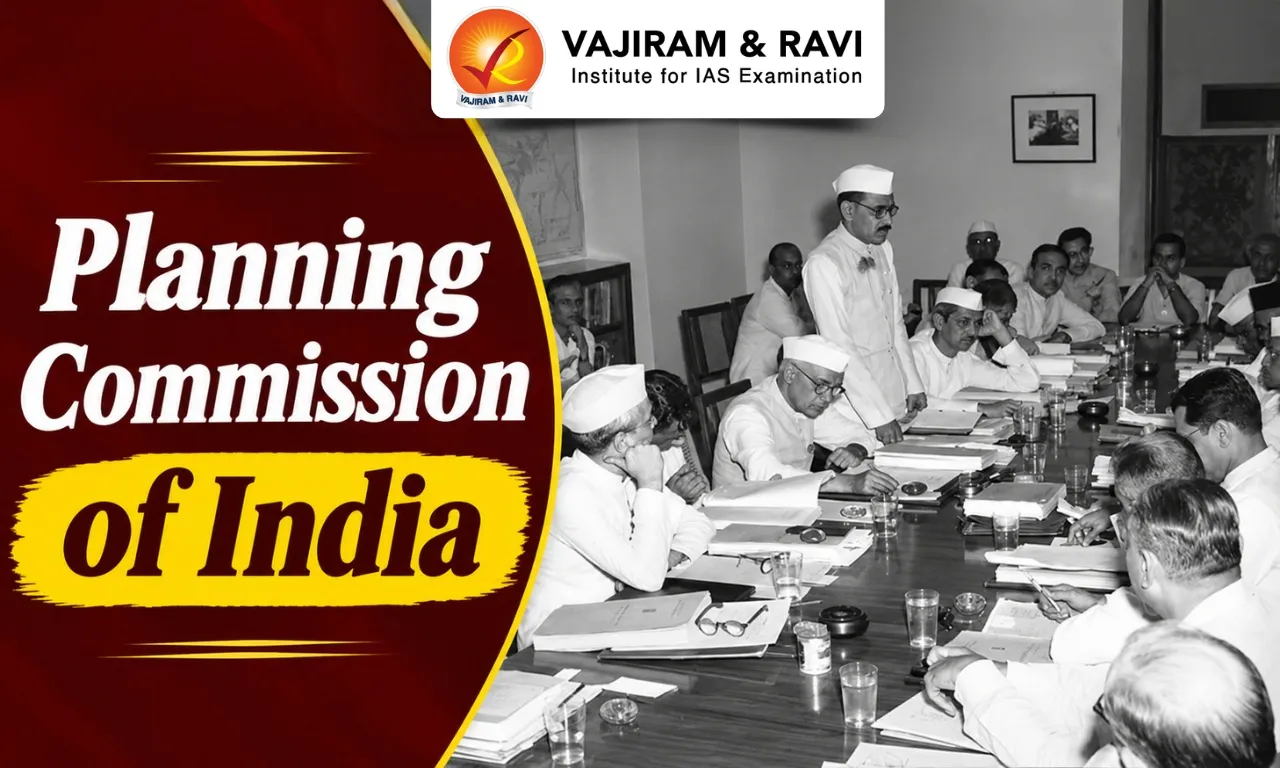
The Planning Commission of India, established on 15 March 1950 through a Cabinet Resolution, was India's central institution for formulating Five Year Plans and guiding economic development. It aimed to promote balanced growth, efficient resource utilisation and social justice through coordinated national planning.
The Commission played a significant role in India's industrialisation, infrastructure development, poverty alleviation and expansion of public-sector investment. However, its centralised, top-down approach, limited state participation, bureaucratic functioning and weak implementation mechanisms attracted criticism, eventually leading to its replacement by NITI Aayog in 2015.
Planning Commission of India About
The Planning Commission of India was an important institution responsible for formulating India's economic and social development strategies after independence. It played a central role in allocating resources, preparing Five Year Plans of India and guiding national development priorities.
Planning Commission Established
The Planning Commission was set up in March 1950 through a resolution of the Government of India. It was an extra-constitutional and non-statutory body, meaning it was neither created by the Constitution nor established through an Act of Parliament. It was established on 15 March 1950, through a Cabinet Resolution of the Government of India.
- The institution was inspired by the idea of planned economic development, in which the government played a significant role in directing investment, resource allocation and development activities.
- The Prime Minister of India served as the ex-officio Chairman of the Planning Commission. It worked closely with Union Ministries, State Governments and other institutions to formulate development policies and monitor their implementation.
State Planning Commission
Several Indian States also had their own State Planning Commissions or State Planning Boards. These bodies prepared State-level development plans, aligned them with national priorities, and coordinated with the central Planning Commission.
Planning Commission of India History
The Planning Commission in India emerged during the pre-independence period to address poverty, industrial backwardness, and economic inequalities. Several plans and institutional initiatives laid the foundation for establishing a central planning body after Independence.
Pre-Independence Initiatives
Several leaders, economists, and industrialists proposed different approaches to economic development, highlighting the need for systematic national planning.
- Visvesvaraya's Plan (1934): M. Visvesvaraya proposed a ten-year plan for India's industrialisation in his book Planned Economy for India.
- National Planning Committee (1938): It was established by the Indian National Congress under Jawaharlal Nehru to formulate a comprehensive national development strategy.
- Alternative Economic Plans (1944–45): Three major proposals emerged:
- Bombay Plan, which was proposed by leading industrialists, emphasising industrialisation.
- Gandhian Plan was proposed by S.N. Agarwal, focusing on village industries and decentralisation.
- People's Plan was proposed by M.N. Roy, prioritising agriculture and nationalisation.
- Advisory Planning Board (1946): It was established under K.C. Neogy, which recommended setting up a permanent planning body.
Post-Independence Initiatives
Following Independence, the need for coordinated resource utilisation and balanced economic development led to the creation of formal planning institutions.
- Planning Commission (1950): The Planning Commission was established on 15 March 1950 through a Cabinet Resolution to assess national resources, formulate development plans and promote balanced economic growth.
- National Development Council (1952): It was established to strengthen Centre–State coordination and facilitate the participation of states in economic planning.
- Five-Year Plans (1951): The First Five-Year Plan marked the beginning of systematic economic planning in independent India.
- Replacement by NITI Aayog: On 1 January 2015, the Government of India replaced the Planning Commission of India with NITI Aayog to promote cooperative federalism, policy innovation and participatory governance.


Planning Commission of India Objectives
The Planning Commission of India was established to guide India's socio-economic development through systematic planning and optimal utilisation of available resources. Its objectives focused on economic growth, social justice and balanced regional development.
- Economic Growth: To promote a rapid increase in national and per capita income through planned development.
- Resource Utilisation: To identify and effectively utilise the country's material, capital and human resources.
- Balanced Regional Development: To reduce regional disparities by promoting development in backward and underdeveloped areas.
- Employment Generation: To expand productive employment opportunities and improve people's living standards.
- Social Justice: To reduce inequalities in income and wealth and ensure equitable distribution of development benefits.
- Self-Reliance: To strengthen domestic production capacity and reduce dependence on external resources.
Planning Commission of India Composition
The Planning Commission of India had a flexible organisational structure comprising political leaders, economic experts and senior administrators. It was headed by the Prime Minister, with the Deputy Chairman managing its executive functions and expert members providing technical advice. The Planning Commission members included:
- Planning Commission Chairman: The Prime Minister of India served as the ex-officio Chairman of Planning Commission of India. The Chairman provided overall leadership and guidance to the institution.
- Jawaharlal Nehru was the first Chairman of Planning Commission. The last Chairman was Narendra Modi, who served until the Commission’s dissolution in 2014.
- Deputy Chairman: He was appointed by the Central Cabinet and functioned as the de facto executive head. He was responsible for formulating and submitting five-year plans and enjoyed Cabinet Minister rank.
- Gulzarilal Nanda was the first Deputy Chairman of Planning Commission of India.
- Ex-officio Members: Finance Minister and Planning Minister, along with selected Union Ministers.
- Full-time Members: Generally 4–7 experts with backgrounds in economics, administration and other specialised fields; enjoyed Minister of State rank.
- Member-Secretary: A senior IAS officer responsible for administrative coordination and secretarial functions.
Planning Commission of India Functions
Planning Commission of India played a central role in India's economic planning by formulating development strategies, coordinating national priorities, and promoting the efficient utilisation of resources. Its major functions included:
- Assessment of Resources: The Commission assessed the country's material, capital, and human resources and identified possibilities for their expansion.
- Plan Formulation: It prepared Five Year Plans by determining national development priorities, objectives and targets.
- Priority Setting: It identified key sectors and established development priorities based on national economic and social needs.
- Resource Allocation: It recommended the distribution of plan assistance among different sectors and states.
- Centre–State Coordination: It facilitated coordination between Central Ministries and State Governments for effective implementation of development programmes.
- Monitoring and Evaluation: It reviewed the progress of development plans and assessed the achievement of their objectives and targets.
- Policy Recommendations: It suggested changes in economic policies and administrative arrangements to improve planning and development outcomes.
Planning Commission of India and Five Year Plans
The Planning Commission of India played a central role in India's Five-Year Plan system, which was adopted to organise economic development through medium-term targets and investment priorities. India launched its First Five-Year Plan in 1951, focusing primarily on agriculture, irrigation and rehabilitation after independence. A total of 12 Five-Year Plans were implemented between 1951 and 2017.
| Five-Year Plan | Period | Major Focus |
|
First Plan |
1951–1956 |
Agriculture, irrigation and rehabilitation |
|
Second Plan |
1956–1961 |
Heavy industries and industrialisation |
|
Third Plan |
1961–1966 |
Self-reliance and agricultural development |
|
Plan Holiday |
1966–1969 |
Three Annual Plans |
|
Fourth Plan |
1969–1974 |
Growth with stability and self-reliance |
|
Fifth Plan |
1974–1979 |
Poverty removal and self-reliance |
|
Rolling Plan |
1978–1980 |
Flexible planning approach |
|
Sixth Plan |
1980–1985 |
Poverty alleviation and technological development |
|
Seventh Plan |
1985–1990 |
Food, work and productivity |
|
Annual Plans |
1990–1992 |
Economic adjustment and stabilisation |
|
Eighth Plan |
1992–1997 |
Human resource development |
|
Ninth Plan |
1997–2002 |
Growth with social justice and equality |
|
Tenth Plan |
2002–2007 |
Faster and equitable growth |
|
Eleventh Plan |
2007–2012 |
Faster and more inclusive growth |
|
Twelfth Plan |
2012–2017 |
Faster, more inclusive and sustainable growth |
Planning Commission of India Achievements
The Planning Commission of India contributed to India's socio-economic transformation through successive Five Year Plans, focusing on economic growth, self-reliance, social justice, modernisation and economic stability. Its major achievements can be understood through the following areas:
- Agricultural Growth & Food Security: Initiated targeted investments and the Green Revolution (starting from the 3rd Plan), turning India from a food-aid-dependent nation into a grain-surplus country with foodgrain production expanding dramatically (from 51 million tonnes to nearly 292 million tonnes by later decades).
- Economic Growth: India's average annual Gross Domestic Product (GDP) growth improved from around 3.7% before 1980 to 5.4% during the Sixth Plan, 5.8% during the Seventh Plan and 6.8% during the Eighth Plan.
- Economic Self-Reliance: India achieved self-sufficiency in foodgrain production by the end of the Fifth Plan, while the share of foreign aid in plan outlays declined from 28.1% in the Second Plan to 5.5% in the Eighth Plan.
- Social Justice: Various land reforms, poverty alleviation programmes and targeted development initiatives were introduced to improve the socio-economic conditions of weaker sections, including SCs and STs.
- Modernisation: Championed the Mahalanobis model in the Second Plan, establishing heavy public-sector steel plants (Bhilai, Durgapur, Rourkela), multi-purpose river valley dams (such as Bhakra Nangal), and core machine-building capabilities that reduced import dependence.
- Educational & Technical Infrastructure: Laid the groundwork for world-class technical and research institutions, including the early setting up of the Indian Institutes of Technology (IITs) and the University Grants Commission (UGC), lifting national literacy significantly.
Planning Commission of India Limitations
Despite its contribution to India's economic development, the Planning Commission of India faced several structural and operational limitations that affected the effectiveness of economic planning and implementation.
- Centralised Planning: Its top-down approach limited the autonomy of State Governments and reduced their participation in national planning.
- Weak Cooperative Federalism: The Commission's control over plan assistance and centrally sponsored schemes created an imbalance in Centre–State financial relations.
- Implementation Gaps: Delays in project execution, administrative inefficiencies, and inadequate monitoring resulted in gaps between planned targets and actual achievements.
- Political Interference: Political considerations sometimes influenced resource allocation and the selection of development priorities.
- Limited Grassroots Participation: Insufficient involvement of Panchayati Raj Institutions, urban local bodies, and local communities weakened decentralised planning.
- Bureaucratic Approach: Excessive dependence on administrative procedures and centralised decision-making reduced flexibility and responsiveness.
Replacement of Planning Commission of India
The Planning Commission of India was replaced by the National Institution for Transforming India (NITI Aayog) on 1 January 2015 through a Cabinet Resolution. The reasons for replacement were:
- Changing Economic Environment: India's transition towards a liberalised, globalised and market-orientated economy required a more flexible approach to development planning.
- Centralised Planning: The top-down planning approach of the Commission limited State Governments' autonomy in determining their development priorities.
- Need for Cooperative Federalism: Greater involvement of States was necessary to promote shared decision-making and participatory development.
- One-Size-Fits-All Approach: Regional differences in resources, economic conditions, and development requirements demanded state-specific strategies.
- Implementation Challenges: Delays in policy execution and inadequate coordination among ministries highlighted the need for stronger institutional mechanisms.
- Changing Role of Government: The shift from direct resource allocation towards policy facilitation, regulation, and enabling private investment required a different institutional framework.
Difference Between Planning Commission and NITI Aayog
The Planning Commission of India and NITI Aayog differ in their institutional structure, approach to planning, relationship with states and role in resource allocation.
|
Basis |
Planning Commission |
NITI Aayog |
|
Establishment |
Established on 15 March 1950 through a Cabinet Resolution. |
Established on 1 January 2015 through a Cabinet Resolution. |
|
Nature |
Central planning and advisory body. |
Government's policy think tank. |
|
Approach |
Followed a largely top-down planning approach. |
Promotes bottom-up and participatory planning. |
|
Federalism |
Limited direct participation of States in its organisational structure. |
Promotes cooperative and competitive federalism. |
|
Resource Allocation |
Influences the allocation of Plan funds to States and Ministries. |
It has no independent power to allocate funds; financial allocations are handled by the Ministry of Finance. |
|
Planning Framework |
Formulated Five Year Plans and Annual Plans. |
Develops long-term strategies, policy frameworks and action agendas. |
|
Role of States |
States participated mainly through the National Development Council and Plan discussions. |
Chief Ministers and Lieutenant Governors participate through the Governing Council. |
|
Policy Formulation |
Recommended policies and development priorities through centralised planning. |
Provides strategic and technical advice based on regional requirements and national priorities. |
|
Membership |
Chairman, Deputy Chairman, full-time members and other designated members. |
Chairperson, Vice-Chairperson, full-time members, part-time members, ex-officio members and CEO. |
|
Monitoring |
Monitored the implementation and performance of Five Year Plans. |
Monitors and evaluates government programmes and policy outcomes. |
|
Accountability |
Influenced development through plan allocations and performance assessments. |
Emphasises policy outcomes, performance indicators and cooperative engagement. |
Planning Commission of India UPSC PYQs
Q1: The Government of India has established NITI Aayog to replace the (UPSC Prelims 2015)
(a) Human Rights Commission
(b) Finance Commission
(c) Law Commission
(d) Planning Commission
Ans: (d)

 Last updated on Nov, 2026
→ UPSC Mains Result 2026 has been declared on 05 November 2026 at the official website at upsc.gov.in.
→ UPSC 2027 Notification will be released on 13 January 2027 at upsconline.nic.in.
→ Check Nobel Prize 2026 Winners List here.
→ Download PIB PRiSM Monthly Magazine 2026 here.
→ Check UPSC Monthly Current Affairs Magazine The Recitals here.
→ Check out the latest UPSC Syllabus here.
→ Download UPSC Model Answers for Mains 2026
→ UPSC Mains Question Paper 2026 is out now for Essay & GS Paper 1, 2, 3 & 4.
→ UPSC Calendar 2027 has been released.
→ Enroll in Vajiram & Ravi’s UPSC Mains Test Series 2027 for structured answer writing practice, expert evaluation, and exam-oriented feedback.
→ Join Vajiram & Ravi’s UPSC Mentorship Program 2027 for personalized guidance, strategy planning, and one-to-one support from experienced mentors.
→ Go through the UPSC Mains Previous Year Papers to enhance your preparation.
→ UPSC has released UPSC Toppers List 2025 with the Civil Services final result on its official website.
→ Also check Best UPSC Coaching in India
Planning Commission of India FAQs
Q1. What is the Planning Commission?+
Q2. Who established the Planning Commission of India?+
Q3. Why was the Planning Commission replaced by NITI Aayog?+
Q4. Who is the father of the Planning Commission in India?+
Q5. What's the difference between NITI Aayog and the Planning Commission?+
Tags: planning commission of india quest UPSC Post-Independence India Notes