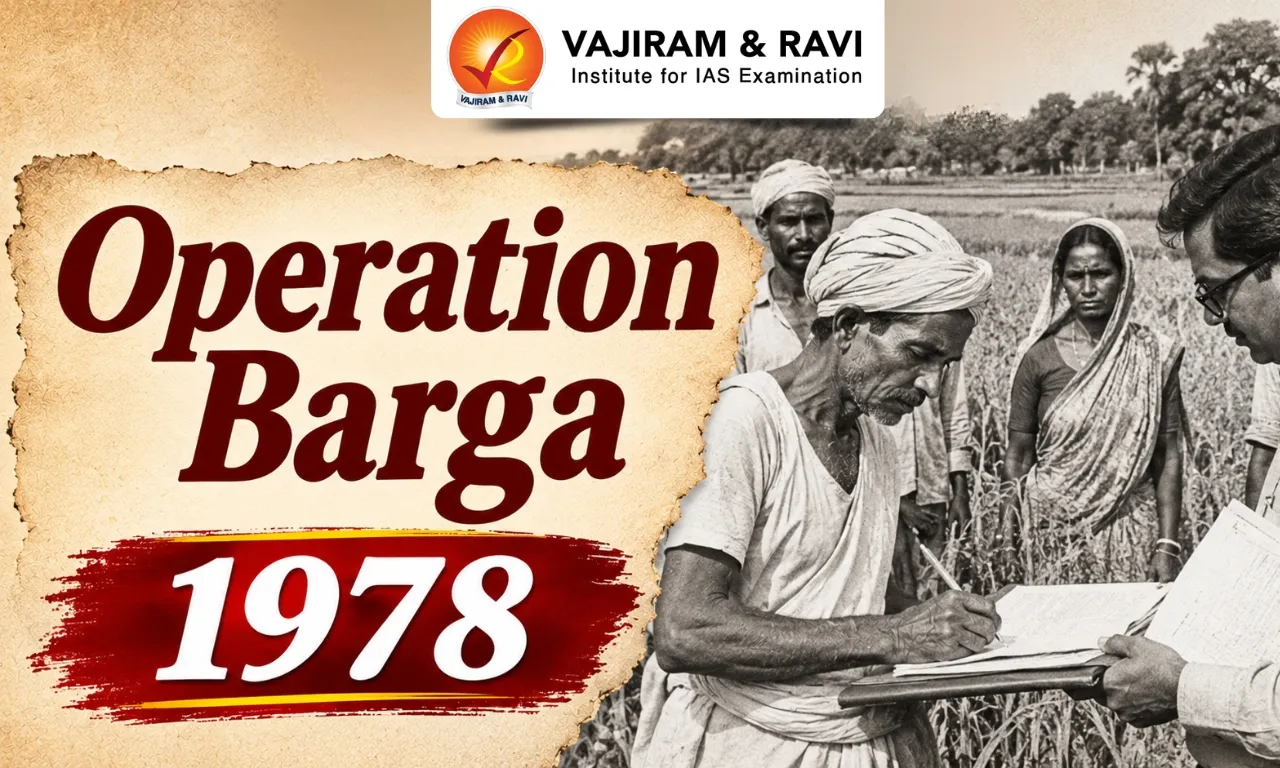
Operation Barga was a major land reform initiative launched by the Left Front government in West Bengal in 1978 to protect the rights of sharecroppers (bargadars) and provide them with security of tenure. The programme focused on officially recording the names of sharecroppers in government land records, protecting them against arbitrary eviction and ensuring their legally prescribed share of agricultural produce.
As of now, the operation has successfully documented the names of around 1.5 million bargadars. Operation Barga is considered one of India's most successful land reforms, strengthening sharecroppers' security and rights within the agricultural system.
Operation Barga Background
Operation Barga in West Bengal was introduced in 1978 by the Left Front government to address longstanding agrarian inequalities and protect the rights of sharecroppers (bargadars).
- Unequal Land Relations: The Permanent Settlement of 1793 established the zamindari system in Bengal. Over time, multiple layers of intermediaries emerged between landowners and actual cultivators. This contributed to unequal land relations and the exploitation of agricultural tenants.
- Insecure Tenancy: Before Operation Barga, many sharecroppers (bargardars) in West Bengal cultivated land owned by landlords, called jotedars. These bargadars often lacked formal documentation and faced the constant threat of eviction.
- Earlier Land Reform Measures: Following independence, the West Bengal government introduced legislative measures to improve the condition of agricultural tenants. The West Bengal Bargadars Act, 1950, was an early attempt to protect sharecroppers.
- Its provisions were subsequently incorporated into the West Bengal Land Reforms Act, 1955.
- However, legal protection on paper did not automatically translate into actual protection at the village level.
- Need for Land Reforms: The government sought to provide legal security to sharecroppers, improve their bargaining power, and promote equitable agricultural development.
- Introduction of Operation: After the Left Front government came to power in West Bengal in 1977, land reforms became a major policy priority. Operation Barga was launched by the West Bengal government in 1978 to systematically register sharecroppers and ensure the effective implementation of tenancy laws.
Operation Barga Objectives
Operation Barga aimed to empower sharecroppers (bargadars) by providing legal protection, improving their economic security, and promoting equitable agrarian relations.
- Tenancy Security: To protect sharecroppers from arbitrary eviction and ensure continuity of cultivation.
- Legal Recognition: To formally register sharecroppers and establish their tenancy rights in land records.
- Fair Crop Sharing: To ensure a fairer distribution of agricultural produce between landowners and sharecroppers.
- Agrarian Equity: To reduce exploitation by landlords and address inequalities in rural land relations.
- Agricultural Productivity: To encourage investment in cultivation by providing sharecroppers greater security over their livelihoods.


Operation Barga Features
Operation Barga was implemented through a village-level registration campaign to enforce existing tenancy rights and provide legal and economic security to sharecroppers (bargadars).
- Registration of Bargadars: Sharecroppers were officially registered in government land records, providing legal recognition to their cultivation rights and enabling them to claim statutory protection.
- Security of Tenure: Registered sharecroppers received heritable cultivation rights, protecting them against arbitrary eviction and ensuring continuity of agricultural operations, subject to legal conditions.
- Fair Crop Sharing: Sharecroppers were entitled to 75% of the produce if they provided the major agricultural inputs, while their share was 50% if the landowner supplied the required inputs.
- Burden of Proof: The responsibility of disproving a sharecropper's claim to tenancy rights was placed on the landowner, reducing the vulnerability of cultivators to arbitrary eviction and disputes.
- Institutional Support: Registered sharecroppers received improved access to institutional agricultural credit and government support, including subsidised seeds, fertilisers and other agricultural inputs, helping strengthen their productive capacity.
Operation Barga Working and Implementation
Operation Barga's implementation focused on involving the people in land reforms and promoting collective action among all stakeholders for its implementation. While it did not directly seek to make bargadars landowners, it included provisions to support their potential conversion, such as granting them priority rights to purchase barga land if the landlord decided to sell.
- The Operation authorised the creation of a "land corporation" to provide funding for the land purchase, though this provision has yet to be implemented due to financial constraints.
- Operation Barga was carried out in the following five key steps:
- Identifying areas with a high concentration of bargadars
- Setting up camps by government officials in these areas
- Organising meetings between bargadars and officials
- Involving villagers in field verification to validate the claims of sharecroppers
- Issuing temporary certificates ('parchas') to confirm their rights, allowing them to access bank credit.
Operation Barga Significance
Operation Barga marked a major milestone in India's land reform history by strengthening sharecroppers' rights and promoting agrarian equity, rural empowerment, and agricultural development.
- Tenancy Security: It provided legal recognition and protection against arbitrary eviction, improving the livelihood security of sharecroppers. It helped register approximately 1.5 million sharecroppers by 2003, providing legal recognition and protection against arbitrary eviction.
- Economic Empowerment: It strengthened the bargaining power of sharecroppers by ensuring fairer crop-sharing arrangements and reducing their dependence on landlords and moneylenders.
- Agricultural Productivity: The Operation encouraged greater investment and cultivation efforts through improved tenure security and better contractual terms.
- A 2002 study by Banerjee, Gertler and Ghatak estimated that Operation Barga contributed to around 28% of subsequent agricultural productivity growth in West Bengal.
- Agrarian Equity: It also improved the position of tenant cultivators, particularly small and marginal farmers, by addressing unequal landlord–tenant relationships.
- Participatory Governance: The Operation conducted over 8,000 village-level meetings, involving Panchayats, peasant organisations and government officials in implementing tenancy reforms.
- Poverty Reduction: Improved livelihood security and the economic position of rural households through greater control over cultivation and agricultural income.
Operation Barga Impacts
Operation Barga had significant implications for agrarian relations, rural livelihoods and agricultural development in West Bengal.
- Large-Scale Registration of Sharecroppers: Government figures commonly cited in academic studies indicate that approximately 1.5 million sharecroppers were recorded. This was a major achievement considering the difficulties involved in identifying and registering informal agricultural tenants.
- Improved Security of Tenure: Registration strengthened the legal position of sharecroppers and reduced their vulnerability to arbitrary eviction. It enabled them to exercise their statutory rights with greater confidence.
- Improvement in Bargaining Power: The formal recognition of tenancy rights improved the bargaining position of sharecroppers in negotiations over agricultural produce and cultivation arrangements.
- Improvement in Rural Livelihoods: The programme contributed to improving the economic position of many sharecropper households by strengthening their rights over agricultural production.
- Strengthening of Panchayati Raj Institutions: The involvement of local institutions increased the role of Panchayats in rural development and land reform implementation.
- Reduction in Rural Power Imbalances: By improving the legal position of sharecroppers, the initiative challenged traditional landlord-dominated agrarian relations and contributed to changes in rural social structures.
Operation Barga Criticism
Despite improving tenancy security, Operation Barga faced limitations in land redistribution, coverage, and its overall impact on agricultural development.
- Limited Land Redistribution: The programme primarily focused on registering sharecroppers rather than transferring land ownership, leaving the problem of landlessness largely unresolved.
- Incomplete Coverage: Although around 1.5 million sharecroppers were officially recorded, a significant proportion of tenancy arrangements remained unregistered.
- Limited Productivity Gains: It is found that Operation Barga had negligible effects on overall agricultural productivity growth, challenging earlier estimates.
- Declining Tenancy: The institution of sharecropping declined over two decades, partly due to a shift towards alternative lease arrangements and informal tenancy.
- Neglect of Agricultural Labourers: The emphasis on sharecroppers did not adequately address the wage demands and socio-economic concerns of landless agricultural labourers.
- Gender Inequality: Limited attention to women's inheritance rights and ownership of redistributed land weakened the programme's potential for gender-equitable land reforms.

 Last updated on Nov, 2026
→ UPSC Mains Result 2026 has been declared on 05 November 2026 at the official website at upsc.gov.in.
→ UPSC 2027 Notification will be released on 13 January 2027 at upsconline.nic.in.
→ Check Nobel Prize 2026 Winners List here.
→ Download PIB PRiSM Monthly Magazine 2026 here.
→ Check UPSC Monthly Current Affairs Magazine The Recitals here.
→ Check out the latest UPSC Syllabus here.
→ Download UPSC Model Answers for Mains 2026
→ UPSC Mains Question Paper 2026 is out now for Essay & GS Paper 1, 2, 3 & 4.
→ UPSC Calendar 2027 has been released.
→ Enroll in Vajiram & Ravi’s UPSC Mains Test Series 2027 for structured answer writing practice, expert evaluation, and exam-oriented feedback.
→ Join Vajiram & Ravi’s UPSC Mentorship Program 2027 for personalized guidance, strategy planning, and one-to-one support from experienced mentors.
→ Go through the UPSC Mains Previous Year Papers to enhance your preparation.
→ UPSC has released UPSC Toppers List 2025 with the Civil Services final result on its official website.
→ Also check Best UPSC Coaching in India
Operation Barga FAQs
Q1. What do you mean by Operation Barga?+
Q2. Who started Operation Barga?+
Q3. What were the results of Operation Barga?+
Q4. In which year was Operation Barga introduced in West Bengal?+
Q5. What were the barga rules in West Bengal?+
Tags: operation barga quest UPSC Post-Independence India Notes