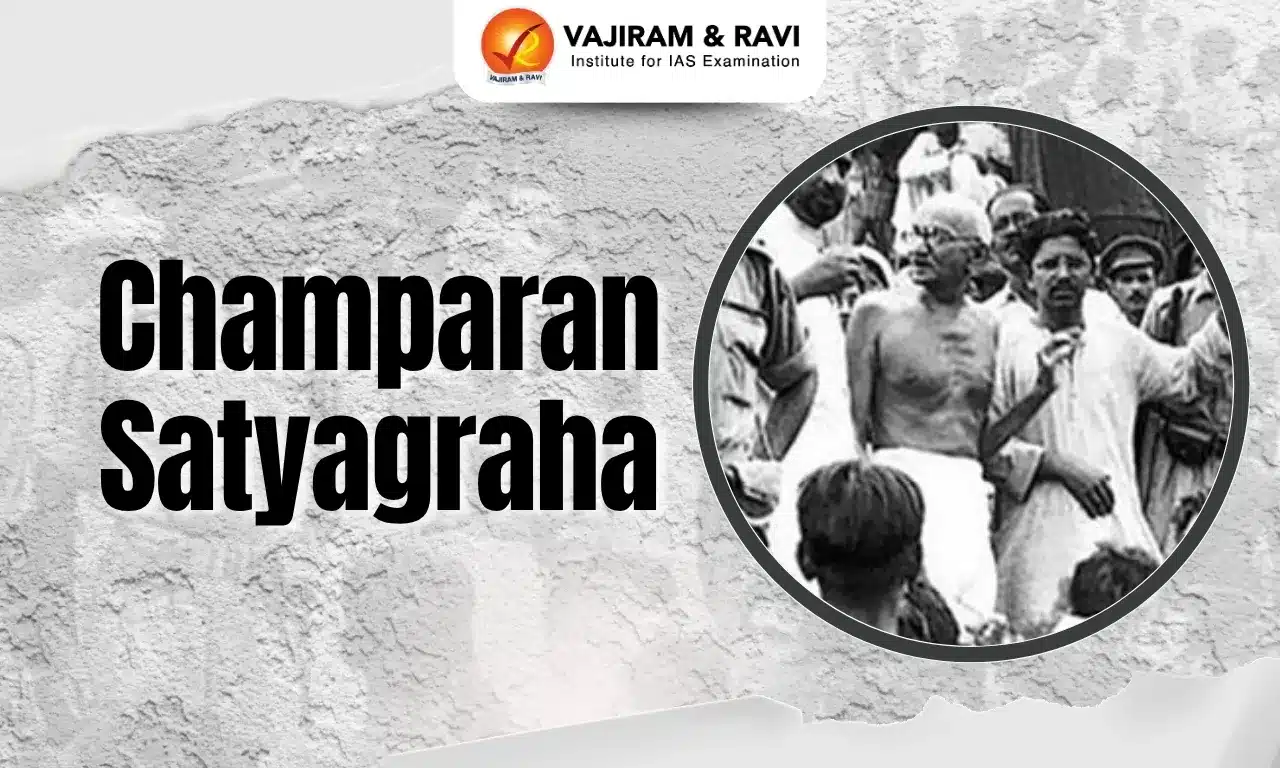
The Champaran Satyagraha of 1917 marked a pivotal moment in India's fight for independence, being the first Satyagraha movement against British colonial rule led by Mahatma Gandhi. The movement took place in Champaran, Bihar, where indigo farmers suffered under the oppressive 'Teen Kathia' system, forcing them to grow indigo on a portion of their land. The European planters exploited the farmers, imposing unfair taxes and harsh terms.
However, Gandhi's leadership in the movement not only secured relief for the farmers but also laid the foundation for future mass movements. As a result, the success of the Champaran Satyagraha became a powerful example of peaceful protest, inspiring widespread participation and strengthening the Indian independence struggle.
Champaran Satyagraha 1917 About
Champaran Satyagraha in 1917 is considered the first successful Satyagraha among Mahatma Gandhi’s Movements in India, launched to end the exploitation of Bihar’s indigo farmers under the oppressive 'tinkathia' system. Invited by Rajkumar Shukla amidst economic distress, Gandhi investigated their plight despite British opposition.
- Opposition from Bihar Planters' Association: The Bihar Planters' Association strongly opposed the inquiry, claiming it presented a biased view and could incite aggression among the ryots.
- Concerns of European Officials: Some European officials expressed concerns that Gandhi's investigation could escalate into an anti-European movement.
- Government Intervention: Amidst growing opposition, the Government instructed Gandhi to submit a preliminary report on the findings of his investigation. Gandhi submitted his preliminary report on May 13, 1917, leading to the Champaran Agrarian Act of 1918, which abolished the system and provided relief to the farmers.
Champaran Satyagraha Background
The background for the Champaran Satyagraha of 1917 was born out of the persistent exploitation of indigo farmers in Champaran under the oppressive tinkathia system. Gandhi’s intervention was prompted by the farmers' severe economic distress, exacerbated by the decline of indigo factories.
- Indigo Cultivation in Champaran: Champaran had been growing indigo since the late 18th century, and by 1850, it became the region’s most important crop, surpassing even sugar.
- Tinkathia System: Under the tinkathia system, European planters forced ryots to cultivate indigo on 3/20th of their landholding, severely restricting their ability to grow food crops.
- Decline of Indigo Factories: Post-1900, the decline of indigo factories due to synthetic indigo from Europe led planters to cancel contracts with ryots, imposing heavy fines (tawan) for release from the indigo obligations.
- Financial Burden: Ryots unable to pay the fine were issued handnotes and mortgage bonds at a high 12 per cent annual interest rate, worsening their financial plight.
Champaran Satyagraha Tinkathia System
Under the Tinkathia system in Champaran, factory owners legally forced tenants to cultivate indigo on a fixed portion of their land for a set price. Around 1860, this requirement was 5 Kathas per Bigha (one-fourth of the landholding). By 1867, it was reduced to 3 Kathas per Bigha, giving the system its name, Tinkathia (3 Kathas).
- Factory Owners and Short-term Leases: When the factories were being established for the first time, their owners had no permanent interest in land. They used to take short-term leases from the Bettiah Raj (the second-largest zamindari in the Bettiah region of Bihar).
- Deceptive Practices by Factory Owners: The factory owners would try to deceive the Bettiah Raj by renting land at a low price, and then they would have the tenants grow indigo for them to earn a profit.
- Profits and Losses: While factory owners made large profits from indigo cultivation, the tenants bore the brunt of the exploitation.
- Indigo Growing Agreements: Tenants were required to grow indigo on 3 Kathas per bigha of their holding for some years, with the specific land selected by the factory for cultivation.
- Variable Payment and Penalties: If the crops were good, a fixed price per bigha would be paid to the tenant. But if the crop was not bumper, then the tenant would get only a reduced price. If the tenant failed to grow indigo, he was liable to pay a heavy sum by way of damages for his breach.


Champaran Satyagraha Key Events
The key events of the Champaran Satyagraha unfolded in the following chronological order:
|
Period |
Key Event |
|
Late 1916 |
Rajkumar Shukla urged Gandhi at the Lucknow Congress to address the plight of indigo cultivators in Champaran. |
|
10 April 1917 |
Gandhi arrived in Motihari, Champaran, with prominent lawyers including Rajendra Prasad and Acharya Kripalani. |
|
16 April 1917 |
Gandhi began his inquiry; British authorities ordered him to leave. He refused and was summoned to court. |
|
18 April 1917 |
Thousands of peasants gathered peacefully outside the court. The government dropped the case, allowing Gandhi to investigate. |
|
Mid-1917 |
Gandhi and his team visited hundreds of villages and recorded thousands of peasant testimonies. |
|
October 1917 |
British government formed the Champaran Agrarian Inquiry Committee, with Gandhi as a member. |
|
Late 1917–Early 1918 |
The Tinkathia system was abolished, and landlords agreed to refund part of the illegally collected money. |
Champaran Satyagraha Causes
The Champaran Satyagraha was primarily driven by widespread dissatisfaction among the ryots due to the oppressive tinkathia system, which was exacerbated by economic and social exploitation. These grievances led to multiple protests, eventually culminating in Gandhi’s intervention in 1917.
- Dissatisfaction over Indigo Cultivation: The ryots were unhappy with indigo cultivation under the tinkathia system due to low remuneration for their crops and constant harassment from factory workers.
- Protests in 1867 and 1907-08: In 1867, tenants of the Lalsariya factory protested against indigo cultivation, and in 1907-08, unrest and violence broke out in Sathi and Bettiah due to the worsening conditions under the tinkathia system.
- Pressure to Cultivate Indigo on Best Lands: Planters insisted that indigo be cultivated on the best lands, further pressuring the ryots to grow indigo to maximise crop production.
- Fixed Prices Based on Land Area: The price paid to the ryots was fixed based on the area of land, not on the volume of the crop, leading to unfair compensation.
- Economic and Social Exploitation: The ryots faced both economic hardships and social exploitation, leading to widespread agitation against the planter Raj.
Role of Mahatma Gandhi in Champaran Satyagraha
The role of Mahatma Gandhi was crucial in the success of the Champaran Satyagraha. His unwavering commitment to nonviolent protest and his approach to understanding the situation firsthand helped galvanise the movement and put pressure on the British authorities.
- Initial Encounter with Local Leaders: In 1916, local Congress leaders Brajkishore Prasad and Raj Kumar Shukla met Gandhi at the INC Session in Lucknow.
- Despite their invitation, Gandhi initially appeared unimpressed by both of them and stated unequivocally that he would not act unless he saw the situation for himself.
- Resolution by Congress: Brajkishore Prasad introduced a resolution in Congress about the plight of the Champaran peasants, which was passed unanimously. However, Gandhi remained determined to act only after his assessment.
- First Visit to Muzaffarpur: Gandhi arrived in Muzaffarpur, aware of the situation, and wrote to the Commissioner of the Tirhut Division, expressing his intention to work with the government’s knowledge and cooperation.
- Clarification of Intentions: Gandhi stated that his purpose was to investigate the conditions of indigo cultivation and the grievances of the peasants due to public demand.
- Despite Gandhi's explanation, British officials remained doubtful of his motives, fearing that his actions might lead to agitation and disturb public order.
- Notice to Leave the District: British authorities decided to issue Gandhi a notice to leave Champaran upon his arrival, citing Section 144 of the Criminal Procedure Code.
- Gandhi's Defiance: Upon reaching Champaran on April 15, 1917, Gandhi wrote to the Magistrate, expressing his determination to stay and willingness to face any penalty for disobedience.
- Trial and Refusal to Defend: Gandhi was summoned for a trial on April 18, 1917. He did not offer a defence, instead declaring his willingness to go to jail. His stance baffled the officials, which led to the postponement of the sentence.
- Government Withdrawal of Case: In the meantime, the Lieutenant Governor, on the grounds of insufficient evidence against Gandhi, ordered the local administration to withdraw the case. Moreover, he also permitted Gandhi to conduct the inquiry.
Champaran Satyagraha Leaders
The Champaran Satyagraha (1917) was led by Mahatma Gandhi, who visited Champaran after being persuaded by Raj Kumar Shukla, a local indigo cultivator. Other key Champaran Satyagraha Leaders included Raj Kumar Shukla, Rajendra Prasad, Brajkishore Prasad, Mazharul Haq, J.B. Kripalani, Anugrah Narayan Sinha, Mahadeo Desai, Narhari Parekh, Ramnavmi Prasad, and Shambhusharan Varma.
Champaran Satyagraha British Response
The British response initially was one of dismissiveness, but the authorities were soon compelled to address the growing discontent surrounding the exploitation of indigo farmers in Champaran. The government, under pressure from both the local populace and Gandhi's leadership, set up an inquiry to assess the situation.
- Formation of Committee of Inquiry: The Lieutenant Governor established a Committee of Inquiry to investigate the agrarian conditions in Champaran, with Gandhi being appointed as one of its members.
- Committee’s Findings and Recommendations: On October 4, 1917, the Committee submitted its report to the Government, making the following recommendations:
- The Tinkathia system should be abolished.
- The ryots who paid Tawan to the factories would receive one-fourth of it back.
- The realisation of abwab (illegal cesses) should be stopped.
- If someone agrees to grow indigo, it should be voluntary; the term should not be longer than three years, and the decision to select the field where indigo will be grown should be made by the ryots.
- Government’s Acceptance of Recommendations: The British government accepted almost all of the Committee's recommendations, which led to the passing of the Champaran Agrarian Act in 1918.
- Abolition of Tinkathia System: As a result, the tinkathia system, which had exploited farmers for over a century, was officially abolished.
Champaran Satyagraha Significance
Champaran Satyagraha was a significant moment in the history of Indian independence. It introduced a previously unheard-of methodology to confront imperial oppression, utilising a force more powerful than all the physical might combined. Gandhi named this powerful method Satyagraha, marking a turning point in the struggle for freedom.
- First Civil Disobedience Movement: It was the first peasant movement to garner nationwide attention and, in many ways, propelled India’s masses to join the liberation struggle against the British colonisers.
- Champaran's outcome redefined the concept of and approach to political freedom, adding a vibrant twist to the entire British-Indian equation.
- Entry of Mahatma Gandhi in the Freedom Struggle: Champaran Satyagraha was the movement responsible for putting Gandhi in the front seat of the Indian nationalist movement and making satyagraha a powerful tool of civilian resistance.
- It is touted as the first crucial move towards the birth of Mahatma Gandhi’s political experiment of passive and non-violent resistance.
- Evolution of Mass-based Movements: There have been peasant movements before and after the Champaran movement of 1917, but what makes Champaran satyagraha significant is the fact that it was the first time that bridges were built between the peasants and the other sections, especially the middle-class intelligentsia.
- Peasant Unrest to the Freedom Struggle: After Champaran, Gandhi's localised movements in Ahmedabad (Ahmedabad Mill Strike) and Kheda (Kheda Satyagraha) served as training grounds for the massive nationwide protests.
Champaran Satyagraha UPSC PYQs
Q1: Indigo cultivation in India declined by the beginning of the 20th century because of (UPSC Prelims 2020)
- peasant resistance to the oppressive conduct of planters
- its unprofitability in the world market because of new inventions
- national leaders’ opposition to the cultivation of indigo
- Government control over the planters
Ans: (b)
Q2: Which one of the following is a very significant aspect of the Champaran Satyagraha? (UPSC Prelims 2018)
- Active all-India participation of lawyers, students and women in the National Movement.
- Active involvement of Dalit and Tribal communities of India in the National Movement.
- Joining of peasant unrest to India’s National Movement.
- Drastic decrease in the cultivation of plantation crops and commercial crops.
Ans: (c)
| Other Related Posts | |
| Mahatma Gandhi's Movements | Ahmedabad Mill Strike |
| Satyagraha | Kheda Satyagraha |
| Champaran Satyagraha | Vaikom Satyagraha |

 Last updated on Oct, 2026
→ UPSC 2027 Notification will be released on 13 January 2027 at upsconline.nic.in.
→ Check Nobel Prize 2026 Winners List here.
→ Download PIB PRiSM Monthly Magazine 2026 here.
→ Check UPSC Monthly Current Affairs Magazine The Recitals here.
→ Check out the latest UPSC Syllabus here.
→ Download UPSC Model Answers for Mains 2026
→ UPSC Mains Question Paper 2026 is out now for Essay & GS Paper 1, 2, 3 & 4.
→ UPSC Calendar 2027 has been released.
→ Enroll in Vajiram & Ravi’s UPSC Mains Test Series 2027 for structured answer writing practice, expert evaluation, and exam-oriented feedback.
→ Join Vajiram & Ravi’s UPSC Mentorship Program 2027 for personalized guidance, strategy planning, and one-to-one support from experienced mentors.
→ Go through the UPSC Mains Previous Year Papers to enhance your preparation.
→ UPSC has released UPSC Toppers List 2025 with the Civil Services final result on its official website.
→ Also check Best UPSC Coaching in India
Champaran Satyagraha FAQs
Q1. What is the main reason for Champaran Satyagraha?+
Q2. Who started the Champaran Satyagraha?+
Q3. What is the history of Champaran?+
Q4. What were the Champaran Satyagraha and Kheda Satyagraha?+
Q5. Which Satyagraha happened first, Champaran or Kheda?+
Tags: champaran satyagraha quest